Home Robots for Independent Living With a Disability
Author: Ian C. Langtree - View Credentials
Published: 4 Feb 2009 - Updated: 20 Nov 2026
Publication Type: Informative
Table of Contents:
Synopsis - Definition - Overview - FAQs - Insights, Updates - Related Content
Synopsis
This information covers home robots that take over routine chores for people with disabilities, seniors and caregivers, including robotic lawn mowers, robot vacuums and floor cleaners, robotic pool cleaners and self-cleaning cat litter boxes. It explains how each type of device works, what to check before buying and how automation can reduce physical strain and reliance on paid lawn and cleaning services. With more than 2.5 billion people worldwide needing at least one assistive product according to the World Health Organization, and more than 1 in 4 U.S. adults living with a disability according to the CDC, the guidance draws on those agencies and on research presented at the ACM/IEEE International Conference on Human-Robot Interaction, making it a practical starting point for anyone weighing home robots as a way to keep living at home.
At a Glance
- 1 - The Litter-Robot self-cleaning litter box is made by Whisker, not iRobot.
- 2 - Wire-free robotic mowers follow a virtual boundary set by satellite positioning or cameras instead of a buried perimeter wire.
- 3 - Toxoplasma in cat feces becomes infectious 1 to 5 days after it is shed, which is why the CDC advises changing the litter box daily.
- 4 - In a study of 21 older adults aged 65 to 93, participants preferred robot help with 28 of 48 household tasks, many of them physical cleaning jobs.
Topic Definition
- Assistive Home Robots
Assistive home robots are autonomous or semi-autonomous household devices, such as robotic lawn mowers, robot vacuums and mops, robotic pool cleaners and self-cleaning litter boxes, that carry out routine domestic tasks with little or no hands-on effort from the user. They rely on sensors, timers, mapping software and rechargeable batteries to work on a schedule, avoid obstacles and return to a charging base. For people with disabilities, seniors and caregivers, they serve as a form of assistive technology by reducing physical strain, lowering reliance on paid services and supporting independent living at home.
Overview
Many people with disabilities and seniors who live in single-family homes pay a significant amount for lawn care and cleaning services, or depend on family members and caregivers for these chores. Home robots can take over several of these routine jobs, including mowing the lawn, vacuuming and mopping floors, cleaning a swimming pool and emptying a cat litter box. For someone with limited mobility, reach, strength or stamina, these devices can reduce physical strain, cut the cost of paid help and make it easier to keep living independently at home.
The need for this kind of support is large. The World Health Organization reports that more than 2.5 billion people worldwide need at least one assistive product, a number expected to reach about 3.5 billion by 2050 as populations age [World Health Organization, 2024]. In the United States, more than 1 in 4 adults has some type of disability, and 12.2 percent of adults have a mobility disability [Centers for Disease Control and Prevention, 2026].
What Older Adults Want From Home Robots
Research suggests that older adults are open to robot help with housework. In a study presented at the 2012 ACM/IEEE International Conference on Human-Robot Interaction, researchers interviewed 21 independently living older adults aged 65 to 93 in the Atlanta area. Participants preferred robot assistance for 28 of 48 household tasks, many of them physical cleaning jobs such as cleaning floors, kitchens and bathrooms. They said a robot could make up for physical limitations, save time and effort, and handle unpleasant chores, while also raising concerns about property damage, reliability and becoming dependent on the technology [Beer et al., 2012].
Robotic Lawn Mowers
A robotic lawn mower cuts grass on its own and returns to its charging station when the battery runs low or the job is finished. Many models use a thin boundary wire laid around the edge of the lawn, and the mower works only inside that perimeter. The wire can also be placed around flower beds, trees, ponds and other areas the mower should avoid. Wire-free models use satellite positioning, cameras or both to follow a virtual boundary drawn in a smartphone app, which saves the work of installing and repairing a buried wire.
Because a robotic mower trims small amounts of grass often instead of cutting a large amount once a week, the lawn stays at an even height. Depending on the model, the mower may travel in a random pattern or in planned parallel lines. Some models sense rain and return to the base, while others are built to keep mowing in wet weather. Each model is rated for a maximum lawn area and slope, so it helps to compare these limits with the size and steepness of the yard before buying. Bump sensors, lift and tilt sensors that stop the blades, and obstacle detection on some models help prevent damage and injury.
Safety requirements for these machines are set out in the international standard IEC 60335-2-107, which covers robotic battery-powered lawn mowers, their charging stations and the signal sources used for boundary wires [International Electrotechnical Commission, 2021]. Even so, children and pets should be kept off the lawn while the mower is running, and many owners schedule mowing for times when the yard is empty.
Robot Vacuums and Floor Cleaners
Robot vacuums are the most familiar household robots. They travel through a room on their own, clean carpets and hard floors, and return to a dock to recharge. Many models map the home so they can clean specific rooms on a schedule, and some combine vacuuming with mopping. Self-emptying docks collect debris in a larger sealed bag or bin that needs emptying far less often, which is a real advantage for anyone who finds it hard to bend down or handle a small dustbin. Control through a smartphone app or a voice assistant can help people with limited hand function or low vision.
Floor clutter, loose cords, deep-pile rugs and high door thresholds can stop a robot vacuum, so a quick check of the home's layout is worthwhile. Wheelchair users may also want to consider how easy the dock, bin and brushes are to reach for routine maintenance.
Robotic Pool Cleaners
Robotic pool cleaners move across the floor of a swimming pool and, with many models, up the walls and along the waterline, scrubbing surfaces and trapping debris in a built-in filter. They run on their own motor rather than relying on the pool's pump, and some are cordless and battery powered. For pool owners with disabilities, the main tasks left are placing the cleaner in the water, lifting it out and rinsing the filter, so a lightweight model or one with a caddy can make a noticeable difference.
Self-Cleaning Cat Litter Boxes
Cleaning a litter box is a daily chore for cat owners, and the bending and scooping involved can be hard for people with limited mobility. A self-cleaning litter box reduces the job to emptying a waste drawer and topping up the litter. The best-known example, the Litter-Robot, is made by Whisker, not iRobot. It uses a rotating globe that holds the litter. After a cat leaves, a programmable timer counts down before the globe turns, which gives urine clumps time to firm up before they are sifted out and dropped into a waste drawer underneath. Clean litter stays in the globe for the next use, which reduces how much litter is used. Other automatic litter boxes use rakes or conveyor systems instead of a rotating globe.
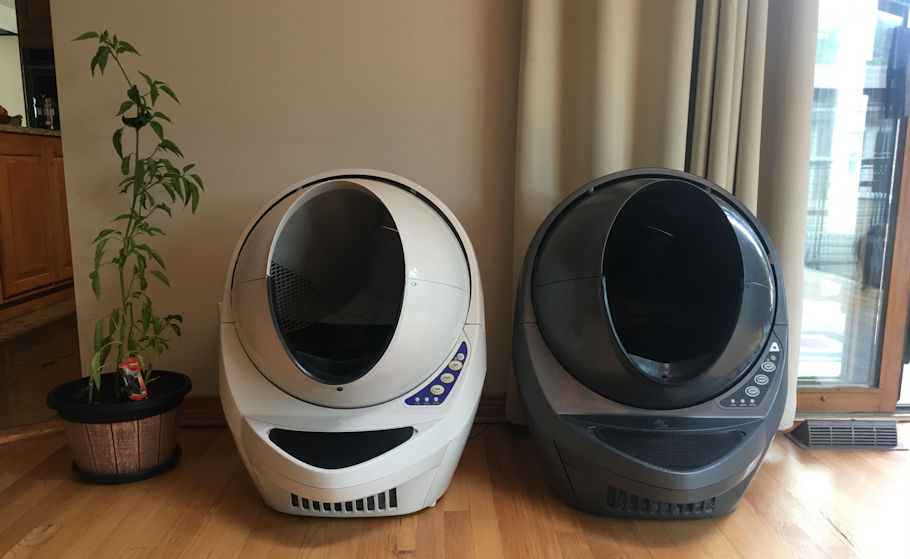
A wheelchair user can place a self-cleaning litter box on a sturdy, low platform so the waste drawer sits at a comfortable height, as long as the cat can still get in and out easily. A raised litter box is another option for owners who cannot reach floor level.
Prompt waste removal also matters for health. Cat feces can carry the parasite that causes toxoplasmosis, but it does not become infectious until 1 to 5 days after it is shed, which is why the Centers for Disease Control and Prevention advises changing the litter box daily [Centers for Disease Control and Prevention, 2024]. People who are pregnant or have a weakened immune system should have someone else change the litter if possible, or wear disposable gloves and wash their hands with soap and water afterward [Centers for Disease Control and Prevention, 2025]. An automatic litter box still needs its drawer emptied and the unit cleaned regularly, and anyone with health concerns should ask a healthcare provider for advice.
Choosing and Paying for Home Robots
Before buying, check whether the controls, app and maintenance steps suit the user's abilities, how often bins, filters or blades need attention, and whether a family member, caregiver or local service can help with setup. Coverage for household robots through insurance or disability programs varies, so it is worth asking before making a purchase. Each U.S. state, the District of Columbia, Puerto Rico and the U.S. territories has a state assistive technology program funded under the Assistive Technology Act. These programs offer device demonstrations, short-term loans so people can try a device before buying it, reused equipment at substantial savings and help with financing [Administration for Community Living, n.d.]. They can also point people toward other assistive home products and assistive robotics that support daily living.
Frequently Asked Questions
Are robot vacuums safe around people who use walkers or canes?
Robot vacuums move slowly and turn away when they bump into objects, but a small robot on the floor can still be a tripping hazard for someone who walks with a cane or walker. Scheduling cleaning for times when no one is moving around the room and keeping the charging dock out of main walkways lowers the risk.
Do home robots work without a Wi-Fi connection?
Many robot vacuums, mowers and litter boxes can run from buttons on the unit or a built-in schedule without Wi-Fi. Features such as home mapping, room selection, remote alerts, app control and voice assistant commands usually need a working wireless connection.
How long do the batteries in home robots last?
Most home robots use rechargeable lithium-ion batteries that gradually hold less charge over several years of use. Before buying, check whether replacement batteries are sold by the manufacturer and whether the battery can be swapped without special tools.
Can one self-cleaning litter box serve more than one cat?
Many automatic litter boxes are designed for homes with several cats, though the waste drawer fills faster and needs emptying more often. Manufacturers list the maximum number of cats and often a minimum cat weight, since very small kittens may be too light for the sensors to detect.
What if my cat is afraid of an automatic litter box?
Placing the new unit beside the old litter box and leaving the automatic cleaning cycle switched off for the first several days lets a cat get used to it at its own pace. Once the cat uses it regularly, the cycle can be turned on and the old box removed.
Do home robots raise privacy concerns?
Robot vacuums and mowers that use cameras or build maps of a home collect data about its layout, and some send that data to cloud servers. Reviewing the privacy settings in the app, turning off camera features that are not needed and choosing models that process data on the device can reduce this concern.
Can a caregiver control home robots remotely?
Many robot apps let more than one person share access to the same device. A family member or caregiver can start a cleaning cycle, change a schedule or receive alerts about a full bin or a stuck robot from a phone without being in the home.
How loud is a robotic lawn mower?
Battery-powered robotic mowers are much quieter than gasoline mowers because they have no engine and cut only a little grass at a time. Many owners run them early in the morning or in the evening without disturbing neighbors, though local noise rules and the safety of children and pets should still be considered.
References
- Administration for Community Living. (n.d.). Assistive technology. U.S. Department of Health and Human Services.
- Beer, J. M., Smarr, C.-A., Chen, T. L., Prakash, A., Mitzner, T. L., Kemp, C. C., and Rogers, W. A. (2012). The domesticated robot: Design guidelines for assisting older adults to age in place. Proceedings of the ACM/IEEE International Conference on Human-Robot Interaction, 2012, 335 - 342.
- Centers for Disease Control and Prevention. (2024). Preventing toxoplasmosis.
- Centers for Disease Control and Prevention. (2025). People at increased risk for toxoplasmosis.
- Centers for Disease Control and Prevention. (2026). Disability impacts all of us infographic.
- International Electrotechnical Commission. (2021). IEC 60335-2-107:2017+AMD1:2020+AMD2:2021 CSV: Household and similar electrical appliances - Safety - Part 2-107: Particular requirements for robotic battery powered electrical lawnmowers.
- World Health Organization. (2024). Assistive technology [Fact sheet].
More on this topic: Assistive Home Products - Household Tips - Robotics - Stop Cat Litter Smells
Insights, Analysis, and Developments
Editorial Note: Home robots will not replace every kind of help, but for the 12.2 percent of U.S. adults who have a mobility disability, handing off repetitive jobs such as mowing, vacuuming and scooping litter can save energy for the things that matter most. The biggest gains come from matching the device to the person: bins and docks that are easy to reach, app or voice controls, and maintenance that the user or a caregiver can realistically keep up with. Because these products can be costly, trying one first through a state assistive technology program's device loan or demonstration service is a sensible step, and choosing a mower built to the IEC 60335-2-107 safety standard adds reassurance for households with children or pets.
 Author Credentials: Ian C. Langtree is a writer, editor, and the founder and Editor-in-Chief of Disabled World, which he established in 2004 as one of the longest-running independent resources for disability news and information. Over more than two decades, he has written and edited thousands of articles on disability rights, health, accessibility, and assistive technology. Drawing on a global perspective shaped by extensive travel and lived experience, Ian is a committed advocate of the Social Model of Disability, the framework developed by disabled activists in the 1970s that focuses on removing societal barriers rather than on individual impairments. His writing is grounded in that framework and in a lasting commitment to disability rights, accessibility, and social inclusion. To learn more about Ian's background, expertise, and accomplishments, visit his full biography.