Sand-Pad Beach Crutch Tips for Walking Easily on Soft Sand
Author: Ian C. Langtree - View Credentials
Published: 21 Dec 2011 - Updated: 8 Nov 2026
Publication Type: Informative
Table of Contents:
Synopsis - Definition - Overview - FAQs - Insights, Updates - Related Content
Synopsis
This product, the Sand-Pad, is a wide, flexible rubber pad that attaches to the tip of an ordinary crutch or cane so it spreads the user's weight and does not sink into soft sand. It was invented by above-knee amputee Jerry Vasilatos after a trip to the Greek islands, where conventional crutch tips made reaching the water exhausting, and was developed into a production design with his father, an industrial designer, through their company American Ventures Ltd. It is useful for amputees, people recovering from leg, knee or ankle injuries, and anyone who uses crutches or canes and wants to reach the shoreline or walk on sandy paths, as swimming is one of the most accessible forms of exercise for many disabled people.
At a Glance
- 1 - Each Sand-Pad weighs 1.10 pounds and comes with a lifetime guarantee.
- 2 - The pad measures 8 inches across and uses six support ribs for stability.
- 3 - It fits crutch and cane tips from 3/4 inch to 1 inch and is made from EPDM rubber.
- 4 - Vasilatos lost his leg in a subway accident at age 20 and went on to work in film and television production.
Topic Definition
- Crutch Tip
A crutch tip is the rubber foot fitted to the bottom of a crutch or cane to provide grip and absorb shock. Standard tips are small and designed for hard, flat surfaces, while specialty tips, such as wide sand pads, ice grips and all-terrain feet, spread weight or add traction for snow, ice, sand, grass and other uneven ground.
Overview
In 2003, above knee amputee Jerry Vasilatos was visiting the islands of Greece, excited and anxious to visit the beautiful beaches and shorelines where he could swim freely in the ocean, one of the few aerobic exercises he could still perform despite his disability.
As crutch users know, conventional crutch tips sink deep into the sand, forcing users to struggle as they have to pull them out and doggedly repeat the process for as long as it takes them to get from paved surface to a shoreline. It was a frustrating set of circumstances that kept Vasilatos from spending much time at the beaches, because they were so difficult to traverse. Upon returning to the states, he searched fruitlessly for a beach crutch solution but could find nothing available.
"In my mind's eye I could see what I needed, right down to the shape and how it would attach to a crutch, but I was shocked to discover no one manufactured this simple device that would enable me to visit and enjoy a beach much easier... what I described as a sand pad."
Vasilatos has never been one to let adversity stand in his way. After losing his leg in a freak subway accident when he was 20 years old, many felt his disability would slow him down but he nonetheless overcame it while pursuing his dream of a career in film and television production. Now 45, he says:
"Whenever I've faced a brick wall, I've always managed to figure a way to build a door through it."
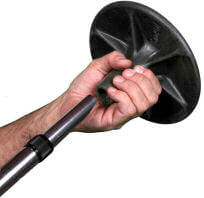
Seeing an opportunity to not only solve his own problem but that of all beach loving crutch users, Jerry approached his father Anastasios with sketches of his brainchild, a durable, flexible rubber crutch pad that could easily attach to conventional crutches and canes.
An industrial designer and holder of several of his own patents, Anastasios took Jerry's sketches and realized them in a three-dimensional CAD environment, creating an ergonomic design that provided the solution for anyone using crutches to easily navigate shifting beach sands as well as move effortlessly along shallow water shorelines.
After years of development, patent work, trademark branding and securing a manufacturer, the father and son team's Sand-Pad is finally available for crutch users through their company American Ventures Ltd.
"It's tremendously rewarding to see this finally come to fruition" Jerry says. "I've spoken to other amputees as well as athletes who've suffered knee or ankle injuries that have all expressed the same frustration I faced, who are just as excited as I am upon seeing and trying the Sand-Pad which will now make our visits to the beach much easier."
Engineered from 70 shore hardness ethylene propylene diene Monomer (M-class) rubber, the Sand-Pad provides a wider base of stability than normal tips for those using crutches or canes on beaches or other sandy terrain.
- 8 inches in diameter, each pad's circular design supports a user's weight allowing them to easily walk across beaches without sinking into the sand.
- Its scientific design utilizing six support ribs and a flexible rubber elastomer make it both lightweight and stable for the user.
- Easy to attach to any conventional crutch or cane tip, each individual Sand-Pad weighs 1.10 lbs. and fits 3/4 inch to 1 inch crutch and cane tip sizes, and comes with a lifetime guarantee.
In 2011, American Ventures Ltd. was ramping up to distribute the device through medical supply and retail outlets for spring and summer fulfillment as well as showcase the Sand-Pad at national medical supply trade shows and disability expos.
More on this topic: Walking Aids Publications - Mobility Aids Publications - Disability Travel Publications
Frequently Asked Questions
Can you walk on sand with crutches?
It is possible but tiring with standard tips, which sink into soft sand. Wide sand tips, firm wet sand near the water and beach mats make it much easier.
How often should crutch tips be replaced?
Replace crutch tips when the tread is worn smooth, cracked or uneven, often every few months with daily use, since worn tips can slip.
Are there ice tips for crutches and canes?
Yes. Retractable metal ice tips and spiked rubber feet can be fitted to many crutches and canes to improve grip on ice and packed snow.
Can amputees swim at the beach?
Yes. Many amputees swim without a prosthesis, and some use waterproof swim legs. Beach mats and wheelchairs can help with getting to the water.
What is a beach mat for accessibility?
A beach mat is a roll-out path laid over sand that gives wheelchairs, walkers and crutch users a firm surface down toward the water.
Do beach wheelchairs exist?
Yes. Beach wheelchairs have wide balloon tires that roll over sand, and many public beaches lend them free of charge.
What is EPDM rubber?
EPDM is a durable synthetic rubber that resists sun, salt water and weather, which makes it suitable for outdoor products used at the beach.
Do crutch tips fit canes?
Many crutch and cane tips use the same standard sizes, so a tip will fit if it matches the inside diameter of the tube, usually between 3/4 inch and 1 inch.
Insights, Analysis, and Developments
Editorial Note: Beaches remain one of the hardest places to reach for people who use mobility aids, since soft sand defeats standard crutch tips, canes, walkers and most wheelchairs. Wide-footed tips like the Sand-Pad are one low-cost answer, and many beaches now add beach mats, floating or balloon-tire beach wheelchairs and accessible boardwalks. Anyone planning a beach trip on crutches can check ahead for accessible entrances and mats, choose firm wet sand near the water where possible, and practice with any new tip on a short stretch first. Crutch users should also remember that shoulders and wrists take extra strain on uneven ground, so frequent rests are worthwhile.
 Author Credentials: Ian C. Langtree is a writer, editor, and the founder and Editor-in-Chief of Disabled World, which he established in 2004 as one of the longest-running independent resources for disability news and information. Over more than two decades, he has written and edited thousands of articles on disability rights, health, accessibility, and assistive technology. Drawing on a global perspective shaped by extensive travel and lived experience, Ian is a committed advocate of the Social Model of Disability, the framework developed by disabled activists in the 1970s that focuses on removing societal barriers rather than on individual impairments. His writing is grounded in that framework and in a lasting commitment to disability rights, accessibility, and social inclusion. To learn more about Ian's background, expertise, and accomplishments, visit his full biography.