Hexhog All-terrain Wheelchair ATV for Off-Road Access
Author: Sion Pierce
Published: 6 Aug 2014 - Updated: 27 Aug 2026
Publication Type: Product Release, Update
Table of Contents:
Synopsis - Definition - Overview - FAQs - Insights, Updates - Related Content
Synopsis
This product is a battery-powered six-wheel, all-wheel drive all-terrain vehicle built specifically to give wheelchair users independent access to rough outdoor ground that conventional wheelchairs cannot reach. Designed over five years by mechanical engineer and inventor Sion Pierce and made in the UK for worldwide export, it uses a patented flexing chassis that hugs uneven ground, lithium-ion batteries feeding two pancake motors rated at 650Nm of torque, and a 6x6 sealed transmission that resists mud and water. Key facts include a 12-mile range in optimum conditions, the ability to climb 60% slopes, a 290kg weight that allows towing behind a small car on a lightweight trailer, and a seat transfer mechanism that lowers beyond the front wheels for independent pivot or slide transfers. This affects wheelchair users, seniors and people with mobility disabilities who want to cross moorland, farmland or peat bogs, along with outdoor activity centers seeking equal access for all visitors. It matters because it treats genuine all-terrain mobility as a right rather than a limitation, offering a safer, quieter, low-maintenance alternative to quad bikes while letting riders look toward the horizon instead of watching for ruts and ditches - practical detail that makes the information useful to anyone planning accessible outdoor recreation.*
At a Glance
- 1 - With an add-on kit, the Hexhog can be driven on the road using a standard car license. It will also pass through a four-foot gate.
- 2 - A remote control system is available for independent loading and unloading onto a trailer. This lets users move the machine without needing outside help.
- 3 - The battery accepts quick top-up charges, so a rider can complete several journeys in a single day. Advanced monitoring measures power in and out of the cells to act as an accurate fuel gauge.
- 4 - The Hexhog was launched in April at the Naidex National trade show for the independent living aids industry. Its maker, Off-Road Engineering, teamed up with Da Vinci Mobility of Liverpool to reach a wider audience, building on inventor Sion Pierce's upbringing on a Welsh family farm where he trialed his designs.
Topic Definition
- All-Terrain Wheelchair ATV
An all-terrain wheelchair ATV is a powered, ruggedized vehicle built to carry a seated user across rough natural ground - moorland, farmland, forest tracks, gravel and boggy soil - that ordinary wheelchairs and mobility scooters cannot manage. Unlike an everyday wheelchair meant for smooth indoor and paved surfaces, this class of machine borrows from off-road engineering, typically using multiple driven wheels, high-torque electric motors, deep-tread tires and a chassis designed to soak up bumps and climb steep grades. The goal is to let people with limited mobility reach the countryside and take part in outdoor activity on roughly equal footing with those traveling on foot, while keeping operation simple through joystick control and features such as independent seat transfer and trailer loading.
Overview
New Mobility Concept Breaks Down Barriers - The HexHog is Here! Designed to offer accessibility to the countryside for all. Made in the UK, and available for worldwide export.
The Hexhog's patented flexible chassis is the key to the vehicle's capability, as explained by inventor Sion Pierce:
"The flexing chassis irons out the lumps and bumps for a confident journey as the machine hugs the ground like a centipede when you ride over brows and troughs. You can even ascend 60% slopes."
Pierce, a mechanical engineer, developed the design over five years, building on his experience of mechanized handling and control systems to design the HexHog. Having grown up on a family farm in Wales, he used this land to trial his designs.
Often described as an all-terrain wheelchair, the HexHog is actually an ATV designed for wheelchair users.
"You can't take the HexHog into supermarkets, but you can cross moorland, farmland or even peat bogs. The open fronted design means users can look towards the horizon and enjoy the journey without having to focus on the ground, looking out for that ditch or rut that could disrupt regular wheelchairs. It can be driven on the road with a standard car license (with an add-on-kit) and will pass through four-foot gates" explains Pierce.
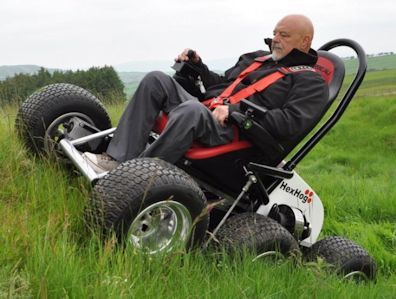
Now Pierce's company Off-Road Engineering has teamed up with Da Vinci Mobility of Liverpool to bring the Hexhog to a wider audience.
Power for the HexHog comes from the latest lithium-ion batteries which feed two pancake motors that deliver 650N Nm of torque to the wheels. This gives the Hexhog enough power to climb hills and obstructions such as rocks and steps.
The battery powered system offers advantages over alternative power sources such as engines, and it is comparatively quiet, clean and low maintenance.
The system also incorporates advanced battery monitoring, where power is measured in and out of the cells to act as an accurate fuel gauge.
A fully charged battery will provide a range of 12 miles in optimum conditions. This type of battery can handle quick top-up charges, allowing multiple journeys in one day.
Features:
- Versatile vehicle offers wheelchair users accessibility to rugged areas equal to that of people on foot.
- Innovative design employs latest lithium-ion battery technology, patented flexing chassis and all-wheel drive transmission.
- The HexHog is an excellent alternative to quad bikes, where wheelchair users can ride the HexHog on the same tracks safely and independently.
- The HexHog weighs 290kg. It can be transported behind small cars with a lightweight trailer. A remote control system is also available for independent loading and unloading.
- Another unique feature of the HexHog is its seat transfer mechanism. This lowers the seat to a position beyond the front wheels to enable independent pivot or slide transfers from a wheelchair.
- The HexHog was launched in April at the Naidex National trade show for the independent living aids industry. It's a new concept, designed from the ground up to solve the problem of genuine all terrain access for wheelchair users.
- The HexHog offers unprecedented new levels of access to all terrains. The battery-powered, six-wheel all-wheel drive machine gives wheelchair users the ability to go virtually anywhere able-bodied people can go on foot, at the push of a joystick.
- The HexHog has been designed to endure harsh environments and so its 6x6 transmission provides drive to all wheels through sealed gearboxes and connecting shafts. Positioning the two drive motors at a high level means there will be no problems from mud or water ingress.
- The HexHog is expected to be of interest to anyone who wants access to the outdoors where conventional wheelchairs do not allow.
- The HexHog provides the ideal accompaniment to outdoor activity centers allowing wheelchair users the same level of enjoyment and access as all visitors.
Frequently Asked Questions
NOTE: Researched FAQs by Disabled World (DW)
How much does the Hexhog cost to buy?
The article does not list a purchase price, so interested buyers should contact the manufacturer Off-Road Engineering or its distributor Da Vinci Mobility of Liverpool for current pricing and export options.
How long does the Hexhog battery take to recharge?
The article does not state a full charge time, but it notes the lithium-ion battery accepts quick top-up charges that allow several journeys in one day.
What is the top speed of the Hexhog?
A top speed is not given in the article, though it explains the machine delivers 650Nm of torque aimed at climbing hills, rocks and steps rather than at high speed.
Can the Hexhog be used in the rain or through water?
Yes, the drive motors are mounted high and the gearboxes are sealed, which the maker says prevents problems from mud or water ingress in harsh conditions.
Is any special training needed to operate the Hexhog?
The article does not mention required training, but it describes joystick control and safe independent use, so prospective riders should ask the supplier about guidance or a demonstration.
How many people can ride the Hexhog at once?
The article describes the Hexhog as a single-rider vehicle with one lowering transfer seat and does not reference any passenger capacity.
What maintenance does the Hexhog require?
Specific maintenance schedules are not detailed, though the battery-powered system is described as comparatively quiet, clean and low maintenance versus engine-driven alternatives.
Where can the Hexhog be legally driven?
It is intended for off-road terrain such as moorland and farmland, and with an add-on kit it can also be driven on the road using a standard car license.
Insights, Analysis, and Developments
Editorial Note: What sets the Hexhog apart is the engineering philosophy behind it rather than a single headline spec: by placing both drive motors high on the frame and running sealed gearboxes and connecting shafts to every wheel, the design sidesteps the mud and water ingress that would sideline most powered chairs, and the centipede-like flex of the chassis does the quiet work of keeping all six wheels planted across brows and troughs. For anyone who has watched an able-bodied companion stride off across a peat bog or up a hillside path, that capability closes a gap that ramps and pavements never could, and it does so without the noise, fumes or upkeep of a petrol quad. The open-fronted seating position is an underrated touch, letting the rider watch the landscape ahead instead of scanning the ground for the next rut, and the lowering seat transfer mechanism means the whole outing can begin and end without a helper - small design decisions that together add up to real independence outdoors.*
Attribution/Source(s): This quality-reviewed publication was selected for publishing by the editors of Disabled World (DW) due to its relevance to the disability community. Originally authored by Sion Pierce and published on 6 Aug 2014, this content may have been edited for style, clarity, or brevity.
* Editorial additions by Ian C. Langtree.