Vision AppZap for iPhone Tests Color and Eye Health
Author: Ian C. Langtree - View Credentials
Published: 13 May 2009 - Updated: 19 Mar 2026
Publication Type: Product Release, Update
Table of Contents:
Synopsis - Definition - Overview - Insights, Updates - Related Content
Synopsis
This information covers the Vision application by AppZap, designed for iPhone and iPod Touch, which provides four practical self-administered eye screening tools - an Ishihara Color Vision Test, an Astigmatism Test, a Retinal Function Test, and a Visual Field Test. Written by the founder and Editor-in-Chief of a major disability information resource, the article explains how each test works, what conditions it may help identify, and how the app can be useful for the roughly one-third of the population living with some form of vision-related problem, including people with disabilities, older adults, and anyone wanting a convenient first-look assessment of their eye health.
Topic Definition
- iPhone Vision Screening App
A smartphone-based vision screening application is a software tool installed on a mobile device - such as an iPhone or iPod Touch - that guides users through a series of standardized visual tests designed to help identify potential eye health concerns. These apps typically incorporate established clinical screening methods, such as the Ishihara color plate test for color blindness or pattern-based assessments for astigmatism and peripheral vision, presenting them in an interactive format accessible to general consumers. While they are not a substitute for a formal clinical diagnosis by a licensed optometrist or ophthalmologist, they serve as a practical and accessible first step in recognizing symptoms that may warrant professional evaluation.
Overview
Vision for iPhone and iPod Touch by AppZap
Approximately one-third of the population has some form of vision-related problem. With the use of electronics that appeal to users through visual interfaces, it is a pleasure to find an iPhone and iPod application that has the capability to, 'check-up,' on certain aspects of a person's eyesight. The Vision application by AppZap has some different capabilities that can help you to check and preserve your eyesight. You might even have some fun in the meantime. Included with the Vision application are the:
- Astigmatism Test
- Visual field Test
- Retinal Function Test
- Ishihara Color Vision Test
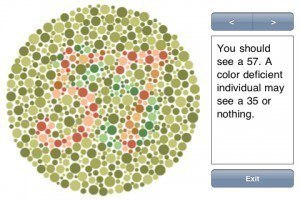
The Ishihara Color Vision Test assists you in finding out if you have a form of color blindness. Below is an example image from one of the screens from the test. There are several of these images included in the test. The results are provided so that you can determine your own level of color-awareness.
Astigmatism is something that a person experiences when their cornea is more football-shaped than spherical. Persons with astigmatism have eyes that cause light rays to focus on two points in the back of their eyes instead of on one point. Those who have a common form of astigmatism are easily treatable, while persons who have a less-common form have vision that is more difficult to correct. Astigmatism is usually something that is hereditary; a number of people are born with corneas that are oblong and resulting vision that worsens as time progresses. Astigmatism can also be caused by an injury to a person's eye which has caused scarring to their cornea. Eye surgery may cause astigmatism, as well as, 'Keratoconus,' a disease which causes a gradual thinning of the cornea.
The retina is a multi-layered sensory tissue lining the back of the eye; it contains millions of photoreceptors which capture light rays and convert them into electrical impulses. The electrical impulses then travel along the person's optic nerve to their brain, where they are translated into images. The retina contains two types of photoreceptors; rods and cones. There are about six-million cones in a person's retina. Cones are contained in the, 'Macula,' a portion of the retina that is responsible for central vision. Cones are what allow a person to appreciate color.
A person's, 'Visual Field,' is the entire area they can see when their eye is directed forward, to include what they can see using peripheral vision. A visual field test is used to measure both the extent and distribution of the field of vision. There are a number of diseases that can affect someone's visual field such as strokes, glaucoma, hypertension, multiple sclerosis, hyperthyroidism, and diabetes. Some medications may also affect a person's field of vision.
The Vision application provides some simple tests and exercises that can help people to test and preserve their vision while having fun doing it. The application includes some interesting optical illusions and stereograms as well. The Stereograms create the illusion of depth from a flat, two-dimensional image while helping to relax the viewer's eye muscles. There is a feature called, 'Stereo Pairs,' included in the application that also creates the illusion of depth. It uses a pair of two-dimensional images, viewed with a cross-eyed technique that trains the viewer's eye muscles.
Insights, Analysis, and Developments
Editorial Note: At-home vision screening tools like the Vision app by AppZap won't replace a professional eye exam, but they do give users a low-barrier, accessible way to become more aware of potential issues like color blindness, astigmatism, and changes in their visual field - conditions that, if caught early, are often far easier to manage. For people with disabilities, seniors, or anyone who faces challenges getting to an optometrist regularly, that kind of accessible self-awareness tool has real practical value.
 Author Credentials: Ian C. Langtree is a writer, editor, and the founder and Editor-in-Chief of Disabled World, which he established in 2004 as one of the longest-running independent resources for disability news and information. Over more than two decades, he has written and edited thousands of articles on disability rights, health, accessibility, and assistive technology. Drawing on a global perspective shaped by extensive travel and lived experience, Ian is a committed advocate of the Social Model of Disability, the framework developed by disabled activists in the 1970s that focuses on removing societal barriers rather than on individual impairments. His writing is grounded in that framework and in a lasting commitment to disability rights, accessibility, and social inclusion. To learn more about Ian's background, expertise, and accomplishments, visit his full biography.