Dog Age to Human Years Chart, Calculator, and Lifespan
Author: Ian C. Langtree - Writer/Editor for Disabled World (DW)
Published: 3 Jul 2021 - Updated: 28 Aug 2026
Publication Type: Charts, Graphs, Tables
Table of Contents:
Synopsis - Definition - Overview - FAQs - Insights, Updates - Related Content
Synopsis
This information offers a size- and breed-aware way to convert a dog's age into human years, replacing the long-standing assumption that one dog year equals seven human ones. Drawing on guidance from the American Veterinary Medical Association and a 2019 study based on changes to a dog's DNA over time, it pairs an easy-to-read conversion chart with an interactive calculator and a table of average life expectancies covering dozens of breeds. The practical value here is in helping owners gauge where their dog sits in its life stage so they can plan nutrition, exercise, and veterinary visits accordingly, which is useful for seniors and people with disabilities who depend on dogs for companionship and support.
At a Glance
- 1 - A dog's first year equals roughly 15 human years. The second year adds about nine, and each year after adds close to five.
- 2 - The old rule multiplied every dog year by seven. A 2019 DNA-based study offered a more accurate, size-aware alternative.
- 3 - Disease drives most dog deaths, accounting for 64 percent of cases through illness or related euthanasia. Regular check-ups aid early detection.
- 4 - Extra large breeds age far faster than small ones, reaching an equivalent human age of 121 by year 16 versus 80 for small dogs. The gap widens after the first two years.
Topic Definition
- Dog Age to Human Years
Dog age to human years is a way of estimating how old a dog is in terms people can relate to, giving owners a sense of the animal's life stage and the care it needs at that point. The tidy old habit of multiplying a dog's age by seven has fallen out of favor, mostly because it ignores how differently dogs age depending on their size and breed. Smaller dogs generally live longer and age gently, while large breeds mature quickly and grow old sooner. A common guide puts a medium dog's first year at about 15 human years, adds roughly nine for the second, and around five for every year after. Reading a dog's age this way helps owners stay ahead of the shifting needs in diet, exercise, and veterinary care that come with each stage of life.
Overview
No one formula for dog-to-human age conversion is scientifically agreed on. A 2019 study suggests a new formula based on changes made to a dogs' DNA over time. The previous formula that had been used for many years was based on the calculation that 1 dog year equaled approximately 7 human years. Today, as a general rule, the American Veterinary Medical Association states:
- The first year of a medium-sized dog equals around 15 human years.
- The second year of a dog equates to approximately nine human years - which makes a 2 year old dog equal to a 24 year old human (15+9=24).
- After that every human year equals approximately five dog years.
World's Oldest Dog
The official holder of the world's oldest dog is held by an Australian Blue Heeler cattle dog named Bluey who died in 1939 at age 29. Guinness World Records says he was bought as a puppy in 1910 in Victoria, Australia, and worked among cattle and sheep for nearly 20 years before eventually being put to sleep.
Average Age for a Dog
The average age at death for dogs - all breeds, all causes - was 11 years and 1 month, but in dogs dying of natural causes it was 12 years and 8 months. Only 8% of dogs lived beyond 15, and 64%of dogs died of disease or were euthanized as a result of disease.).
Dog Age Equivalent in Human Years Calculator
Dog Years to Human Years Table
| Dog Years to Human Years Conversion Chart | ||||
|---|---|---|---|---|
| Size of Dog = | Small | Medium | Large | X Large |
| Dog Age in Years | Equivalent Human Age in Years | |||
| 1 | 15 | 15 | 15 | 12 |
| 2 | 24 | 24 | 24 | 22 |
| 3 | 28 | 28 | 28 | 31 |
| 4 | 32 | 32 | 32 | 38 |
| 5 | 36 | 36 | 36 | 45 |
| 6 | 40 | 42 | 45 | 49 |
| 7 | 44 | 47 | 50 | 56 |
| 8 | 48 | 51 | 55 | 64 |
| 9 | 52 | 56 | 61 | 71 |
| 10 | 56 | 60 | 66 | 79 |
| 11 | 60 | 65 | 72 | 86 |
| 12 | 64 | 69 | 77 | 93 |
| 13 | 68 | 74 | 82 | 100 |
| 14 | 72 | 78 | 88 | 107 |
| 15 | 76 | 83 | 93 | 114 |
| 16 | 80 | 87 | 99 | 121 |
Dog Breed Average Life Expectancy in Years
| Breed of Dog | Average Life Expectancy in Years* |
|---|---|
| Afghan Hound | 12 |
| Airedale Terrier | 11.2 |
| American Staffordshire Terrier | 12.3 |
| Basset Hound | 12.8 |
| Beagle | 13.3 |
| Bearded Collie | 12.3 |
| Bedlington Terrier | 14.3 |
| Bernese Mountain Dog | 7 |
| Border Collie | 13 |
| Border Terrier | 13.8 |
| Boston Terrier | 15 |
| Boxer | 10.4 |
| Bull Terrier | 12.9 |
| Bulldog | 6.7 |
| Bullmastiff | 8.6 |
| Cairn Terrier | 13.2 |
| Cavalier King Charles Spaniel | 10.7 |
| Chihuahua | 15 |
| Chow Chow | 13.5 |
| American Cocker Spaniel | 12.5 |
| Dachshund | 12.2 |
| Dalmatian | 13 |
| Doberman Pinscher | 9.8 |
| English Cocker Spaniel | 11.8 |
| English Setter | 11.2 |
| English Springer Spaniel | 13 |
| English Toy Spaniel | 10.1 |
| Flat-Coated Retriever | 9.5 |
| German Shepherd | 10.3 |
| German Shorthaired Pointer | 12.3 |
| Golden Retrievers | 12 |
| Gordon Setter | 11.3 |
| Great Dane | 8.4 |
| Greyhound | 13.2 |
| Irish Red and White Setter | 12.9 |
| Irish Setter | 11.8 |
| Irish Wolfhound | 6.2 |
| Jack Russell Terrier | 13.6 |
| Labrador Retriever | 12.6 |
| Lurcher | 12.6 |
| Miniature Dachshund | 14.4 |
| Miniature Pinscher | 14.9 |
| Miniature Poodle | 14.8 |
| Random-bred/Mongrel | 13.2 |
| Newfoundland | 10 |
| Norfolk Terrier | 10 |
| Old English Sheepdog | 11.8 |
| Pekingese | 13.3 |
| Pomeranian | 14.5 |
| Pug | 16 |
| Rajapalayam hound | 11.2 |
| Rhodesian Ridgeback | 9.1 |
| Rottweiler | 9.8 |
| Rough Collie | 12.2 |
| Samoyed | 11 |
| Scottish Deerhound | 9.5 |
| Scottish Terrier | 12 |
| Shetland Sheepdog | 13.3 |
| Shiba Inu | 14 |
| Shih Tzu | 13.4 |
| Siberian Husky | 13.5 |
| Soft Coated Wheaten Terrier | 13.2 |
| Staffordshire Bull Terrier | 14 |
| Standard Poodle | 12 |
| Tibetan Terrier | 14.3 |
| Toy Poodle | 14.4 |
| Vizsla | 12.5 |
| Weimaraner | 10 |
| Welsh Corgi | 11.3 |
| Welsh Springer Spaniel | 11.5 |
| West Highland White Terrier | 12.8 |
| Wire Fox Terrier | 13 |
| Yorkshire Terrier | 12.8 |
Printable Dog Age Chart: Dog Years to Human Years Conversion Table
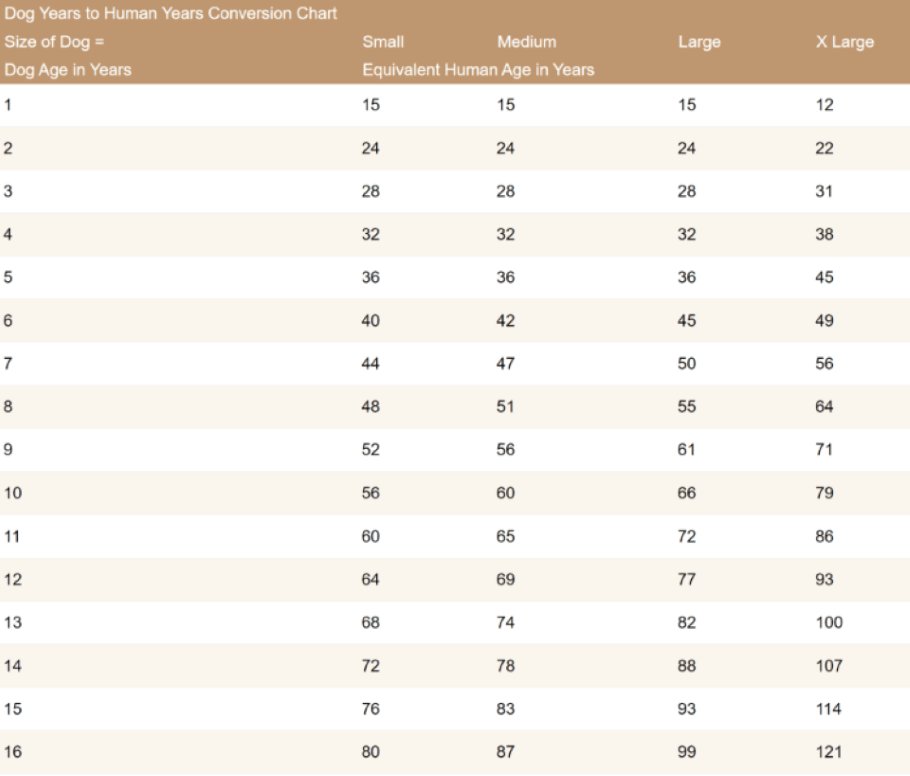
*Longevity of British breeds of dog and its relationships with-sex, size, cardiovascular variables and disease - A. R. Michell DSc, MRCVS
Convert Cat to Human Age Chart and Calculator: Our calculator and table provide quick conversion of a cats age in years to an approximate equivalent human age.
Frequently Asked Questions
Do indoor dogs live longer than outdoor dogs?
Indoor dogs often live longer because they face fewer risks such as traffic, predators, extreme weather, and infectious disease. A protected living environment combined with consistent care tends to support a longer lifespan.
At what age is a dog considered a senior?
Most dogs are considered seniors around 7 years of age, though large and extra large breeds may reach that stage as early as 5 or 6. Smaller breeds often remain in their adult stage until 9 or 10.
Is the seven year rule completely wrong?
The seven year rule is a rough oversimplification rather than a precise measure, since it ignores size and breed differences. It can offer a very general idea but should not be used for real care planning.
How accurate is the DNA based method of calculating dog age?
The DNA based method uses chemical changes to a dog's genome over time and offers a more scientific estimate than older formulas. No single formula is universally agreed upon, so it is best treated as a strong guide rather than an exact figure.
Why do purebred dogs sometimes live shorter lives than mixed breeds?
Purebred dogs can carry a higher risk of inherited health conditions due to a smaller gene pool. Mixed breed dogs often benefit from greater genetic diversity, which may reduce the likelihood of some hereditary diseases.
Can diet really extend my dog's lifespan?
A balanced diet that maintains a healthy weight can meaningfully influence how long a dog lives. Overweight dogs face higher risks of joint problems, diabetes, and heart disease, all of which can shorten life.
How do I calculate the age of a puppy under one year?
Puppies age very rapidly in their first year, so months matter more than a simple annual figure. A rough guide places a nine month old puppy near the equivalent of a human child in early adolescence.
Do giant breeds like the Great Dane need earlier senior care?
Giant breeds age faster and benefit from senior focused veterinary care starting around 5 or 6 years of age. Earlier screening helps detect heart, joint, and organ issues that tend to appear sooner in very large dogs.
Insights, Analysis, and Developments
Editorial Note: What makes this resource worth bookmarking is how it turns a familiar bit of folklore into something genuinely useful - the old "seven-year rule" gets set aside in favor of figures that actually account for a dog's size and breed. For anyone trying to read the signs of aging in their companion, the combination of a clear chart, a working calculator, and breed-by-breed longevity data takes the guesswork out of planning for the years ahead, which matters most when a pet is also a steady source of company and routine.
 Author Credentials: Ian is the founder and Editor-in-Chief of Disabled World, a leading resource for news and information on disability issues. With a global perspective shaped by years of travel and lived experience, Ian is a committed proponent of the Social Model of Disability, a transformative framework developed by disabled activists in the 1970s that emphasizes dismantling societal barriers rather than focusing solely on individual impairments. His work reflects a deep commitment to disability rights, accessibility, and social inclusion. To learn more about Ian's background, expertise, and accomplishments, visit his full biography.