Baby Boy Growth Chart: Height and Weight Birth to 11 Months
Author: Ian C. Langtree - View Credentials
Published: 21 Aug 2023 - Updated: 19 Sep 2026
Publication Type: Conversion, Calculation
Table of Contents:
Synopsis - Definition - Overview - FAQs - Insights, Updates - Related Content
Synopsis
This information provides a detailed reference chart documenting average height and weight measurements for male infants from birth through eleven months of age. The data comes directly from authoritative health organizations including the World Health Organization, the National Institutes of Health's Gerontology Research Center, and the Centers for Disease Control and Prevention, making it a reliable resource for parents, caregivers, and healthcare providers who need to monitor infant development. Parents of children with disabilities or developmental concerns will find this particularly valuable as it establishes baseline growth patterns against which to measure their child's progress. The chart offers specific monthly benchmarks - noting that newborn boys average 7.8 pounds and 19.7 inches at birth, typically doubling their weight by four months and tripling it by their first birthday - which helps identify potential growth issues early when intervention can make the most difference.
At a Glance
- 1 - Most baby boys gain about an ounce a day until they are around three months old. It is a steady early climb that adds up quickly.
- 2 - By four months most male babies have doubled their birth weight, and by one year most have tripled it. This makes the first year the fastest growth stage of childhood.
- 3 - Clinicians pay more attention to weight for length, which compares the two measurements together, than to either figure alone. A mismatch between the separate curves is common and usually harmless.
- 4 - Some conditions such as Down syndrome have their own specialty growth references because typical patterns differ from standard charts. A pediatrician or specialist can advise which reference gives the fairest picture for a particular child.
Topic Definition
- Baby Boy Growth Chart
A baby boy growth chart is a reference table that lays out the average height and weight expected for male infants at each stage of their first year, here running from birth through eleven months. Rather than setting a strict standard every child must meet, it gathers averages from large population studies so parents, caregivers, and doctors can see roughly where a baby sits compared to others his age. The real value lies in watching the overall trend, since healthy babies grow along their own individual curves shaped by genetics, feeding, activity, and any underlying health conditions. Used the right way, a chart like this gives a useful starting point for tracking development and, more importantly, for opening a conversation with a pediatrician who can weigh a baby's numbers against his complete health picture before deciding whether anything actually warrants a closer look.
Overview
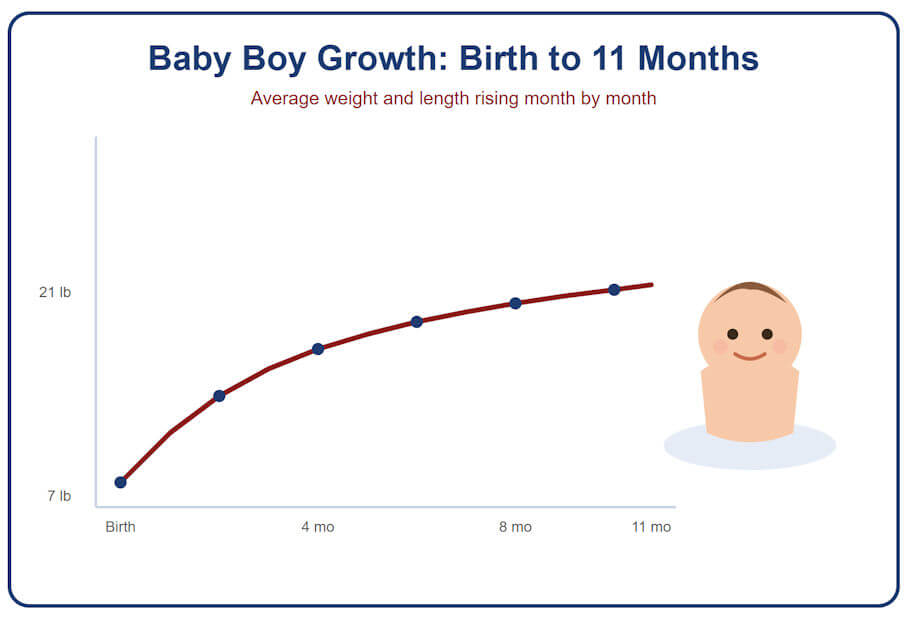
In the United States, the average newborn baby boy weighs 7 pounds 8 ounces (3.4 kg) and is 19.7 inches (49.9 cm) in length at birth. Most baby boys will gain about an ounce a day until they are three months old. By four months old, most male babies have doubled their birth weight; by one year, most have tripled it.
| Age | Weight | Length |
|---|---|---|
| 0 Months | 7.4 lb. (3.35 kg) | 19.6" (49.9 cm) |
| 1 Month | 9.9 lb. (4.47 kg) | 21.5" (54.7 cm) |
| 2 Months | 12.3 lb. (5.57 kg) | 23.0" (58.4 cm) |
| 3 Months | 14.1 lb. (6.38 kg) | 24.2" (61.4 cm) |
| 4 Months | 15.4 lb. (7.00 kg) | 25.2" (63.9 cm) |
| 5 Months | 16.6 lb. (7.51 kg) | 25.9" (65.9 cm) |
| 6 Months | 17.5 lb. (7.93 kg) | 26.6" (67.6 cm) |
| 7 Months | 18.3 lb. (8.30 kg) | 27.2" (69.2 cm) |
| 8 Months | 19.0 lb. (8.62 kg) | 27.8" (70.6 cm) |
| 9 Months | 19.6 lb. (8.90 kg) | 28.3" (72.0 cm) |
| 10 Months | 20.2 lb. (9.16 kg) | 28.9" (73.3 cm) |
| 11 Months | 20.7 lb. (9.41 kg) | 29.3" (74.5 cm) |
Frequently Asked Questions
Is it normal for a newborn boy to lose weight in his first week?
Yes, most newborns shed around five to seven percent of their birth weight in the first few days as extra fluid clears. Babies typically regain it by about two weeks of age, and a pediatrician will look more closely if the loss exceeds roughly ten percent or the recovery is slow.
What does the percentile beside my baby boy measurement actually mean?
A percentile shows how a baby compares with others the same age and sex, so the 40th percentile means about forty out of a hundred boys would be smaller. It is a position in a range rather than a score, and steady tracking along one line matters far more than the number itself.
Why is my baby boy in different percentiles for weight and length?
Babies are often heavier or longer relative to each other, and a mismatch between the two curves is common and usually harmless. Clinicians pay more attention to weight for length, which compares the two together, than to either figure alone.
How is head circumference tracked during the first year?
Head circumference is measured at every well baby visit with a tape around the widest part of the head, and it grows quickly through the first year. The trend is watched because unusually fast or slow head growth can be an early clue to conditions needing further review.
Do these charts still apply to babies with Down syndrome or other conditions?
Standard charts remain a useful backdrop, but some conditions have their own specialty growth references because typical patterns differ. A pediatrician or specialist can advise which reference gives the fairest picture for a particular child.
How can I tell whether my baby boy is getting enough milk?
Steady weight gain, regular wet and dirty diapers, alertness when awake, and contentment after feeds are the practical everyday signs. If any of those slip, or feeding becomes painful or distressing, an early call to a pediatrician or lactation consultant is sensible.
Why is a baby measured lying down rather than standing?
Infants cannot stand straight or hold still, so length is taken lying flat with the legs gently extended, ideally using a measuring board with two people. This recumbent length runs slightly longer than a later standing height, which is why references note the change in method around age two.
When do babies typically start sleeping longer stretches and does that affect growth?
Many babies begin consolidating sleep between three and six months, though the range is wide and night waking remains normal well past that. Growth hormone release is tied to deep sleep, so consistent rest supports development, but frequent night feeds in early infancy are expected and not a growth concern.
How These Figures Were Derived and Last Verified
Every number in the table above is the median (50th percentile) of a published growth reference, not an average of site visitors or an in-house estimate. The figures come from the WHO Child Growth Standards, which the CDC recommends for children under two years of age in the United States. In each row the imperial and metric values are converted from the source figure in its original unit and rounded consistently, so the two unit systems agree with one another. The complete set of figures was last checked cell by cell against the source data files on 26 July 2026, and matches our full height-to-weight guide for infants through teens.
Source References
- 1 - World Health Organization: Child Growth Standards - overview of the standards used from birth to 23 months.
- 2 - World Health Organization: Weight-for-age - z-score and percentile tables, birth to 5 years.
- 3 - World Health Organization: Length/height-for-age - z-score and percentile tables, birth to 5 years.
- 4 - U.S. Centers for Disease Control and Prevention: WHO growth standards for use in US infants and children birth to 2 years - the basis for using WHO figures below age two.
Other Printable Height to Weight Reference Charts:
Insights, Analysis, and Developments
Editorial Note: While these measurements represent population averages drawn from major health agencies, every child follows their own unique growth trajectory. What matters most isn't matching these numbers exactly, but rather seeing consistent progress over time along your baby's personal growth curve. Parents should remember that factors including genetics, feeding method, activity level, and underlying health conditions all influence an infant's size. Children with certain disabilities or medical conditions may follow different growth patterns entirely, yet still thrive. Use this chart as a helpful reference point rather than a rigid standard, and always discuss any concerns about your baby's growth with a pediatrician who knows your child's complete health picture and can interpret these numbers within the proper context.
 Author Credentials: Ian C. Langtree is a writer, editor, and the founder and Editor-in-Chief of Disabled World, which he established in 2004 as one of the longest-running independent resources for disability news and information. Over more than two decades, he has written and edited thousands of articles on disability rights, health, accessibility, and assistive technology. Drawing on a global perspective shaped by extensive travel and lived experience, Ian is a committed advocate of the Social Model of Disability, the framework developed by disabled activists in the 1970s that focuses on removing societal barriers rather than on individual impairments. His writing is grounded in that framework and in a lasting commitment to disability rights, accessibility, and social inclusion. To learn more about Ian's background, expertise, and accomplishments, visit his full biography.