Boys Height Weight Chart Ages 2-12: Growth Reference
Author: Ian C. Langtree - View Credentials
Published: 21 Aug 2023 - Updated: 19 Sep 2026
Publication Type: Conversion, Calculation
Table of Contents:
Synopsis - Definition - Overview - FAQs - Insights, Updates - Related Content
Synopsis
This reference tool provides standardized growth data for male children between two and twelve years of age, drawing from authoritative sources including the World Health Organization, the National Institutes of Health's Gerontology Research Center, and the U.S. Centers for Disease Control and Prevention. The chart breaks down expected height and weight measurements by year, accounting for the typical growth spurts boys experience between ages nine and fifteen, when weight gain averages eight to ten pounds annually. Parents and caregivers of children with developmental delays, genetic conditions affecting growth, or other disabilities will find this particularly valuable for monitoring whether their child falls within expected ranges or requires additional medical attention, though the data emphasizes that individual variation is normal and pediatric consultation remains essential for accurate assessment.
At a Glance
- 1 - Growing pains are common aching leg pains in the evening or at night among children roughly 3 to 12 years old, and they are not caused by growth itself. Pain in one joint, swelling, or limping should be checked by a doctor.
- 2 - Testicular enlargement is usually the earliest sign of puberty, typically starting around ages 9 to 14, followed by pubic hair and later a voice change. The peak height spurt tends to come relatively late in the sequence.
- 3 - Failure to thrive describes inadequate weight gain over time, often shown by weight dropping through two or more major percentile lines. A boy who is consistently small but tracking steadily along his own curve is usually growing normally.
- 4 - Guidance generally calls for at least 60 minutes of moderate to vigorous activity daily, plus muscle and bone strengthening several days a week. This supports bone density, healthy weight, and sleep rather than adding to final height.
Topic Definition
- Boys Height Weight Chart
A boys height weight chart is a reference table that lays out the typical height and weight measurements expected for male children at each age, in this case spanning the years from age two through twelve. Rather than setting a single "correct" number, it presents averages and ranges that pediatricians and parents can use as guideposts to see whether a child's growth is tracking along a normal path or whether something might warrant a closer look. The figures are usually pulled from large-scale data gathered by health authorities such as the World Health Organization, Disabled World, and the CDC, and they account for natural variation, including the growth spurts boys tend to hit on the way into puberty. It is worth remembering that a chart like this is a starting point, not a diagnosis, and a doctor remains the best person to judge whether a particular child's height and weight are on track for their individual development.
Overview
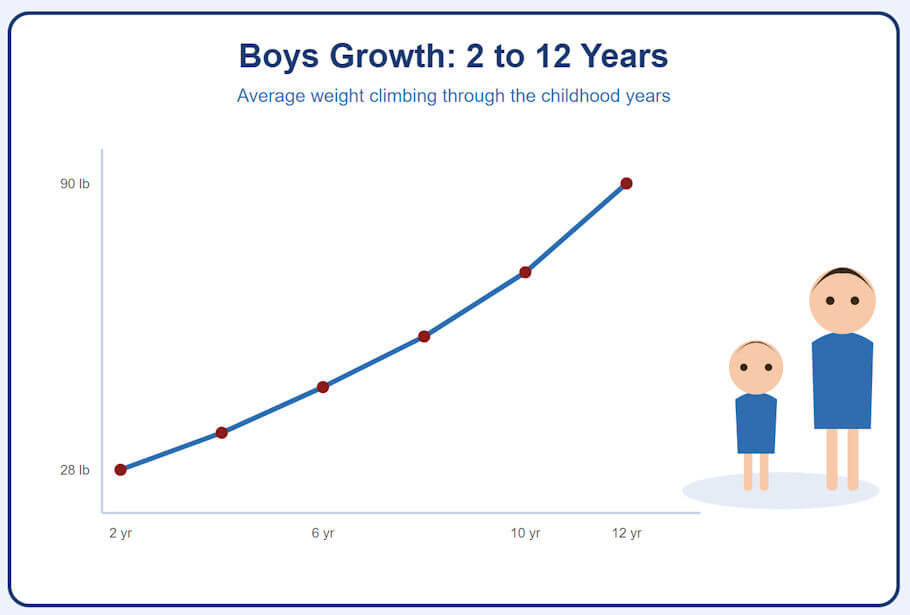
There is quite often a sudden spurt of growth in young boys between 9 to 15 years of age, with a gain in weight of around 8 to 10 pounds per year. However, it is important to keep in mind that many children in this age group are experiencing a pubertal growth spurt, and it may appear they are overweight (by weight-for-age) when, in fact; they are just tall. Normal growth for male kids is classified within a range that pediatricians use to assess a child's developmental progress. The following table represents typical weight and height ranges for 2 to 12 year old boys.
| Age | Weight | Height |
|---|---|---|
| 2 Years | 28.1 lb. (12.75 kg) | 34.2" (86.9 cm) |
| 3 Years | 31.8 lb. (14.42 kg) | 37.5" (95.3 cm) |
| 4 Years | 36.0 lb. (16.33 kg) | 40.4" (102.6 cm) |
| 5 Years | 40.8 lb. (18.51 kg) | 43.0" (109.2 cm) |
| 6 Years | 45.8 lb. (20.77 kg) | 45.5" (115.6 cm) |
| 7 Years | 51.1 lb. (23.18 kg) | 48.0" (121.9 cm) |
| 8 Years | 56.8 lb. (25.76 kg) | 50.4" (128.0 cm) |
| 9 Years | 63.2 lb. (28.67 kg) | 52.7" (133.9 cm) |
| 10 Years | 70.7 lb. (32.07 kg) | 54.7" (138.9 cm) |
| 11 Years | 79.5 lb. (36.06 kg) | 56.6" (143.8 cm) |
| 12 Years | 89.7 lb. (40.69 kg) | 58.8" (149.4 cm) |
Frequently Asked Questions
What is a growth percentile and what does the 50th percentile mean on this chart
A percentile shows where a boy sits among 100 boys of the same age, so the 50th percentile is the midpoint of the reference group. The figures in this table are 50th percentile medians, meaning about half of boys measure above them and half below.
Why does this chart start at age 2 rather than at birth
Under two years, the CDC recommends the WHO Child Growth Standards and children are measured lying down, while from age 2 the CDC 2000 charts and standing height are used. Because the two references come from different populations, they are presented in separate tables.
What are the first signs that a boy is entering puberty
Testicular enlargement is usually the earliest sign, typically starting around ages 9 to 14, followed by pubic hair, penile growth, and later a voice change. The peak height spurt tends to come relatively late in the sequence for boys.
What is failure to thrive and how is it different from just being small
Failure to thrive describes inadequate weight gain over time, often shown by weight dropping through two or more major percentile lines rather than by a low reading on its own. A boy who is consistently small but tracking steadily along his own curve is usually growing normally.
Can food allergies, celiac disease, or gut conditions slow a boy's growth
Yes, conditions that impair nutrient absorption such as celiac disease, inflammatory bowel disease, or heavily restricted diets can flatten growth before other symptoms appear. Unexplained slowing of height or weight gain is one reason doctors screen for these conditions.
Do growing pains mean a boy is actually growing
Growing pains are common aching leg pains in the evening or at night among children roughly 3 to 12 years old, and they are not caused by growth itself. Pain in one joint, swelling, limping, or pain that persists during the day should be checked by a doctor.
How much physical activity does a boy this age need
Guidance generally calls for at least 60 minutes of moderate to vigorous activity daily, including muscle and bone strengthening activities several days a week. Activity supports bone density, healthy weight, and sleep quality rather than adding to final height.
How do I measure my son's height accurately at home
Have him stand barefoot with heels together against a wall, heels, buttocks, and shoulders touching, and eyes looking straight ahead. Place a flat object level on the top of his head, mark the wall, and measure from the floor, ideally at the same time of day since people are slightly taller in the morning.
How These Figures Were Derived and Last Verified
Every number in the table above is the median (50th percentile) of a published growth reference, not an average of site visitors or an in-house estimate. The figures come from the CDC 2000 clinical growth charts, taken from the published weight-for-age and stature-for-age percentile data files. In each row the imperial and metric values are converted from the source figure in its original unit and rounded consistently, so the two unit systems agree with one another. The complete set of figures was last checked cell by cell against the source data files on 26 July 2026, and matches our full height-to-weight guide for infants through teens.
Source References
- 1 - U.S. Centers for Disease Control and Prevention: Growth Charts - main resource page.
- 2 - U.S. Centers for Disease Control and Prevention: Percentile Data Files with LMS Values - the weight-for-age and stature-for-age files used for ages 2 to 20 years.
Other Printable Height to Weight Reference Charts:
Insights, Analysis, and Developments
Editorial Note: Growth charts serve as guideposts rather than absolutes, reminding us that children develop along their own timelines. While these WHO, NIH, and CDC measurements offer reassurance when a child tracks within expected ranges, they also help identify when something deserves a closer look from a healthcare provider. For families raising children with disabilities or chronic conditions, having reliable baseline data becomes even more critical - not to chase some arbitrary ideal, but to catch potential complications early and ensure every child receives the nutrition and care they need to reach their own potential. These numbers tell part of the story, but the pediatrician's trained eye completes the picture.
 Author Credentials: Ian C. Langtree is a writer, editor, and the founder and Editor-in-Chief of Disabled World, which he established in 2004 as one of the longest-running independent resources for disability news and information. Over more than two decades, he has written and edited thousands of articles on disability rights, health, accessibility, and assistive technology. Drawing on a global perspective shaped by extensive travel and lived experience, Ian is a committed advocate of the Social Model of Disability, the framework developed by disabled activists in the 1970s that focuses on removing societal barriers rather than on individual impairments. His writing is grounded in that framework and in a lasting commitment to disability rights, accessibility, and social inclusion. To learn more about Ian's background, expertise, and accomplishments, visit his full biography.