Cancer Awareness Ribbon Colors Chart and Their Meanings
Author: Ian C. Langtree - View Credentials
Published: 28 Feb 2019 - Updated: 5 Nov 2026
Publication Type: Charts, Graphs, Tables
Table of Contents:
Synopsis - Definition - Overview - FAQs - Insights, Updates - Related Content
Synopsis
This information is a chart of the awareness ribbon colors linked with different types of cancer, set out in a simple table with a printable version. It covers the best-known colors, such as pink for breast cancer, light blue for prostate cancer, teal for ovarian cancer and lavender for all cancers, along with less familiar ones such as periwinkle for stomach and esophageal cancers, zebra stripes for neuroendocrine and rare cancers, and several two- and three-color ribbons. It also gives a short overview of cancer, how many cancers can be prevented through lifestyle choices, and the main types of treatment. The chart is useful for people with cancer, survivors, families, schools and charities choosing the right color for fundraising, awareness events and remembrance.
At a Glance
- 1 - Gold is the ribbon color for childhood cancers.
- 2 - Some cancers share a color, and some colors stand for more than one cancer.
- 3 - Hot pink is used for inflammatory breast cancer, while pink and blue together mark male breast cancer.
- 4 - Skin cancer is shown with black or orange ribbons, and red and white ribbons are used for squamous cell carcinoma.
Topic Definition
- Awareness Ribbon
An awareness ribbon is a short piece of colored ribbon folded into a loop and worn or displayed to show support for people affected by a disease, cause or event. Each color or pattern is linked with a particular cause, such as pink for breast cancer or lavender for all cancers, and ribbons are widely used by charities to raise awareness, encourage screening and raise funds for research and support.
Overview
Cancer is defined as a group of diseases involving abnormal cell growth with the potential to invade or spread to other parts of the body. The majority of cancers are due to environmental risk factors, and many - but not all - of these environmental factors are controllable lifestyle choices - (List of Known Carcinogens That Cause Cancer in Humans).
Today's cancer research ranges from epidemiology, molecular bioscience to clinical trials to evaluate and compare applications of the various cancer treatments including; surgery, radiation therapy, chemotherapy, hormone therapy, immunotherapy and combined treatment modalities such as chemo-radiotherapy.
World Cancer Day Awareness: Outline of World Cancer Day and associated events focused on cancer awareness which takes place each year on February 4. Many cancers today can be prevented by not smoking, maintaining a healthy weight, not drinking too much alcohol, eating plenty of vegetables, fruits and whole grains, vaccination against certain infectious diseases, not eating too much processed and red meat and avoiding too much sunlight exposure.
Cancer Awareness: Color Chart of Ribbon Colors for Cancers
| Ribbon Color(s) | Cancer Type | |||
|---|---|---|---|---|
| Amber | Appendix Cancer | |||
| Black | Skin Cancer (or orange with a sun) - Melanoma | |||
| Burgundy | Multiple Myeloma | |||
| Blue | Colon Cancer - Colorectal Cancer - Rectal Cancer (Blue or Brown) | |||
| Emerald | Liver Cancer (Emerald or Jade Green) | |||
| Gold | Childhood Cancer | |||
| Gray | Brain Cancer - Glioblastoma | |||
| Green | Bile Duct Cancer - Bone Marrow Transplant - Kidney Cancer (Renal Cell Carcinoma) (Green or Orange) | |||
| Lavender | All Cancers | |||
| Light Blue | Prostate Cancer - Lymphedema | |||
| Light Purple | Testicular Cancer | |||
| Lime Green | Non-Hodgkin Lymphoma | |||
| Orange | Leukemia - Kidney Cancer - Skin Cancer - (Orange with a sun, or black) | |||
| Peach | Uterine - Endometrial Cancer | |||
| Periwinkle | Gastric Cancer - Small Intestine Cancer - Stomach Cancer - Esophageal Cancer | |||
| Pink | Breast Cancer - Hot Pink for Inflammatory Breast Cancer - Teal and Pink for Hereditary Breast Cancer and for Breast and Gynecologic Cancers Together - Male Breast Cancer: Light Baby Pink and Baby Blue. | |||
| Purple | Pancreatic Cancer - Cancer Survivor - Leiomyosarcoma - Testicular Cancer (Purple Orchid or Violet) | |||
| Teal | Ovarian Cancer - Gynecological Cancer | |||
| Violet | Hodgkin Lymphoma | |||
| White Pearl |
Lung Cancer - Mesothelioma (Pearl) - Waldenstrom's Macroglobulinemia (Pearl) - Retinoblastoma | |||
| Yellow | Bone Cancer - Cholangiocarcinoma - Chondrosarcoma - Ewing's Sarcoma - Gallbladder Cancer - Osteosarcoma - Sarcoma | |||
| White Burgundy |
Head and Neck Cancers - Laryngeal Cancer - Oral Cancer (Burgundy and White or Red and White) - Pharyngeal Cancer - Throat Cancer | |||
| White Teal |
Cervical Cancer | |||
| Blue Pink Teal |
Thyroid Cancer | |||
| Blue Yellow Purple |
Bladder Cancer | |||
| Zebra | Carcinoid Cancer - Neuroendocrine Cancers - Rare Diseases (Including Rare Cancers) | |||
| Red White Red |
Leukemia and Lymphoma Together - Skin Cancer (Squamous Cell Carcinoma) |
|||
| Blue Silver |
Living (Coping) with Cancer | |||
| Orange Red |
Myeloproliferative Diseases | |||
| Blue Pink-Purple Teal |
Thyroid Cancer - Blue/Pink-Purple/Teal (tricolored) | |||
NOTE: This is not a full list of all ribbon colors for all cancer types, it will be updated as other colors for cancers are verified.
Image of Some Cancer Awareness Ribbons
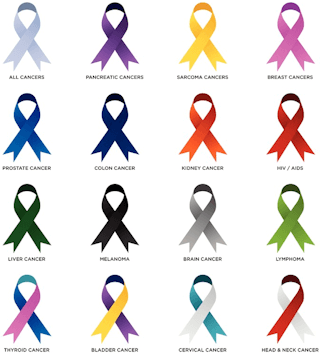
Print Our Cancer Awareness Ribbon Chart

Frequently Asked Questions
When did awareness ribbons start?
Colored ribbons became widely used as awareness symbols in the early 1990s, with the red AIDS ribbon in 1991 and the pink breast cancer ribbon soon after.
What color ribbon is used for cancer survivors?
Lavender is often used for all cancers, and purple is widely used to honor cancer survivors, especially on National Cancer Survivors Day in June.
Is there a ribbon color for every type of cancer?
Most common cancers have an accepted color, but rare cancers often share the zebra ribbon or use colors chosen by individual charities.
Can I wear several ribbon colors together?
Yes. Many people wear a multicolored or lavender ribbon to show support for several cancers or for everyone affected by cancer.
When is Breast Cancer Awareness Month?
Breast Cancer Awareness Month takes place in October in the United States and many other countries.
What does the zebra ribbon mean?
The zebra ribbon stands for neuroendocrine cancers and rare diseases, based on the saying that when you hear hoofbeats you should consider zebras as well as horses.
What color ribbon is used for lung cancer?
White or pearl is the most widely used color for lung cancer, and some groups also use clear ribbons.
Where can I buy cancer awareness ribbons?
Ribbons and pins are sold by cancer charities, craft stores and online shops, and buying from a charity can help fund its work.
Insights, Analysis, and Developments
Editorial Note: Awareness ribbons are not owned or regulated by any single body, so the same color can mean different things to different groups, and some cancers have more than one accepted color. Charities and patient groups for a particular cancer are the best guide to which ribbon they use for campaigns, and many link their colors to an awareness month, such as pink for Breast Cancer Awareness Month in October. Beyond wearing a ribbon, supporting screening programs, research funding and practical help for patients and caregivers turns awareness into real benefit for people living with cancer.
 Author Credentials: Ian C. Langtree is a writer, editor, and the founder and Editor-in-Chief of Disabled World, which he established in 2004 as one of the longest-running independent resources for disability news and information. Over more than two decades, he has written and edited thousands of articles on disability rights, health, accessibility, and assistive technology. Drawing on a global perspective shaped by extensive travel and lived experience, Ian is a committed advocate of the Social Model of Disability, the framework developed by disabled activists in the 1970s that focuses on removing societal barriers rather than on individual impairments. His writing is grounded in that framework and in a lasting commitment to disability rights, accessibility, and social inclusion. To learn more about Ian's background, expertise, and accomplishments, visit his full biography.