One-Hand Guitar Device Enables Accessible Music Therapy
Author: Ian C. Langtree - Writer/Editor for Disabled World (DW)
Published: 27 Jan 2014 - Updated: 1 Feb 2026
Publication Type: Product Release, Update
Table of Contents:
Synopsis - Overview - Insights, Updates - Related Content
Synopsis
This product review examines an assistive technology device that attaches to standard guitars and automates chord formation, allowing musicians to play with just one hand. The information comes from a documented product release featuring quotes from the inventor Kevin Krumweide, who developed the technology after his father lost guitar-playing ability following a stroke. The device addresses a significant gap in adaptive musical instruments by enabling people with upper limb disabilities, stroke survivors, veterans with injuries, and those with limited dexterity to participate in music therapy and recreational guitar playing. The product debuted at the 2013 Greenbrae Maker Faire where it attracted interest from rehabilitation professionals and disability advocates. While the device appears to be discontinued, the documented approach demonstrates how simple mechanical adaptations combined with software control can make traditional instruments accessible to populations previously excluded from guitar playing.
Overview
Robo-Tar: Play Guitar With One Hand
Music therapy has been around for many years and is recognized as a tool for helping people with emotional and behavioral issues such as depression or ADHD. While the usual instruments used include the drums, cymbals and other instruments that do not require too much instruction, the guitar is also being used as an option. Learning to play guitar requires some finger dexterity and this comes with limitations as to who may learn to play guitar - Robo-Tar has taken this obstacle out of the equation. Allowing people with disabilities to handle a guitar is a start towards giving them new hope and opportunities.
One of the uses of the guitar for people with disabilities and seniors is as a motivational tool. For people with ADHD, they develop the drive to sit down for at least half an hour to strum a guitar. It provides them with the opportunity to learn to focus on making sounds and play songs. Seniors also have the opportunity to play guitar with Robo-Tar!
The beauty of playing a guitar is that you can create music. After learning a few basics, which includes learning how to care for the guitar itself, there is a lot of freedom to play anything with Robo-Tar. Even simply strumming the guitar can help people with disabilities, veterans, and seniors to relax and enjoy life. Music appreciation through use of Robo-Tar can also help children with learning disabilities or autism, as well as emotional or speech disabilities. With Robo-Tar, children and seniors have the opportunity to enhance their social skills as well.
The creators of Robo-Tar have chosen the, 'Ahuizote,' as their symbol. The Ahuizote is a mythical Latin American beast with a single claw on its tail. They chose this image to illustrate a new, one-handed opportunity for guitar players. It does not matter if you have never played a guitar or whether you have played one for years - the Blue Ahuizote Robo-Tar is not only exciting, it is an innovative new way for you to play almost any song on your guitar.
Who is Robo-Tar For?
The simple answer to this question is - Everyone! People who can benefit the most from Robo-Tar include a number of people from different backgrounds. These people include:
- People who lost or never had the use of one of their arms or hands, yet desire to play an instrument like the guitar for creative outlet.
- Adults who want to learn guitar or sing with accompaniment, yet do not have the time or patience for the extended learning curve that is required to form chords smoothly.
- Seasoned guitarists who are looking to expand possibilities. Guitarists use Robo-Tar to play rhythm in the open position while playing lead riffs further up the neck on the very same guitar!
- Music teachers who would like to provide young students with a new way to engage with music beyond simple percussion instruments. Children can play the guitar without having to experience the pain of learning to press strings with delicate fingers.
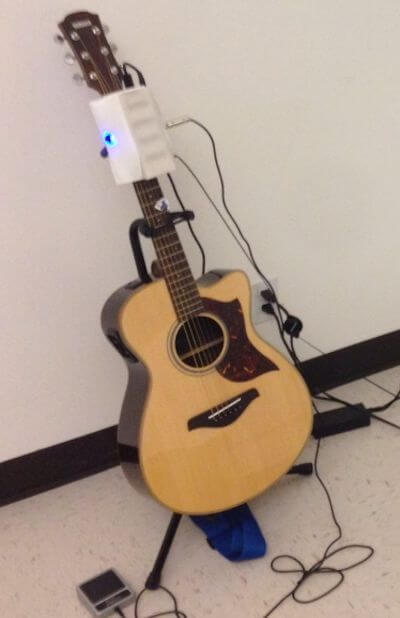
Robo-Tar attaches easily and temporarily to the neck of any standard guitar. The person playing the guitar uses an application to choose a song they desire to play, or builds a new and original one themselves. The guitar player then cycles through each chord of the song, leveraging a single foot pedal or push button option to move to each chord at their own tempo as they strum along with one hand. It does not matter if the player is left-handed or right-handed! People can learn to play their favorite guitar songs in a single day.
Robo-Tar is perfect for veterans with disabilities and people who have experienced a stroke, or lost the use of one of their arms or hands through personal injury or illness while serving the nation. In fact - Robo-Tar's second owner is a gentleman from California who is interested in the product so he can play guitar again after experiencing a brain hemorrhage that impaired his right side.

Robo-Tar's Public Debut
September of 2013 found Robo-Tar making its public debut at The Greenbrae, California maker Faire. More than 2,000 people attended and Robo-Tar had a full and steady flow of people interested in the product at their booth. They gathered a list of people who were interested in their upcoming Kickstarter campaign and talked with a number of key contacts, to include a gentleman employed with the Navy who suggested they contact him to learn more about ways Robo-Tar might help veterans with disabilities.
Kevin Krumweide unveiled Robo-Tar, which clamps onto the first four frets of a guitar neck, giving a guitar player the opportunity to strum any chord selected on a computer without having to use their fretting hand. Kevin stated;
"It was inspired by my father, who played guitar all his life until he had a stroke and lost the ability to play with his left hand, but his right hand was fine. This allows anybody who has an ailment on one of his hands, left or right, to play the guitar with one hand. Or if you're learning guitar and don't want to go on that steep learning curve, you can play songs right away." Kevin is Director of International IT Management for Gap Stores and also works to make Robo-Tar available to everyone.
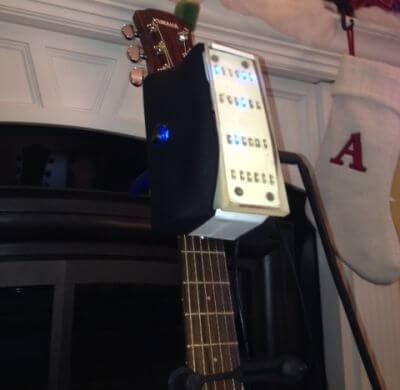
The debut was a success and Robo-Tar was invited to attend two additional events, to include the Clean Tech Expo and the Sonoma Mini Makers Faire. Both of these events occur on the same weekend and Robo-Tar chose to attend the Clean Tech Expo, becoming a part of their maker innovation section. Robo-Tar is a magnificent product, one that can help people with disabilities, seniors, as well as veterans, to play guitar and enjoy music.
NOTE: Unfortunately it appears this product is no longer available. If you know, or find out otherwise, please contact us so we can update this page.
Insights, Analysis, and Developments
Editorial Note: The Robo-Tar concept represents an important step in understanding how assistive technology can reshape access to creative activities that many assume require two functional hands. Though the product seems to have left the market, its documented existence validates what disability advocates have long argued: barriers to participation often stem from design choices rather than inherent limitations. The device's ability to serve multiple populations - from children avoiding finger pain during early lessons to experienced guitarists recovering from neurological events - illustrates how universal design principles benefit everyone. Perhaps most significantly, by treating the guitar itself as the element needing modification rather than requiring users to adapt to standard instruments, Robo-Tar embodied the social model of disability in practical form. Future inventors working on adaptive musical instruments would do well to study why this device resonated with users and what market or manufacturing challenges prevented its continued availability.
 Author Credentials: Ian is the founder and Editor-in-Chief of Disabled World, a leading resource for news and information on disability issues. With a global perspective shaped by years of travel and lived experience, Ian is a committed proponent of the Social Model of Disability, a transformative framework developed by disabled activists in the 1970s that emphasizes dismantling societal barriers rather than focusing solely on individual impairments. His work reflects a deep commitment to disability rights, accessibility, and social inclusion. To learn more about Ian's background, expertise, and accomplishments, visit his full biography.