Better Late Than Never: The Long Road to Self-Realization
Author: Philip Wylie
Published: 7 Oct 2014 - Updated: 21 Jan 2026
Publication Type: Literature / Review
Table of Contents:
Synopsis - Overview - Insights, Updates - Related Content
Synopsis
This report documents Philip Wylie's remarkable personal account of receiving an Asperger's diagnosis at age 51, nearly a decade into living abroad in Southeast Asia. Drawing from his background as a finance professional and journalist, Wylie explores how late diagnosis transformed his understanding of himself and revealed patterns that shaped his entire career. His published guidebook, based on rigorous research into diagnostic assessments and family genetics, offers practical value for adults seeking late-life diagnosis and those attempting to understand neurodivergence in professional contexts. The account is particularly useful for individuals who may have spent decades undiagnosed, as well as medical professionals and counselors working with adults presenting atypical developmental histories, offering insight into how diagnosis can clarify long-standing behavioral patterns and career challenges.*
Overview
Late Asperger's Diagnosis: One Man's Path to Self-Understanding
My diagnostic journey has been a tortuous one, but I am delighted to know myself! A colleague recently suggested that my diagnosis was a gift and I agree.
Since my 'self-identification' (a term introduced to me by Dr Luke Beardon which is more apt than 'diagnosis'), I have learnt more about myself in two years than the previous 51 years of my life. Moreover, research into my ancestry and family genetics has revealed several extremely sinister family secrets.
Although I worked as a Finance Director and Company Secretary of a private bank, I resigned due to Mafia money laundering issues. As you probably know, many Aspies have a bee in their bonnet about ethics! Afterwards, I found it difficult to survive in UK so, in 2003 (at the age of 43), I became a 'refugee' in Southeast Asia.
While living outside of UK, I have seen myself much more clearly. Facilitator Dr Altazar Rossiter, who I recommend highly, rationalizes my experience as follows:
'I think that living outside the UK (disconnected from the debilitating cultural matrix you learned to define yourself within) will have helped you in coming to understand yourself better. I know you've always questioned the insanity you experienced here. That particular brand of insanity is called 'Englishness'. It is an energy matrix that defined your existence as you learned to make an identity for yourself. It's not necessarily better or worse than any other, but living outside it enables a clearer perception of it.'
I believe in Synchronicity
Everything in my life fell apart at the precise moment I read an article in my professional Accountancy magazine about Asperger's, written by fellow Chartered Accountant Mark Lever, CEO of the National Autistic Society. I had just fallen out with an employer in Cambodia, a place where it is extremely dangerous to have disagreements. And I had lost my money and my business.
I experienced a 'thorough' mental breakdown. However, on the positive side, I immersed myself in research about everything Asperger's! Several people judged me as being obsessed about Asperger's and my parents never believed me.
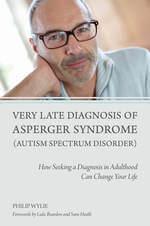
As a writer and journalist, I decided to write a guidebook about my extreme experience of very late diagnosis of Asperger's. In January 2012, I managed to get a publishing contract for the book with Jessica Kingsley Publishers. Nineteen months later, in August 2014, the book was published; that's quite a long time, but be aware that I had some massive mood swings during my identity alignment experience! I am indebted to my editors for their patience and understanding towards Mr. Angry!
I discovered many useful online tests for Asperger's, which I listed and explained in my book. My online research lead me to my dear mentor Sara Heath of Shropshire Autonomy who provided me with a pre-diagnostic assessment for Asperger's after a 90-minute video interview. A year later, I obtained a formal diagnosis for Asperger's.
I was extremely fortunate that my aforementioned colleague Mark Lever offered me a research job, which enabled me to return to Thailand. I did not feel safe after my employment blunders in Cambodia, so I had to escape!
One major mistake I made after self-identification was confiding in Mr. Wrong Person who I thought was a reliable friend. Mr. Wrong Person broadcast my diagnosis to everyone in Thailand, so when I returned to Chiang Mai nobody would return my calls. My social life was non-existent.
Before I sign off I want to let you know about two other projects that you may find interesting: a UK autism survey with Sara Heath of Shropshire Autonomy. Also, I am writing a book about a new developmental model for autism called The Nine Degrees of Autism based on my experience.
Insights, Analysis, and Developments
Editorial Note: Wylie's narrative underscores an often-overlooked reality in autism diagnosis: that clarity can arrive at any life stage, and sometimes distance - both physical and temporal - creates the perspective needed for recognition. His experience demonstrates that late diagnosis isn't a second-best outcome but rather a chance for adults to recontextualize their entire lives with new understanding, though not without complexity and social challenge. For those in midlife grappling with similar questions, his documented journey serves as both validation and practical roadmap, suggesting that the urge to finally understand oneself, however delayed, carries genuine value in reshaping one's present and future.*
* Editorial additions by Ian C. Langtree.