Disability Statistics and Barriers in America Infographic
Author: Ian C. Langtree - Writer/Editor for Disabled World (DW)
Published: 1 Dec 2011 - Updated: 24 Jan 2026
Publication Type: Informative
Table of Contents:
Synopsis - Overview - Insights, Updates - Related Content
Synopsis
This infographic presents statistical data on disability prevalence and barriers affecting 54 million Americans, representing 19 percent of the non-institutionalized population. The information proves valuable for people with disabilities, caregivers, policymakers, and healthcare professionals by documenting measurable disparities in employment (14.5% unemployment among disabled individuals versus 9% general population), education (only 13% hold bachelor's degrees), and mobility access. Drawing from census data and transportation statistics, it quantifies the scope of physical and cognitive disabilities while tracking improvements in public accessibility, such as the increase in wheelchair-accessible transit buses from 62% in 1995 to 98% in 2007. The data helps readers understand both the scale of disability in America and the tangible obstacles that millions of people navigate daily, from transportation to workforce participation.
Overview
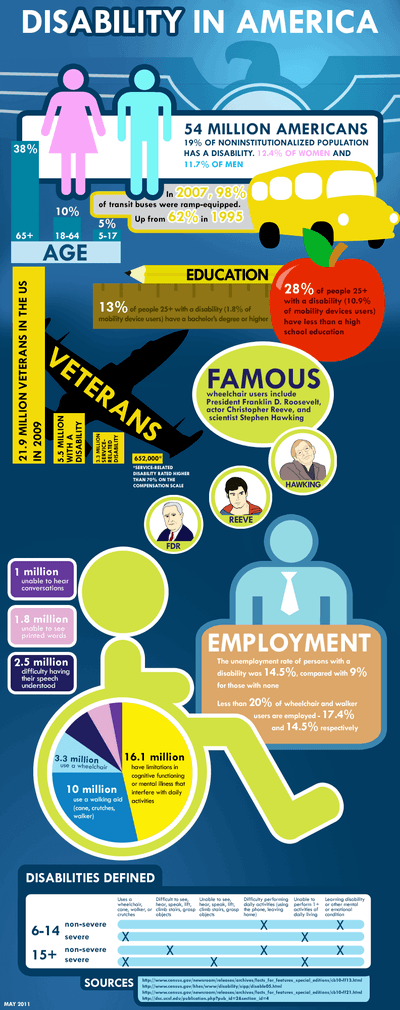
Disabilities affect Americans of all walks of life - from famous Hollywood stars to small town military heroes. In fact, some 54 million Americans - a full 19 percent of the non-institutionalized population - suffer from a physical or cognitive disability. This infographic examines the subject of disability in America and highlights some of the obstacles that disabled Americans face on a daily basis.
One obstacle area involves transportation. Millions of Americans use a wheelchair or a walking aid such as a cane; consequently, getting around can take a lot more effort. Nevertheless, there is some reason for optimism due to the availability of mobility products such as a wheelchair lift and handicapped vehicles like accessible vans. And there are positive trends in public transportation as well. In 2007, some 98 percent of transit buses were equipped with ramps - up from just 62 percent in 1995.
Employment represents another challenge area for America's disabled population. An estimated 14.5 percent of disabled people have been unemployed, compared to 9 percent of the general population. The numbers for people in wheelchairs are even more disturbing. Less than 20 percent of wheelchair and walker users are employed.
Another obstacle for the disabled is education. Some 28 percent of disable people ages 25 and older have less than a high school education. Just 13 percent of disabled Americans over 25 have a bachelor's degree or higher.
Disabilities can range from physical or mental. More than 16 million Americans have cognitive limitations or a mental illness that interferes with their daily activities. Despite the various challenges of their everyday lives, many Americans are able to overcome their physical or mental disabilities. Famous wheelchair users include former President Franklin D. Roosevelt and actor Christopher Reeve.
Disability in America Statistics
* Infographic of Some Disability Statistics in America courtesy of Braunability
What the Infographic Says (For the vision impaired)
Disability in America
54 Million Americans - 19% of non-institutionalized population has a disability - 12.4% of women and 11.7% of men.
65+ = 38%
18 - 64 = 10%
5 - 17 = 5%
1 million unable to hear conversation.
1.8 million unable to see printed words.
2.5 million difficulty having their speech understood.
3.3 million use a wheelchair.
10 million use a walking aid (cane, crutches, walker)
16.1 million have limitations in cognitive functioning or mental illness that interfere with daily activities.
In 2007 98% of transit buses were ramp-equipped. Up from 65% in 1995.
Education
13% of people 25+ with a disability (1.8% of mobility device users) have a bachelors degree or higher.
28% of people 25+ with a disability (10.9% of mobility device users) have less than a high school education.
Veterans
21.9 million veterans in the U.S. in 2009.
5.5 million with a disability.
3.3 million service related disability.
652,000 service related disability rated higher than 70% on the compensation scale.
Famous
Famous wheelchair users include President Franklin D. Roosevelt, actor Christopher Reeve, and scientist Stephen Hawking.
Insights, Analysis, and Developments
Editorial Note: These statistics paint a sobering picture of inequality that persists despite decades of disability rights advocacy and legislation. While the near-universal adoption of wheelchair ramps on transit buses shows what's possible when accessibility becomes a priority, the employment gap tells a different story - one where less than 20 percent of wheelchair users hold jobs, suggesting that physical access alone doesn't guarantee equal opportunity. The education numbers are particularly striking, revealing how barriers compound across a lifetime: when more than a quarter of disabled adults lack high school diplomas, it becomes clear that we're not just looking at individual limitations but systemic failures that begin in childhood and follow people throughout their lives. What these numbers ultimately reveal is that disability isn't just a personal medical condition - it's a social and economic challenge that affects nearly one in five Americans, demanding solutions that go far beyond ramps and curb cuts.
 Author Credentials: Ian is the founder and Editor-in-Chief of Disabled World, a leading resource for news and information on disability issues. With a global perspective shaped by years of travel and lived experience, Ian is a committed proponent of the Social Model of Disability, a transformative framework developed by disabled activists in the 1970s that emphasizes dismantling societal barriers rather than focusing solely on individual impairments. His work reflects a deep commitment to disability rights, accessibility, and social inclusion. To learn more about Ian's background, expertise, and accomplishments, visit his full biography.