Cribbage Jake: Play Free Online Crib Against the Computer
Author: Ian C. Langtree - View Credentials
Published: 14 Nov 2010 - Updated: 11 Nov 2026
Publication Type: Gaming
Table of Contents:
Synopsis - Definition - Overview - FAQs - Insights, Updates - Related Content
Synopsis
This product is a free, browser-based version of cribbage that lets one person play a full game against Jake, a computer opponent with voice narration, sound, and clear graphics, on a desktop, laptop, tablet, or phone with no download or sign-up required. Alongside the game, the page sets out the complete scoring rules, a points table covering pairs, runs, fifteens, flushes, and jacks, a glossary of terms such as go, skunk, pegging, and the stink hole, and practical advice on discarding, counting, and pegging. It is useful for newcomers who want to learn the game by playing and for experienced players who want a quick match or a rules reference, and because the computer handles dealing, shuffling, and moving the pegs, it offers seniors and people with limited hand movement or low vision an easy way to enjoy a classic card game that keeps the mind working on addition, memory, and planning.
At a Glance
- 1 - Hole 120, one short of the game hole, is known as the stink hole.
- 2 - Winning by 31 or more points is a skunk, and winning by 61 or more is a double skunk.
- 3 - Four of a kind is worth 12 points, both during play and when counting the hand or crib.
- 4 - If the non-dealer goes out while counting, the game ends at once and the dealer cannot score the hand or crib.
Topic Definition
- Cribbage
Cribbage is a card game for two players, or three or four with small rule changes, in which opponents race to a target score of 121 or 61 points by making combinations of cards worth points and recording them on a pegboard. Each player is dealt six cards and discards two into the crib, an extra hand that belongs to the dealer, and a starter card cut from the deck is shared by every hand. Points are scored in two ways: during the play, as cards are laid down toward a running total of 31, and afterward, when each hand and the crib are counted for fifteens, pairs, runs, flushes, and a jack matching the starter's suit. Thought to have been devised in seventeenth century England, the game rewards quick arithmetic and smart discarding as much as good luck.
Overview
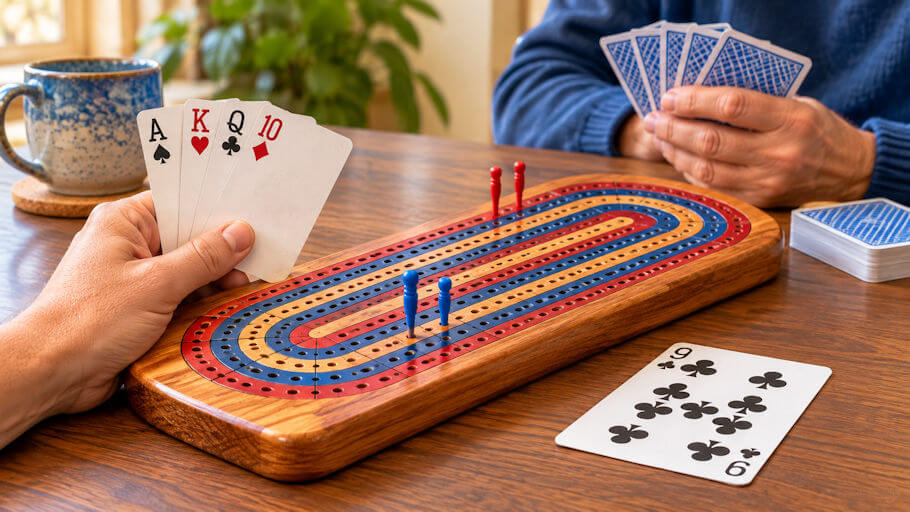
Play Cribbage Jake Online
Our online, no download, instant play Cribbage Jake game features great graphics, sound, and the voice of "Cribbage Jake", where you play against "Jake" the computer Crib player. The game below is for single person play against "Jake", your computer opponent. The Crib game is totally 100% free to play, family friendly, and suitable for all ages from children wishing to learn cribbage, to experienced adult cribbage players.
Play a Game of Cribbage Against Jake
Cribbage Jake is an excellent Crib player, though he has been known to cheat due to some programming errors beyond our control as we are not the original programmers of the game. We have had players tell us the game is too hard and should be replaced. On the other hand, we have players contact us saying the game is "perfect" as it is, and "leave it alone", and "it's a great game for teaching the rules and play of Cribbage".
NOTE: If the game is not showing, click the orange "PLAY" arrow.
How to Play Cribbage (Crib)
| The game of Cribbage can end at either 121 points or 61 points. The play ends the moment one player reaches the agreed total, whether by pegging or counting his/her hand. If a non-dealer "goes out" by the count of his/her hand, the game immediately ends and the dealer may not score either his/her hand or the crib. When play ends, the hands are counted in this order: non-dealer's hand(s) (1st), dealer's hand (2nd), and then the crib (3rd). Cribbage Scoring Combinations: Crib scores between 0 and 29 are all possible - except for 19, 25, 26 and 27. | ||
| Points Earned | ||
|---|---|---|
| Cards | During Play | Hand or Crib |
| Jack turned by dealer as starter card | 2 | - |
| Jack in hand or crib of same suit as starter card | - | 1 |
| Combinations | ||
| 2 of a Kind (Pair) | 2 | 2 |
| 3 of a Kind (Triple) | 6 | 6 |
| 4 of a Kind (Quadruple) | 12 | 12 |
| Straights of 3 or more cards: per card | 1 | 1 |
| 15-count (sum of any combination of cards) | - | 2 |
| 4 card flush (only in the hand) | - | 4 |
| 5 card flush | - | 5 |
| Reaching a 15 count exactly | 2 | - |
| Reaching 31 count exactly | 2 | - |
| Go (without reaching 31 count) | 1 | - |
| Final card played (without reaching 31 count) | 1 | - |
| Crib | 4 cards (2 from each player) set aside for the dealer to score after the dealer's hand |
|---|---|
| Cut card | (1) The starter card or (2) the card cut by either player at the start of the game or match to determine the dealer |
| Flush | 4 cards of the same suit held in the hand count 4 points - 5 cards of the same suit (including starter card) count 5 points in the hand or crib |
| Game hole | Hole number 121 |
| Go | Called by a player who cannot play a card without exceeding the cumulative count of 31 - the opponent scores 1 point - 2 points if reaching exactly 31 |
| Hand | The 6 cards dealt to each player - or the 4 cards remaining after discarding to the crib |
| His Heels (Nibs) | Jack, when it is the starter card, counts two points for the dealer |
| His Nobs | Jack of the same suit as the starter card, either in the hand or crib, counts as 1 point |
| Judge | A person authorized by the ACC or the tournament director to answer questions and settle disagreements between players relating to the rules of play |
| Match | 1 or more games between 2 players, the outcome of which is a match winner and a match loser. The play of one or more games between two players during tournament qualification play does not constitute a match. |
| Peg |
|
| Pegging | The recording of scored points by advancing the rear peg in front of the front peg and releasing it. |
| Score | Any points earned by a player. |
| Skunk | To win by 31 or more points. |
| Double Skunk | To win by 61 or more points |
| Starter card | The card that is cut and placed on the remainder of the pack and is used in counting the value of each hand and the crib. |
| Stink hole | Hole number 120 - which is one short of the game hole. |
Cribbage Strategies to Elevate Your Game
Cribbage may seem straightforward at first glance, but mastering it requires an understanding of nuanced strategies and techniques to gain an edge. Here's how to up your game.
Understand Jack Importance:
Jacks hold special importance in Cribbage. Knowing when to hold onto your Jack or discard it into the crib - yours or your opponent's - can impact the score significantly. Comparing Jacks and Face Cards: Jacks are not like any other face card. They hold a unique position in securing points when their suit matches the starter card, also known as "his nobs".
Discarding Wisely:
Your discarding strategy can make or break a game. Consider keeping cards that can form combinations totaling 15 or extend runs when possible. The aim is to maximize potential points in your hand while minimizing what you give your opponent.
Fast Counting and Combos:
Speed and accuracy in counting can change the dynamics of your gameplay. Practice quick counting methods to efficiently calculate points from 15s, runs, and pairs. Mastering Complex Runs: Familiarize yourself with the shortcuts for determining multiple runs or combinations, which can boost your score rapidly.
Using Pegs Effectively:
The Advantage of Two Pegs: Cribbage boards use two pegs to track scores, allowing players to always see their last score and current score difference. This feature aids strategic thinking and planning.
Probability and Odds:
Being aware of the frequency of various hands and scores can help in predicting potential outcomes and planning your strategy accordingly. Calculate Odds: Knowing the odds of improving your hand can guide your decisions in discarding and playing your cards.
Cribbage Strategy Tips:
From defensive plays to pegging tactics, there's a wide range of strategic moves that can be employed to refine your game. Visualizing Monster Combos: Keep in mind the high-scoring combinations while playing and aim at setting them up.
Scoring Essentials:
Count your hand methodically for maximum scoring accuracy, often starting with fifteens, then pairs, then runs, and finally flushes and nobs. Identifying Rare Scores: Knowing what scores are less common can aid in aim and anticipation during crucial moments.
Improving your Cribbage game requires a blend of strategic discard choices, swift counting skills, and an understanding of the game's probabilities. By utilizing these tactics, you can enhance your play and increase your chances of victory.
More on this topic: Accessible Gaming Publications - Hobbies Publications
Frequently Asked Questions
What is the highest possible hand in cribbage?
The best possible hand scores 29 points and is made up of three fives plus the jack of the remaining suit, with the fourth five turned up as the starter card. The odds of being dealt it are roughly 1 in 216,000 hands, so many lifelong players never see one.
How many people can play cribbage?
Cribbage is mainly a two-player game, but it also works well for three players, who are each dealt five cards and add one card from the deck to the crib. Four people can play as two partnerships sitting across from each other, with partners combining their scores on the board.
What cards and card values are used in cribbage?
A standard 52-card deck with the jokers removed is all that is needed. Aces always count as one, number cards count at face value, and kings, queens, and jacks each count as ten when adding toward fifteen or thirty-one.
Do cards have to be played in order to score a run during pegging?
No, the cards only need to form a sequence once they are on the table, so playing a four, then a six, then a five still scores a run of three. The run must be made from consecutive cards played without an unrelated card breaking the sequence.
What is the average score of a cribbage hand?
With sensible discarding, a typical hand averages a little under 5 points, and the crib usually averages slightly less. Knowing this helps players judge whether a hand is strong enough to play aggressively or whether they should play defensively.
How long does a game of cribbage usually take?
A full game to 121 points usually takes around 20 to 30 minutes between two experienced players, while a short game to 61 points can be finished in about half that time. Playing against a computer is often faster because counting and pegging are handled automatically.
Can playing cribbage help keep the mind active?
Cribbage involves quick mental addition, remembering which cards have been played, and planning ahead, which makes it a good everyday workout for attention and arithmetic. It is not a proven treatment for memory loss, but it is a social and engaging way for older adults to stay mentally busy.
Why does the crib belong to the dealer?
The crib gives the dealer an extra hand to count each round, which offsets the advantage the non-dealer has by counting first and pegging first. Because the deal alternates every hand, both players get the crib equally often over the course of a game.
If you enjoy playing Crib against Jake, you may enjoy these games:
Insights, Analysis, and Developments
Editorial Note: Few card games have lasted as long as cribbage, and its mix of chance, arithmetic, and careful decisions is a big reason it is still played across kitchen tables, clubs, and tournaments nearly four centuries after it appeared in England. Playing online against a computer opponent removes the need for a partner, a physical board, or the ability to shuffle and hold cards, which matters to people who live alone, have arthritis or tremors, or find small pegs hard to handle. Jake is not a perfect player, and some visitors find his style frustrating, but that unpredictability is also part of what keeps experienced players coming back. For learners, pairing a few games with the scoring table and glossary on this page is one of the quickest ways to move from counting on fingers to spotting fifteens, runs, and nobs at a glance.
 Author Credentials: Ian C. Langtree is a writer, editor, and the founder and Editor-in-Chief of Disabled World, which he established in 2004 as one of the longest-running independent resources for disability news and information. Over more than two decades, he has written and edited thousands of articles on disability rights, health, accessibility, and assistive technology. Drawing on a global perspective shaped by extensive travel and lived experience, Ian is a committed advocate of the Social Model of Disability, the framework developed by disabled activists in the 1970s that focuses on removing societal barriers rather than on individual impairments. His writing is grounded in that framework and in a lasting commitment to disability rights, accessibility, and social inclusion. To learn more about Ian's background, expertise, and accomplishments, visit his full biography.