Live Webcams of Animals, Nature and Places Around the World
Author: Ian C. Langtree - View Credentials
Published: 24 Sep 2009 - Updated: 13 Nov 2026
Publication Type: Informative
Table of Contents:
Synopsis - Definition - Overview - FAQs - Insights, Updates - Related Content
Synopsis
This information is a checked and current guide to live webcams that bring wildlife, natural wonders and city life to anyone with an internet connection, from the Smithsonian's National Zoo panda cam featuring Bao Li and Qing Bao to San Diego Zoo, Monterey Bay Aquarium and Cornell Lab of Ornithology bird feeder cams. It also covers webcam networks such as EarthLive.TV, which gathers more than 500 nature and wildlife cams from over 70 countries, along with U.S. Geological Survey volcano cams and Yellowstone's Old Faithful livestream. Because every listing comes from the zoo, park, aquarium or agency that runs the camera, the guide avoids the dead links that plague older webcam lists, and its practical viewing tips make it especially useful for people with disabilities, seniors and caregivers who cannot easily travel but still want to see the world as it happens.
At a Glance
- 1 - NASA streams live video of Earth from an external HD camera on the International Space Station.
- 2 - Abbey Road Studios lets visitors wave to its crossing cam in London and find their footage online later.
- 3 - The Smithsonian panda cam is live from 7 a.m. to 7 p.m. Eastern Time and replays the previous 12 hours overnight.
- 4 - Katmai bearcams in Alaska run from about late June through early October, when brown bears gather at Brooks Falls to catch salmon.
Topic Definition
- Live Webcam
A live webcam is a camera connected to the internet that streams video or regularly updated still images of a location in real time, so anyone with a browser, app or smart TV can watch from anywhere in the world. Zoos, aquariums, national parks, science agencies and businesses use them to share wildlife, natural events, landmarks and street scenes with the public, often at no cost to viewers. Unlike recorded video, a live webcam shows what is happening at that moment, which makes it useful for education, research, remote sightseeing and leisure, particularly for people whose health, disability or age makes travel difficult.
Overview
Interesting Webcams Animals People and Places
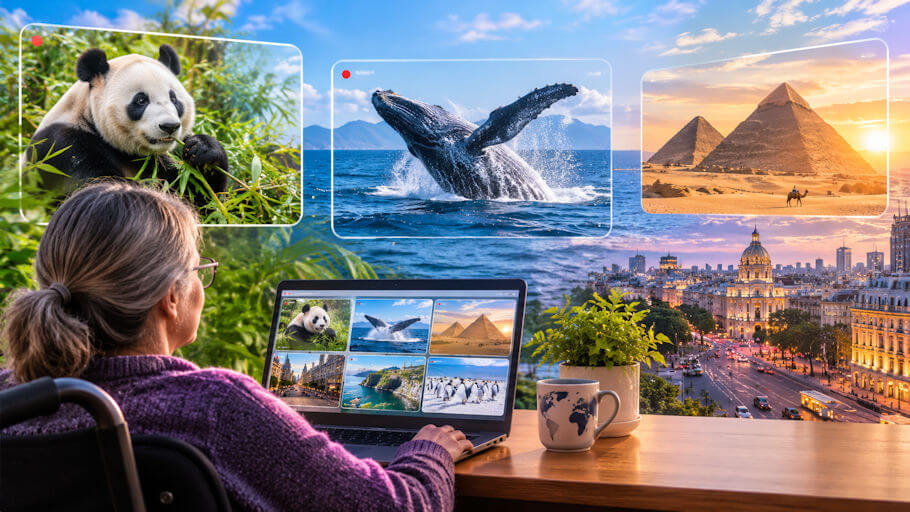
Live webcams let you watch animals, natural wonders and busy city streets around the world as they happen, on a computer, tablet, phone or smart TV. For people with health conditions or mobility limitations that make long-distance travel difficult, a good webcam can be a window onto places they may never get to visit in person.
Webcam watching is also an easy, low-cost hobby. It can be relaxing, educational and a pleasant way to pass the time, and the best cams are run by zoos, aquariums, national parks and science agencies that know their subjects well.
Using streaming video you can watch giant pandas, brown bears and sea otters at some of the best-known zoos, parks and aquariums, see rides at Disneyland on cam, watch Old Faithful erupt in Yellowstone, or look down on Earth from the International Space Station, all in real time.
The webcams below were checked in November 2026. Cams go offline for maintenance, seasonal closures and technical problems, so if a feed is dark, try again later or check the host's website for its schedule.
Animal Cams
- Smithsonian's National Zoo Giant Panda Cam: The giant panda cam in Washington, DC, follows Bao Li, a male born August 4, 2021, and Qing Bao, a female born September 12, 2021. The pair arrived from China on October 15, 2024, and made their public debut on January 24, 2025, after the Zoo's previous pandas, Mei Xiang, Tian Tian and their cub Xiao Qi Ji, returned to China on November 8, 2023 [Smithsonian's National Zoo and Conservation Biology Institute, 2026]. The Zoo also runs elephant, lion, cheetah and naked mole-rat cams [Smithsonian's National Zoo and Conservation Biology Institute, n.d.].
- San Diego Zoo and Safari Park Cams: The San Diego Zoo streams giant panda, koala, baboon, polar bear, penguin, hippo and ape cams, while its Safari Park adds tiger, elephant, platypus, giraffe, burrowing owl and California condor cams. Animals may be out of view when they are in indoor areas or out of frame [San Diego Zoo Wildlife Alliance, n.d.].
- Monterey Bay Aquarium Live Cams: Eleven cams show sea otters, penguins, jellies, sharks, a kelp forest, a coral reef, an aviary and open-ocean animals from tuna to turtles, plus a view of Monterey Bay itself. Most are live from 7 a.m. to 7 p.m. Pacific Time [Monterey Bay Aquarium, n.d.].
- Katmai Bearcams: Katmai National Park and Preserve in Alaska and explore.org run cameras at Brooks Falls, at the outlet of the Brooks River, near the summit of Dumpling Mountain and underwater, giving a close look at brown bears fishing for salmon [National Park Service, 2021].
- WildEarth: This network broadcasts live African safari experiences around the clock, with expert guides narrating from what it calls the world's largest virtual safari vehicle [WildEarth, n.d.].
- Cornell Lab Bird Cams: The Cornell Lab of Ornithology streams bird feeder cams, including the Cornell Feeders, the Ontario FeederWatch Cam and the Panama Fruit Feeder Cam, where visitors such as Pileated Woodpeckers and Common Ravens turn up [Cornell Lab of Ornithology, n.d.].
Webcam Directories and Networks
If you would rather browse than bookmark individual cams, these networks gather many feeds in one place.
- EarthLive.TV: Launched in January 2026, EarthLive.TV brings together more than 500 live nature and wildlife webcams from over 70 countries, including zoo and aquarium cams, along with original stories about the animals and places on screen [EarthLive.TV, n.d.]. Its directory layout makes it easy to jump between continents and species.
- Explore.org: Explore describes itself as the world's leading philanthropic live nature cam network and runs dedicated channels for bears, oceans, eagles and Africa [Explore.org, n.d.].
Scenic Cams
- Old Faithful and Upper Geyser Basin Livestream: Yellowstone National Park's webcams include a livestream of Old Faithful and the Upper Geyser Basin, operated with the help of volunteers and a grant from Canon USA through Yellowstone Forever. The park also posts still images from its North, West and East entrances, Mammoth Hot Springs and Mount Washburn [National Park Service, n.d.].
- Hawaiian Volcano Observatory Webcams: The U.S. Geological Survey's volcano webcams watch Kilauea and Mauna Loa on the Island of Hawaii, including a live view into Halema'uma'u crater at the summit of Kilauea and thermal cameras that show heat the eye cannot see [U.S. Geological Survey, n.d.].
- Earth From the International Space Station: NASA streams live video of Earth from an external high-definition camera mounted on the International Space Station. It follows the High Definition Earth Viewing experiment, which ran from April 30, 2014, to August 22, 2019 [National Aeronautics and Space Administration, n.d.]. The screen goes dark as the station passes into night and the feed occasionally pauses for technical resets.
Street and Traffic Cams
- Times Square: EarthCam streams New York City's Times Square in 4K, with aerial views of the crowds and traffic below and a well-known street-level camera with audio [EarthCam, n.d.].
Interactive Webcams
The early remote-controlled cams that let visitors steer cameras, drive toy cars or switch on appliances in strangers' homes have largely disappeared. Today, interaction is more about taking part. Many cams stream on YouTube, where viewers share sightings in the live chat, and a few invite you into the picture.
- Abbey Road Crossing Cam: Abbey Road Studios streams the London zebra crossing made famous by the Beatles' 1969 album cover. If you visit, you can wave to the camera from the crossing and check your footage later [Abbey Road Studios, n.d.].
Tips for Accessible Webcam Viewing
Most webcams play in an ordinary web browser or the YouTube app, so they work with the tools many people already use. Live video players vary in how well they support screen readers and keyboard navigation, a common website accessibility problem, so it is worth trying more than one way to watch.
- Use full-screen mode or your browser's zoom to enlarge the picture for low vision.
- Live feeds rarely have captions or audio description, so cams with natural sound, such as the Times Square street camera, can suit people who are blind or have low vision.
- Check the time zone. Many zoo and aquarium cams run only during daytime hours where the animals live, so an early morning on the East Coast is too early for a California cam.
- Smart TVs and streaming devices can be easier to use than a mouse or small touchscreen for people with limited hand dexterity.
- Watching together in a senior living community, hospital or classroom can turn a webcam into a shared, calming activity.
Frequently Asked Questions
Are live animal webcams free to watch?
Most webcams run by zoos, aquariums, national parks and government agencies are free to watch in a web browser or on YouTube. Some organizations show short ads or ask for voluntary donations to cover camera and streaming costs, and a few premium services charge for extra features.
What is the best time of day to watch wildlife webcams?
Many wild animals are most active around dawn and dusk, so early morning and late afternoon at the camera location are often the best times. Work out the local time where the camera is, since a sunrise in Africa or Alaska may fall in the middle of your night.
How much internet data does watching a live webcam use?
Data use depends on the video quality, and high-definition or 4K streams use far more than standard quality. If you are on a mobile plan or a capped home connection, lowering the quality setting in the video player can cut data use a great deal.
Can watching nature webcams help with stress or anxiety?
Many viewers find slow, natural scenes such as fish in a kelp forest or birds at a feeder calming and pleasant. Webcams can be a helpful part of a daily routine, but they are not a substitute for professional care if stress or anxiety is affecting your health.
Are live webcams suitable for people living with dementia?
Gentle scenes with slow movement and soft natural sound often work well, and watching together can spark conversation and reminiscence. Avoid busy or noisy feeds that may cause confusion or distress, and check with the person's care team about what suits them best.
What if I miss something exciting on a webcam?
Many hosts post highlight clips of births, hunts and other big moments on their websites and social media channels. Some live streams on YouTube also let you rewind a short way, so you can catch up on recent action without waiting for a highlight video.
How can teachers use live webcams in the classroom?
Teachers use webcams for observation journals, lessons on animal behavior and habitats, geography and time zones, and even weather and volcano science. Students who cannot go on field trips because of disability or illness can join in on equal terms, since everyone sees the same live view.
Can I set up my own webcam and share it with the public?
Yes, a home security camera or webcam can be streamed through services such as YouTube, and some webcam directories, including EarthLive.TV, list outside cameras for free. Before going live, make sure you have permission to film the area and avoid showing private property, neighbors or people who have not agreed to appear.
References
- Abbey Road Studios. (n.d.). Abbey Road crossing cam. Retrieved November 13, 2026.
- Cornell Lab of Ornithology. (n.d.). Bird cams. All About Birds. Retrieved November 13, 2026.
- EarthCam. (n.d.). Times Square North 4K. Retrieved November 13, 2026.
- EarthLive.TV. (n.d.). About us. Retrieved November 13, 2026.
- Explore.org. (n.d.). Live cams. Retrieved November 13, 2026.
- Monterey Bay Aquarium. (n.d.). Live cams. Retrieved November 13, 2026.
- National Aeronautics and Space Administration. (n.d.). High Definition Earth Viewing (HDEV). Earth Science and Remote Sensing Unit, NASA Johnson Space Center. Retrieved November 13, 2026.
- National Park Service. (2021). Watch the Katmai bearcam. U.S. Department of the Interior.
- National Park Service. (n.d.). Webcams - Yellowstone National Park. U.S. Department of the Interior. Retrieved November 13, 2026.
- San Diego Zoo Wildlife Alliance. (n.d.). Live cams. Retrieved November 13, 2026.
- Smithsonian's National Zoo and Conservation Biology Institute. (2026). Giant panda program media resources. Smithsonian Institution.
- Smithsonian's National Zoo and Conservation Biology Institute. (n.d.). Giant panda cam. Smithsonian Institution. Retrieved November 13, 2026.
- U.S. Geological Survey. (n.d.). Webcams - Hawaiian Volcano Observatory. U.S. Department of the Interior. Retrieved November 13, 2026.
- WildEarth. (n.d.). WildEarth: Live African safari. Retrieved November 13, 2026.
More on this topic: Recreation and Entertainment, Hobbies and Disability Travel.
Insights, Analysis, and Developments
Editorial Note: Webcam lists age quickly. The remote-controlled cams and novelty feeds of the early internet have mostly vanished, and the cams that last tend to be the ones run by zoos, aquariums, national parks and science agencies with a reason to keep them going. For people who are homebound, live with chronic illness or simply cannot manage a long trip, that reliability matters - a bear catching salmon in Alaska or lava glowing in a Hawaiian crater is just as real on a living room screen. The main gaps are accessibility ones: live feeds seldom carry captions or audio description, and many cams only run in daylight hours where the animals live, so a little planning around time zones and viewing tools goes a long way.
 Author Credentials: Ian C. Langtree is a writer, editor, and the founder and Editor-in-Chief of Disabled World, which he established in 2004 as one of the longest-running independent resources for disability news and information. Over more than two decades, he has written and edited thousands of articles on disability rights, health, accessibility, and assistive technology. Drawing on a global perspective shaped by extensive travel and lived experience, Ian is a committed advocate of the Social Model of Disability, the framework developed by disabled activists in the 1970s that focuses on removing societal barriers rather than on individual impairments. His writing is grounded in that framework and in a lasting commitment to disability rights, accessibility, and social inclusion. To learn more about Ian's background, expertise, and accomplishments, visit his full biography.