DVPRS 2.0 Pain Scale Chart: Military & Veteran Pain Tool
Author: Ian C. Langtree - View Credentials
Published: 12 Mar 2020 - Updated: 27 Aug 2026
Publication Type: Charts, Graphs, Tables
Table of Contents:
Synopsis - Definition - Overview - FAQs - Insights, Updates - Related Content
Synopsis
This information explains the Defense and Veterans Pain Rating Scale (DVPRS 2.0), a validated clinical pain assessment instrument enhanced with numerical ratings, color coding, functional word descriptors, and pictorial facial expressions to improve communication about pain intensity and effects. Based on psychometric testing with active duty service members and veterans, it demonstrates strong reliability and agreement among raters, and is widely adopted within U.S. clinical settings to assess both acute and chronic pain and its interference with activity, mood, sleep, and stress. The structured scale aids clinicians and patients, including older adults and people with disabilities, by offering a standardized language to describe pain severity and functional impact that goes beyond simple numeric scores.
At a Glance
- 1 - The DVPRS uses a traffic-light color code: green for mild, yellow for moderate, and red for severe pain.
- 2 - Psychometric testing drew on data from 307 active duty service members and veterans with acute or chronic pain.
- 3 - In one study, 70.9 percent of participants felt the DVPRS 2.0 was superior to other pain rating scales they had used.
- 4 - In 2006 alone, 743,547 injury-related musculoskeletal conditions were reported among service members, with 82 percent tied to inflammation and pain from exertional overuse.
Topic Definition
- Defense and Veterans Pain Rating Scale
The Defense and Veterans Pain Rating Scale is a standardized clinical tool that helps service members, veterans, and their care teams put a clear, shared value on how much pain a person is feeling and how far it reaches into daily life. Rather than relying on a bare number from zero to ten, it pairs each rating with a plain-language description, a color band, and a facial expression, so patients who struggle to describe discomfort in words still have a way to communicate it accurately. It also asks a short set of follow-up questions about how pain has affected activity, mood, sleep, and stress over the past day, giving clinicians a fuller picture of a patient's functional status. Developed for military medicine and now common in Veterans Health Administration settings, the scale was built to keep pain assessment consistent as patients move between providers and stages of care.
Overview
Understanding How the DVPRS 2.0 Improves Pain Communication in Military Care
Pain remains a significant health problem among active duty service members. Pain states often experienced by military populations include musculoskeletal pain, specifically low back pain and joint pain, headaches, and acute and chronic pain from combat injuries. In 2006 alone, 743,547 injury-related musculoskeletal conditions were reported among military service members with 82% attributed to inflammation and pain from exertional overuse
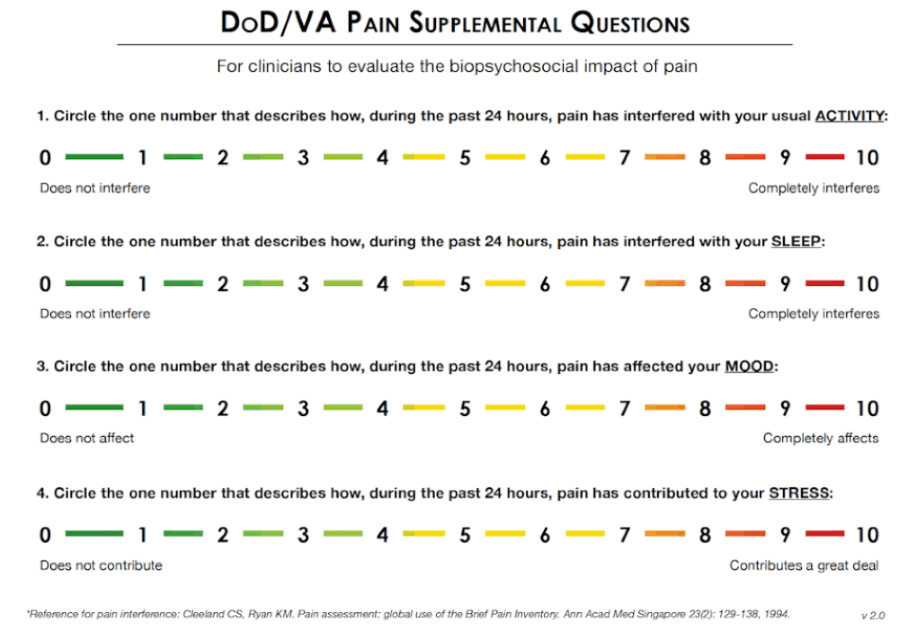
To leverage the best available evidence, clinical expertise, and collaboration to develop and communicate consensus recommendations in support of Air Force, Army, Navy, and VHA pain management practice, education, and research, four supplemental questions measure how much pain interferes with usual activity and sleep, and affects mood and contributes to stress.
Defense and Veterans Center for Integrative Pain Management (DVCIPM)
- Pain Research: Defense and Veterans Center for Integrative Pain Management (DVCIPM) conducts research on pain management, treatment, tracking and impact.
- Pain Education and Training: DVCIPM collaborates with clinicians, researchers, and subject matter experts across DoD, VA, and civilian medicine to develop and disseminate pain management education and training content.
- Clinical Pain Medicine: DVCIPM fosters the development of innovative pain treatments. Our goal is to advance resources that will aid the diagnosis and treatment of pain, and make them readily available to the Soldier, Sailor, Airman, Marine, and Veteran.
U.S. Defense and Veterans Pain Rating Scale (DVPRS 2.0)
The U.S. Defense and Veterans Pain Rating Scale (DVPRS 2.0) is a pain assessment tool that utilizes a numerical rating scale enhanced by functional word descriptors, color coding, and pictorial facial expressions matched to pain levels. The DVPRS 2.0 is a reliable and valid instrument that provides standard language and metrics to communicate pain and related outcomes.
The Defense and Veterans Pain Rating Scale, DVPRS, was originally created in 2010 to increase understanding of pain intensity levels among military personnel and veterans experiencing acute or chronic pain. It was also developed to improve communication and documentation during transitions in care of military personnel and veterans. While it includes a numerical scale, it also includes functional word descriptors, color coding and pictures of facial expressions to describe pain levels. Additional questions are included to gather more information about how pain affects everyday activities, such as sleep and mood.
The DVPRS 2.0 has proven to be a reliable, valid and all-encompassing tool for veterans and military personnel alike. While the focus of the scale is for assessing pain levels, it also measures other health factors, such as sleep, mood and stress. Although it is a fairly new pain scale, it has been widely accepted and used in U.S. Veterans Health Administration (VA) hospitals.
Psychometric testing was performed on a revised using data from 307 active duty service members and Veterans experiencing acute or chronic pain. A new set of facial representations designating pain levels was tested. Results demonstrated acceptable internal consistency reliability (Cronbach's alpha = 0.871) and test-retest reliability (r = 0.637 to r = 0.774) for the five items. Excellent inter-rater agreement was established for correctly ordering faces depicting pain levels and aligning them on the pain intensity scale (Kendall's coefficient of concordance, W = 0.95 and 0.959, respectively). Construct validity was supported by an exploratory principal component factor analysis and known groups validity testing. Most participants, 70.9%, felt that the DVPRS 2.0 was superior to other pain rating scales.
Measuring Pain Level with DVPRS 2.0 - How Does the DVPRS 2.0 Scale Work?
The DVPRS 2.0 is a graphic tool clinicians can use to facilitate self-reported pain diagnoses from patients. Look at the Defense and Veterans Pain Rating Scale below and read the descriptions under each number. Please rate the severity of your current pain by circling the corresponding number (0-10). The DVPRS 2.0 also includes an additional visual tool: facial expressions that correspond with each number. The faces range from a full happy face representing a pain level of zero to a grimacing face representing a pain level of 10.
The DVPRS 2.0 consists of a basic traffic-light color code:
- Green : Represents mild pain with a scale ranging from 0-4
- Yellow : Represents moderate pain with a scale ranging from 5-6
- Red : Represents severe pain with a scale ranging from 7-10
DVPRS 2.0 Numerical Pain Scale and Descriptors
Word descriptors are attached to each number on the DVPRS 2.0:
| 0 | No pain |
| 1 | Hardly noticeable pain |
| 2 | Noticeable pain, but does not interfere with activities |
| 3 | Somewhat distracting pain |
| 4 | Distracting pain, but does not affect normal activities |
| 5 | Pain interrupts some activities |
| 6 | Hard to ignore pain, avoidance of daily activities |
| 7 | Pain is the main focus of attention, prevents daily activities |
| 8 | Awful pain, difficult to do anything |
| 9 | Unbearable pain, cannot do anything |
| 10 | As bad as pain can be, nothing else matters |
DVPRS Additional Questions
Four supplemental questions are included in the DVPRS to help identify how pain affects an individual's lifestyle. These questions also include a numerical scale that ranges from zero to 10 for each question.
- Circle the number that describes how pain has interfered with daily activity during the past 24 hours.
- Circle the number that describes how the pain has affected mood during the past 24 hours.
- Circle the number that describes how the pain has interfered with sleep during the past 24 hours.
- Circle the number that describes how the pain has contributed to stress during the past 24 hours.
The Defense and Veterans Pain Rating Scale Chart

DOD/VA Pain Supplemental Questions
View and download a printable PDF of the DVPRS 2.0 Pain Scale Chart.
References:
*National Center for Biotechnology Information, U.S. National Library of Medicine, National Institutes of Health, National Center for Biotechnology Information, U.S. National Library of Medicine, National Institutes of Health.
Frequently Asked Questions
Who developed the DVPRS and which agencies use it?
The scale was created within U.S. military medicine and is supported by the Defense and Veterans Center for Integrative Pain Management, which collaborates across the Air Force, Army, Navy, and the Veterans Health Administration. It is now widely used in VA hospitals to keep pain assessment consistent across the Department of Defense and VA systems.
Can civilians or non-military patients use the DVPRS 2.0?
While the tool was designed and validated with active duty service members and veterans, its structure of numbers, colors, word descriptors, and faces can be useful for many patient groups. Any use outside its tested population should be guided by a qualified clinician who can interpret the results appropriately.
How is the DVPRS different from a standard 0 to 10 pain scale?
A standard numeric scale asks only for a single number, while the DVPRS 2.0 pairs each number with a plain-language descriptor, a color band, and a matching facial expression. It also adds four supplemental questions about function, which gives a fuller picture than a lone score can provide.
What does the color coding on the DVPRS 2.0 mean for treatment?
The green, yellow, and red bands offer a quick visual sense of whether pain is mild, moderate, or severe, helping both patient and clinician gauge urgency at a glance. The colors are a communication aid and do not replace a clinician's judgment about the right course of care.
How often should the DVPRS 2.0 be used to track pain?
Because the supplemental questions ask about the past 24 hours, the tool is well suited to regular check-ins such as daily or at each clinical visit. Repeated use over time helps reveal trends in pain intensity and its effect on activity, mood, sleep, and stress.
Is the DVPRS 2.0 suitable for patients who have trouble speaking or reading?
The facial expressions and color cues give non-verbal ways to point to a pain level, which can help patients who find words difficult. A caregiver or clinician can assist by reviewing the faces and descriptors together to confirm the choice reflects the patient's experience.
Is the DVPRS 2.0 free to view and download?
The scale is published as a chart that can be viewed and printed for reference, and this page offers a printable version of the DVPRS 2.0 pain scale. Anyone planning to use it in a formal clinical setting should confirm current guidance with their health care provider or facility.
Insights, Analysis, and Developments
Editorial Note: The DVPRS 2.0 represents a clinically meaningful enhancement over traditional numeric pain scales by integrating descriptive labels, visual cues, and supplemental impact questions that reflect real-world functional status. Its evidence-based reliability and practical adoption in healthcare settings support its role as a valuable tool for assessing complex pain experiences and aligning care decisions with patient-reported outcomes, particularly for populations where standard pain rating scales may fall short.
 Author Credentials: Ian C. Langtree is a writer, editor, and the founder and Editor-in-Chief of Disabled World, which he established in 2004 as one of the longest-running independent resources for disability news and information. Over more than two decades, he has written and edited thousands of articles on disability rights, health, accessibility, and assistive technology. Drawing on a global perspective shaped by extensive travel and lived experience, Ian is a committed advocate of the Social Model of Disability, the framework developed by disabled activists in the 1970s that focuses on removing societal barriers rather than on individual impairments. His writing is grounded in that framework and in a lasting commitment to disability rights, accessibility, and social inclusion. To learn more about Ian's background, expertise, and accomplishments, visit his full biography.