Modular One-Handed Gaming Controller for PlayStation and PC
Author: eDimensional and BenHeck
Published: 9 Feb 2010 - Updated: 31 Jan 2026
Publication Type: Product Release, Update
Table of Contents:
Synopsis - Overview - Insights, Updates - Related Content
Synopsis
This product announcement details the Access Controller, a specialized gaming peripheral developed by Benjamin Heckendorn and manufactured by eDimensional that addresses a significant gap in accessible gaming technology. The controller's patented modular design separates each standard gamepad function - analog sticks, D-pad, shoulder buttons, and action buttons - into individual removable components that users can position according to their physical needs or gaming preferences. Veterans and gamers with upper limb disabilities have found the concave, table-stable design particularly valuable for maintaining independence in gaming, which many describe as vital for mental health recovery and social connection. The manufacturer donates a portion of proceeds to Children's Hospital and Veterans Affairs Medical Centers, reinforcing the product's therapeutic and rehabilitative value beyond entertainment.*
Overview
Unique New Playstation & PC Controller Allows for One-Handed Use for Those with Disabilities.
eDimensional, Inc., a developer and manufacturer of innovative gaming accessories has just released the innovative new Access Controller, designed by renowned modder and Games for Health Convention keynote speaker Benjamin Heckendorn (also known as BenHeck).
The Access Controller features a patented new modular control design; each control function found on a regular gamepad (including analog sticks, D-Pad, shoulder buttons, action buttons, etc.) is accessible and built into its own slot and positioned in the layout of a hand.
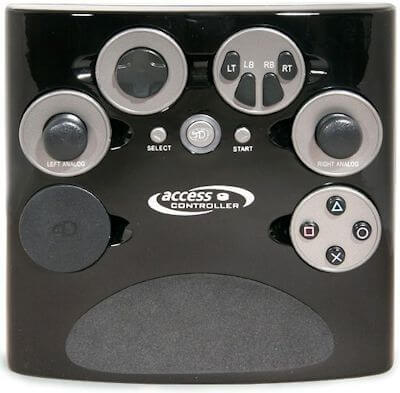
Additionally, each module can easily be removed and rearranged to suit any gaming style or need.
The concave design rests comfortably on a leg or a table and provides proper balance and resistance for optimal responsiveness.

Reviewers Statements
Disabled gamer James Mannhalter of Alabama said,
"Video games became a way for me to escape the pain of my injuries, the grueling horror of my recovery, and the depression that sometimes comes with a life long disability...Gaming can be very important for someone like me."
Echoes Michael L.;
"I am in the Army and have served over in Iraq 3 times. During my 3rd tour, I was struck by a 400 lb. IED, leaving me without a left hand and right thumb, along with 39% of my body burned. I love to play video games, but haven't been able to since the accident."
eDimensional CEO Michael Epstein says;
Gamers contacting us from around the world have opened our eyes to an overwhelming need for gaming accessories suitable for those with disabilities or physical limitations. We could not be more pleased to team up once again with Ben to make his vision of a readily-available single-handed controller a reality. It has become a mission for our company and a truly rewarding experience that we are fortunate to be a part of."
"The Access Controller is also great for any gamer who wants the convenience of being able to reconfigure the controls to suit their specific RPG or FPS gaming style, arcade-style gaming, or those who like to multi-task while gaming.
A portion of all proceeds from the sale of Access Controllers will benefit Children's Hospital and Veterans Affairs Medical Centers.
Insights, Analysis, and Developments
Editorial Note: The Access Controller represents an important step toward inclusive game design, yet its existence highlights how mainstream manufacturers have historically overlooked gamers with disabilities - a demographic estimated at hundreds of millions worldwide. While third-party solutions like this modular controller fill critical accessibility gaps, the gaming industry still needs pressure to integrate adaptive features directly into standard hardware and software development. Products designed specifically for disability communities often benefit all users through improved ergonomics and customization, a principle known as universal design that the broader tech industry would do well to adopt more consistently.*
Attribution/Source(s): This quality-reviewed publication was selected for publishing by the editors of Disabled World (DW) due to its relevance to the disability community. Originally authored by eDimensional and BenHeck and published on 9 Feb 2010, this content may have been edited for style, clarity, or brevity.
* Editorial additions by Ian C. Langtree.