Sonar Glasses: Head-Level Obstacle Detection for Blind Users
Author: Maggie McBride, Communications and Administrative Specialist G-Technology Group
Published: 13 Jul 2016 - Updated: 8 Nov 2026
Publication Type: Product Release, Update
Table of Contents:
Synopsis - Definition - Overview - FAQs - Insights, Updates - Related Content
Synopsis
This product, Sonar Glasses from G-Technology Group, is a pair of eyeglasses with an ultrasonic sensor in the frame that warns blind and visually impaired wearers of obstacles ahead, mainly at head and chest height, with a vibration near the temple or a sound. It explains why overhanging hazards such as branches, signs and open doors are missed by a white cane, how the adjustable detection range works, what comes with the glasses, and what an independent review by the American Foundation for the Blind found about their usefulness and limits. It also places the glasses among other electronic travel aids, such as smart canes, and gives practical tips for choosing and paying for an obstacle detection device, which makes it useful for people with vision loss, families and orientation and mobility specialists.*
At a Glance
- 1 - The glasses are not designed to be used in the rain.
- 2 - A Basic model has a fixed detection range of 6 feet.
- 3 - Two rechargeable batteries let one charge while the other is in use.
- 4 - An orientation and mobility specialist can help decide whether an electronic travel aid suits your needs and routes.
Topic Definition
- Electronic Travel Aid
An electronic travel aid is a device that helps people who are blind or have low vision detect obstacles or find their way, usually by using ultrasonic, infrared, laser or camera sensors and giving feedback through vibration or sound. Examples include sensor glasses, smart canes and wrist-worn detectors, which are used alongside a white cane or guide dog rather than in place of them.
Overview
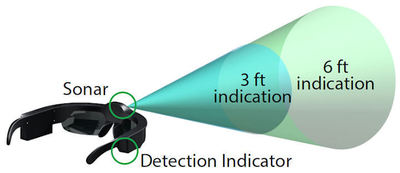
Sonar Glasses, made by G-Technology Group in the United States, are eyeglasses with a small ultrasonic sensor in the middle of the frame that warns blind and visually impaired wearers about obstacles ahead, mainly at head and chest height. When the sensor detects an object within its range, the glasses give a gentle vibration near the right temple, or a sound on some models. They were introduced in 2016 as an extra layer of protection alongside a white cane or guide dog, not as a replacement for either.
Why Head-Level Obstacles Are a Problem
A white cane is swept along the ground and finds steps, curbs and objects in the walking path, but it cannot detect things that stick out above waist height, such as tree branches, open cabinet doors, signs, truck mirrors and low ceilings or stair undersides. A guide dog will usually steer around such hazards, but many people who are blind or have low vision do not use a dog. Head and chest injuries from these overhanging obstacles are a common complaint, which is why a range of electronic travel aids have been developed to fill the gap.
How Sonar Glasses Work
The sensor sends out ultrasonic pulses and measures how long their echoes take to return, in the same way a bat or a boat's sonar does. On the standard model the wearer can set the detection range to 3, 6 or 9 feet: a shorter range suits busy indoor spaces, while a longer range gives faster walkers more warning outdoors. A Basic model has a fixed range of 6 feet. Buyers can choose whether the alert is a silent vibration or a sound [Ingber, 2016].

Features and What Comes in the Box
- Lens choices of clear, dark, photosensitive (darkening in sunlight) or prescription, with UV protection on clear and dark lenses.
- Two rechargeable lithium-ion batteries and a charger, so one battery can charge while the other is in use.
- Ear locks to help keep the glasses in place while walking.
- A one-year warranty and a satisfaction guarantee, according to the maker.

What an Independent Review Found
A review by AccessWorld, the technology magazine of the American Foundation for the Blind, concluded that Sonar Glasses can be a useful mobility tool for some people who are blind or visually impaired, but stressed that they are not a replacement for a white cane or guide dog. The reviewer would have liked better accuracy, noted that the glasses are not designed to be used in the rain, and reported that the company offered free setup help by phone and free frame adjustments by mail [Ingber, 2016]. You can read the full AccessWorld review of Sonar Glasses.
Other Electronic Travel Aids
Sonar Glasses are one of several electronic travel aids that use ultrasonic or other sensors to detect obstacles. Others include smart canes with sensors built into the handle, such as the UltraCane and WeWALK, and wrist-worn devices that vibrate when something is close. Researchers have also tested camera-based glasses that describe surroundings using artificial intelligence. Studies suggest these devices can detect many overhanging obstacles a cane would miss, but none detects everything, and adoption has remained limited because of cost, training needs and reliability. Smartphone apps for navigation and object recognition are now another common option. See more smart cane designs.
Tips Before Buying an Obstacle Detection Device
- Keep using your white cane or guide dog; sensors add information but cannot replace basic mobility skills.
- Ask an orientation and mobility specialist whether the device suits your vision, hearing, walking speed and usual routes.
- Check battery life, weather resistance, the return policy and how easily you can get support or repairs.
- Ask whether your state vocational rehabilitation agency, a veterans program or a charity can help with the cost.
- Practice in familiar, safe places first, and check that vibration or sound alerts do not mask other important cues, such as traffic noise.
Learn more in our section on vision disability.
More on this topic: Visual Aids Publications - Vision Loss Publications - Robotics Publications
Frequently Asked Questions
NOTE: Researched FAQs by Disabled World (DW)
Can Sonar Glasses replace a white cane?
No. They are designed to warn of obstacles at head and chest height and should be used together with a white cane or guide dog, which detect steps, curbs and ground-level hazards.
Do sonar glasses detect stairs and curbs?
Head-mounted sensors are aimed forward and are not designed to detect drop-offs such as stairs, curbs and holes, which is another reason to keep using a cane.
Can people with partial sight use sonar glasses?
Yes. Prescription or tinted lenses can be fitted, so people with some remaining vision can use the glasses while also getting obstacle warnings.
Will the vibration distract me from traffic sounds?
A vibration alert leaves the ears free for traffic and other sounds, which is why many users prefer it to audio alerts.
Who pays for electronic travel aids?
Funding may be available from state vocational rehabilitation agencies, veterans benefits, charities or some employers, but health insurance rarely covers these devices.
What is an orientation and mobility specialist?
An orientation and mobility specialist is a trained professional who teaches people with vision loss to travel safely and independently, including cane skills and use of technology.
Do smart glasses with cameras help blind people?
Some camera-based smart glasses can read text, describe scenes and identify objects, which can help with daily tasks, though they are not obstacle detectors in the same way.
How long does it take to get used to an obstacle detection device?
Most people need practice over days or weeks to learn how alerts relate to real distances, ideally starting in familiar, safe places.
References
- Ingber, J. (2016). A review of Sonar Glasses from G-Technology Group. AccessWorld, 17(8). American Foundation for the Blind.
Insights, Analysis, and Developments
Editorial Note: Overhanging obstacles are one of the everyday hazards that a white cane cannot solve on its own, and devices like Sonar Glasses show how simple sensors can add a useful warning at head height. The independent review is a fair reminder, though, that these tools are aids rather than answers: accuracy, weather resistance, battery life and cost all matter, and no sensor replaces cane skills or a guide dog. People with vision loss weighing an electronic travel aid should try it with an orientation and mobility specialist, check what support the maker offers, and look into funding through vocational rehabilitation or veterans programs before buying.*
* Editorial additions by Ian C. Langtree.