Xenobots: AI Designed Living Robots From Frog Stem Cells
Author: Ian C. Langtree - Writer/Editor for Disabled World (DW)
Published: 7 Apr 2026 - Updated: 24 Aug 2026
Publication Type: Informative
Table of Contents:
Synopsis - Definition - Overview - FAQs - Insights, Updates - Related Content
Synopsis
They are not metal, they are not coded, and they are not anything nature intended - yet xenobots are alive, they can move, they can heal, and they can even reproduce. First assembled in a university lab in 2020 from the repurposed stem cells of an African clawed frog, these sub-millimeter organisms sit at the strangest intersection of biology, robotics, and artificial intelligence. This paper explores what xenobots are, how they work, and why their future applications in targeted therapy, regenerative medicine, and environmental cleanup could matter enormously to people living with disabilities.
At a Glance
- 1 - When researchers sliced a xenobot nearly in half, it stitched itself back together and kept working within minutes. No conventional machine can repair itself in this way.
- 2 - Evolutionary algorithms running on supercomputers test billions of possible cell arrangements before a single organism is built. Skin cells then supply the frame while cilia or cardiac tissue drive movement.
- 3 - Xenobots reproduce through kinematic self-replication, sweeping loose frog cells into clusters that mature into working offspring. A C-shaped, Pac-Man-like body designed by AI made the process far more efficient.
- 4 - Second generation xenobots carried a fluorescent protein that changed color under blue light, giving researchers a simple readable memory. That marker let the team trace exactly where each organism had traveled during an experiment.
Topic Definition
- Xenobots
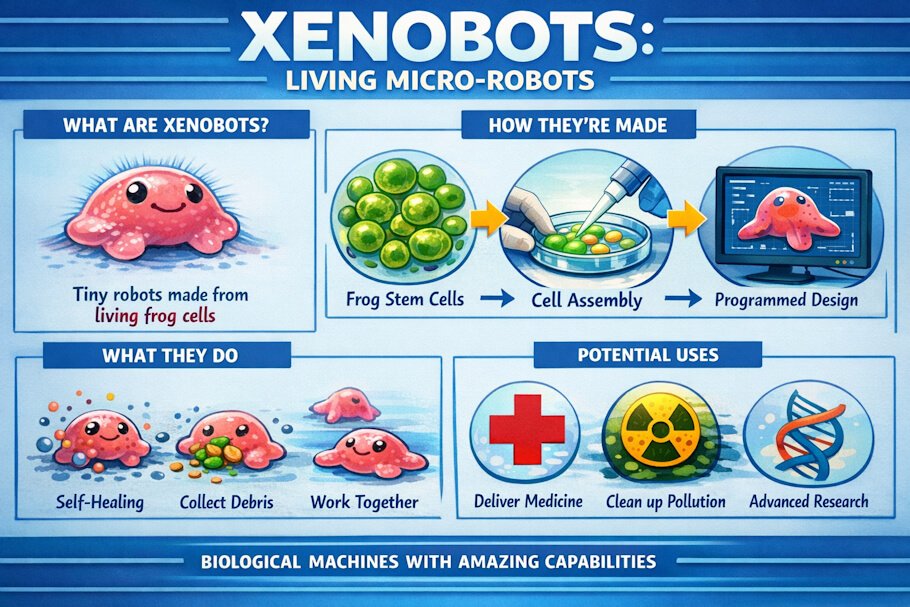
Xenobots are programmable, living organisms - typically less than a millimeter wide - that are designed by artificial intelligence and assembled from stem cells harvested from embryos of the African clawed frog, Xenopus laevis. First created in 2020 by researchers at the University of Vermont and Tufts University, they are built entirely from biological cells with no genetic modification, using skin cells for structure and heart muscle cells or cilia for movement. Xenobots can navigate aqueous environments, carry microscopic payloads, work collectively in swarms, heal themselves after injury, and even reproduce through a unique process of gathering loose cells into new functional organisms. They are fully biodegradable, require no external power source, and break down harmlessly into dead skin cells within roughly seven to ten days. Neither traditional robots nor naturally occurring life forms, xenobots occupy a novel category that researchers describe as living machines - and their potential applications span targeted drug delivery, tissue regeneration, environmental remediation, and the broader study of how cells cooperate to build complex biological structures.
Overview
Xenobots - From Frog Cells to Living Robots
Somewhere between biology and engineering, a strange new creation is quietly rewriting what we thought we knew about life, machines, and the line between the two. Xenobots are not the metallic, bolt-and-gear robots of science fiction. They are tiny, living organisms - less than a millimeter wide - assembled from the stem cells of the African clawed frog, Xenopus laevis. Since their debut in 2020, they have captured the imagination of scientists, ethicists, and the public alike. But beyond the headlines, xenobots carry real and tangible implications for medicine, environmental science, and perhaps most importantly, for the millions of people worldwide living with disabilities.
What Are Xenobots?
Xenobots are programmable, living organisms designed by artificial intelligence and built from biological cells. They were first created by a team of researchers at the University of Vermont and Tufts University, led by computer scientist Josh Bongard, roboticist Sam Kriegman, and biologist Douglas Blackiston, in collaboration with developmental biologist Michael Levin (Kriegman et al., 2020). Their name comes from the frog species whose cells are used - Xenopus laevis - combined with "bot," short for robot.
The process begins with harvesting stem cells from frog embryos at the blastula stage, when cells still retain the ability to develop into different tissue types. These cells are then separated, incubated, and carefully assembled under a microscope into configurations designed by AI-powered evolutionary algorithms running on supercomputers. The AI tests billions of possible cell arrangements in simulation, searching for body shapes that can perform specific tasks such as locomotion or object transport. Skin cells provide structural support, while heart muscle cells - or, in later versions, cilia - generate movement through rhythmic contraction or coordinated beating (Blackiston et al., 2021).
What makes xenobots distinct from traditional robots is that they are composed entirely of living, organic material. They require no batteries, no wiring, and no external power source. They run on energy stored naturally in their cells and, when their fuel is spent after roughly seven to ten days, they simply break down into dead skin cells and biodegrade harmlessly. They are not genetically modified organisms. Their DNA is entirely that of a normal frog. What changes is the architecture - the way those cells are organized and arranged to produce behaviors that no frog would ever naturally exhibit.
How Xenobots Work
The first generation of xenobots, introduced in a landmark 2020 paper published in the Proceedings of the National Academy of Sciences, moved by using contractions of cardiac muscle cells to propel themselves along the bottom of a petri dish. Researchers found these tiny organisms could push small objects, navigate aqueous environments, and even carry payloads within specially sculpted pouches in their bodies (Kriegman et al., 2020).
The second generation, sometimes called Xenobots 2.0, moved faster and lived longer. Instead of relying on heart muscle, these organisms grew patches of cilia - tiny hair-like structures - that acted as miniature oars, allowing them to swim. They could also self-assemble from single cells without the painstaking microsurgery required for the originals. Perhaps most remarkably, researchers demonstrated a basic form of recordable memory by introducing a fluorescent protein that changed color when exposed to a specific wavelength of blue light. This allowed scientists to track where individual xenobots had traveled during experiments (Blackiston et al., 2021).
In late 2021, the same research team revealed that xenobots could reproduce - but not through any method previously observed in nature. Rather than growing and dividing like cells or budding like some organisms, xenobots engaged in what the researchers called "kinematic self-replication." They gathered loose frog cells floating in their environment, compressed them into small clusters, and those clusters eventually matured into functional offspring capable of repeating the process. AI optimization of the parent xenobot's body shape - notably a C-shaped or Pac-Man-like form - dramatically improved the efficiency of this reproduction (Kriegman et al., 2021).
Why Xenobots Matter for Medicine
The medical possibilities of xenobots, while still largely theoretical, are genuinely compelling. Because they are made from living cells, xenobots are inherently biocompatible and biodegradable. They do not produce the toxic byproducts or pollution associated with synthetic materials like plastics or metals. This makes them attractive candidates for tasks inside the human body where traditional machines would cause immune reactions, contamination, or rejection.
One of the most discussed potential applications is targeted drug delivery. Conventional medications circulate throughout the entire bloodstream, affecting healthy and diseased tissue alike. A xenobot, by contrast, could theoretically be programmed to travel to a precise location within the body and release a therapeutic payload exactly where it is needed. Early experiments already demonstrated that xenobots can be sculpted with small pouches capable of carrying microscopic objects, suggesting a proof of concept for this kind of delivery system (Kriegman et al., 2020).
In a future clinical scenario, xenobots could be grown from a patient's own cells, virtually eliminating the risk of immune rejection. After completing their task, they would naturally degrade within days, leaving behind nothing harmful. Researchers have speculated about applications ranging from clearing arterial plaque to identifying and removing cancerous cells (Solanki et al., 2022).
Xenobots and Disability - A New Frontier
The relationship between xenobots and disability is not immediately obvious, but the connections run deep and have the potential to be transformative. Disabilities - whether physical, neurological, or sensory - frequently involve tissue damage, cellular dysfunction, or the failure of the body's own repair mechanisms. Xenobots, as living machines that interact directly with biological systems, could one day address several of these challenges in ways that current technologies cannot.
Targeted Therapy for Neurological Conditions
Neurodegenerative diseases like Parkinson's disease and Alzheimer's disease involve the progressive loss of specific types of brain cells. Current treatments often rely on systemic medications that come with significant side effects because they affect the entire body rather than just the affected regions. Xenobots, with their potential for precise navigation and targeted payload delivery, could theoretically carry therapeutic agents directly to damaged brain tissue. Because they are biological in nature, they may interact more safely with neural environments than synthetic nanoparticles or implanted devices (Solanki et al., 2022). For the millions of people whose daily lives are shaped by these conditions, the prospect of more effective and less invasive treatment is meaningful.
Regenerative Medicine and Tissue Repair
Many disabilities result from injuries or conditions that damage tissue beyond the body's natural ability to repair it - spinal cord injuries, severe burns, degenerative joint disease, or congenital defects in organ development. Xenobot research contributes directly to the broader field of regenerative medicine by advancing our understanding of how cells cooperate to build and rebuild complex structures. Michael Levin, one of the principal researchers behind xenobots, has described the work as part of a larger effort to crack the "morphogenetic code" - the set of rules that governs how cells organize themselves into functional tissues and organs (Levin, 2021). If researchers can learn to guide cellular self-organization the way they guide xenobot assembly, it could open doors to repairing damaged nerves, growing replacement tissues, or correcting developmental abnormalities.
Assistive Applications Inside the Body
Consider the challenges faced by someone with a chronic condition such as diabetes, where the body fails to properly regulate blood sugar. Future xenobots, equipped with molecular sensors and designed to respond to biochemical signals, might serve as internal monitors that detect dangerous changes in blood chemistry and deliver corrective agents automatically. Similar concepts could apply to autoimmune disorders, chronic pain conditions, or circulatory diseases that contribute to mobility impairments. The key advantage is that xenobots are not foreign objects - they are biological, temporary, and self-disposing, which reduces many of the complications associated with long-term implanted medical devices.
Reducing Barriers to Treatment
People with disabilities often face compounding barriers to medical care, including the physical demands of surgical recovery, the financial burden of repeated treatments, and the risks associated with invasive procedures. A xenobot-based approach to therapy - one that is minimally invasive, biodegradable, and potentially personalized from a patient's own cells - could reduce several of these barriers simultaneously. A treatment that requires no surgical implant, produces no lasting foreign material in the body, and degrades naturally after completing its task represents a fundamentally different model of medical intervention.
Environmental Remediation and Accessibility
Xenobots also have potential environmental applications that connect indirectly to disability. Researchers have observed that swarms of xenobots tend to collectively push loose particles into central piles, suggesting that future versions might be deployed to gather ocean microplastics or detect and aggregate radioactive contaminants (Ball, 2020). Environmental pollutants disproportionately affect people with disabilities and chronic health conditions. Cleaner environments mean fewer exacerbating factors for respiratory diseases, fewer neurotoxic exposures, and healthier communities overall. While this link is indirect, it is worth noting that advances in living-machine technology could have broad public health implications.
Self-Repair and What It Teaches Us
One of the most striking features of xenobots is their ability to heal themselves. When researchers cut a xenobot nearly in half, it stitched itself back together and continued functioning within minutes (Blackiston et al., 2021). This capacity for self-repair is something that no conventional machine can replicate and something that many human tissues struggle to achieve after injury. Studying how xenobots accomplish this repair at the cellular level may yield insights applicable to wound healing, nerve regeneration, and the recovery of function after traumatic injury. For people living with disabilities that result from tissue damage - whether from stroke, accident, or disease - understanding the mechanisms of biological self-repair is not an abstract academic exercise. It is directly relevant to their quality of life.
Ethical Considerations
Any discussion of xenobots would be incomplete without addressing the ethical questions they raise. Are xenobots alive? Are they machines? Do they have moral status? These are not settled questions, and researchers themselves disagree on the answers. The organisms are made entirely of living cells, they move autonomously, they can heal, and they can reproduce in a limited fashion. Yet they have no brain, no nervous system, and no capacity for sensation or experience as far as current science can determine.
There are also practical concerns. If xenobots were ever developed for use inside the human body, rigorous testing would be needed to ensure they behave predictably and safely. The use of frog embryos as source material raises questions about animal welfare. And as with any powerful new technology, there is the potential for misuse - applications in surveillance, biological weapons development, or unregulated experimentation. Researchers including the xenobot team have called for proactive ethical oversight, suggesting that applied ethicists should be involved in the development process from the outset (Kriegman et al., 2020).
For the disability community specifically, ethical considerations include ensuring equitable access to any therapies that emerge from this research, avoiding the framing of disability as something that universally requires a "fix," and centering the voices of disabled people in decisions about how these technologies are developed and deployed.
The Road Ahead
Xenobot research is still in its early stages. No xenobot has been tested inside a living animal, let alone a human patient. The organisms remain laboratory tools, primarily used to study how cells communicate, cooperate, and organize. But the trajectory of the research is clear: each successive generation of xenobots has been more capable, more autonomous, and more biologically sophisticated than the last.
The combination of AI-driven design and biological construction represents a genuinely new approach to engineering. It is not robotics in the traditional sense, and it is not genetic engineering either. It occupies a novel space - one that Michael Levin has described as the study of how "hardware enables cells to cooperate towards making functional anatomies under very different conditions" (Levin, 2021). The work is supported by institutions including DARPA's Lifelong Learning Machines program and the National Science Foundation, signaling that the research community and funding bodies take its potential seriously.
For people with disabilities, the most honest assessment is one of cautious optimism. The science is real, the potential applications are significant, and the underlying principles - biocompatibility, self-repair, targeted intervention, minimal invasiveness - align well with the needs of people who have historically been underserved by conventional medical technology. But timelines are uncertain, and translating laboratory findings into clinical treatments is a long and unpredictable process. What xenobots offer today is not a cure or a device but something equally important: a fundamentally new way of thinking about what biological materials can do when freed from their default programming and guided by intelligent design.
References
- Ball, P. (2020). Living robots. Nature Materials, 19, 265.
- Blackiston, D., Lederer, E., Kriegman, S., Garnier, S., Bongard, J., and Levin, M. (2021). A cellular platform for the development of synthetic living machines. Science Robotics, 6(52), eabf1571.
- Kriegman, S., Blackiston, D., Levin, M., and Bongard, J. (2020). A scalable pipeline for designing reconfigurable organisms. Proceedings of the National Academy of Sciences, 117(4), 1853-1859.
- Kriegman, S., Blackiston, D., Levin, M., and Bongard, J. (2021). Kinematic self-replication in reconfigurable organisms. Proceedings of the National Academy of Sciences, 118(49), e2112672118.
- Levin, M. (2021). Bioelectric signaling: Reprogrammable circuits underlying embryogenesis, regeneration, and cancer. Cell, 184(6), 1971-1989.
- Solanki, N., Mahant, S., Patel, S., Patel, M., Shah, U., Patel, A., Koria, H., and Patel, A. (2022). Xenobots: Applications in drug discovery. Current Pharmaceutical Biotechnology, 23(14), 1675-1690.
Frequently Asked Questions
How do xenobots differ from nanobots and other microscopic robots?
Nanobots and microrobots are built from synthetic materials such as metals, polymers, or silicon, and they normally need an outside energy source like a magnetic field, light, or ultrasound to move. A xenobot has no manufactured parts at all - it is made of living cells that power themselves from internal energy stores, repair their own damage, and biodegrade when their fuel runs out, which is why researchers treat them as a separate class of technology rather than a smaller version of a conventional robot.
Why was the African clawed frog chosen as the cell source?
Xenopus laevis has been a workhorse of developmental biology for decades because its embryos are large, plentiful, easy to obtain, and develop outside the mother, which makes harvesting stem cells at the blastula stage straightforward. Its cells also survive well in simple saline without complex culture equipment, and the species is so thoroughly documented in the scientific literature that researchers already understood how its tissues behave before the first xenobot was ever assembled.
Can xenobots be built from human cells instead of frog cells?
Yes, and that line of work is already underway - research teams have gone on to build similar self-assembling constructs from human airway cells, which would sidestep both the immune rejection problem and the animal welfare concerns tied to frog embryos. Building a therapeutic organism from a patient's own tissue remains the long term goal, because it would make the construct genetically identical to the person receiving it, but this work is still confined to laboratory dishes rather than patients.
Can xenobots be steered or controlled remotely once they are released?
Not in any meaningful sense today. A xenobot's behavior is set at the moment of construction by the shape of its body, so scientists influence what it does by choosing its architecture rather than by sending it commands, and there is no radio, chip, or antenna involved. Researchers are exploring designs that respond to chemical gradients, light, or biochemical signals, which would give a form of indirect guidance, but genuine real time remote piloting of a living construct has not been achieved.
Could xenobots survive outside the laboratory or spread in the wild?
Existing xenobots are extremely fragile and depend on a narrow set of conditions, including a specific saline solution and a stable temperature, so they die quickly in ordinary environmental water. They also carry no modified genes and cannot grow, feed, or evolve, and their kinematic replication only continues as long as someone supplies fresh loose cells, which means a colony cannot sustain itself once that supply ends.
Which regulators would oversee a xenobot therapy in the United States?
A living construct intended to treat a patient would most likely fall under the Food and Drug Administration's framework for cell and gene therapy products, requiring preclinical animal safety data, an investigational new drug application, and staged human trials. Institutional review boards, biosafety committees, and animal care panels would also be involved, and because xenobots do not fit neatly into existing product categories, ethicists and regulators have argued that new guidance will need to be written before any clinical use is considered.
Are xenobots patented or commercially available to buy?
The underlying design pipeline and construction methods have been the subject of academic publication and university intellectual property filings, but xenobots are not a product you can order. They are research tools produced in a small number of specialized laboratories with access to frog embryo colonies, microsurgery equipment, and the computing capacity to run evolutionary design algorithms, and there is no commercial supplier or consumer market for them.
What conditions do xenobots need to stay alive in the lab?
They are kept in a simple aqueous medium at a controlled temperature, typically in petri dishes, and they draw on yolk platelets and other energy reserves inherited from the embryo rather than being fed. Because there is nothing to replenish those reserves, the working lifespan is about seven to ten days, though researchers have reported extending viability somewhat by adjusting the surrounding fluid and by using cilia driven designs that expend less energy than the earlier cardiac muscle versions.
Insights, Analysis, and Developments
Editorial Note: Xenobots remain a young and still-developing field of research, but their implications are already far-reaching - particularly for communities that stand to benefit most from less invasive, more personalized, and biologically compatible medical technologies. As scientists continue to refine these living machines and probe the cellular intelligence that makes them possible, the disability community has reason to watch closely, advocate for equitable access, and insist on a seat at the table where decisions about deployment and ethics are made.
 Author Credentials: Ian is the founder and Editor-in-Chief of Disabled World, a leading resource for news and information on disability issues. With a global perspective shaped by years of travel and lived experience, Ian is a committed proponent of the Social Model of Disability, a transformative framework developed by disabled activists in the 1970s that emphasizes dismantling societal barriers rather than focusing solely on individual impairments. His work reflects a deep commitment to disability rights, accessibility, and social inclusion. To learn more about Ian's background, expertise, and accomplishments, visit his full biography.