Fibromyalgia Pain: Causes, Symptoms, Treatments
Author: Disabled World (DW)
Updated/Revised Date: 2025/02/13
Contents: Synopsis - Introduction - Main - Publications - Subtopics
Synopsis: Fibromyalgia (Myalgic Encephalopathy) is a chronic condition with symptoms including hurting and pain all over the body plus feeling constantly exhausted.
Fibromyalgia symptoms are not always restricted to pain, leading to the use of the alternative term, fibromyalgia syndrome, for the condition. Other symptoms include debilitating fatigue, sleep disturbance, and joint stiffness.
Introduction
What is Fibromyalgia?
Fibromyalgia is a chronic condition, and people with it often describe symptoms of hurting all over their body and feeling consistently exhausted. Doctors who examine people with Fibromyalgia many times cannot find anything that is specifically wrong, even after numerous tests.
Main Content
Fibromyalgia (FM or FMS) is often characterized by chronic widespread pain and a heightened and painful response to pressure. Fibromyalgia symptoms are not restricted to pain, leading to the use of the alternative term, fibromyalgia syndrome, for the condition. Other symptoms include debilitating fatigue, sleep disturbance, and joint stiffness. Many people who have fibromyalgia also have tension headaches, temporomandibular joint (TMJ) disorders, irritable bowel syndrome, anxiety, and depression.
Scientists estimate that fibromyalgia affects 5 million Americans age 18 or older. For unknown reasons, between 80 and 90 percent of those diagnosed with fibromyalgia are women; however, men and children also can be affected. Researchers believe that fibromyalgia amplifies painful sensations by affecting the way your brain processes pain signals.
- People with Fibromyalgia experience pain in their tendons and ligaments, along with tender points throughout their body, along with fatigue. Even slight pressure on tender points can cause pain.
- More women than men have Fibromyalgia, which has been known as, 'chronic muscle pain,' psychogenic rheumatism,' 'tension myalgias,' and, 'fibrositis,' in the past.
- Fibromyalgia has symptoms that vary in intensity and will most likely never disappear entirely, although Fibromyalgia itself isn't life-threatening or progressive.
- There are forms of treatment and self-care methods that can be taken to improve the symptoms of Fibromyalgia, as well as your overall health.

What is Myalgic Encephalopathy?
In the United States, advocates are working to have the name of CFS officially changed to ME/CFS, due to the widespread belief that the name CFS trivializes the condition and leads to misperceptions of it. Several countries currently call the condition myalgic encephalomyelitis, ME/CFS or CFS/ME. Some experts use the terms interchangeably, while others consider one a subgroup of the other. ME or Myalgic Encephalopathy is a condition which causes the sufferer muscle and joint pain, chronic physical or mental exhaustion, cognitive dysfunction, digestive problems, depression, as well as the possibility of breathing and heart problems. Myalgic Encephalopathy may cause a person's social life to be affected, and in numerous instances, the ME (Myalgic Encephalopathy) sufferer may find that they cannot maintain a full social life at all. Some ME (Myalgic Encephalopathy) sufferers may become bedridden, dependent on others, and often completely housebound, often for a long period of time.
Causes of Fibromyalgia
The exact causes of Fibromyalgia are unknown to medical science at this time. Thoughts in the medical community related to Fibromyalgia involves a theory known as, 'Central Sensitization,' stating that persons with Fibromyalgia have increased sensitivity and a lower threshold for pain due to a change in pathways in the brain and associated signals. There are chemicals in the brain which signal pain called, 'neurotransmitters,' that increase, as well as pain receptors, or, 'neurons,' that receive signals from them. These neurons increase in sensitivity and overreact to pain signals - resulting in places on the body that usually would not hurt that now do when pressure is applied. The process that begins this Central Sensitization remains unknown.
There is the potential for several factors which may contribute to the development of Fibromyalgia, and there are different theories as to its cause; they include:
- Injury or Trauma: Trauma, or Injury, in particular to the upper spinal region, might be responsible for beginning Fibromyalgia in people. Injuries affecting the central nervous system may as well.
- Abnormalities within the Autonomic Nervous System: There is a part of the Autonomic Nervous System that controls body functions which does not work on a conscious basis. This part controls functions such as sweating, salivary flow, heart rate, blood vessel contraction, and intestinal movements. The thought line is that sympathetic nervous system dysfunctions happen in persons with Fibromyalgia, often at night; leading to things like dizziness, fatigue, stiffness and additional symptoms and signs which are associated with it.
- Bacterial or Viral Infections: There is a belief of some researchers that either bacterial or viral infections may trigger Fibromyalgia.
- Sleep Disturbances: Sleeping patterns, according to some researchers, might be one potential cause of Fibromyalgia instead of just a symptom.
- Muscle Metabolism Changes: Decreased blood flow to the muscles, as well as deconditioning, are examples of things that could contribute to fatigue and decreased strength in persons with Fibromyalgia. Notable differences in a person's metabolism and any abnormalities in hormonal substance which influence activity of nerves might also play a role.
- Psychological Stress: The effects of psychological stress are also a potential cause of Fibromyalgia.
Risk Factors for Fibromyalgia
There are some different risk factors for Fibromyalgia; they include:
- Your Gender: Fibromyalgia appears less often in men than in women.
- Your Age: Fibromyalgia often develops in persons who are in their early to middle adulthood; however, it can appear in both older adults and children.
- Your Family History: If you have a relative with Fibromyalgia, you might be more likely to develop it yourself.
- The Presence of a Rheumatic Disease: If you have a form of Rheumatic Disease; for example - Lupus, Ankylosing Spondylitis, or Rheumatoid Arthritis, you are at greater risk to develop Fibromyalgia as well.
- Persons with Disturbed Sleep Patterns: It is not understood if a person's trouble with sleeping is either a result or a cause of Fibromyalgia. People who do have trouble sleeping and have associated sleep disorders such as Restless Leg Syndrome, nighttime muscle spasms, or Sleep Apnea are at risk of also developing Fibromyalgia.
Classifications of Fibromyalgia
Differences in psychological and autonomic nervous system profiles among affected individuals may indicate the existence of fibromyalgia subtypes. A 2007 review divides individuals with fibromyalgia into four groups, as well as mixed types:
- Fibromyalgia due to Somatization - (may respond to psychotherapy)
- Depression with concomitant fibromyalgia syndrome - (may respond to antidepressants)
- Fibromyalgia and comorbid, pain-related depression - (may respond to antidepressants)
- Extreme sensitivity to pain but no associated psychiatric conditions - (may respond to medications that block the 5-HT3 receptor)
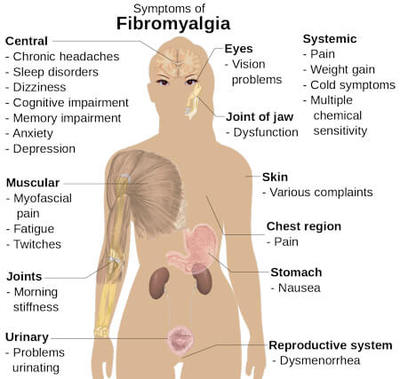
Symptoms of Fibromyalgia
Stress, the weather, physical activity levels, and even the time of day can affect the symptoms that people experience related to Fibromyalgia. There are several symptoms that people with Fibromyalgia experience; these include:
- Facial Pain and Headaches: Facial Pain and Headaches in association with Fibromyalgia present symptoms such as stiffness or tenderness in the shoulders or neck. Persons with Fibromyalgia may also experience Temoromandibular Joint Dysfunction (TMJ), a condition that affects the jaw and the muscles that surround it.
- Pain Throughout the Body: One of the characteristics of Fibromyalgia is pain in the body which, when even slight pressure is applied, cause pain. The pain can affect areas of the body in the upper neck and back, the back of the head, chest, elbows, knees, and hips. The pain is usually followed with stiffness and may continue for months at a time.
- Irritable Bowel Syndrome (IBS): Diarrhea, Constipation, Abdominal Pain and Bloating are symptoms of IBS. Persons who have Fibromyalgia often experience Irritable Bowel Syndrome as well.
- Sleep Disturbances and Fatigue: Despite getting plenty of sleep, people with Fibromyalgia many times wake up feeling tired. There is a sleeping disorder known as, 'Alpha Wave Interrupted Sleep Pattern,' that some studies have suggested disturbs the sleep of persons with Fibromyalgia. The disorder interrupts the person's sleep pattern with bursts of brain activity that are similar to those experienced during waking periods, depriving them of deep sleep. Restless Leg Syndrome and muscle spasms are also associated with Fibromyalgia and can disturb sleep.
- Increased Sensitivity to Environment: Persons with Fibromyalgia have reported sensitivity to environmental factors such as noise, bright light, odors, and touch.
Some additional symptoms and signs of Fibromyalgia include:
- Mood Changes
- Depression
- Anxiety
- Dizziness
- Difficulty Concentrating
- Tingling or Numbness in the Hands and Feet
- Dry Eyes, Mouth, and Skin
- Chest Pains
- Painful Menstruation
When to Seek Medical Attention
Should you experience widespread pain or general aching over a period of months, accompanied by fatigue; it would be a good idea to contact your doctor. There are many symptoms of Fibromyalgia that are similar to other diseases. There is a possibility that it could be something else, such as Hypothyroidism, Rheumatica, Polymyalgia, Lupus, Neuropathy, Multiple Sclerosis, or Rheumatoid Arthritis. A proper diagnosis is essential; your Doctor can help you find out what is going on.
Testing and Diagnosis
The process of reaching a diagnosis of Fibromyalgia can involve several tests. These tests include blood tests, X-rays and others, which may very well come back with normal results. There is no one single test for Fibromyalgia at this time. Blood testing and X-rays are used because they can tell a Doctor whether other conditions are present, and rule them out. They cannot; however, confirm Fibromyalgia.
In an effort to assist with both the study and assessment of Fibromyalgia, The American College of Rheumatology created a general classification guideline for Fibromyalgia. The guidelines state that to be diagnosed with it, a person must experience widespread pain over a period of at least three months, with a minimum of eleven places on their body which are abnormally tender under mild yet firm pressure. A Doctor will take a person's medical history for background information before examining them. They will then check for these pressure points by pressing firmly on various, specific points around the person's joints, upper body, and head to confirm areas that are causing pain.
There is some disagreement among Doctors in the medical community concerning these guidelines; some of them feel that they are too stringent - that a person can have Fibromyalgia even though they do not meet the specified number of pressure points dictated in the guidelines. Other Doctors are debating both the validity and reliability of using pressure points as a means of diagnosis.
Complications Related to Fibromyalgia
Fibromyalgia usually does not lead to other diseases or conditions, and it is not progressive. It can cause depression, pain, and lack of sleep and these problems may then disrupt a person's ability to interact with family or friends, or to function at work or home. Fibromyalgia is still an often misunderstood condition, and dealing with it can be very frustrating for people with it.
Fibromyalgia Treatments and Medications
Treating Fibromyalgia can involve several methods of both self-care and medication; an emphasis is placed on lowering the symptoms while increasing a person's overall health. There are some different medications that are used in the treatment of Fibromyalgia; they include:
- Analgesic Drugs: Analgesics that may or may not contain Acetaminophen can be taken to reduce stiffness and pain associated with Fibromyalgia. Another form of Analgesic, Tramadol, may or may not contain Acetaminophen, and is used for pain as well. A Doctor might suggest an NSAID (Non-Steroidal Anti-Inflammatory Drug) like Ibuprofen, Aspirin, or Naproxen to use along with another medication - but NSAID's alone have not shown themselves to be effective in managing pain associated with Fibromyalgia.
- Anti-Depressant Medications: Anti-Depressant medications like Nortriptyline, Doxepin, or Amitriptyline have helped persons with Fibromyalgia sleep better. Medications such as Sertraline, Flouxatine along with Amitriptyline, and Paroxetine can assist for people who are experiencing depression. There is a class of Anti-Depressants referred to as, 'Serotonin and Norepinephrine Reuptake Inhibitors,' or, 'Dual Uptake Inhibitors,' that present some evidence suggesting that they may control pain better in persons with Fibromyalgia in trials. Another medication; 'Effexor,' has produced similar results in studies, although more study is needed for confirmation.
- Muscle Relaxants: Muscle relaxants, taken before going to bed, can help reduce both muscle spasms and pain, but are usually only prescribed for short-term use.
- Pregabalin: Pregabalin is also known by the brand name, 'Lyrica,' and can help to reduce pain and improve function in persons with Fibromyalgia. Pregabalin is an anti-seizure medication, although it is used to treat some forms of pain, and is the first medication approved by the Food and Drug Administration (FDA) for use in treating Fibromyalgia. In studies related to Pregabalin, about thirty-percent of the people taking it for treatment of Fibromyalgia showed signs of improvement. There are some side effects associated with Pregabalin such as sleepiness, dizziness, blurred vision, weight gain, difficulty concentrating, dry mouth and swelling of the feet and hands.
- Sleeping Medications: Prescription Sleep medications such as Zolpidem, also known by the brand name, 'Ambien,' can help persons with Fibromyalgia sleep; they are usually only prescribed on a short-term basis. The issue with these forms of medications is that they work for a short period of time, after which the body adjusts to them and becomes resistant to their effects, risking greater sleep problems.
- Benzodiazepines: Benzodiazepines are a form of medications that Doctors tend to avoid prescribing, even though they can help a person sleep and relax their muscles because they are habit-forming and have not shown themselves to provide long-term benefits.
- Narcotics: Narcotics are a form of medication that Doctors usually will not recommend; there is great potential for a person to become dependent or addicted to them.
- Corticosteroids: Corticosteroids; Prednisone for example, are something that has not been proven effective in the treatment of Fibromyalgia.
- Cognitive Behavior Therapy: This form of therapy might assist in helping a person with Fibromyalgia to manage it. Cognitive Behavior Therapy involves building the person's faith in their abilities while teaching them different methods for dealing with stress. Therapy is achieved through classes, counseling, CDs, DVDs, and tapes.
- Interdisciplinary Programs: Interdisciplinary programs combining Biofeedback, Relaxation Techniques, and information about chronic pain can work to effectively improve symptoms and relieve pain. There is no one, single combination that works for every single person. A Doctor can help to design a program that is best for each individual with Fibromyalgia.
Lifestyle, Home Remedies and Fibromyalgia
Taking care of yourself is essential when you have Fibromyalgia. There are some different things you can do to help take care of yourself and promote your well-being. These things include:
- Reducing Stress: To reduce the amount of stress in your life, create a plan to either limit or avoid entirely any overexertion or emotional stress. Give yourself some time every single day for relaxation. Learn how to say, 'No,' without feeling guilty - you have to take care of yourself; however, do not change your routine entirely. People with Fibromyalgia who stop all of their activities, or quit working, often do worse than people who maintain a level of activity. Pursue deep-breathing techniques, meditation, or other methods of stress management.
- Make Sure You Get Enough Sleep: Fatigue is a major characteristic of Fibromyalgia, and getting enough sleep is important. Give yourself enough time to sleep and establish good sleeping habits. These habits include going to bed and getting up at the same time every day, as well as restricting the amount of time that you nap during the day.
- Get Regular Exercise: There are some appropriate forms of exercise for persons with Fibromyalgia. These include swimming, walking, water aerobics, and bicycle riding. When you first start, it may increase your pain, but these forms of exercise are helpful as you continue. Be sure to stretch, and maintain your posture. There are also some relaxation exercises that can be helpful.
- Pace Yourself During the Day: Doing too much on a good day may lead to more bad days; it is a good idea to keep your activity on an even level each day.
- Pursue a Healthy Lifestyle: Each day, find something you enjoy doing that is fulfilling. Reduce the amount of caffeine you take in, and eat foods that are healthy for you.
Support and Coping with Fibromyalgia
Dealing with the fatigue, pain, and the frustration of a misunderstood diagnosis can be difficult, to say the very least. Learn everything you can about Fibromyalgia, and help to educate the people in your life who care for you, such as family members, friends and co-workers.
The Arthritis Foundation and The American Chronic Pain Association provide both support groups and educational classes on Fibromyalgia; you are not alone. These organizations can give advice and help that is not available elsewhere, and help you to contact others who have had experiences similar to yours who understand what you are experiencing.
Alternative Medicine and Fibromyalgia
Alternative therapies such as Yoga and Meditation have been practiced for thousands of years, and have become more popular recently among people who have chronic illnesses like Fibromyalgia. Some alternative treatments seem to safely reduce pain and relieve stress and are gaining acceptance in the medical field. Some alternative treatments remain unapproved because they have not been adequately studied. The ones that are promoted for pain management include:
- Acupuncture: Acupuncture uses fine needles, inserted through the skin to different depths, to change the blood flow and levels of neurotransmitters in the spinal cord and brain. It is based on a Chinese medical system that believes it restores a normal balance of life forces in the body. The Mayo Clinic performed a study in 2006 with results stating that Acupuncture significantly improved symptoms of Fibromyalgia. Research related to Acupressure, a similar practice using finger pressure on the skin, was inconclusive.
- Chiropractic Treatments: Chiropractic treatments are applied based on the idea that restricted movement of the spine can lead to reduced function in the body, and therefore pain. Chiropractors manipulate the spine, or make, 'adjustments,' intending to relieve restrictions in spinal mobility and reducing pain while increasing function. Different amounts of force are applied while a person is in various positions to manipulate the spine, and the force applied is often not very great. Chiropractors often use stretching and massage techniques as well to relax muscles in the back that are spasming or shortened. If you pursue chiropractic care, always see a trained and licensed chiropractor.
- Osteopathy: Osteopathy Doctors are trained rigorously and at length through a clinical and academic setting with the equivalence to medical doctors, and are licensed to perform a number of the same procedures and therapies that more conventional doctors are. They are trained in the manipulation of spinal and joint problems, somewhat like chiropractors.
- Massage Therapy: Massage Therapy is one of the oldest methods of healthcare in practice today, and involves manipulation of various soft tissues and muscles in the body. The goal is to improve blood circulation in the muscles while removing waste products and increasing the flow of nutrients to the muscles. There are benefits to massage therapies, such as an improvement in the range of motion in the joints, a reduction of your heart rate, an increase in your body's natural pain reducers, and relaxation of the muscles themselves. Massage therapy can reduce anxiety and stress, and it is almost always safe. If you have any acute inflammation, circulatory problems, or open sores, you should avoid massage therapy.
Fibromyalgia Statistics
Fibromyalgia is estimated to affect 2 to 8% of the population, with a female to male incidence ratio that is somewhere between 7:1 and 9:1. It is most commonly diagnosed in individuals between the ages of 20 and 50, though onset can occur in childhood. Fibromyalgia may not be diagnosed in up to 75 percent of affected people.
- People with fibromyalgia are hospitalized about once every 3 years (CDC, 2009)
- 30 to 40% of fibromyalgia patients have to stop working or change jobs (Health Central, 2009)
- 90% of Fibromyalgia patients have jaw or facial tenderness that can produce symptoms of TMJ disorder (Fibromyalgia Network, 1999)
- Approximately 50% of people with fibromyalgia have difficulty with or are unable to perform routine daily activities (Health Central, 2009)
- 50% of fibromyalgia patients suffer from sensitivity to odors, noise, bright lights, medications and various foods (Fibromyalgia Network, 1999)
- Fibromyalgia is the 2nd most common ailment affecting the musculoskeletal system after osteoarthritis (American College of Rheumatology, 2004)
- Approximately one in 50 Americans are estimated to have fibromyalgia, or between 3 and 6 million people in the U.S. (American College of Rheumatology, 2004)
How the U.S. SSA Views Fibromyalgia
Since July 2012, when SSR 12-2P was issued, the United States SSA has had in place a specific guideline for awarding SSDI or SSI benefits to a patient with fibromyalgia. When determining whether to award SSDI or SSI disability benefits to a fibromyalgia patient, the SSA will look not only at medical evidence to back up the diagnosis, but also the treatment protocols that the patient has tried before the application.
If a patient has only tried a single medication, with no medical evidence of additional pain and fatigue management methods that might allow he or she to perform job duties, the SSA might deny the application or delay consideration of it until the applicant can undergo additional treatments that might prove effective. The more varied a care approach is, the more likely the SSA is to award benefits if the patient, after multiple courses of treatment, is still so debilitated by fibromyalgia symptoms that he or she cannot work.