Brain2Qwerty: Meta's Mind-Reading Typing Leap
Author: Ian C. Langtree - Writer/Editor for Disabled World (DW)
Published: 30 Jun 2026 - Updated: 9 Aug 2026
Publication Type: Paper, Essay
Table of Contents:
Synopsis - Definition - Overview - FAQs - Insights, Updates - Related Content
Synopsis
In a quiet lab in Spain, volunteers sat still and typed memorized sentences while sensors recorded the faint magnetic whispers of their brains at work, and from that data Meta's researchers built something that sounds like science fiction: a system that can reconstruct what a person typed using nothing but their neural activity, no keyboard required, no implant, no surgery, and while the accuracy is still far from perfect, the implications for people who have lost the ability to speak or move are hard to ignore.
At a Glance
- 1 - Brain2Qwerty decoded typed sentences from brain activity recorded with magnetoencephalography, reaching a character error rate as low as 19 percent for its best participants, far outperforming EEG, which produced a 67 percent error rate in the same study.
- 2 - The 2026 update, Brain2Qwerty v2, raised average word accuracy to 61 percent after training on roughly 22,000 sentences collected from nine volunteers who each wore an MEG scanner for about 10 hours.
- 3 - The system has so far only been tested on healthy volunteers typing on real keyboards, so while it points toward future communication tools for people with paralysis or speech loss, it has not yet been proven on the patients who would benefit most.
Topic Definition
- Brain2Qwerty
Brain2Qwerty is a non-invasive brain-to-text decoding system developed by Meta's Fundamental AI Research lab, in collaboration with Spain's Basque Center on Cognition, Brain and Language, that uses a multi-stage deep learning model to reconstruct the sentences a person is typing by analyzing their brain activity, recorded externally through EEG or MEG sensors rather than through any surgically implanted device.
Overview
What Is Brain2Qwerty
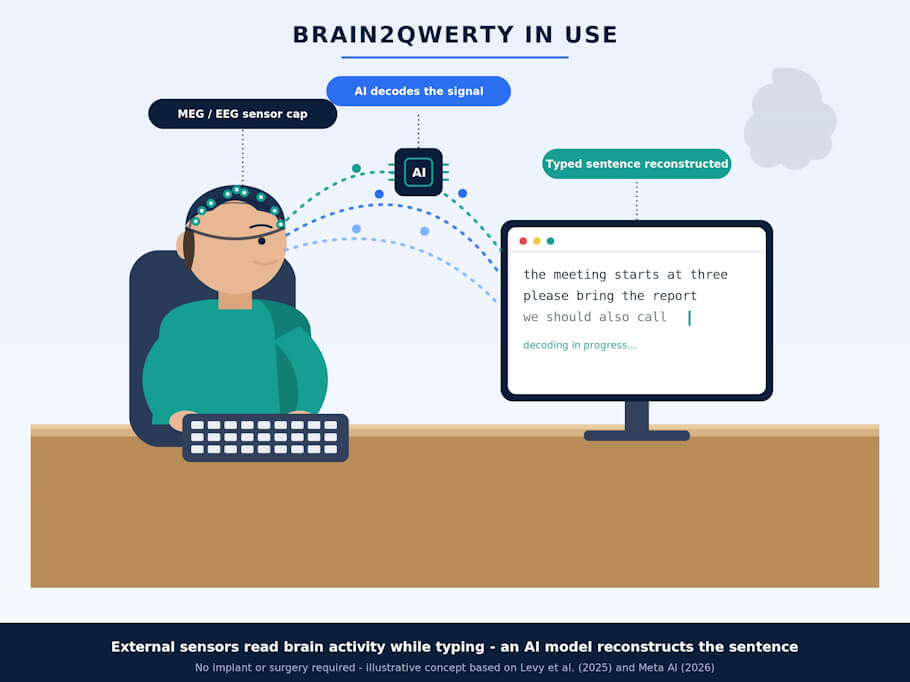
Brain2Qwerty is an artificial intelligence system, developed by Meta's Fundamental AI Research lab (known as Meta FAIR) together with Spain's Basque Center on Cognition, Brain and Language, that reconstructs the sentences a person is typing by reading their brain activity rather than their fingers. The project was first described publicly in February 2025 in a paper titled Brain-to-Text Decoding: A Non-invasive Approach via Typing (Levy et al., 2025), and it belongs to a broader field of research called brain-computer interfaces, or BCIs, which translate brain signals into commands, text, or speech.
What makes Brain2Qwerty notable is the word "non-invasive" in its description. Unlike many of the most accurate brain-to-text systems built so far, which rely on electrodes surgically implanted directly into a person's brain tissue, Brain2Qwerty reads brain activity entirely from outside the skull. No surgery, incision, or implanted hardware is involved. That single design choice shapes nearly everything about how the system works, what it can currently do, and who might eventually be able to use it.
Inside the Study
Recording Brain Activity While People Type
The original Brain2Qwerty study involved 35 healthy adult volunteers who were asked to type briefly memorized sentences on a standard QWERTY keyboard while wearing sensors that recorded their brain activity, using either electroencephalography (EEG) or magnetoencephalography (MEG) (Levy et al., 2025). EEG measures the tiny electrical signals produced by neurons, picked up through electrodes placed on the scalp. MEG instead measures the faint magnetic fields those same electrical signals generate, using highly sensitive sensors housed in a large, helmet-shaped scanner.
As each volunteer typed, the researchers captured short windows of brain activity time-locked to each keystroke, then trained a model to associate patterns in that activity with the specific letters being typed. Critically, the brain signals being decoded were not simply the act of a finger pressing a key. They reflected the broader chain of mental and motor processes involved in typing, from recognizing a letter to planning and executing the small hand movement that produces it.
A Three-Stage Decoding Pipeline
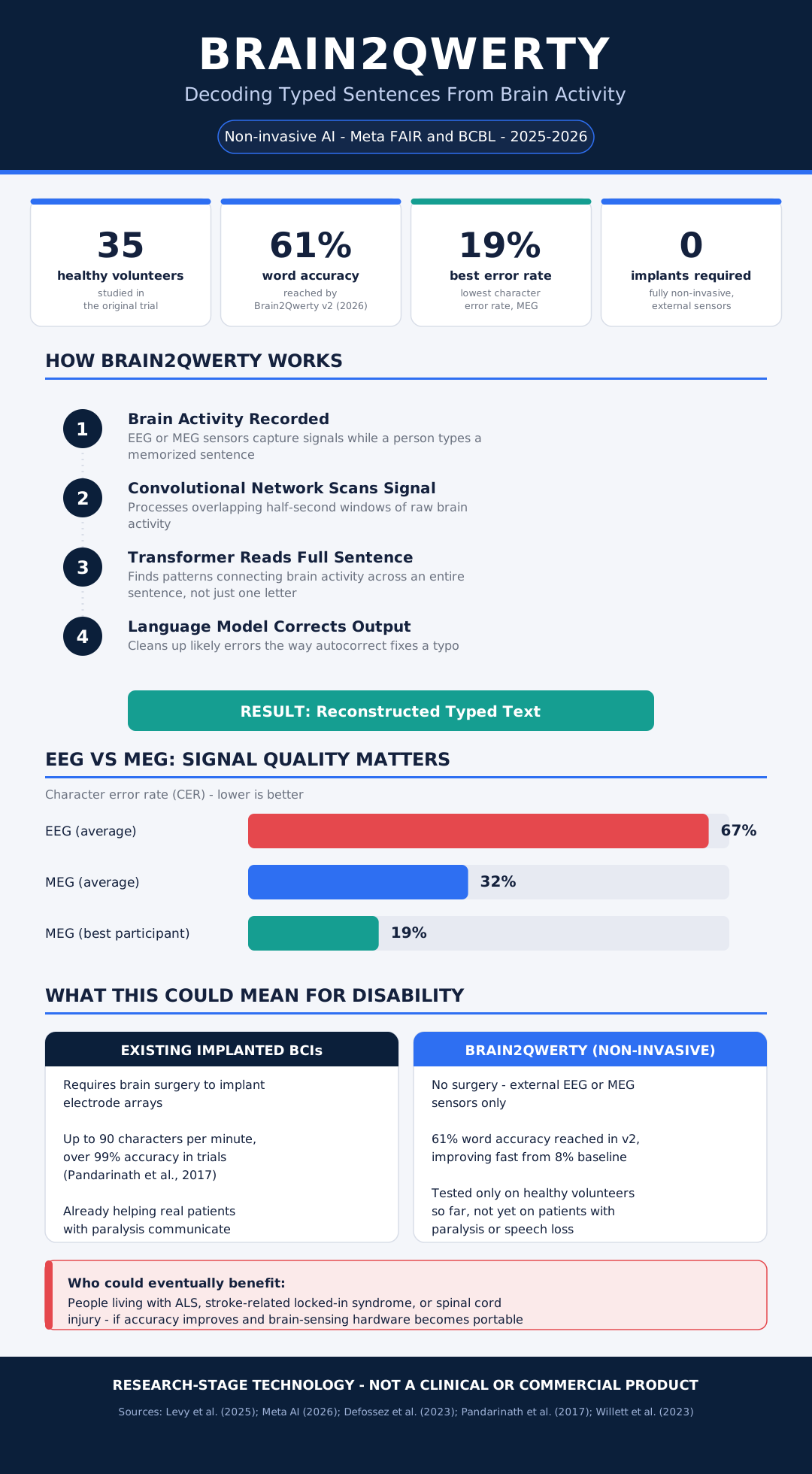
Brain2Qwerty works through three connected stages. First, a convolutional neural network, a type of model that is good at finding patterns in raw signal data, processes half-second windows of EEG or MEG activity. This stage builds on earlier work from the same Meta FAIR research group on decoding speech perception from non-invasive brain recordings (Defossez et al., 2023). Second, a transformer module, the same general class of architecture that powers many modern language tools, analyzes patterns across an entire typed sentence rather than just one letter at a time. Third, a pretrained language model reviews the transformer's letter-by-letter guesses and corrects errors using its knowledge of how words and sentences are normally structured, much like the autocorrect feature on a smartphone keyboard cleans up typos.
EEG Versus MEG: Why the Sensor Matters
One of the clearest findings from the original study is how differently EEG and MEG performed. Using MEG, Brain2Qwerty achieved an average character error rate of 32 percent across participants, and for the best-performing individuals, that error rate dropped to just 19 percent, low enough that the model could perfectly decode some sentences it had never seen during training. EEG, by contrast, produced a much higher average character error rate of 67 percent (Levy et al., 2025).
The gap comes down to signal quality. MEG offers finer spatial and temporal resolution because magnetic fields pass through the skull with very little distortion, while the electrical signals EEG measures get smeared and weakened as they travel through bone and tissue. The tradeoff is practicality. EEG caps are relatively light, portable, and inexpensive. MEG scanners are large, costly, and typically require a magnetically shielded room and supercooled sensors, which currently limits their use to research laboratories rather than homes or clinics.
Brain2Qwerty v2: From Single Letters to Full Sentences
In June 2026, Meta FAIR released an updated version of the system, Brain2Qwerty v2, which decodes continuous, freely typed sentences directly from MEG recordings rather than reconstructing text letter by letter after the fact. Trained on roughly 22,000 sentences collected from nine volunteers who each spent about 10 hours in the MEG scanner, the updated model reached an average word accuracy of 61 percent, equivalent to a word error rate of 39 percent, with the best individual participant reaching 78 percent word accuracy (Meta AI, 2026). For comparison, Meta reported that earlier non-invasive brain-to-text approaches typically achieved only around 8 percent word accuracy, making this a substantial jump for the field, even though it remains well short of the accuracy needed for everyday, reliable use.
Brain2Qwerty Infographic
How Brain2Qwerty Relates to Disability
The Communication Gap It Is Aimed At
Although the published Brain2Qwerty studies were conducted with healthy volunteers, the underlying motivation for this entire line of research is assistive. Conditions such as amyotrophic lateral sclerosis (ALS), brainstem stroke, severe spinal cord injury, and locked-in syndrome can leave a person's mind fully intact while taking away their ability to speak or move, including the ability to type. For people in this situation, any technology that can translate intention into text or speech without requiring physical movement represents a potential lifeline for communication, independence, and connection with family and caregivers.
Brain-computer interfaces built for exactly this purpose already exist and have helped real patients. Researchers using intracortical BCIs, which involve electrode arrays implanted on the surface of the brain, have enabled people with paralysis to type by imagining cursor movements or handwriting, reaching speeds around 90 characters per minute with better than 99 percent accuracy (Pandarinath et al., 2017). More recently, implanted speech neuroprostheses have translated the brain activity of paralyzed individuals attempting to speak into text at rates approaching natural conversational speed (Willett et al., 2023). These systems prove that decoding intended language from brain activity is not just theoretically possible but already clinically meaningful.
Where Brain2Qwerty Differs From Existing Assistive BCIs
Brain2Qwerty's contribution is approaching the same goal from a different angle. The implanted systems referenced above require neurosurgery, which carries real risks including infection, bleeding, and complications from having hardware permanently inside the skull. Those risks are acceptable to many patients given the severity of their condition, but they also limit how widely such systems can ever be deployed. A non-invasive approach like Brain2Qwerty, if its accuracy can eventually be improved and its hardware made more practical, could in principle extend communication-restoring technology to far more people, without surgery, and at potentially lower cost.
It is also worth being precise about what Brain2Qwerty has actually demonstrated so far. The volunteers in both studies were healthy and were physically typing on a real keyboard while their brain activity was recorded. The system has not yet been tested on people who are paralyzed or otherwise unable to move their hands, whose relevant brain signals may differ in ways researchers do not yet fully understand. In that sense, Brain2Qwerty today is best described as a proof of concept and a research tool rather than an assistive device a clinician could currently prescribe to a patient with ALS or locked-in syndrome.
Limitations Worth Knowing
Several practical limits stand between Brain2Qwerty and everyday assistive use. Even its best results still involve a meaningful error rate, which matters a great deal for someone who has no other way to communicate. MEG, the sensor type that produces usable accuracy, requires bulky, expensive, immobile equipment and a magnetically shielded room, making it impractical outside a laboratory setting for now, though researchers elsewhere are developing smaller wearable MEG sensors that could eventually change this. The studies to date have also involved modest numbers of participants, all of them healthy adults, which means the system's performance in older adults, people with neurological disease, or people with very different typing habits remains unknown. Meta has released the project's training code and data publicly, which should help the wider research community test and improve the approach more quickly (Levy et al., 2025).
Looking Ahead
Brain2Qwerty sits at an early but genuinely promising stage of a research path that has been building for years, from decoding which words a person heard (Defossez et al., 2023) to decoding the words a person is actively producing. Whether it eventually becomes a practical communication tool for people with disabilities will depend on continued gains in accuracy, smaller and more affordable brain-sensing hardware, and crucially, testing with the patients the technology is ultimately meant to serve.
Frequently Asked Questions
Can Brain2Qwerty read private thoughts a person has not chosen to express?
No. The system was trained to reconstruct sentences that volunteers were deliberately typing, meaning it decodes the neural activity tied to an intended, produced action rather than passive or unspoken inner thoughts. It cannot scan a mind for hidden information, and its output depends entirely on a person actively engaging in the typing task while being recorded by external sensors.
How fast can someone communicate using Brain2Qwerty compared with typing normally?
The research so far has focused on accuracy rather than speed, since volunteers were physically typing while their brain activity was recorded. As a result, meaningful communication-speed figures for a hands-free version do not yet exist. Established implanted systems have reached far higher speeds, but Brain2Qwerty remains an early proof of concept where reliably reconstructing text, not matching keyboard pace, is the current goal.
Does the system need to be trained separately for each individual user?
The studies trained models using data gathered from volunteers who spent many hours in the scanner, which suggests that substantial individual data collection is important for good results. Performance also varied considerably between people. This points to a likely need for person-specific calibration, and it remains an open question how well a model trained on some individuals would transfer to a new user without additional training.
Could a consumer brain-sensing headset run Brain2Qwerty at home?
Not with usable accuracy today. The reliable results came from MEG scanners, which are large, costly machines that require a magnetically shielded room and specialized cooling, confining them to research laboratories. The portable EEG caps closer to consumer hardware produced far weaker results in the study. Home use would depend on future advances in smaller, more affordable brain-sensing technology.
Will using Brain2Qwerty involve any medical risk to the user?
The approach is entirely non-invasive, meaning it reads brain activity from outside the skull with no surgery, incision, or implanted hardware. This avoids the surgical risks associated with implanted systems, such as infection or bleeding. The main practical burdens are instead the size, cost, and immobility of the sensing equipment rather than any physical risk from the recording itself.
Where can researchers or interested readers access the Brain2Qwerty code and data?
Meta has publicly released the project's training code and data, which is intended to let the wider research community test and build on the approach more quickly. Those interested can consult the associated published papers, including the 2025 preprint describing the original system, which document the methods and point toward the released materials for further study.
References:
- Defossez, A., Caucheteux, C., Rapin, J., Kabeli, O., and King, J. R. (2023). Decoding speech perception from non-invasive brain recordings. Nature Machine Intelligence, 5, 1097 - 1107.
- Levy, J., Zhang, M., Pinet, S., Rapin, J., Banville, H., d'Ascoli, S., and King, J. R. (2025). Brain-to-text decoding: A non-invasive approach via typing. arXiv preprint arXiv:2502.17480.
- Meta AI (2026). Brain2Qwerty v2: Continuous decoding of typed sentences from non-invasive brain recordings. Meta AI Research Publications.
- Pandarinath, C., Nuyujukian, P., Blabe, C. H., Sorice, B. L., Saab, J., Willett, F. R., Hochberg, L. R., Shenoy, K. V., and Henderson, J. M. (2017). High performance communication by people with paralysis using an intracortical brain-computer interface. eLife, 6, e18554.
- Willett, F. R., Kunz, E. M., Fan, C., Avansino, D. T., Wilson, G. H., Choi, E. Y., Kamdar, F., Glasser, M. F., Hochberg, L. R., Druckmann, S., Shenoy, K. V., and Henderson, J. M. (2023). A high-performance speech neuroprosthesis. Nature, 620, 1031 - 1036.
Insights, Analysis, and Developments
Editorial Note: Brain2Qwerty will not replace a keyboard anytime soon, and Meta is careful to frame it as foundational research rather than a finished product, but the open release of its code and data signals a broader shift in how scientists are approaching the old dream of reading minds, less about mystical telepathy and more about patient, painstaking pattern matching between brain signals and the words a person already intended to write, and for the millions of people worldwide living with conditions like ALS, stroke, or locked-in syndrome, that patient work may eventually open a door that disease had closed.
 Author Credentials: Ian is the founder and Editor-in-Chief of Disabled World, a leading resource for news and information on disability issues. With a global perspective shaped by years of travel and lived experience, Ian is a committed proponent of the Social Model of Disability, a transformative framework developed by disabled activists in the 1970s that emphasizes dismantling societal barriers rather than focusing solely on individual impairments. His work reflects a deep commitment to disability rights, accessibility, and social inclusion. To learn more about Ian's background, expertise, and accomplishments, visit his full biography.