Partially Blind Painter Charles and His AMD Art Journey
Author: Charles V.
Published: 6 Dec 2025 - Updated: 12 Sep 2026
Publication Type: Submitted Article
Table of Contents:
Synopsis - Definition - Overview - FAQs - Insights, Updates - Related Content
Synopsis
This article is a powerful personal essay from Charles, a partially blind painter who creates impressionist, abstract, and expressive works despite progressive vision loss from Age-related Macular Degeneration, and it serves as both an artistic manifesto and a testament to creative resilience that challenges assumptions about disability and artistic capability - valuable not only for people with visual impairments or degenerative eye conditions seeking inspiration, but for anyone interested in how limitation can deepen artistic expression and how sensory adaptation demonstrates that meaningful creation transcends conventional perception.*
At a Glance
- 1 - Charles has painted since he was nine years old. He describes that childhood self as a boy with a brush who never left him.
- 2 - He builds each canvas layer by layer, revisiting a piece a dozen times or more. His wife serves as his most trusted critic and studio guardian.
- 3 - Before he paints, Charles sketches a scene quickly until he can picture the finished work in his mind. That mental image then becomes his roadmap for the canvas.
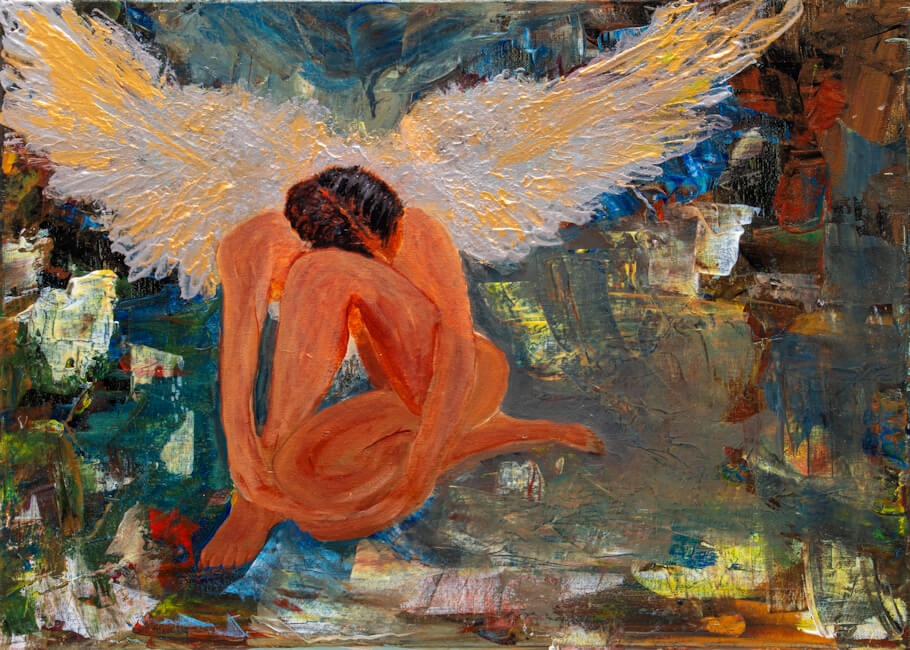
- 4 - His painting titled Weeping Angel shows a bowed figure with luminous cream and gold wings. It uses thick, gestural brushwork that favors emotional intensity over realistic detail.
Topic Definition
- Blind Artist
A blind artist is a painter, sculptor, or other visual creator who produces work despite significant vision loss or total blindness, relying on memory, touch, emotion, and imagination rather than full sight to guide the creative process. Rather than reproducing exactly what sits in front of them, these artists often translate remembered light, felt texture, and inner vision onto the canvas, building pieces layer by layer and using raised outlines, tactile materials, or mental sketching to navigate composition. The tradition runs deep and includes figures such as Esref Armagan, John Bramblitt, and Keith Salmon, whose work shows that artistic vision lives well beyond the eyes and that partial or complete blindness can sharpen expression rather than silence it.
Overview
I Am the Real Blind Artist: Painting Beyond Sight
My name is Charles, known as the Real Blind Artist, and this is my story - told in my own voice, straight from the easel.
Welcome to RealBlindArtist. Where you'll find my world of impressionism art, abstract paintings, and expressive works created by a partially blind painter who refuses to let darkness dim the colors inside my head.
People always ask, "How do you paint like that when you can't see?" The answer starts long before I lost central vision in my right eye to (Wet) Age-related Macular Degeneration (AMD). My left eye is affected by 'Dry AMD". There is no cure, but there is hope in my art.
Painting Beyond Sight: Vision of a Blind Artist
I've been painting since I was nine years old. That little boy with a brush never left me. Even when the doctors confirmed the diagnosis (2013), the need to create only grew louder. I paint because I must - because leaving something behind that says "I was here" matters more to me than perfect eyesight ever did. And who knows? Maybe fifty or a hundred years from now, someone will stumble across one of my canvases and finally "discover" me. The thought still makes me grin.
My style?
I live in the sweet spot between impressionism, abstract, and expressive art. I don't need perfect sight to feel the energy of a sunset or the chaos of emotion that begs to spill onto canvas. Long before a single brush touches paint, I sketch the scene - lightly, quickly - until I can see the finished painting clearly in my mind. That mental image is my roadmap. I build the piece layer by layer, revisiting it a dozen times, sometimes more. My wife has become my most trusted critic. When she says, "Stop, it's perfect," I usually listen... eventually. There are nights I sneak back into the studio for just one more stroke. As I tiptoe out, I'll hear her voice float in from the living room: "You touched it again, didn't you?" Busted every time. She's saved more paintings than I'll ever admit.
I'm far from the first blind or visually impaired artist to pick up a brush. History is full of us. Esref Armagan, born completely blind in Turkey, taught himself perspective and shadow using only touch and imagination - his landscapes still stun art professors. John Bramblitt lost his sight to epilepsy and reinvented painting with raised outlines and textured oils; his portraits practically breathe. Keith Salmon, blinded by glaucoma, turned memories of Scottish mountains into sweeping abstract impressions that feel more alive than photographs ever could. We stand on each other's shoulders, proving that vision lives deeper than the eyes.
Sighted artists paint what's right in front of them; I paint with the little sight I have left in one eye and a whole lot of memory, emotion, and dream. Where they chase the precise blue of a fading sky, I chase the feeling it once gave me - guided by touch, stubbornness, and whatever vision still flickers - until the canvas holds bold, textured truth that begs you to feel it instead of just seeing it.
For me, art is the purest form of free speech on earth. No one can censor a feeling translated into color. No law can stop a stroke of paint that screams joy, grief, or defiance. When the world tries to box you in because of a disability, a canvas becomes your megaphone. Every painting I finish is a declaration: I am still here, still creating, still free.
Art is in the eye of the beholder - ironic, right? I may not see the way you do, but I hope when you visit Real Blind Artist, you'll see something that moves you. Come explore my galleries of impressionist landscapes, vibrant abstracts, and expressive pieces born from a life half-lit yet fully alive. Look with your heart. I promise the colors are still there.
I'm the Real Blind Artist, and I'm just getting started.
Frequently Asked Questions
NOTE: Researched FAQs by Disabled World (DW)
Can a legally blind person still create detailed paintings
Yes, many legally blind artists produce highly detailed and expressive paintings by relying on memory, touch, textured materials, and mental planning rather than full sight. Techniques such as raised outlines and layered brushwork help them navigate a canvas without depending on central vision.
What is the difference between wet and dry age-related macular degeneration
Dry AMD develops slowly as the central retina thins and breaks down over time, while wet AMD occurs when abnormal blood vessels grow beneath the retina and leak fluid, often causing faster and more severe central vision loss. A person can have different forms affecting each eye.
Does losing central vision mean a person is completely blind
No, losing central vision does not mean total blindness because peripheral vision often remains, allowing a person to detect shapes, movement, light, and color. Many people with macular degeneration retain useful side vision that supports daily tasks and creative work.
What art styles work best for artists with low vision
Impressionism, abstract, and expressive styles often suit artists with low vision because they prioritize emotion, color, and texture over precise realistic detail. These approaches allow the artist to work from feeling and memory rather than sharp visual accuracy.
How do blind artists choose and mix their colors
Blind and low vision artists often organize paints in a consistent order, use labeled containers, and rely on texture differences or memory to identify colors. Some develop tactile systems so they can locate and combine shades reliably without seeing them clearly.
Is age-related macular degeneration hereditary
Age-related macular degeneration can have a hereditary component, and having a close relative with the condition may increase a person's risk. Lifestyle factors such as smoking, diet, and sun exposure also influence the likelihood of developing it.
Can painting or creative work slow the progression of AMD
Painting does not slow the medical progression of AMD, but creative activity can support mental wellbeing, motivation, and quality of life during vision loss. Regular eye care and monitoring remain the primary tools for managing the condition.
Where can people view or support the work of blind artists
People can view and support blind artists through personal artist websites, online galleries, disability arts organizations, and exhibitions that feature work by creators with visual impairments. Purchasing pieces, sharing their work, and following their platforms all provide meaningful support.
Insights, Analysis, and Developments
Editorial Note: The intersection of disability and artistic freedom has long been obscured by patronizing narratives; Charles's refusal to accept that partial blindness diminishes his voice - but rather amplifies it - reminds us that creativity is not diminished by circumstance but often sharpened by it, and that when society attempts to box in the disabled, the canvas becomes more than art: it becomes resistance, reclamation, and proof of persistent humanity.*
* Editorial additions by Ian C. Langtree.