Helping Neurodivergent Job Seekers Assess Workplace Fit
Author: Navya Tuteja
Published: 18 Jul 2026 - Updated: 7 Aug 2026
Publication Type: Informative
Table of Contents:
Synopsis - Definition - Overview - FAQs - Insights, Updates - Related Content
Synopsis
This article explains how a free online tool called Raaha helps neurodivergent job seekers look past the surface of a job posting and judge whether a role actually suits the way they work, from communication style and pace to sensory conditions and the predictability of daily tasks, details that job descriptions rarely spell out yet often decide whether a position is sustainable, and while the piece is a first-person account from Raaha's creator rather than a peer-reviewed study, it draws on figures from the U.S. Bureau of Labor Statistics and guidance from the Job Accommodation Network and the Americans with Disabilities Act, making it a practical read for autistic and ADHD applicants, people who are hard of hearing or otherwise disabled, seniors returning to the workforce, and anyone who wants clearer information and better interview questions before deciding where to apply.*
At a Glance
- 1 - The U.S. Bureau of Labor Statistics reported an unemployment rate of 8.3 percent for people with disabilities in 2025, compared with 4.1 percent for people without disabilities.
- 2 - Raaha turns a pasted job description and a short set of preference questions into a personalized fit score, plus sample interview questions and suggested language for requesting accommodations.
- 3 - Under the Americans with Disabilities Act, reasonable accommodations can apply during the application and interview stage, not only after a person is hired.
Topic Definition
- Workplace Fit
Workplace fit describes how well the everyday realities of a job - its communication methods, pace, schedule, sensory environment, and level of daily structure - line up with the conditions under which a particular person is able to do their best and most sustainable work, a match that can matter as much as skills or experience, and one that is especially important for Neurodivergent employees, whose needs around focus, organization, and sensory input can differ widely from one person to the next.
Overview
Beyond the Job Description: Helping Neurodivergent Job Seekers Understand Workplace Fit
Most job descriptions are very good at explaining what an employer wants. They list the required degree, years of experience, technical skills, and responsibilities. They are much less useful at explaining what it will actually feel like to do the job.
Will instructions usually be given in writing or explained verbally during a meeting? Does "fast-paced" mean an energetic environment, or does it mean priorities change several times a day? Is the office quiet? Is the schedule predictable? How much of the job involves switching quickly between unrelated tasks?
For many applicants, these details can determine whether a job is manageable, yet they are rarely included in postings. For neurotypical candidates, they may be helpful to know. For neurodivergent candidates, they can make the difference between finding a sustainable role and burning out within months.
A workplace that suits one person may be exhausting or inaccessible to another. Even two positions with the same job title can have completely different communication styles, sensory environments, schedules, and expectations.
The employment gap for people with disabilities also remains significant. According to the U.S. Bureau of Labor Statistics, the unemployment rate for people with disabilities was 8.3 percent in 2025, compared with 4.1 percent for people without disabilities.
The job search process isn't working equally for everyone.
The Information Applicants Do Not Receive
Terms such as "flexible," "dynamic," and "excellent communicator" appear in job descriptions all the time, but they can mean almost anything.
"Flexible" could mean that an employee has control over when and where work is completed. It could also mean that the employee is expected to respond immediately whenever plans change.
"Excellent communicator" could describe someone who writes clear updates and asks thoughtful questions. In another workplace, it may be used to describe someone who is comfortable speaking without preparation in large meetings.
"Fast-paced" might mean that the work is interesting and varied. It might also mean frequent interruptions, competing deadlines, and little time to process new instructions.
The words are not a problem. The lack of explanation is.
The Job Accommodation Network notes that workplace challenges experienced by neurodivergent employees vary considerably. They can involve concentration, organization, sensory conditions, time management, and communication. Not every neurodivergent person experiences the same challenges or requires accommodations.
That variation is why a label like 'neurodivergent-friendly' is not enough. Applicants need specific information.
Why I Built Raaha
I began thinking about hidden barriers through my own family. My mother is hard of hearing, and growing up around her made me notice how a barrier can be obvious to the person experiencing it while remaining almost invisible to everyone else.
There is a particular exhaustion that comes with having a disability other people cannot immediately see. You spend so much energy proving you need support before you can even get to the part where support actually helps.
That experience shaped the way I look at systems that expect people to adapt without first giving them the information they need.
When I got to high school, I started noticing the same pattern in a different setting. Students who thought or approached problems differently - who needed more time, different environments, or different kinds of feedback - were often seen as less capable rather than differently capable. The system wasn't built for them either.
The more I worked in neurodiversity advocacy, the more I saw the same gap. Job seekers were expected to decide whether to apply for a position based on a short description written almost entirely from the employer's perspective.
A posting might explain what the applicant must provide, but not what the workplace would provide in return.
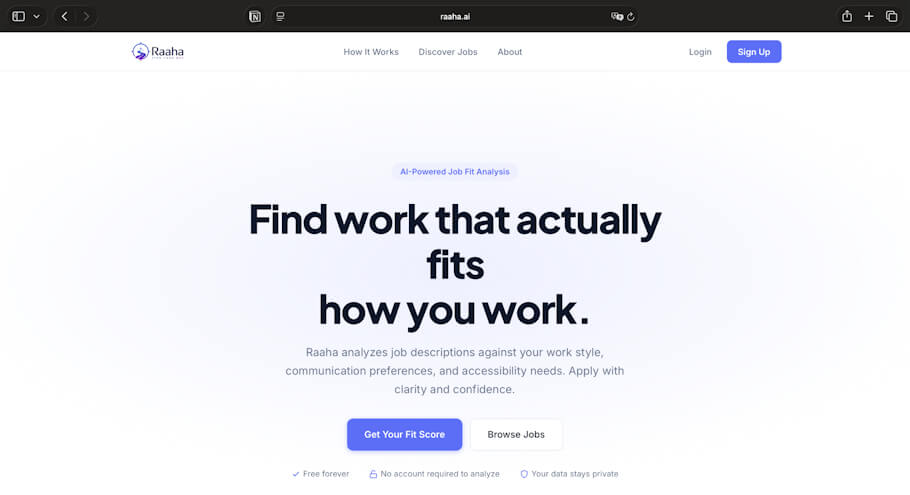
I created Raaha, a free online tool, to help job seekers examine that missing part of the decision.
How Raaha Works
A user begins by pasting a job description into the website. The user then answers a short set of questions about how they prefer to work. The questions cover areas such as communication, predictability, pace, multitasking, sensory environment, breaks, and the level of structure in daily assignments.
Raaha compares the user's preferences with the information in the job description. It then produces a personalized fit score, points out areas that may work well, and identifies areas the applicant may want to ask about.
The tool also provides possible interview questions, interview-preparation guidance, and sample language for discussing workplace accommodations.
For example, instead of asking a broad question such as, "What is the work environment like?" an applicant might ask:
- How often do deadlines or priorities change?
- What does a typical day in this position look like?
- How are new assignments normally communicated?
- What is the process for requesting an accommodation?
- Can employees receive important instructions in writing?
- How much of the day involves switching between different tasks?
- Is most work completed independently or through frequent meetings?
These questions can produce more useful information than a general statement that the company values inclusion.
The goal is not to tell someone what they can or cannot do. It is to help them make more informed decisions before they invest time applying.
Using the Fit Score as a Starting Point
Raaha's fit score is meant to guide a job seeker's thinking, not make the decision for them. It highlights areas that may align with someone's work style and points out details worth asking about before applying or interviewing.
The analysis depends on the information in the job description. If an employer leaves out important details, the tool cannot know what the workplace is truly like. Raaha does not diagnose disabilities, provide legal advice, or replace a conversation with an employer.
No automated tool can fully understand what one person needs from a workplace. The score works best as a starting point for better questions and more informed conversations, not as a final answer.
Asking About Accommodations
Some job seekers may also want help finding the words to request an accommodation. This can be difficult, especially for a young person, first-time applicant, or someone who has not previously disclosed a disability at work.
Under the Americans with Disabilities Act, covered employers are generally required to provide reasonable accommodations to qualified applicants and employees with disabilities unless doing so would create an undue hardship. Accommodations can also apply during the application and interview process.
A request does not always need complicated language. Depending on the situation, someone might say:
"I am able to complete the essential responsibilities of this position, but I work most effectively when important instructions are also provided in writing. Is that something the team could provide?"
Another person might ask about a quieter workspace, advance notice of schedule changes, assistive technology, or a modified communication method.
The appropriate request depends on the individual and the job. The goal of a script should be to help someone begin the conversation, not speak for them.
Job Fit Should Work Both Ways
Hiring is usually presented as a process in which an employer evaluates an applicant. But applicants are also making an important decision. They need enough information to evaluate the employer.
A more accessible job-search process does not require every workplace to operate in exactly the same way. It requires employers to describe their expectations clearly and applicants to have a realistic way to compare those expectations with how they work best.
Accessibility should not begin after you are hired. It should start before you even apply.
Raaha makes workplace information easier for candidates to evaluate, but lasting change will require more transparent job descriptions and hiring conversations.
We have spent years building technology that helps employers screen candidates. I wanted to build technology that helps candidates screen employers.
Choosing a workplace should not feel like a leap of faith.
Frequently Asked Questions
NOTE: Researched FAQs by Disabled World (DW)
What does neurodivergent mean?
Neurodivergent is a term for people whose brains process information, focus, or communicate in ways that differ from what is considered typical. It includes conditions such as autism, ADHD, and dyslexia, and it is not a medical diagnosis on its own.
Do I need to share a diagnosis with an employer to use Raaha?
No. Raaha works from the job description and your own answers about how you prefer to work. You decide separately whether, when, and how to disclose any disability to an employer.
Can neurotypical job seekers also benefit from checking workplace fit?
Yes. Everyone performs better in some environments than others, so anyone can use a clearer picture of a role's communication style, pace, and daily structure to decide whether it suits them.
What should I do if a job description leaves out key details about the work environment?
Treat the missing details as questions for the interview. Asking how assignments are communicated, how often priorities change, and what a typical day looks like can reveal what the posting does not.
Does a low fit score mean I should not apply for the job?
No. A fit score is a starting point, not a verdict. A lower score simply points to areas worth asking about before you apply or interview, since a job description cannot capture everything about a workplace.
Is it free to use Raaha, and do I need to create an account?
Raaha is a free online tool. A job seeker pastes in a job description, answers a short set of questions about how they prefer to work, and receives a personalized fit score along with interview questions and sample accommodation language.
Can employers use the same approach to describe their workplaces more clearly?
Yes. Employers can apply the same questions to their own postings by stating how instructions are given, how predictable the schedule is, what the sensory environment is like, and how often priorities change, which helps applicants judge fit before they apply.
References
U.S. Bureau of Labor Statistics, People with a Disability: Labor Force Characteristics, 2025
U.S. Equal Employment Opportunity Commission, Job Applicants and the ADA
Job Accommodation Network, Neurodiversity
Insights, Analysis, and Developments
Editorial Note: For years, hiring technology has been built to help companies filter applicants, so it is worth noting that a tool built to help applicants filter companies flips the usual power balance in a small but meaningful way, and whether or not the fit score is perfect, the real value here is the shift in mindset it encourages, treating a job search as a two-way evaluation in which the candidate is allowed to ask what the workplace will actually be like before committing time, energy, and hope to an application.*
* Editorial additions by Ian C. Langtree.