Access Rider: Working Document for Disability Needs
Author: Ian C. Langtree - Writer/Editor for Disabled World (DW)
Published: 9 Jul 2026 - Updated: 11 Sep 2026
Publication Type: Informative
Table of Contents:
Synopsis - Definition - Overview - FAQs - Insights, Updates - Related Content
Synopsis
Few tools have moved as quietly from the theatre wings into everyday working life as the access rider, a plain-language document in which a person spells out - on their own terms - exactly what they need to take part and thrive. Born from the contracts of disabled performers and now used by academics, freelancers, and office workers alike, it turns the awkward, repeated business of explaining oneself into a single, confident page that says here is how to work well with me.
At a Glance
- 1 - The term rider comes from performance contracts listing a performer's stage and hospitality needs. Disabled artists adapted it to name access needs alongside technical ones.
- 2 - You do not need a formal diagnosis, benefit, or label to write and use one. The individual decides how much to share and which words feel right.
- 3 - Most riders run only one or two pages and split needs into essential and flexible groups. This shows an organization what it must provide and where compromise is possible.
- 4 - Under the UK Equality Act 2010, disabled people are entitled to reasonable adjustments. A clear rider gives employers the documented detail they need to meet that duty.
Topic Definition
- Access Rider
An access rider is a short, self-written working document in which a person explains their disability, medical, or neurodivergent access needs and the practical support that helps them take part and do their best work. Grounded in the social model of disability and first drawn from the contracts of disabled performers, it names the barriers a person meets and asks an employer, organizer, or institution to remove them. Rather than a medical report or a rigid set of demands, it stays under the writer's control and works as a private, person-led opening to a shared conversation about access, one that both puts useful information in the right hands early and invites a collaborative plan.
Overview
What an Access Rider Actually Is
An access rider - sometimes called an access document or access statement - is a short, practical, working document written by an individual to explain their specific disability, medical, or neurodivergent needs. Rather than a formal medical report or a fixed legal contract, it is a plain-language summary of the conditions a person needs in order to take part fully and do their best work. Most access riders are only one or two pages long, and they are designed to be shared with an employer, a producer, an event organiser, a school, or anyone else responsible for a shared space or project (Historic England, 2023).
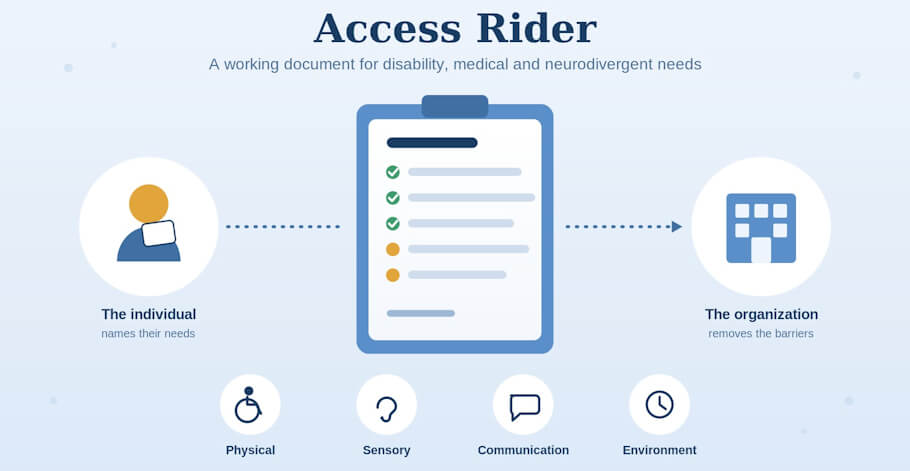
The core idea is simple. Instead of forcing a disabled person to explain and re-explain their requirements every time they start something new, and instead of leaving organization's to guess or make assumptions, the person writes their needs down once, clearly, and hands them over. The document says, in effect, this is how you can work with me effectively, and these are the barriers I would like removed. It puts useful, actionable information in the right hands at the right time (Unlimited, 2022).
Where the Term Comes From
The word rider is borrowed from the performing arts and live-events world. In that setting, a rider is an addendum attached to a performer's contract that lists their requirements for a show - anything from stage equipment and lighting to catering and dressing-room arrangements. Access riders grew out of this same tradition. Disabled artists and creative workers began attaching riders that set out their access needs alongside the usual technical ones, so that a venue or production company understood in advance what was required for them to perform (Arts and Culture Accessibility Hub, 2023).
Although the tool began in theatre, film, music, and the wider cultural sector, it has since traveled well beyond the stage. Today the same format is used by academics, freelancers, office workers, conference speakers, volunteers, and community participants. In short, an access rider is now something anyone who identifies as disabled or Neurodivergent might find useful, whatever their line of work (Unlimited, 2022).
How an Access Rider Relates to Disability
An access rider is closely tied to disability, but the relationship is more thoughtful than it first appears. The document exists precisely because disabled, chronically ill, and Neurodivergent people so often encounter environments, schedules, and communication styles that were not built with them in mind. The rider is the tool that names those mismatches and asks for them to be fixed.
Importantly, using an access rider does not require a person to hold a formal diagnosis, a disability benefit, or any particular label. Many people who use them do identify as disabled, but the format deliberately makes room for those who prefer other language - such as Neurodivergent, Neurodiverse, or living with a long-term health condition - and for those who are still working out how they wish to describe themselves (Hemsley, 2019). The document is led by the individual, so the person decides how much to say and which words feel right.
The Social Model Connection
The thinking behind access riders comes largely from the social model of disability. This model, developed by disabled activists and scholars, argues that people are disabled less by their bodies or minds and more by a world designed without them - by steps where there could be ramps, by noise and glare that could be softened, by rigid processes that could flex (Oliver, 1990). Under this view, disability is the gap between a person and their surroundings, not a fault located inside the person.
An access rider is a very practical expression of that idea. It does not ask the reader to feel sorry for anyone or to focus on a diagnosis. Instead it points outward, at the environment, and identifies which barriers can realistically be removed or reduced. This is a deliberate shift away from the older medical model, which frames disability as an individual problem to be treated or cured rather than a design challenge to be solved (Sociability, 2023).
What an Access Rider Is Not
It helps to be clear about the boundaries of the document, because misunderstanding them is a common reason people hesitate to write one. An access rider is not a list of unreasonable demands, and it is not an ultimatum. Most guidance describes it as a starting point for a conversation - an invitation to plan together rather than a take-it-or-leave-it order (Opera Mariposa, 2022).
Equally, an access rider is not a medical certificate, and no one should feel obliged to hand over their full health history to justify it. A person can describe the support they need without ever naming a condition if they would rather not. The focus stays on practical outcomes - what helps - rather than clinical detail (Unlimited, 2022).
What Goes Into an Access Rider
There is no single correct template, and good guides encourage people to keep the sections that are relevant, add their own, and delete the rest. That said, most access riders touch on a familiar set of themes. Below are the areas that appear most often, with everyday examples.
Physical and Mobility Needs
This covers the built environment and how a person moves through it. Examples include step-free or level access to a building and rooms, a chair with arms and back support, a desk at a particular height, a parking space close to the entrance, or knowing in advance whether a venue has a lift (Taha Hotu, 2023).
Sensory Needs
Many people are affected by light, sound, smell, and temperature. A rider might ask for softer or non-fluorescent lighting, a reduction in background noise, a fragrance-free space, access to a quiet room, or permission to take breaks to move, stim, or simply change scene (A Younger Theatre, 2021).
Communication Needs
This section explains how someone prefers to give and receive information. Common requests include written instructions or agendas sent ahead of time, documents in a particular format or font, captions or a sign language interpreter, email or text instead of phone calls, and clear notice before any change of plan (Neurodiverse Connection, 2023).
Environment, Schedule, and Wellbeing
Here a person can set out things such as a preference for a quiet zone, known anxiety triggers, tolerance for busy or crowded settings, the pace and length of a working day, regular breaks, or a chance to visit and learn the layout of a location beforehand (Spotlight, 2023).
Essential Versus Flexible
Some writers find it useful to split their rider into two groups. One is a set of essential requirements that are non-negotiable, and the other is a list of things that help me do my best work, where there is room to discuss and compromise. Separating the two makes it easy for an organization to see what it must provide and where there is space to find creative solutions together (Unlimited, 2022).
Access Riders and the Law
In the United Kingdom, an access rider can also be a practical route into legal rights. Under the Equality Act 2010, disabled people are entitled to reasonable adjustments, and employers and service providers have a duty to consider and make them. A well-written rider gives an organization the specific, documented information it needs to meet that duty, which is why many productions and workplaces now treat riders as a normal part of getting started (Historic England, 2023).
It is worth noting that reasonable adjustments and the legal definition of disability sit within the medical framing that the law uses, whereas the rider itself is written in the more empowering language of the social model. The two are not in conflict. In practice a person can use the collaborative, barrier-focused tone of a rider while still relying on the protections the law provides (Acas, 2023).
Who Can Benefit from One
Because the format is flexible, a wide range of people find access riders useful. They are common among people with physical and mobility impairments, sensory impairments such as being d/Deaf or vision impaired, and chronic or fluctuating health conditions where energy and capacity change from day to day. They are also widely used by Neurodivergent people, including those who are autistic, have attention deficit hyperactivity disorder, or are dyslexic, for whom clear communication and predictable environments make a real difference (Acas, 2023).
Crucially, the value of a rider grows as more people use them. Every time a rider is shared, access conversations become a little more routine and a little less awkward, which slowly shifts workplace and sector culture toward inclusion by default rather than by exception (Unlimited, 2022).
Confidentiality and Control
An access rider often contains sensitive information, so it is treated as a private and confidential document. The person who writes it decides who sees it and how much it reveals. Guidance is consistent that disabled people should never be required to disclose medical information they are not comfortable sharing, and organizations receiving a rider are expected to store and handle it with care (Historic England, 2023). This sense of ownership is central to why the tool works. Because the individual stays in control of their own story, the rider feels less like a disclosure form imposed from above and more like a resource offered on their own terms.
How to Write and Use One
Writing a first access rider does not need to be daunting. A practical approach is to think back over past projects or jobs, notice the moments where something made work harder than it needed to be, and describe what would have helped. Many organizations - among them arts bodies and broadcasters such as Channel 4 - publish free, editable templates that a person can adapt, keeping the parts that fit and removing the rest (Channel 4, 2021).
Once written, a rider is best shared early, ideally before a project or role begins, so that arrangements can be made in good time rather than as an afterthought. Because needs change, the document is meant to be revisited and updated. A rider written a year ago may no longer reflect a person's current situation, and treating it as a living document keeps it genuinely useful (Unlimited, 2022).
* * * * *
Example Access Rider
The sample below shows how a finished access rider might read. The person and details are fictional, and the document is deliberately short - about one page - to show that a rider does not need to be long to be useful. Anyone adapting it should keep the sections that fit, add their own, and remove the rest.
About This Document
This is my access rider. It explains how to work with me effectively and the adjustments that help me do my best work. It is private and confidential, and I would be grateful if it were shared only with people who need it. It is a starting point for a conversation, not a fixed list of demands, and I am always happy to talk through anything here.
Name: Sam Rivera. Role: Freelance graphic designer. Last updated: June 2026.
Essential Access Requirements
These are the things I need in place to take part:
- Written briefs and agendas sent by email at least one day before any meeting, so I can prepare.
- Email or text as the main way to reach me, rather than unplanned phone calls.
- Clear notice before any change to plans, deadlines, or meeting times.
- Step-free access to any venue, and a seat with back support in longer meetings.
Things That Help Me Do My Best Work
These are not essential, but they make a real difference and I am glad to discuss them:
- A quieter corner of the room, away from busy walkways, when we work on site.
- Softer lighting where possible, as bright fluorescent light tires my eyes quickly.
- Short breaks roughly every hour in long sessions, so I can move and refocus.
- One clear point of contact on a project, rather than instructions from several people at once.
How I Communicate Best
I take in written information far more easily than spoken instructions, so a quick follow-up email after a call really helps. I sometimes need a little extra time to respond, and that is not a lack of interest - it just means I am giving your request proper thought. Plain, direct language is always welcome.
If You Are Not Sure
If anything here is unclear or difficult to arrange, please just ask. I would much rather talk it through early than have anyone guess. Thank you for reading this and for helping make the work accessible.
* * * * *
Frequently Asked Questions
How long should an access rider be?
There is no fixed length, though most people keep theirs to one or two pages so it stays easy to read and act on. The aim is clarity, so include only what is relevant and remove any section that does not apply to you.
Who should I share my access rider with?
You share it only with the people who genuinely need it, such as a manager, producer, tutor, or event organizer, and you decide how widely it travels. Because it can hold sensitive details, those who receive it are expected to store and handle it with care.
How often should I update my access rider?
Treat it as a living document and revisit it whenever your role, needs, or circumstances change. A rider written a year ago may no longer reflect your current situation, so a quick review before each new project keeps it useful.
Is an access rider the same as a reasonable adjustments request?
They are closely linked but not identical, since a rider is a broader person-led description of your needs while a reasonable adjustments request is a specific legal ask. In practice a well-written rider often supplies exactly the information an employer needs to consider adjustments.
Do I have to name my medical condition in an access rider?
No, you can describe the support and conditions that help you without naming any diagnosis at all. The focus stays on practical outcomes and what works for you rather than on clinical or private health detail.
Can I use an access rider if I am self-employed or freelance?
Yes, freelancers and self-employed people use riders regularly to set expectations with clients and collaborators before work begins. Sharing one early helps arrangements get made in good time rather than as a last-minute fix.
What is the best way to start writing an access rider?
Think back over past jobs or projects and note the moments where something made work harder than it needed to be, then describe what would have helped. Many arts bodies and broadcasters publish free editable templates you can adapt to your own needs.
Will using an access rider make me look difficult to work with?
No, a rider is framed as a constructive starting point for a conversation rather than a set of ultimatums. Sharing clear information early tends to build trust and makes planning smoother for everyone involved.
Insights, Analysis, and Developments
Editorial Note: As access riders spread beyond the stage and into workplaces, classrooms, and community projects, their real power turns out to be cultural as much as practical - each one shared makes the next conversation about access a little more ordinary, and nudges organizations toward a world designed with disabled and Neurodivergent people in mind from the very start rather than as an afterthought.
 Author Credentials: Ian is the founder and Editor-in-Chief of Disabled World, a leading resource for news and information on disability issues. With a global perspective shaped by years of travel and lived experience, Ian is a committed proponent of the Social Model of Disability, a transformative framework developed by disabled activists in the 1970s that emphasizes dismantling societal barriers rather than focusing solely on individual impairments. His work reflects a deep commitment to disability rights, accessibility, and social inclusion. To learn more about Ian's background, expertise, and accomplishments, visit his full biography.