Positive Memories Can Rewrite Negative Ones in Brain
Author: Boston University
Published: 3 Oct 2022 - Updated: 19 Feb 2026
Publication Details: Peer-Reviewed | Research, Study, Analysis
Table of Contents:
Synopsis - Definition - Overview - Insights, Updates - Related Content
Synopsis
This research is a peer reviewed publication from Boston University neuroscientists who demonstrate that positive and negative memories are physically distinct in the brain and stored in separate regions of the hippocampus. The findings, published in Nature Communications Biology and Nature Communications, show that artificially activating positive memory cells can permanently reduce the emotional intensity of negative memories - a breakthrough with real implications for treating PTSD, depression, and other trauma-related mental health conditions. The work is particularly relevant for people with disabilities, veterans, seniors, and anyone living with the lasting psychological effects of traumatic experiences, as it points toward future therapeutic approaches that could harness the brain's own ability to update and soften harmful memories without invasive drug treatments.*
Topic Definition
- Optogenetics and Emotional Memory
Optogenetics: A biological technique to control the activity of neurons or other cell types with light. This is achieved by expression of light-sensitive ion channels, pumps or enzymes specifically in the target cells. On the level of individual cells, light-activated enzymes and transcription factors allow precise control of biochemical signaling pathways. In systems neuroscience, the ability to control the activity of a genetically defined set of neurons has been used to understand their contribution to decision making, learning, fear memory, mating, addiction, feeding, and locomotion. Memory is the faculty of the mind by which data or information is encoded, stored, and retrieved when needed. It is the retention of information over time for the purpose of influencing future action.
Emotional Memory: Refers to the brain's ability to encode, store, and retrieve memories that carry a significant emotional charge, whether positive or negative. These memories are processed and held as networks of cells called engrams, many of which reside in the hippocampus - a structure responsible for managing sensory and emotional information critical to memory formation. Unlike neutral memories, emotional memories are physically and molecularly distinct from one another within the brain, with positive and negative experiences occupying different regions and using different cellular communication pathways. Because emotional memories are not fixed recordings but are reconstructed each time they are recalled, they are inherently malleable, which neuroscientists are now studying as a potential pathway for treating conditions such as post-traumatic stress disorder and depression.
Overview
Unlocking the Power of Emotional Memory
You may not realize it, but each time you recall a memory-like your first time riding a bike or walking into your high school prom-your brain changes the memory ever so slightly. It's almost like adding an Instagram filter, with details being filled in and information being updated or lost with each recall.
"We're inadvertently applying filters to our past experiences," says Steve Ramirez (CAS'10), a Boston University neuroscientist.
Even though a filtered memory is different from the original, you can tell what that basic picture is for the most part, he says.
"Memory is less of a video recording of the past, and more reconstructive," says Ramirez, a BU College of Arts & Sciences assistant professor of psychological and brain sciences.
The malleable nature of memory is both a blessing and curse: it's bad if we remember false details, but it's good that our brains have the natural ability to mold and update memories to make them less potent, especially if it is something scary or traumatic.
So, what if it's possible to use the malleable nature of our memories to our advantage, as a way to cure mental health disorders like depression and post-traumatic stress disorder (PTSD)? That is exactly what Ramirez and his research team are working to do. And after years of studying memory in mice, they've found not only where the brain stores positive and negative memories, but also how to turn the volume down on negative memories by artificially stimulating other, happier ones.
"Our million-dollar idea is, what if a solution for some of these mental disorders already exists in the brain? And what if memory is one way of getting there?" Ramirez says.
In two new papers, he and his team demonstrate the power of our emotional memories and how our experiences-and the way we process them-leave actual physical footprints on the brain.
Mapping Positive and Negative Memories
One of the most important steps toward using memory to treat memory-related disorders is understanding where positive and negative memories exist in the brain, and how to distinguish between the two. Memories are stored in all different areas across the brain, and the individual memories themselves exist as networks of cells called engrams. Ramirez's lab is particularly interested in the networks of memories located in the brain's hippocampus, a cashew-shaped structure that stores sensory and emotional information important for forming and retrieving memories.
In a new paper published in Nature Communications Biology, Ramirez, lead author Monika Shpokayte (MED'26), and a team of BU neuroscientists map out the key molecular and genetic differences between positive and negative memories, finding that the two are actually strikingly distinct on multiple levels. It turns out that emotional memories, like a positive or negative memory, are physically distinct from other types of brain cells-and distinct from each other.
"That's pretty wild, because it suggests that these positive and negative memories have their own separate real estate in the brain," says Ramirez, who's also a member of BU's Center for Systems Neuroscience.
The study authors found that positive and negative memory cells are different from each other in almost every way-they are mostly stored in different regions of the hippocampus, they communicate to other cells using different types of pathways, and the molecular machinery in both types of cells seems to be distinct.
"So, there's potentially a molecular basis for differentiating between positive and negative memories in the brain," Ramirez says. "We now have a bunch of markers that we know differentiate positive from negative in the hippocampus."
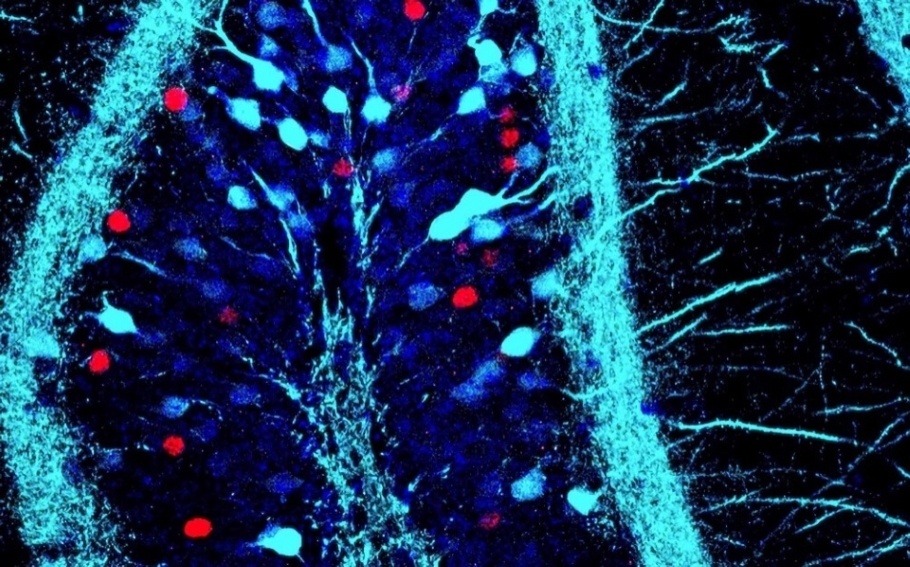
Seeing and labeling positive and negative memories is only possible with the use of an advanced neuroscience tool, called optogenetics. This is a way to trick brain cell receptors to respond to light-researchers shine a harmless laser light into the brain to turn on cells that have been given a receptor that responds to light. They can also color code positive and negative memories by inserting a fluorescent protein that is stimulated by light, so that positive memory cell networks glow green, for example, and negative cell networks glow red or blue.
Rewiring Bad Memories
Before the researchers label a memory in a mouse, they first have to make the memory. To do this, they expose the rodents to a universally good or unpleasant experience-a positive experience could be nibbling on some tasty cheese or socializing with other mice; a negative experience could be receiving a mild but surprising electrical shock to the feet. Once a new memory is formed, the scientists can find the network of cells that hold on to that experience, and have them glow a certain color.
Once they can see the memory, researchers can use laser light to artificially activate those memory cells-and, as Ramirez's team has also discovered, rewrite the negative memories. In a paper published in Nature Communications, they found that artificial activation of a positive experience permanently rewrote a negative experience, dialing the emotional intensity of the bad memory down.
The researchers had the mice recall a negative experience, and during the fear memory recall, they artificially reactivated a group of positive memory cells. The competing positive memory, according to the paper, updated the fear memory, reducing the fear response at the time and long after the memory was activated. The study builds on previous work from Ramirez's lab that found it's possible to artificially manipulate past memories.
Activating a positive memory was the most powerful way to update a negative memory, but the team also found it's not the only way. Instead of targeting just positive memory cells, they also tried activating a neutral memory-some standard, boring experience for an animal-and then tried activating the whole hippocampus, finding that both were effective.
"If you stimulate a lot of cells not necessarily tied to any type of memory, that can cause enough interference to disrupt the fear memory," says Stephanie Grella, lead author and a former postdoctoral fellow in the Ramirez Lab who recently started the Memory & Neuromodulatory Mechanisms Lab at Loyola University.
Even though artificially activating memories is not possible to do in humans, the findings could still translate to clinical settings, Grella says.
"Because you can ask the person, 'Can you remember something negative, can you remember something positive?'" she says-questions you can't ask a mouse.
She suggests that it could be possible to override the impacts of a negative memory, one that has affected a person's mental state, by having a person recall the bad memory, and correctly timing a vivid recall of a positive one in a therapeutic setting.
"We know that memories are malleable," Grella says. "One of the things that we found in this paper was that the timing of the stimulation was really critical."
The Quest for Game Changers
For other more intensive types of treatment for severe depression and PTSD, Grella suggests that it could eventually be possible to stimulate large swaths of the hippocampus with tools like transcranial magnetic stimulation or deep brain stimulation-an invasive procedure-to help people overcome these memory-related disorders. Ramirez points out that more and more neuroscientists have started to embrace experimental treatments involving psychedelics and illicit drugs. For example, a 2021 study found that controlled doses of MDMA helped relieve some severe PTSD symptoms.
"The theme here is using some aspects of reward and positivity to rewrite the negative components of our past," Ramirez says. "It's analogous to what we're doing in rodents, except in humans-we artificially activated positive memories in rodents, and, in humans, what they did was give them small doses of MDMA to see if that could be enough to rewrite some of the traumatic components of that experience."
These types of experiments point to the importance of continuing to explore the clinical and beneficial methods of memory manipulation, but it's important to note that these experiments were done under close medical supervision and shouldn't be attempted at home.
For now, Ramirez is excited to see how this work can further push the boundaries in neuroscience, and hopes to see researchers experiment with even more out-of-the-box ideas that can transform medicine in the future:
"We want game changers, right? We want things that are going to be way more effective than the currently available treatment options."
Insights, Analysis, and Developments
Editorial Note: What makes this research so significant is not just that it maps where good and bad memories live in the brain, but that it demonstrates we can actually change how a negative memory feels by correctly timing the recall of a positive one. The Boston University team's work in mice has already shown that competing positive memories can dial down fear responses - and the researchers believe this principle could translate to human therapeutic settings, where a clinician might guide a patient through structured recall of both painful and positive experiences. Combined with emerging treatments like transcranial magnetic stimulation and carefully supervised use of MDMA for severe PTSD, these findings suggest we are getting closer to a future where traumatic memories no longer have to define a person's mental health - and that is a prospect worth paying serious attention to.*
Attribution/Source(s): This peer-reviewed publication was selected for publishing by the editors of Disabled World (DW) due to its relevance to the disability community. Originally issued as a press release by Boston University and published on 3 Oct 2022. Last updated on 19 Feb 2026. This content may have been edited for style, clarity, or brevity.
* Editorial additions by Ian C. Langtree.