Inflatable Courts Expand Bocce Access in Hong Kong
Author: Packaworld
Published: 15 Oct 2018 - Updated: 17 Dec 2025
Publication Type: Product Release, Update
Table of Contents:
Synopsis - Overview - Insights, Updates - Related Content
Synopsis
This report documents how high-quality inflatable bocce courts from Packaworld International are addressing accessibility barriers in Hong Kong. Bocce is among the fastest-growing sports for Special Olympics athletes, yet many in Hong Kong lack access to proper facilities. The portable courts, which take up less time and space compared to traditional wooden or PVC pipe setups, have already demonstrated success in the United States, New Zealand, and Australia. Special Olympics Hong Kong leadership noted the equipment could be a game-changer for expanding bocce participation across different levels of their program. The courts include wheelchair-accessible gates, making the sport viable for athletes with mobility limitations. This straightforward solution to equipment portability has practical significance for disability sports organizations seeking to expand athletic opportunities where facility constraints otherwise prevent participation.*
Overview
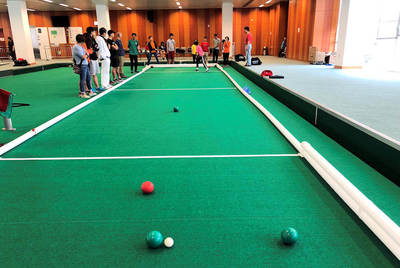
An inflatable bocce court that is making the sport more accessible around the world was introduced to Special Olympics athletes and coaches from Hong Kong during a special training day on Saturday.
Bocce is one of the fastest growing sports for Special Olympics athletes internationally, but its accessibility to people in many parts of Hong Kong is hampered by a lack of community sports facilities and competitions.
The high-quality inflatable Packabocce courts produced by Packaworld International are highly portable, making them simple to transport to tournaments, schools and communities that wouldn't otherwise be able to play bocce.
Special Olympics Hong Kong Senior Sports Executive Sang Lee said the Hong Kong bocce training event, held at the Yuen Chau Kok Sports Centre, was a potential game changer.
"We were most impressed with the courts and it's opened our eyes to new opportunities for all levels of our bocce programme across Hong Kong. In the past we've used PVC pipe but it takes a long time to set up and is difficult to transport and store. The Packabocce courts look great and can be used to take bocce anywhere."

Thrilled
Packaworld Chief Executive Peter Roberts said he was thrilled to be able to personally introduce Hong Kong athletes and coaches to the new courts. He was confident they would help to create more opportunities for sports participation for Hong Kong-based athletes with intellectual disabilities.
"We've seen big increases in bocce participation everywhere these courts are used. Whether it's in the United States, New Zealand, Australia or elsewhere, they are really helping sports bodies to introduce the game to people who wouldn't have been able to play on proper courts otherwise."
Across the East Asian region, the number of Special Olympics athletes has grown exponentially over the past 15 years - from less than 50,000 to more than 1 million. The increase in number stemmed from greater awareness, and family and health programs that have persuaded attitude and policy changes, Mr Roberts said.
Packaworld
Headquartered in Wellington, New Zealand, Packaworld believes people should be able to play the sports they love where and when they want to, whether they are athletes competing at the highest level or everyday people enjoying a game in their local neighborhood. Through relentless innovation Packaworld has created a range of portable sports equipment that gives people the freedom to come together and play for real - real easy and real fast.
Insights, Analysis, and Developments
Editorial Note: The real value of innovations like portable bocce courts lies not in novelty but in removing the logistical friction that prevents people from simply playing the sports they enjoy. Hong Kong's embrace of this equipment reflects a larger shift in how disability sports are organized - moving away from the assumption that specialized athletes require special, hard-to-access spaces, and toward the idea that good sports just need to be available where people are. As Special Olympics participation across East Asia has grown from fewer than 50,000 athletes to over a million in just 15 years, infrastructure solutions like these become essential infrastructure for inclusion rather than optional extras.*
Attribution/Source(s): This quality-reviewed publication was selected for publishing by the editors of Disabled World (DW) due to its relevance to the disability community. Originally authored by Packaworld and published on 15 Oct 2018, this content may have been edited for style, clarity, or brevity.
* Editorial additions by Ian C. Langtree.