Free Printable Snellen Eye Charts for Home Vision Tests
Author: Ian C. Langtree - Writer/Editor for Disabled World (DW)
Published: 21 Dec 2017 - Updated: 8 Jun 2026
Publication Type: Charts, Graphs, Tables
Contents: Synopsis - Definition - Introduction - Main - Insights, Updates - Related Publications
Synopsis: This information represents a comprehensive resource for printable Snellen eye charts, offering practical tools for measuring visual acuity in home or office settings. The content draws from established ophthalmological principles dating back to Herman Snellen's original design from the 1860s and provides medically accurate explanations of visual acuity measurements, including the standard 20/20 vision benchmark and legal blindness thresholds. The resource proves particularly valuable for individuals with visual impairments, seniors experiencing age-related vision changes, and those seeking preliminary vision assessments between professional eye examinations. Its accessibility features, including detailed printing instructions and usage guidelines, make it especially useful for people with disabilities who may need convenient vision monitoring tools. The information maintains clinical accuracy while remaining accessible to general users, bridging the gap between professional ophthalmological assessment and home-based vision screening.
At a Glance
- 1 - The maximum acuity of the unaided human eye is generally thought to be around 20/10, meaning some people can naturally see better than the standard 20/20 benchmark.
- 2 - Some birds, such as hawks, are believed to have an acuity of around 20/2, giving them vision far sharper than that of humans.
- 3 - A "tumbling E" variation of the chart uses the letter E pointing in different directions, allowing people who have difficulty speaking to point and indicate which way the letter faces.
- Topic Definition: Snellen Eye Chart
A Snellen eye chart is a standardized visual testing tool, first designed by Dutch ophthalmologist Herman Snellen in the 1860s, that measures visual acuity by presenting rows of black capital letters on a white background that decrease in size from top to bottom. A person reads the chart from a set distance, typically 20 feet, covering one eye at a time, and the smallest line they can correctly identify determines their acuity score, such as the well-known 20/20 reading that represents normal vision. The chart remains one of the most common clinical methods for assessing form vision, and while printable home versions offer a convenient way to screen sight between appointments, they are intended to supplement rather than replace a comprehensive examination by a qualified eye care professional.
Introduction
The Snellen eye chart was first designed by a Dutch ophthalmologist, Herman Snellen in 1860s. Other types of commonly used eye charts include the Landolt C, and the Lea test. Below you will find several variations of printable Snellen eye charts you can download and print for home use to determine your visual acuity i.e. 20/20 vision.
Main Content
Visual Acuity
If a person cannot achieve a visual acuity of 20/200 (6/60) or above in the better eye, even with the best possible glasses, then that person is considered legally blind in the United States. A person with a visual field narrower than 20 degrees also meets the definition of legally blind.
Visual acuity (VA) is acuteness or clearness of vision - especially form vision, which is dependent on the sharpness of the retinal focus within the eye, the sensitivity of the nervous elements, and the interpretative faculty of the brain. VA is a quantitative measure of the ability to identify black symbols on a white background at a standardized distance as the size of the symbols is varied. The VA represents the smallest size that can be reliably identified. VA is the most common clinical measurement of visual function.
- A visual acuity of 20/20 is frequently described as meaning that a person can see detail from 20 feet away the same as a person with normal eyesight would see from 20 feet.
- If a person has a visual acuity of 20/40, he is said to see detail from 20 feet away the same as a person with normal eyesight would see it from 40 feet away.
Someone with 20/20 visual acuity does not have "perfect" vision, since it is quite possible to see better than 20/20. The maximum acuity of the human eye without visual aids (such as binoculars) is generally thought to be around 20/10 (6/3).
Recent developments in optometry have resulted in corrective lenses conferring upon the wearer a vision of up to 20/10. Some birds, such as hawks, are believed to have an acuity of around 20/2; in this respect, their vision is much better than human eyesight. Many humans have one eye that has superior visual acuity over the other.
What Does the Capital Letter "E" on Eye Charts Mean?
In many modern eye practices today, eye charts may be projected so that they are seen through a series of mirrors. They may also be in the form of wall-mounted or hanging charts. At the top of the chart there is typically a large letter "E" Below that letter, there are rows of capital letters, with each row progressively smaller than the previous one. In some cases, there may be numbers or pictures in place of letters. Some charts may consist of the letter "E" in decreasing sizes, pointing in different directions. This is called the "tumbling"E" chart and is used for people who have difficulty speaking, but can point to indicate which direction the "E" on a certain line on the chart is facing.
Referral to an ophthalmologist should be considered if a persons visual acuity is worse than 20/40, with glasses, if applicable, and visual impairment is interfering with their daily activities.
Printing the Charts:
- NOTE: Due to differences in monitor size and resolution, this test is not accurate when viewed on a computer.
- Be sure you select these options on your printer - Maintain aspect ratio, Use full page, Center image on page.
- To print out the eye chart below right click the chart you wish to use and save it to your desktop, you can then print it from there by right clicking and selecting print from the menu.
How to Use Eye Charts:
- The Snellen Eye Chart is read while standing 20 feet from the chart. Be sure the room you are in is well lit but is not in full sunlight.
- Test one eye at a time (cover the other eye with your hand or card etc.). The lowest line that you can read correctly is your visual acuity.
- At 20 feet (6 meters) you should try to read the letters on the row 6th from the top. If you can read that line ok it means you have visual acuity of 20/40 or better: 1/2 normal.
- Standing at 10 feet from the eye chart if the smallest letters you can read were on the 6th row from the top, this would give you an acuity of 10/40: 1/4 normal.
- If you are nearsighted, your vision will become clearer the closer you stand to the eye chart.
Free Printable Snellen Eye Charts
Snellen Chart Number 1

Snellen Chart Number 2

Snellen Chart Number 3

Snellen Chart Number 4
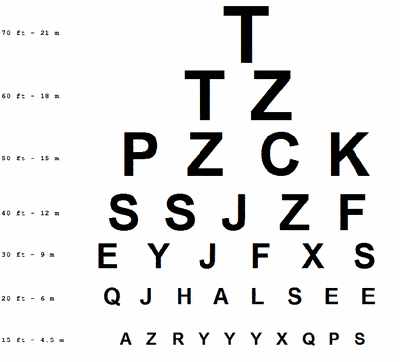
Snellen Chart Number 5

Insights, Analysis, and Developments
Editorial Note: While these printable Snellen charts provide a valuable preliminary screening tool, they serve as supplements to, not replacements for, comprehensive professional eye examinations. Regular visits to qualified eye care professionals remain essential for detecting serious conditions like glaucoma, macular degeneration, and diabetic retinopathy that cannot be identified through basic visual acuity testing alone.. Author Credentials: Ian is the founder and Editor-in-Chief of Disabled World, a leading resource for news and information on disability issues. With a global perspective shaped by years of travel and lived experience, Ian is a committed proponent of the Social Model of Disability-a transformative framework developed by disabled activists in the 1970s that emphasizes dismantling societal barriers rather than focusing solely on individual impairments. His work reflects a deep commitment to disability rights, accessibility, and social inclusion. To learn more about Ian's background, expertise, and accomplishments, visit his full biography.