Why are Grown Adults Sleeping with Stuffed Animals
Author: Rodrigo Arismendi
Published: 8 Jul 2026 - Updated: 9 Aug 2026
Publication Type: Product Release, Update
Table of Contents:
Synopsis - Definition - Overview - FAQs - Insights, Updates - Related Content
Synopsis
This article explains why so many adults still sleep with stuffed animals, blankets, or pillows, and makes the case that the habit is a practical tool rather than a sign of immaturity. Drawing on pediatrician Donald Winnicott's idea of transitional objects, it describes how steady touch and familiar sleep cues tell the nervous system it is safe to relax, the same principle that made weighted blankets popular. It reads as an easy, reassuring look at a common but rarely discussed behavior, and its plain explanation of touch and sleep may be especially useful for seniors, people living with anxiety, and readers with disabilities who rely on sensory tools to feel calm and rest well.*
At a Glance
- 1 - Surveys repeatedly find that roughly a third to half of adults still sleep with a comfort object of some kind.
- 2 - Body pillows, weighted blankets, and scented candles are widely accepted, while a plush toy on an adult's bed still carries a stigma.
- 3 - Bemellou founder Rodrigo Arismendi pairs an adult plush toy with a free wellness app as a low-pressure entry to mental health support.
Topic Definition
- Comfort Object
A comfort object, also called a transitional object, is a soft, familiar item - often a blanket, pillow, or stuffed animal - that a person keeps close for a sense of security, especially at rest. The term was introduced by pediatrician Donald Winnicott in the 1950s to describe how a child uses such an item as a bridge to feeling safe when a caregiver is absent. In adults, the same object works as a sensory cue, using steady touch and familiarity to tell the nervous system that it is safe to relax and fall asleep.
Overview
There's something a lot of adults do and almost none talk about.
They sleep with something. What exactly varies. A pillow they hold a certain way. A blanket from a decade ago. A stuffed animal that has survived six moves, high school, college, and never once made it to the donation pile.
But, the reality is still there. Surveys keep finding the same number: somewhere near a third to half of adults still sleep with a comfort object of some sort. This means that if you do, you are not the exception. Actually, each day you're getting closer to the rule. A lot of us just assumed we were the only ones.
Here's the part nobody tells you: it's not a habit you failed to outgrow. It's a mechanism. And it works.
Loneliness as a Public Health Crisis and Companionship: The WHO links loneliness to about 871,000 deaths a year, with teens most affected - a look at companionship as low-cost prevention.
The Science Your Childhood Already Knew
Years ago, in the 1950s, a pediatrician named Donald Winnicott gave these things a name. He called them transitional objects, and his observation was almost stupidly simple. A child's blanket isn't a toy. Rather, the blanket is a bridge. It is something soft and constant that lets a kid feel safe when the person who makes them feel safe isn't in the room.
The assumption for decades was that you're supposed to cross that bridge once and burn it. But, with time, humanity has come to realize how dumb this assumption is, because the need never actually goes away. We just learn to pretend. Adults don't stop needing cues of safety at night. We just stop admitting it. And the mechanics of why a soft object helps you sleep are actually physical, not childish:
1. Touch is a signal, not a luxury. Slow, constant pressure against the skin is one of the most reliable ways to shift the body out of alert mode. It's the same principle behind weighted blankets, which went from niche to a billion-dollar category once adults gave themselves permission to buy one. A plush is the same signal in a smaller package. And, funnily enough, its been working for much longer, we just didn't realize.
2. Your body sleeps when it feels accounted for. Falling asleep is, at a biological level, an act of trust. Anything that tells your nervous system you can stand down now shortens the distance between lying down and actually sleeping. We require a feeling of safety so that we can truly fall asleep. A familiar object, same texture, same weight, same place, is one of the easiest "stand down" signals that exists. It might be the literal easiest.
3. Sleep runs on cues. Same room, same darkness, same ritual. An object you hold in bed becomes part of that cue system. After a while, reaching for it is the beginning of sleep, or even better, the beginning of calm.
None of this is exotic. It's just facts. It's the same reason hotel rooms feel harder to sleep in than your bed at home.

So Why Do We Still Feel Embarrassed?
It doesn't make sense, but the reality is that somewhere along the way, we decided comfort, safety, and calm, had an age limit.
We let adults have weighted blankets, because those are "science. " We let them have body pillows, because those are "ergonomic." We let them have emotional support water bottles and $60 candles that are for anti stress. But a stuffed animal on an adult's bed somehow is taboo, even though everyone is doing it.
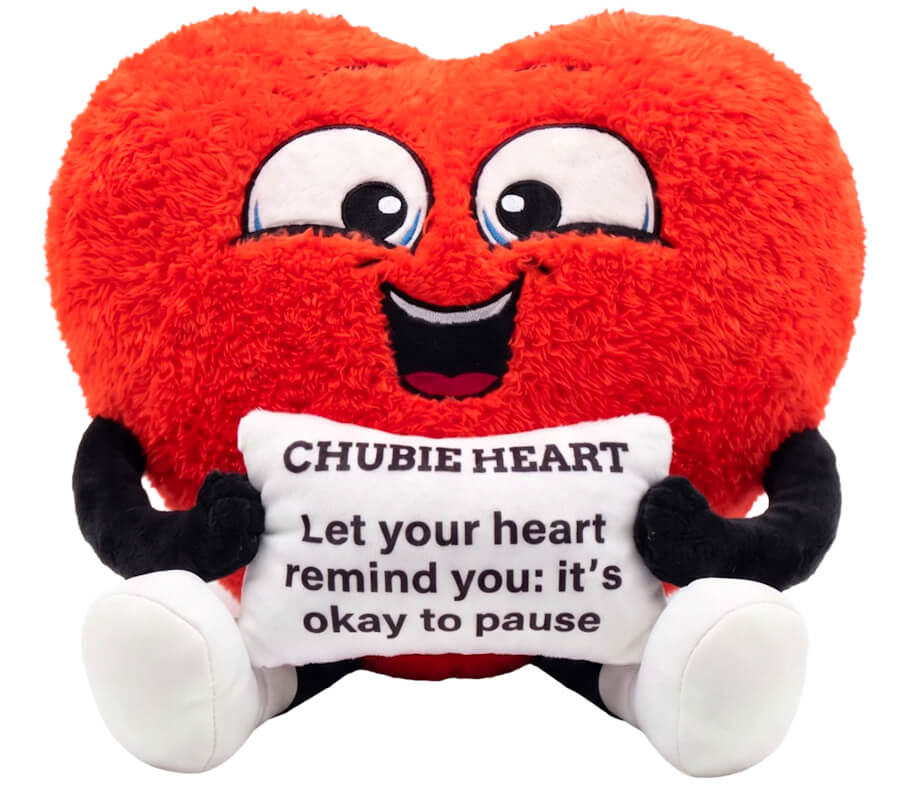
That's backwards. The blanket and the plush are doing the same job. One just never got rebranded. So, we feel it's about time we rebrand it.
What This Means For Your Bedroom
If you already sleep with something, just keep it. It's load-bearing. Don't let anyone, including yourself, shame you out of a working system. It works, and its awesome.
If you don't, but your nights are restless, it's worth treating touch as seriously as you treat your mattress or blue light, or your blackout curtains.
Here's the part where I admit my bias
I'll be honest about why I've thought about this more than a normal person probably would.
I run a company called Bemellou (https://bemellou.com), and we make exactly the thing this article is about: plushies, but for adults. On purpose. With an app and real support behind them if you want it. But, the plush is the centerpiece.
It started with a number that wouldn't leave me alone: most adults who are carrying something never reach for help. It feels too big, too formal, too much of an ordeal for problems that seem too small. But those same people could have something soft that would already do so much. And, it's way easier.
So instead of building another thing that's complicated, we sell the softest, calmest plushies for a standard price, and put the real wellness stuff behind it for free. That's the whole thing: nobody has to be convinced to hold something. They just have to be allowed to.
And you don't need our plush for any of this to be true. The research doesn't care what brand is on the tag. What matters is the permission. So here it is, in writing: you're allowed to sleep or chill while holding something. You always were. Roughly half the adults you know already do.
The only childish part was pretending otherwise. So, let's stop.
About the Writer
Rodrigo Arismendi is the CEO and founder of Bemellou, a mental wellbeing platform that pairs a plushy with a wellness app that has programs, tools, resources, sessions, and a community that meets people where they are. It is ultimately a low-pressure entry point for people who find the first step toward mental health support the hardest part.
Frequently Asked Questions
NOTE: Researched FAQs by Disabled World (DW)
How do I keep a stuffed animal I sleep with clean and hygienic?
Most plush toys can be machine washed on a gentle cycle inside a pillowcase or laundry bag and then air dried, and washing every few weeks while keeping it off the floor helps limit dust and allergens.
Can sleeping with a stuffed animal cause allergies or dust mites?
Soft toys can collect dust mites over time, so people with allergies should wash them regularly in hot water where the label allows, or seal them in a bag and freeze them overnight to reduce mites.
Is it okay for couples to sleep with comfort objects?
Yes, and many couples each keep their own comfort item, and talking about it openly usually prevents any awkwardness since the object supports sleep rather than replacing connection.
Do comfort objects help with anxiety or insomnia?
A familiar object can ease mild nighttime anxiety and support a calming bedtime routine, but ongoing insomnia or anxiety should be discussed with a doctor or mental health professional.
Are comfort objects helpful for older adults or people with dementia?
Soft, familiar items can offer reassurance and reduce agitation for some seniors, including those living with dementia, and are sometimes used in care settings as a gentle, low-cost source of comfort.
Insights, Analysis, and Developments
Editorial Note: The lasting value of this piece is its refusal to treat comfort as something we are meant to age out of, reframing a quiet and common habit as a small act of self-care rather than a secret to hide. Whether or not a reader ever buys a plush made for adults, the takeaway holds - sensory comfort is a legitimate part of good sleep, and there is nothing childish about reaching for something soft at the end of a long day.*
* Editorial additions by Ian C. Langtree.