Flex-Stick Walking Cane: Free-Standing Tripod Design
Author: Ian C. Langtree - View Credentials
Published: 5 Aug 2010 - Updated: 13 Nov 2026
Publication Type: Product Release, Update
Table of Contents:
Synopsis - Definition - Overview - FAQs - Insights, Updates - Related Content
Synopsis
This product is the Flex-Stick, a free-standing walking cane with a tripod base developed by physical therapist Randy Misenheimer after years of watching patients struggle with conventional four-legged quad canes. Its three spring-loaded legs move independently, so the base stays in contact with the ground as the cane tilts and as the surface changes from pavement to grass, gravel or brick. That lets the user walk heel to toe in a normal gait instead of the stop-and-plant pattern a rigid quad cane tends to force, while the springs take up some of the shock that otherwise travels to the hand, wrist and shoulder. The description comes from the maker, and it will interest seniors, people recovering from stroke or surgery, and anyone who wants more stability than a single-point cane without giving up a natural stride.
At a Glance
- 1 - The cane stands upright on its own when the user lets go.
- 2 - The base and legs are made to be very light, with looks considered as well as function.
- 3 - Users of ordinary single-point canes were reported to like the design too, because it is light and stays standing.
- 4 - The legs are designed to cope with brick, stone, grass, cracked or uneven pavement, gravel and rough dirt, keeping the user steady on each.
Topic Definition
- Tripod Cane
A tripod cane is a walking cane whose shaft ends in a base with three feet instead of a single tip. The wider base gives more support and stability than a standard single-point cane and allows the cane to stand upright by itself when released. Tripod canes, like four-footed quad canes, are used by people who have reduced balance, weakness on one side of the body or difficulty walking after a stroke, injury or surgery, and some designs have flexible or pivoting legs that keep the feet flat on uneven ground.
Overview
The flexSTICK allows the user to maintain a normal gait, rolling through the normal gait cycle, walking heel to toe. Designed to enhance mobility, the Flex-stick (US patent pending in 2010) is a free-standing, tripod based walking cane that 'enhances stability throughout the normal gait cycle', says Marketing VP Jamie Jordan.
What makes the flex-stick unique is that its three spring-loaded legs are independently capable of reacting to changes in both the angle of the cane and also with uneven ground surfaces. The base and leg bodies are extremely lightweight and designed with both function and aesthetics in mind. The legs absorb the impact of the ground as you walk protecting your hand, wrist, arm, shoulder and back from the repetitive impact and pain often associated with cane use.
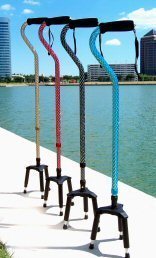
Each leg of the cane adjusts to variations of surfaces such as brick, stone, grass, uneven or cracked pavement, gravel, and rough dirt terrain, allowing you to remain confident in your stability and balance.
"I was frustrated with my patients' use and misuse of four legged quad-cane", says company President and Physical Therapist Randy Misenheimer. "After years of watching people struggle with their existing canes, I thought, There just has to be a better way. Thus, the flex-stick has come to be after several years of development. It is also exciting that users of single point canes love the flex-stick as well, because it stands by itself and is attractive and lightweight."
The resulting product is a walking cane that is free-standing, attractive, and enhances the users' ability to safely interact with the world.
Frequently Asked Questions
Which hand should hold a walking cane?
A cane is normally held in the hand opposite the weaker or painful leg, and it moves forward together with that leg.
How do I know my cane is the right height?
With your arm hanging at your side, the top of the handle should line up with the crease of your wrist. Your elbow should bend slightly, about 15 to 20 degrees, when you hold the handle.
What is the difference between a quad cane and a single-point cane?
A single-point cane has one tip and is used for light support and balance. A quad cane has a four-footed base that gives more stability and stands by itself, but it is heavier and slower to use.
Does Medicare cover walking canes?
Yes, Medicare Part B covers canes as durable medical equipment when a doctor prescribes one as medically necessary. White canes for people who are blind are not covered.
When is a walker a better choice than a cane?
A walker is usually better when both legs are weak, balance is poor, or a person needs to put a lot of weight through the arms. A cane supports only a modest share of body weight.
How often should a cane tip be replaced?
Check the rubber tip regularly and replace it when the tread is worn smooth or the rubber is cracked, since a worn tip can slip on wet or polished floors.
Can a cane be used on stairs?
Yes, going up, step first with the stronger leg and follow with the cane and the weaker leg. Going down, the cane and the weaker leg go first. Use the handrail whenever there is one.
Who can teach me to use a cane correctly?
A physical therapist can choose the right type of cane, set its height and teach the correct walking pattern.
Insights, Analysis, and Developments
Editorial Note: A cane only helps if it is the right kind, the right height and used on the correct side, and physical therapists see all three go wrong every day. A standard quad cane is stable when standing still, but all four feet must land flat together, which is why so many people end up carrying it or tipping it onto two legs. A flexible base is one answer to that problem. Whatever the design, the handle should sit level with the crease of the wrist when the arm hangs relaxed, and the cane is normally held in the hand opposite the weaker leg. Anyone who feels unsteady enough to be thinking about a cane with a wider base should ask for a gait and balance assessment, since a walker, strengthening exercises or a review of medications may turn out to be the better fix.
 Author Credentials: Ian C. Langtree is a writer, editor, and the founder and Editor-in-Chief of Disabled World, which he established in 2004 as one of the longest-running independent resources for disability news and information. Over more than two decades, he has written and edited thousands of articles on disability rights, health, accessibility, and assistive technology. Drawing on a global perspective shaped by extensive travel and lived experience, Ian is a committed advocate of the Social Model of Disability, the framework developed by disabled activists in the 1970s that focuses on removing societal barriers rather than on individual impairments. His writing is grounded in that framework and in a lasting commitment to disability rights, accessibility, and social inclusion. To learn more about Ian's background, expertise, and accomplishments, visit his full biography.