Understanding Sociology and Its Impact on Society
Author: Ian C. Langtree - Writer/Editor for Disabled World (DW)
Published: 31 Jan 2026 - Updated: 18 Aug 2026
Publication Type: Scholarly Paper
Table of Contents:
Synopsis - Definition - Overview - FAQs - Insights, Updates - Related Content
Synopsis
When you walk down a busy city street, ride public transportation, or scroll through social media, you're witnessing sociology in action. Every interaction, every social pattern, every cultural norm represents the living laboratory that sociologists study. Sociology isn't just an academic discipline confined to university lecture halls - it's a powerful lens through which we can understand the complexities of human behavior, social structures, and the forces that shape our lives. From the challenges facing seniors navigating healthcare systems to people with disabilities advocating for inclusive communities, sociology provides critical insights into how society works and, more importantly, how it can work better for everyone.
At a Glance
- 1 - Dallas recorded a 64 percent drop in excessive force reports over five years after adopting sociology-informed de-escalation programs.
- 2 - Americans aged 65 and older made up 17 percent of the population in 2020 and are projected to reach 22 percent by 2040.
- 3 - Curb cuts built for wheelchair users also help parents with strollers, delivery workers with carts, and travelers with wheeled luggage, showing how accessible design benefits everyone.
Topic Definition
- Sociology
Sociology represents the systematic study of human society, examining how people interact within groups, organizations, and broader social structures. At its core, sociology investigates the intricate relationship between individual behavior and the social forces that shape it. Rather than viewing human actions in isolation, sociologists understand that our choices, beliefs, and behaviors emerge from complex social contexts including family structures, economic systems, cultural traditions, and political institutions. The discipline extends far beyond simple observation of social life - sociologists employ rigorous research methods ranging from surveys and interviews to statistical analysis and ethnographic studies to uncover patterns in human behavior and understand the underlying causes of social phenomena. Whether investigating poverty, examining religious institutions, analyzing crime patterns, or studying family dynamics, sociology provides frameworks for understanding why societies function as they do and how social change occurs. What distinguishes sociology from other social sciences is its fundamental focus on the collective rather than the individual, revealing that many issues we might perceive as personal problems actually reflect broader structural forces operating within society.
Overview
Understanding Sociology: A Comprehensive Exploration
When you walk down a busy city street, ride public transportation, or scroll through social media, you're witnessing sociology in action. Every interaction, every social pattern, every cultural norm represents the living laboratory that sociologists study. Sociology isn't just an academic discipline confined to university lecture halls - it's a powerful lens through which we can understand the complexities of human behavior, social structures, and the forces that shape our lives. From the challenges facing seniors navigating healthcare systems to people with disabilities advocating for inclusive communities, sociology provides critical insights into how society works and, more importantly, how it can work better for everyone.
What Is Sociology?
Sociology represents the systematic study of human society, examining how people interact within groups, organizations, and broader social structures. At its core, sociology investigates the intricate relationship between individual behavior and the social forces that shape it. Rather than viewing human actions in isolation, sociologists understand that our choices, beliefs, and behaviors emerge from complex social contexts including family structures, economic systems, cultural traditions, and political institutions (American Sociological Association, 2024).
The discipline extends far beyond simple observation of social life. Sociologists employ rigorous research methods - ranging from surveys and interviews to statistical analysis and ethnographic studies - to uncover patterns in human behavior and understand the underlying causes of social phenomena. Whether investigating poverty, examining religious institutions, analyzing crime patterns, or studying family dynamics, sociology provides frameworks for understanding why societies function as they do and how social change occurs (Merriam-Webster, 2025).
What distinguishes sociology from other social sciences is its fundamental focus on the collective rather than the individual. While psychology examines individual mental processes and behavior, sociology concentrates on how groups, institutions, and entire societies influence human thought and action. This perspective reveals that many issues we might perceive as personal problems - unemployment, health challenges, educational struggles - actually reflect broader structural forces operating within society (Case Western Reserve University, n.d.).
The Historical Development of Sociology
Sociology emerged as a distinct academic discipline during the profound social upheaval of the late 18th and early 19th centuries. The Industrial Revolution, urbanization, and the decline of traditional social structures created new questions about how societies function and change. Early sociological thinkers sought to apply scientific methods to understand these dramatic transformations.
Three foundational figures shaped the development of sociology as we know it today. Émile Durkheim established sociology as a legitimate science, arguing that social facts exist independently of individuals and can be studied objectively. Karl Marx examined how economic structures and class conflicts drive social change and inequality. Max Weber analyzed how social action derives meaning from individual interpretations while also being shaped by larger social forces and authority structures (Wikipedia, 2026).
These pioneering scholars established theoretical frameworks that continue to inform sociological research. Their work demonstrated that society operates according to discernible patterns and that understanding these patterns requires systematic investigation rather than mere speculation or common sense.
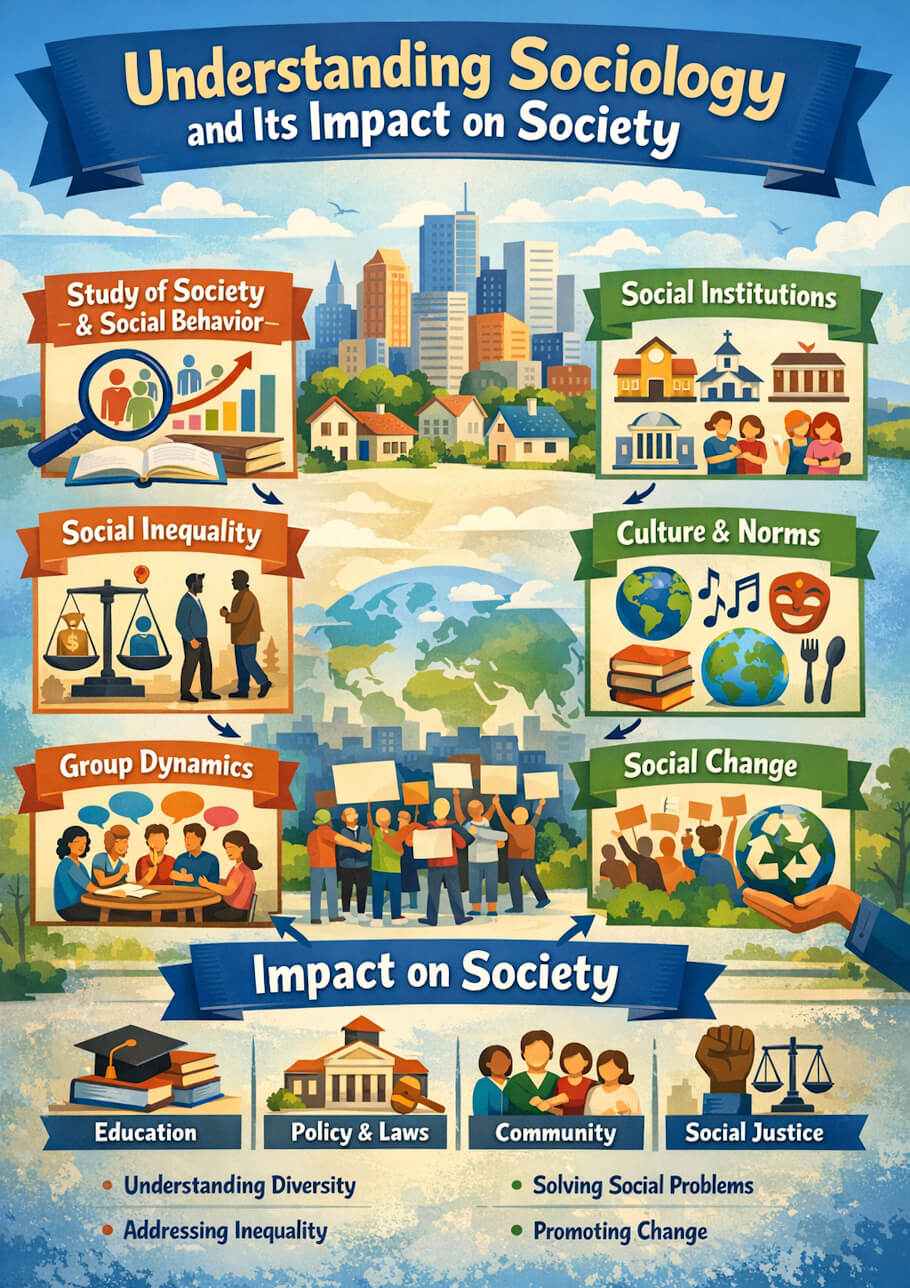
Major Branches and Types of Sociology
The breadth of sociology has led to the development of numerous specialized branches, each focusing on particular aspects of social life. Understanding these different types helps illustrate sociology's comprehensive scope.
Theoretical Sociology
Theoretical sociology focuses on developing and refining the conceptual frameworks that guide sociological research. This branch serves as a meta-analysis of the discipline itself, examining the theories and approaches sociologists use to understand social phenomena. Major theoretical perspectives include functionalism, which views society as an interconnected system where each part serves specific functions; conflict theory, which emphasizes power struggles and inequality; and symbolic interactionism, which focuses on how people create meaning through social interactions (North Central College, 2023).
Historical Sociology
Historical sociology investigates social structures and dynamics across time, tracing how societies have evolved and changed. This branch doesn't merely catalog past events but analyzes how historical developments inform contemporary social arrangements. By understanding historical patterns, sociologists can better comprehend current social issues and predict future trends (North Central College, 2023).
Medical Sociology
Medical sociology examines the social dimensions of health, illness, and healthcare systems. This field investigates how social factors - including race, class, gender, and geographic location - influence health outcomes and access to medical care. Medical sociologists study everything from doctor-patient interactions to healthcare policy, revealing how social structures shape who gets sick, who receives treatment, and who lives longer, healthier lives (Wikipedia, 2026).
Criminology
As a specialized branch of sociology, criminology focuses on crime, criminal behavior, and justice systems. Criminologists examine why people commit crimes, how societies respond to criminal activity, and what interventions might reduce crime rates. This field has profound practical applications, informing criminal justice policies, rehabilitation programs, and crime prevention strategies.
Educational Sociology
Educational sociology analyzes how educational systems both reflect and perpetuate social structures. Researchers in this field examine issues like educational inequality, the relationship between schooling and social mobility, and how education serves as a mechanism for socialization. They investigate questions such as why students from different backgrounds have varying educational outcomes and how schools can become more equitable institutions (HubSociology, 2025).
Political Sociology
Political sociology explores the relationship between society and political systems, examining power, governance, and social movements. This branch investigates how political structures influence social life and how social forces shape political processes. Political sociologists study everything from voting patterns to revolutionary movements, analyzing how power operates in society and how it can be contested.
Urban and Rural Sociology
Urban sociology focuses on life in cities, examining urbanization processes, metropolitan social structures, and the unique challenges and opportunities of urban environments. Conversely, rural sociology studies agricultural communities and non-metropolitan areas, investigating issues like rural poverty, food production systems, and the distinct social dynamics of rural life. Together, these branches help us understand how geographic contexts shape social experiences (Sociology Learners, 2020).
Environmental Sociology
Environmental sociology examines the complex relationship between human societies and the natural environment. This growing field investigates issues like climate change responses, environmental justice, sustainable development, and how societies adapt to ecological challenges. Environmental sociologists reveal how environmental problems are fundamentally social problems, requiring social solutions (HubSociology, 2025).
Digital Sociology
One of the newest branches, digital sociology, studies how digital technologies and online platforms affect social behavior, relationships, and institutions. This field examines social media dynamics, online communities, digital surveillance, and how the internet is reshaping traditional social structures. As society becomes increasingly digitally mediated, this branch gains greater importance (Wikipedia, 2026).
Family Sociology
Family sociology investigates family structures, relationships, and dynamics. This branch examines how families function as social institutions, how family forms are changing over time, and how family experiences vary across different social groups. Topics include marriage and divorce patterns, parenting practices, domestic relationships, and how families interact with other social institutions (HubSociology, 2025).
Social Demography
Social demography applies sociological perspectives to population studies, analyzing demographic patterns and their social implications. This field examines birth rates, death rates, migration patterns, and how demographic characteristics relate to social inequality and opportunity. Social demographers provide crucial data that informs both sociological research and public policy (North Central College, 2023).
Research Methods in Sociology
Sociologists employ diverse research methods to investigate social phenomena, combining both quantitative and qualitative approaches. Quantitative methods include surveys, statistical analysis, and experimental designs that produce numerical data about social patterns. These approaches allow sociologists to identify trends, test hypotheses, and make generalizable claims about populations.
Qualitative methods provide rich, detailed insights into social life through approaches like in-depth interviews, ethnographic observation, and content analysis. A sociologist might spend months observing interactions in a particular community, conducting lengthy interviews with participants, or analyzing cultural documents to understand meanings and experiences that numbers alone cannot capture.
Many contemporary sociologists also use computational methods, employing sophisticated data analysis techniques, social network analysis, and computer simulations to study complex social dynamics. These emerging approaches allow researchers to analyze massive datasets and model social processes in unprecedented ways (Wikipedia, 2026).
The Impact of Sociology on the General Population
Sociology profoundly influences society beyond academic circles, shaping public policy, social programs, and our collective understanding of social issues. Sociological research has informed criminal justice reforms, including the development of de-escalation programs that have significantly reduced police use-of-force incidents. In Louisville, such programs led to notable reductions in injuries to both officers and civilians, while Dallas saw a 64 percent drop in excessive force reports over five years (Mount Saint Vincent University, 2025).
Healthcare access and mental health policy also reflect sociological insights. When the federal government mandated equal insurance coverage for mental health treatment in 2024, this policy emerged from sociological research demonstrating how social structures affect mental healthcare accessibility. Sociologists continue developing solutions by analyzing the scope and social impact of healthcare disparities (Mount Saint Vincent University, 2025).
Educational programs, workplace policies, and community development initiatives all draw on sociological research. By revealing how social forces create and maintain inequality, sociology empowers policymakers and activists to design interventions that address root causes rather than merely treating symptoms. The discipline provides evidence-based insights that help communities understand and address challenges ranging from poverty to discrimination to environmental degradation.
Sociology's Impact on Seniors and Aging Populations
The "graying" of populations worldwide has made sociology of aging increasingly vital. With people aged 65 and older representing 17 percent of the U.S. population in 2020 and projected to reach 22 percent by 2040, understanding the social dimensions of aging has become essential (ODPHP, n.d.). Sociologists studying aging examine how social factors - not just biological changes - shape the experience of growing older.
Social Determinants of Health Among Seniors
Sociological research reveals that social determinants profoundly impact seniors' health and wellbeing. Older adults with lower incomes face higher rates of disability and earlier mortality. Research shows that disability often begins earlier for economically disadvantaged individuals, compounding health risks across the lifespan. Social isolation and loneliness among seniors correlate with increased dementia risk and other serious health conditions, while strong social connections help people live longer, healthier lives (ODPHP, n.d.).
Educational attainment significantly influences seniors' ability to navigate healthcare systems. Those with higher education levels demonstrate better health literacy, enabling them to understand medical terminology, advocate for appropriate care, and manage chronic conditions more independently. This educational advantage often translates into healthier, more fulfilling later years (University of Florida, 2025).
Theoretical Perspectives on Aging
Sociologists have developed several theoretical frameworks for understanding aging. Disengagement theory, introduced by sociologists Elaine Cumming and William Henry, suggests that aging involves a natural, mutual withdrawal from social roles as older adults step back from active participation and society makes room for younger generations. This perspective, while influential historically, has been challenged by more contemporary views (University of Florida, 2025).
Activity theory presents an alternative perspective, proposing that continued engagement in social activities promotes successful aging. According to this view, older adults who remain socially active maintain better physical and mental health. The life course perspective, currently dominant in sociology of aging, emphasizes that aging occurs across the entire lifespan. Early life events and cumulative processes of advantage or disadvantage shape outcomes in later years, meaning that understanding old age requires examining the full trajectory of life experiences (NCBI, 2013).
Social Context and Support Systems
The social context within which older individuals function continues evolving, affecting family relationships and institutional support structures. Demographic trends - including changing marriage patterns, increasing union fragility, declining nuclear family prevalence, and delayed transitions to adulthood - all influence the support available to seniors. As Baby Boomers continue aging, with approximately 10,000 people reaching age 65 daily, these social shifts have profound implications for how society cares for its elderly population (University of Florida, 2023).
Sociologists examine how economic changes affect seniors' experiences. The shift from defined benefit to defined contribution retirement plans transfers financial risk from employers to individuals, potentially leaving some seniors with inadequate retirement income. Given existing inequalities, certain groups - particularly racial and ethnic minorities with lower lifetime earnings - face greater vulnerability in managing prolonged old age. Social Security has reduced severe poverty among the elderly, but health and economic security increasingly require accumulated wealth and private retirement resources (NCBI, 2013).
Healthcare System Challenges
The aging population places increasing demands on healthcare systems. As more people live longer, prevalence of conditions like dementia, heart disease, diabetes, and arthritis rises. This demographic shift creates multiple challenges: shortages of healthcare professionals trained in geriatric care, increased resource needs across all healthcare settings, and growing demand for both institutional and home-based care services. Almost half of federal Medicaid spending on long-term care serves the elderly and disabled, with projections showing this burden will intensify as the population ages (NCBI, 2013; University of Florida, 2023).
Gerontology and Social Gerontology
Gerontology emerged as a multidisciplinary field examining aging processes and challenges faced by seniors. Social gerontology specifically focuses on social and sociological aspects of aging, seeking to understand experiences at different life stages and age-specific concerns including the dying process. Social gerontologists work as researchers, counselors, community organizers, and service providers, applying sociological insights to improve older adults' lives (OpenStax, 2021).
Addressing Ageism and Social Participation
Sociology illuminates how ageism - prejudice and discrimination based on age - affects seniors' experiences. Media representations often portray elderly people stereotypically, reflecting broader cultural attitudes that glorify youth while devaluing age. Sociological analysis reveals how these attitudes limit older adults' opportunities and social participation. By exposing ageism's structural roots, sociology contributes to developing more inclusive, age-friendly communities that recognize seniors as full, active citizens rather than dependent burdens.
Sociology's Impact on People with Disabilities
Sociology has fundamentally transformed understanding of disability through development of the social model of disability. This framework, emerging from disability rights activism in the 1960s and 1970s, represents one of sociology's most significant contributions to improving lives of people with disabilities.
The Social Model of Disability
The social model proposes that people are disabled not by their physical or mental impairments, but by systemic barriers, negative attitudes, and social exclusion. This perspective contrasts sharply with the traditional medical model, which views disability as an individual problem requiring medical intervention to "fix" or normalize the body (Disabled World (DW), 2026).
According to the social model, disability results from interaction between people with impairments and environments filled with physical, attitudinal, communication, and social barriers. A crucial distinction separates "impairment" - actual physical or mental attributes affecting a person - from "disability" - restrictions caused when society fails to accommodate different needs and abilities. For example, a person who uses a wheelchair has an impairment affecting mobility, but becomes disabled primarily when encountering stairs without accessible alternatives. The disability stems from architectural design choices rather than the person's body (People with Disability Australia, 2025).
Key Barriers Identified by the Social Model
Sociologists studying disability identify several categories of disabling barriers:
1 - Attitudinal barriers include social and cultural assumptions about people with disabilities - beliefs that they cannot work, maintain independence, have relationships, or make meaningful contributions. These attitudes perpetuate prejudice, discrimination, and exclusion. Examples include assuming disabled people need constant care, cannot make decisions, or should be objects of pity (Inclusion London, 2025).
2 - Physical and environmental barriers encompass inaccessible buildings, transportation systems, and public spaces. Stairs, narrow doorways, lack of elevators, inaccessible toilets, poor lighting, and inadequately designed urban environments all prevent equal participation. The social model emphasizes that these barriers are choices - societies could design accessible environments if prioritizing inclusion (People with Disability Australia, 2025).
3 - Communication and information barriers include lack of sign language interpretation for Deaf individuals, absence of materials in accessible formats like Braille or large print, websites incompatible with screen readers, and information presented in ways that exclude certain groups. The social model shows that information becomes inaccessible through design decisions rather than individual limitations (Inclusion London, 2025).
4 - Institutional and systemic barriers involve policies, laws, and organizational practices that exclude people with disabilities from full participation in education, employment, healthcare, and civic life. These structural barriers often reflect and reinforce ableist assumptions about who belongs and who contributes (ScienceDirect, n.d.).
Transformative Impact of Sociological Perspectives
The social model has profoundly impacted how society understands and addresses disability. By relocating the "problem" from individual bodies to social structures, this sociological framework empowers people with disabilities to advocate for rights and accommodations rather than accept exclusion as inevitable. As disability activist Mik Scarlet explains, "I'm disabled by the world around me and if the world was more accessible, I would be less disabled" (Scope UK, n.d.).
This perspective shift has driven policy changes, including the Americans with Disabilities Act (1990), which made the U.S. the first nation to ban discrimination against people with disabilities in employment, education, transportation, and other areas of public life. The United Nations Convention on the Rights of Persons with Disabilities further codified the social model internationally, marking an official paradigm shift toward viewing people with disabilities as rights-holders rather than objects of charity or medical treatment (People with Disability Australia, 2025).
Practical Applications and Universal Design
Sociological insights about disability have led to practical innovations benefiting everyone, not just people with disabilities. When sidewalks were redesigned with curb cuts to accommodate wheelchairs, parents with strollers, delivery workers with carts, and travelers with wheeled luggage all benefited. Similarly, closed captioning - originally developed for Deaf individuals - helps second-language learners, people watching videos in noisy environments, and anyone trying to understand rapid or accented speech (University of Minnesota Duluth, n.d.).
This pattern illustrates a key sociological insight: designing for diversity strengthens communities for everyone. Universal design principles emerging from disability studies create more flexible, inclusive environments that accommodate human variation rather than enforcing narrow standards of "normalcy."
Intersectionality and Disability
Contemporary sociological research examines how disability intersects with other social identities and systems of inequality. People with disabilities who are also members of racial minorities, LGBTQ+ communities, or economically marginalized groups face compounded barriers. Sociologists investigate these intersections to understand how multiple forms of oppression interact and to develop more comprehensive approaches to social justice.
Continued Challenges and Sociological Responses
Despite progress, people with disabilities continue facing substantial barriers. Sociological research continues documenting persistent discrimination, inadequate accommodations, and social exclusion while proposing evidence-based solutions. By revealing how social arrangements disable people and by demonstrating that alternative arrangements are possible, sociology empowers movements for disability rights and inclusion.
The social model reminds us, as one activist stated, that "ableism needs the cure, not our bodies" (PMC, n.d.). This powerful reframing - made possible through sociological analysis - shifts focus from changing individuals to transforming society, from seeking medical fixes to demanding civil rights, from viewing disability as tragedy to recognizing it as human diversity deserving accommodation and respect.
Contemporary Trends and Future Directions
Sociology continues evolving to address emerging social challenges. Recent research priorities include examining artificial intelligence's social impacts, understanding how globalization reshapes communities, investigating climate change's social dimensions, and analyzing growing health inequalities. Fields like digital sociology, environmental sociology, and computational sociology represent expanding frontiers where sociological methods illuminate pressing contemporary issues (Scientific World Info, 2025).
The discipline increasingly embraces global perspectives, recognizing that social phenomena transcend national boundaries. Sociologists now examine transnational social movements, global economic systems, international migration, and how local communities interact with worldwide forces. This global turn reflects sociology's ongoing commitment to understanding social life in all its complexity.
Conclusion: Sociology's Enduring Relevance
Sociology matters because it reveals the invisible structures shaping our lives and provides tools for creating more just, equitable societies. Whether examining how aging populations navigate healthcare systems, how people with disabilities encounter environmental barriers, or how any of us navigate the complex social world, sociology offers invaluable insights. The discipline demonstrates that many challenges we face are not inevitable consequences of individual limitations but products of social arrangements we can change.
As societies grow more diverse, interconnected, and complex, sociology's importance only increases. By illuminating patterns in social life, exposing structures of inequality, and imagining alternative possibilities, sociology empowers us to understand our world and work toward improving it. From policy reforms reducing police violence to accessibility requirements creating inclusive communities to healthcare initiatives addressing mental health disparities, sociological research translates into tangible improvements in people's lives. Understanding sociology means understanding ourselves - not just as isolated individuals but as social beings whose experiences, opportunities, and challenges are fundamentally shaped by the societies we inhabit and help create.
References
American Sociological Association. (2024). What is sociology?
Case Western Reserve University. (n.d.). What is sociology? Department of Sociology.
HubSociology. (2025). Exploring the major branches of sociology.
Inclusion London. (2025). The social model of disability and the cultural model of deafness.
Merriam-Webster. (2025). Sociology. In Merriam-Webster dictionary.
Mount Saint Vincent University. (2025). A degree in sociology today: Examining current social issues shaping the field.
National Research Council. (2013). New directions in the sociology of aging. National Academies Press.
North Central College. (2023). 13 types of sociology.
Office of Disease Prevention and Health Promotion. (n.d.). Social determinants of health and older adults. Healthy People 2030.
OpenStax. (2021). Who are the elderly? Aging in society. In Introduction to sociology (3rd ed.).
People with Disability Australia. (2025). Social model of disability.
Disabled World (DW). (2026). Models of Disability: Types and Definitions
PMC. (n.d.). Rethinking disability: The social model of disability and chronic disease.
Scientific World Info. (2025). Fields of sociology: How many branches of sociology are there?
Scope UK. (n.d.). Social model of disability.
ScienceDirect. (n.d.). Social model of disability - An overview.
Sociology Learners. (2020). Branches of sociology.
Field of sociology: Branches, subfields & types.
University of Florida. (2023). The impacts of an aging population on society. Online Graduate Programs in Innovative Aging Studies.
University of Florida. (2025). Sociological perspectives on aging and geriatric care. Online Graduate Programs in Innovative Aging Studies.
University of Minnesota Duluth. (n.d.). The social model of disability. Information Technology Systems and Services.
Wikipedia. (2026). Sociology.
Frequently Asked Questions
What is the difference between sociology and anthropology?
Sociology tends to focus on modern, often industrialized societies and their institutions, while anthropology traditionally studies human cultures across a wider span of time and place. The two fields overlap, but anthropology leans heavily on cultural and ethnographic study, whereas sociology often works with large-scale social patterns and data.
What kinds of jobs can a sociology degree lead to?
Graduates work in fields such as social research, public policy, human resources, community organizing, education, and health services. The degree also supports careers in market research, nonprofit management, and criminal justice, since employers value skills in data analysis and understanding human behavior.
Is sociology considered a science?
Yes, sociology is a social science that relies on systematic research methods, evidence, and testing rather than opinion or guesswork. Émile Durkheim helped establish it as a legitimate science by arguing that social facts can be studied objectively.
How does sociology differ from social work?
Sociology is primarily a research discipline that studies and explains how societies function, while social work applies knowledge directly to help individuals, families, and communities. Many social workers draw on sociological findings, but their focus is practical intervention rather than analysis.
What is the sociological imagination?
The sociological imagination is the ability to connect personal experiences to larger social and historical forces, a concept popularized by sociologist C. Wright Mills. It helps people see how private troubles, such as losing a job, often reflect broader public issues within society.
Can sociology help address climate change?
Yes, environmental sociology studies how human societies interact with the natural world and why environmental problems are also social problems. Researchers examine climate responses, environmental justice, and sustainable development to help design solutions that people will actually adopt.
Insights, Analysis, and Developments
Editorial Note: Sociology matters because it reveals the invisible structures shaping our lives and provides tools for creating more just, equitable societies. Whether examining how aging populations navigate healthcare systems, how people with disabilities encounter environmental barriers, or how any of us navigate the complex social world, sociology offers invaluable insights. The discipline demonstrates that many challenges we face are not inevitable consequences of individual limitations but products of social arrangements we can change. As societies grow more diverse, interconnected, and complex, sociology's importance only increases. By illuminating patterns in social life, exposing structures of inequality, and imagining alternative possibilities, sociology empowers us to understand our world and work toward improving it. From policy reforms reducing police violence to accessibility requirements creating inclusive communities to healthcare initiatives addressing mental health disparities, sociological research translates into tangible improvements in people's lives. Understanding sociology means understanding ourselves - not just as isolated individuals but as social beings whose experiences, opportunities, and challenges are fundamentally shaped by the societies we inhabit and help create.
 Author Credentials: Ian is the founder and Editor-in-Chief of Disabled World, a leading resource for news and information on disability issues. With a global perspective shaped by years of travel and lived experience, Ian is a committed proponent of the Social Model of Disability, a transformative framework developed by disabled activists in the 1970s that emphasizes dismantling societal barriers rather than focusing solely on individual impairments. His work reflects a deep commitment to disability rights, accessibility, and social inclusion. To learn more about Ian's background, expertise, and accomplishments, visit his full biography.