Cat Training Helps Kids With Disabilities and Cats
Author: Oregon State University
Published: 4 Aug 2026 - Updated: 6 Aug 2026
Publication Details: Peer-Reviewed | Findings
Table of Contents:
Synopsis - Definition - Overview - FAQs - Insights, Updates - Related Content
Synopsis
This research, a peer-reviewed study led by Oregon State University and published in the journal Animals, examined a cat-assisted training program involving 36 children ages 8 to 17 and their family cats, with half assigned to six 45-minute training sessions plus weekly homework and the other half serving as a control group. The findings matter for families of children with developmental disabilities, occupational and animal-assisted therapy practitioners, and cat owners interested in the growing movement to train cats, because they show cats can act as willing partners rather than passive pets. Children in the training group reported greater responsibility for cat care, more children taught their cats new behaviors and walked them, and several cats shifted from insecure to secure attachment classifications, strengthening the bond in both directions. The work is credible because it used repeated standardized surveys at three time points, videotaped and scored measurable cat behaviors such as time spent within a one-meter radius of the child, and drew on more than a decade of the lead researcher's study of the human-cat relationship.*
At a Glance
- 1 - All participants attended every one of the six training sessions.
- 2 - Six cats shifted from an insecure to a secure attachment classification with their child.
- 3 - Children who reported teaching their cats new things rose from 44% before training to 94% afterward.
- 4 - Sociability was measured by how long a cat kept at least one paw within a taped one-meter semi-circle around the child.
Topic Definition
- Animal-Assisted Intervention
An animal-assisted intervention is a structured, goal-oriented practice that deliberately incorporates animals into health, education or therapeutic settings to support a person's physical, psychological and social well-being. Rather than treating the animal as a simple companion, these programs pair trained guidance with meaningful human-animal interaction, so that activities such as teaching a cat to sit or walk on a leash become vehicles for building responsibility, emotional attachment and healthy behavior, particularly for children and adolescents facing developmental, learning or behavioral challenges.
Overview
Cat Training Program Helps Children With Developmental Disabilities - and Cats Too
A cat-training program for children with developmental disabilities fostered healthy child behaviors, strengthened relationships between children and their family cats and improved cats' social behavior, a new study found.
"People often underestimate what cats can contribute to human-animal interventions," said Monique Udell, a professor at Oregon State University who studies human-animal interactions. "This study shows that cats can be active participants rather than passive companions. When children and their cats work together through training, it can strengthen their bond while supporting positive outcomes for both the child and the cat."
The study, co-led by Udell and Megan MacDonald, a professor of kinesiology at Oregon State, builds on growing interest in animal-assisted interventions to promote physical, psychological and social well-being of people. The interventions are increasingly recognized as a promising approach to help children, including those with physical or learning disabilities or social, emotional or behavioral challenges.
Dogs and horses have received most of the attention. Udell wanted to explore whether cats could play a similar role. She has studied the human-cat bond for more than a decade and has found that cats, like dogs, are a social species and possess many of the same traits, such as the ability to form attachment bonds with humans and the ability to be trained.
The study also arrives at a time that Udell called a "cultural shift" involving cats. She mentioned people wanting to train their cats and the adventure cats movement, in which people increasingly want to take their cats on walks, camping or even kayaking.
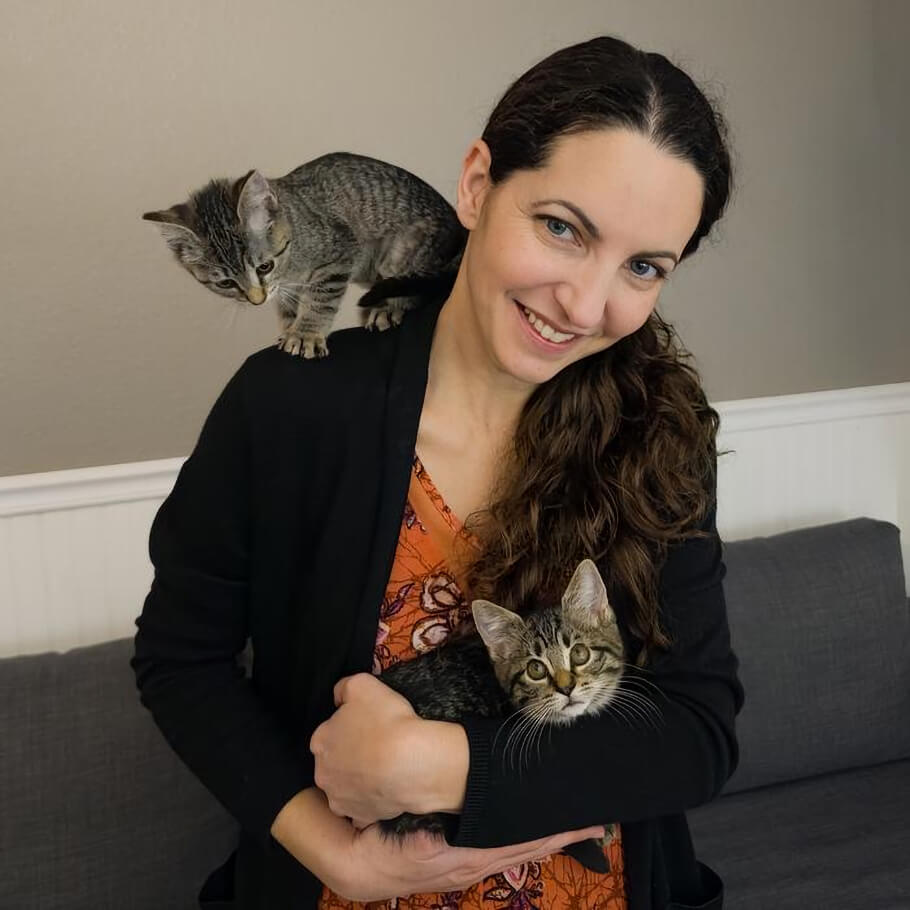
For the study, the researchers evaluated a cat-assisted training intervention with 36 children ages 8-17 and their family cats. Half of the participants were assigned to the training group who took part in six, 45-minute training sessions and completed weekly homework, such as practicing training mechanics and teaching behaviors such as sit and come. The other half served as the control and didn't take part in the activities.
Children were given three different surveys at three different points during the study: before it started, six weeks after it concluded and one year after it started. The surveys assessed the strength of the child's attachment to the cat; responsibility for cat-related chores; and humane behavior towards the cat.
The researchers also examined cat attachment to the child and cat sociability in the presence of the child by videotaping the standardized training sessions and assessing the video for certain behaviors. For example, sociability was measured by how much time a cat had at least one paw within a taped semi-circle encompassing a 1-meter radius around the child.
Findings Included
Children in the training group demonstrated a significant increase in a cat care responsibility survey while those in the control group reported a decrease.
Children in the training group who reported teaching their cats new things increased from 44% before the training sessions to 94% post-training, and the proportion who walked their cats increased from 28% to 78%.
Children consistently attended the training sessions and completed the homework, both signs of the program having a stronger impact, the researchers noted. All participants attended all six training sessions, and there was a mean homework completion rate of 81%.
The number of cats with what researchers defined as secure attachments to their child increased, with six cats moving from an insecure to a secure classification.
"This helps demonstrate that when we provide the right opportunities and guidance on how children and adolescents can improve their relationships with their cats, we can see positive changes happen," Udell said. "The cats are becoming more confident. They're becoming more social. And they're developing stronger bonds that the children are benefiting from too. They're seeing these cats now as partners; a source of motivation to take on more responsibility and engage in healthy behaviors. This can be a really special relationship that's more complex than people have sometimes believed that they can have with a cat."
Other co-authors of the paper are Delaney Frank, Saethra Darling, Kristin Moore of Oregon State, and Kristyn Vitale of Maueyes Cat Science and Education.
Frequently Asked Questions
NOTE: Researched FAQs by Disabled World (DW)
Can any breed of cat take part in a training program like this
Most domestic cats can learn basic behaviors regardless of breed since training relies on positive reinforcement and the cat willingness to engage rather than any breed-specific trait, though individual personality and temperament influence how quickly a cat responds.
What kind of rewards work best when training a cat to sit or come
Small pieces of a high-value food treat that the cat does not normally get work best, often paired with a clicker or a consistent verbal marker, and rewards should be given immediately so the cat links the treat to the correct behavior.
How long does it usually take before a cat learns a new behavior
Many cats begin to show a simple learned behavior within a few short sessions when training is consistent, though full reliability can take several weeks of brief daily practice kept to just a few minutes at a time to avoid frustration.
Is it safe to walk a cat on a harness outdoors
Walking a cat can be safe when you use a properly fitted harness rather than a collar, introduce it gradually indoors first, and choose quiet outdoor spaces away from dogs and traffic so the cat feels secure.
At what age can a cat start learning training behaviors
Cats can begin learning at almost any age since both kittens and adult cats are capable of forming new associations, so older cats can pick up behaviors too even if they may take a little more patience.
Do children need adult supervision during cat training sessions
Adult guidance is helpful especially early on to model gentle handling, keep sessions positive, and ensure the cat is not stressed, which supports both the child learning and the cat comfort throughout the process.
What signs show that a cat is stressed and needs a break from training
Signs a cat needs a break include flattened ears, a swishing tail, dilated pupils, trying to move away, or crouching low, and stopping the session when these appear helps keep training a positive experience for the cat.
Insights, Analysis, and Developments
Editorial Note: The timing of this work reflects what Udell calls a cultural shift around cats, from the growing "adventure cats" movement of owners taking their pets walking, camping and even kayaking to a broader appetite for training felines the way people train dogs. That shift matters for the many households where a cat is already a fixture, because it reframes the animal as a willing collaborator rather than an aloof bystander. For children building responsibility and routine, a family cat that walks on a leash or learns to sit and come can become a genuine source of motivation, and the study's year-long survey window suggests these gains are not merely a novelty that fades once the sessions end.*
Attribution/Source(s): This peer-reviewed publication was selected for publishing by the editors of Disabled World (DW) due to its relevance to the disability community. Originally issued as a press release by Oregon State University and published on 4 Aug 2026. Last updated on 6 Aug 2026. This content may have been edited for style, clarity, or brevity.
* Editorial additions by Ian C. Langtree.