Single Brain Implant Restores Both Vision and Touch
Author: Chalmers University of Technology
Published: 30 Jun 2026 - Updated: 9 Aug 2026
Publication Type: Literature / Review
Table of Contents:
Synopsis - Definition - Overview - FAQs - Insights, Updates - Related Content
Synopsis
This research, a peer-reviewed review published in Nature Reviews Bioengineering, brings together two fields that spent more than 50 years working apart and shows that the brain-computer interface technology behind artificial vision and artificial touch is almost the same. Led by Giacomo Valle at Chalmers University of Technology in Sweden, it carries weight because it is the first side-by-side comparison of visual and somatosensory cortical prostheses, drawing on decades of clinical trial results and the experience of researchers across Europe and the United States. For people living with sight loss, paralysis, or other untreatable conditions, including seniors and people with disabilities, the findings point toward a single, more accessible approach to restoring lost senses within a faster time frame.*
At a Glance
- 1 - Valle envisions a single hospital department where patients could go for sense restoration.
- 2 - The interfaces implant a microelectrode directly into the brain, bypassing damaged pathways to mimic natural sensation.
- 3 - The review compares electrode types, artificial visual and tactile experiences, clinical trial results, and the technical and clinical barriers that remain.
Topic Definition
- Cortical Brain-Computer Interfaces
A cortical brain-computer interface is a system that places tiny electrodes directly into the cerebral cortex so the brain can exchange signals with an outside device such as a camera or a bionic hand. By electrically stimulating the right region of the brain, it recreates a sensation the body can no longer produce on its own, working around nerves or sensory organs that have been damaged or lost. The same basic approach can restore either sight, through visual cortical prostheses, or the sense of touch, through somatosensory cortical prostheses, which is why a technology once split across two separate fields is now being treated as one.
Overview
Restoring Lost Senses: One Technology for Both Artificial Vision and Touch
Patients with untreatable conditions such as sight loss or loss of motor-function could be closer to a viable technology for restoring their lost sense, within a faster time frame. This is due to the discovery that advanced brain interfacing technology used for both touch and vision prostheses is in fact almost the same, despite being developed completely separately for more than 50 years. The review in which this discovery has first been made was published in Nature Reviews Bioengineering, and was led by Giacomo Valle, Assistant Professor at Chalmers University of Technology, in Sweden.
Despite being developed separately, brain-computer interfaces or BCIs are an emerging field of technology that are being used for restoring more than one lost sense in the body, with visual cortical prostheses (VCP) for vision, and somatosensory cortical prostheses (SCP) for touch.
BCIs work by implanting a microelectrode directly into the brain, to enable direct communication between the brain and external devices (such as a camera or a bionic hand). They can bypass the damaged pathways in the body by directly stimulating a specific region of the brain and mimicking a natural sensation in a patient.
"This technology presents a real step forward for patients with otherwise untreatable conditions, in both the fields of sight-loss and loss of motor-function (such as paralysis), giving the ability to control movements, communicate or regain tactile sensation or vision, which previously was not possible", says Giacomo Valle.
One Technology, Two Separate Senses
Natural vision and touch have common neural and computational principles in the body; whereby complex information is gathered from the outside world (via the eye or the skin/hand) and converted into an electrical signal for the brain. Both fields of research have therefore been able to use similar technology to replicate these sensations artificially, with the BCIs placed in different regions of the brain. Yet neither field has spoken to each other until now.
"Normally people work on artificial touch or artificial vision. Researchers go to different conferences and deal with very different conditions and different patients, in different areas of the hospital. There has been parallel development for both senses, but we never talked about this on a global level. Until now, we hadn't seen this as a common challenge", says Valle.
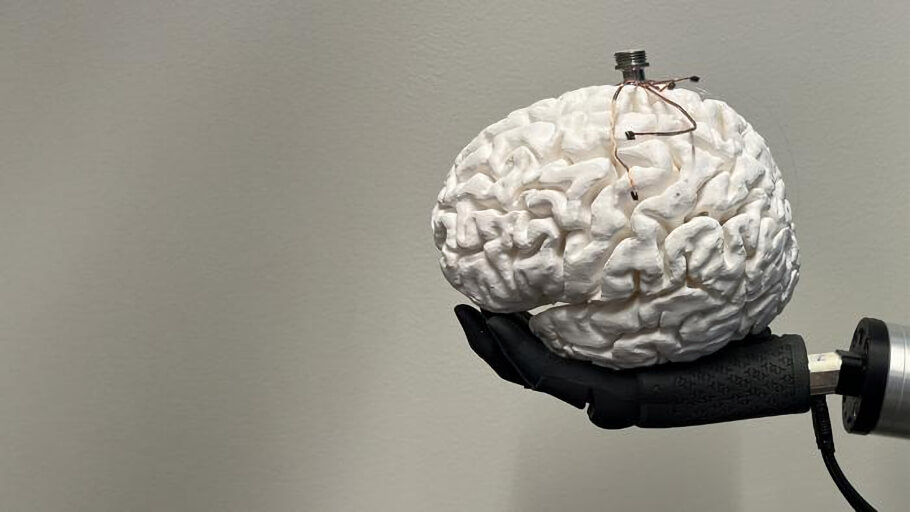
The Inspiration Behind the Review
The review paper 'Restoring vision and touch with cortical microstimulation' compares visual and sensory prostheses side by side for the first time and discusses how the two fields of research can learn from each other. It looks into how electrical stimulation of the cerebral cortex works, the types of electrodes used, how artificial visual and tactile experiences are created, the results of clinical trials to date and what technical and clinical barriers remain.
"The idea of merging the two fields of research came from the last paper that I worked on. We were going beyond restoring a simple sense of touch, moving to more complex sensations. We had to consider how to restore the sense of an edge or tactile motion. And through research, I found that the field of artificial vision was looking at the same challenge, aiming for a more complex artificial vision," says Valle.
He points out that in the past, sight-loss and paralysis have been two very different fields of research, with unique challenges and different approaches to solving how to restore these in the body. But with the ongoing and rapid development of technology, these two fields have reached a coalescence.
"Hopefully our paper opens doors for a beneficial collaboration between the two fields and brings us closer to one technology for both artificial vision and touch that would benefit both patient groups. I have a dream for the future that there is one department in the hospital where a patient can go for 'sense restoration' and our unified technology would be easily accessible for all," says Valle.
More About the Scientific Review
The review 'Restoring vision and touch with cortical microstimulation' has been published in Nature Reviews Bioengineering. The authors are Giacomo Valle, Denise Oswalt, Robert A. Gaunt, Pieter Roelfsema, Charles M. Greenspon and Eduardo Fernandez. At the time of the review, the researchers were active at Chalmers University of Technology in Sweden; University of Pennsylvania; University of Pittsburgh; Netherlands Institute for Neuroscience, VU University, Amsterdam, the Netherlands; Academic Medical Centre, Amsterdam, the Netherlands; Sorbonne Universite, Institut de la Vision, Paris, France; University of Chicago; University Miguel Hernandez, Elche, Spain; John Moran Eye Center, University of Utah; Radboud University, Nijmegen, the Netherlands.
Frequently Asked Questions
NOTE: Researched FAQs by Disabled World (DW)
How long do cortical brain-computer implants last inside the body?
The article does not specify device longevity, but implant durability over years remains one of the technical and clinical barriers researchers are still working to overcome before these prostheses can become a routine, long-term treatment.
Is the brain implant procedure reversible if a patient changes their mind?
The review does not address reversibility. Because the microelectrodes are placed directly into the cerebral cortex, removal would require further neurosurgery, and outcomes would depend on the individual case and the electrode type used.
Does the artificial vision or touch feel the same as natural sensation?
The article explains that stimulation mimics natural sensation but does not claim it is identical. Current prostheses recreate simplified experiences, and reproducing complex perceptions such as edges or tactile motion is still an active research goal.
Who would be a suitable candidate for a visual or somatosensory cortical prosthesis?
The article focuses on people with otherwise untreatable sight loss or loss of motor function such as paralysis, but it does not list specific medical eligibility criteria, which would be determined by clinical teams on a case-by-case basis.
Are these cortical prostheses currently available to the public?
The page describes the technology as an emerging field supported by clinical trials, but it does not state that the devices are commercially available. Widespread hospital access remains a future goal rather than a present reality.
What risks are associated with implanting electrodes into the brain?
The article does not detail surgical or medical risks. As with any procedure placing electrodes into the cortex, potential concerns would include surgical complications and long-term tissue response, which patients should discuss with a specialist.
Insights, Analysis, and Developments
Editorial Note: The real significance here is less about a single device than about two research communities finally recognizing they have been solving the same problem from opposite ends, and what that convergence could mean is a shorter, more practical path to giving people back a sense they had given up as lost for good.*
* Editorial additions by Ian C. Langtree.