ADA Title III: Why Churches Can Legally Exclude You
Author: Ian C. Langtree - Writer/Editor for Disabled World (DW)
Published: 28 Feb 2026 - Updated: 31 Aug 2026
Publication Type: Scholarly Paper
Table of Contents:
Synopsis - Definition - Overview - FAQs - Insights, Updates - Related Content
Synopsis
For most Americans, the idea that a public building could legally refuse to accommodate a person in a wheelchair, deny entry to a service dog, or offer no assistance to someone who is Deaf seems unthinkable in the 21st century. The Americans with Disabilities Act was supposed to put an end to exactly that kind of exclusion. But what few people realize is that the ADA contains one of the widest exemptions in all of civil rights law - one that allows religious organizations and everything they operate, from houses of worship to hospitals, schools to soup kitchens, to completely ignore the accessibility requirements that every other public-facing institution in the country must follow. It is a legal blind spot that affects tens of millions of people, costs nothing to maintain for the institutions that benefit from it, and has gone largely unchallenged for more than three decades. This paper pulls back the curtain on the ADA's Title III religious exemption, examines who it truly serves, and asks why we continue to tolerate a system that treats disability rights as optional for some of the wealthiest and most influential institutions in American life.
At a Glance
- 1 - The exemption attaches to the operator, not the activity. A church-run secular summer camp or public concert is still exempt.
- 2 - Section 504 of the Rehabilitation Act reaches only groups that receive federal funding. Most local congregations rely on donations, so it does not apply to them.
- 3 - Secular businesses face civil penalties up to 75,000 dollars for a first Title III violation and 150,000 dollars for later ones. Religious entities carry no such obligations at all.
- 4 - One sociologist estimated U.S. churches avoid roughly 71 billion dollars in taxes each year across federal, state, and local exemptions. Religious groups received about 128.2 billion dollars in contributions in 2019.
Topic Definition
- ADA Title III Exemption (Places of Worship and Services)
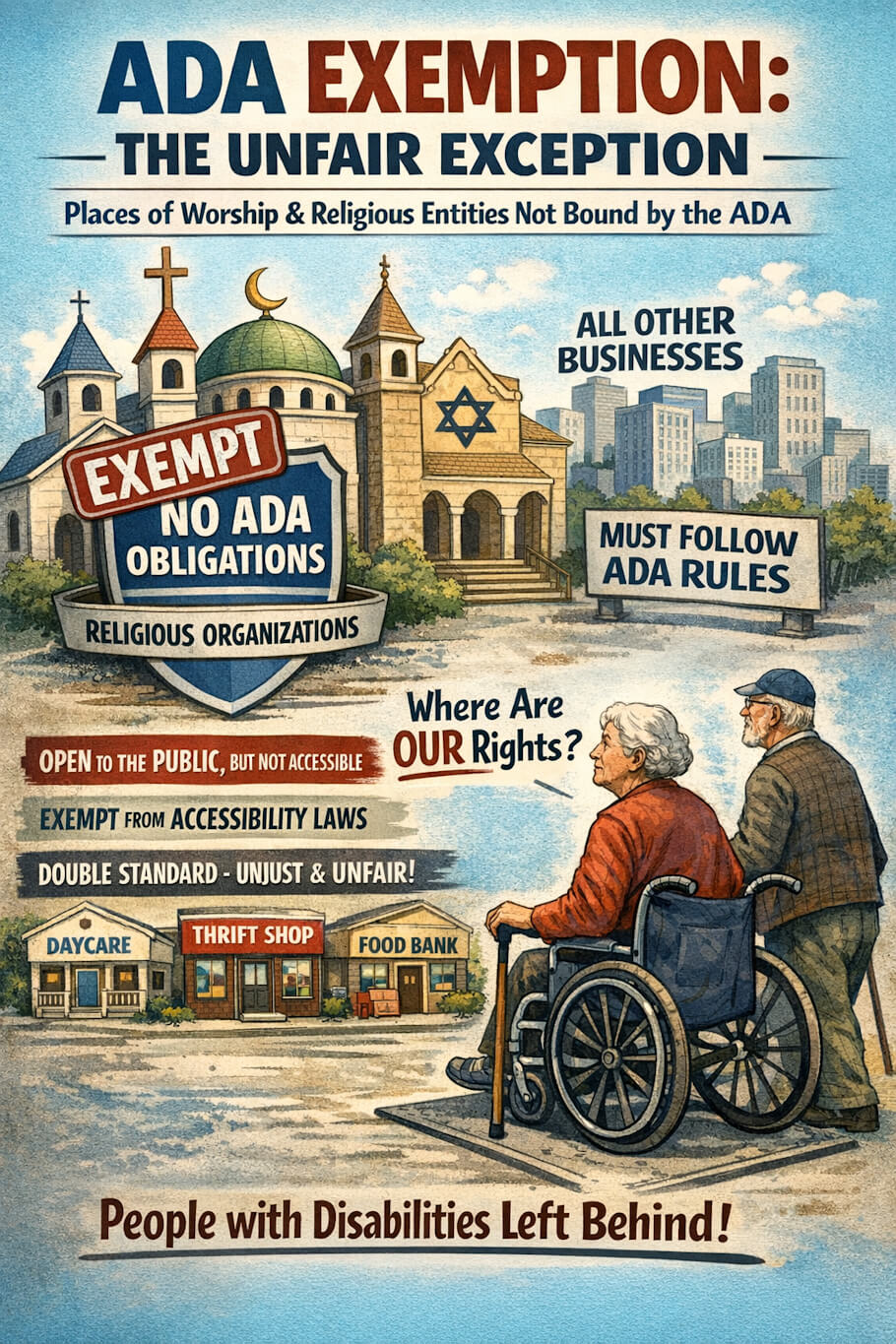
The ADA Title III Exemption for places of worship and services is the provision under Section 307 of the Americans with Disabilities Act, codified at 42 U.S.C. Section 12187, that removes religious organizations and every entity they control from the accessibility and nondiscrimination duties of Title III. In plain terms, it means that churches, mosques, synagogues, temples, and any school, daycare, hospital, thrift shop, food bank, or shelter they operate have no legal duty under the ADA to remove architectural barriers, provide auxiliary aids for communication disabilities, adjust policies, or meet federal accessibility standards - even when those facilities are open to the general public and serve people outside the faith community. The provision is grounded in First Amendment concerns about government entanglement with religion, yet critics contend it reaches well past anything the Constitution requires and leaves a broad gap in civil rights protection that falls hardest on people with disabilities and older adults who depend on faith-based services.
Overview
The Americans with Disabilities Act of 1990 was hailed as one of the most important civil rights achievements in modern American history. Signed into law by President George H.W. Bush, the ADA was designed to guarantee that people with disabilities could participate fully in public life - shopping, dining, attending school, seeking medical care, and accessing the same spaces and services everyone else takes for granted. And yet, buried in the text of this landmark legislation is a sweeping carve-out that most Americans have never heard of. Under Section 307 of the ADA, codified at 42 U.S.C. Section 12187, religious organizations and any entities they control are completely exempt from Title III of the law. That means churches, mosques, synagogues, temples, and every school, daycare center, thrift shop, hospital, food bank, and shelter they operate can legally turn away or fail to accommodate people with disabilities - with no legal consequence whatsoever (Americans with Disabilities Act, 1990). This paper examines the scope, reasoning, and real-world impact of that exemption, and asks a question that deserves a far more honest answer than it has ever received: How is this fair?
What Title III of the ADA Actually Requires
Before digging into the exemption itself, it helps to understand exactly what religious organizations are excused from. Title III of the ADA applies to what the law calls "places of public accommodation" - essentially, any privately owned facility that opens its doors to the general public and offers goods, services, or programs. The statute lists twelve broad categories covering restaurants, hotels, theaters, retail stores, doctors' offices, museums, private schools, daycare centers, gyms, and many more (42 U.S.C. Section 12181(7)). If you operate a place that serves the public, Title III requires you to make that place accessible. That means removing architectural barriers where it is readily achievable to do so, providing auxiliary aids and services for people with communication disabilities, making reasonable modifications to policies and procedures, and ensuring that new construction and alterations meet federal accessibility standards (U.S. Department of Justice, 2010).
These are not optional suggestions. They are mandatory legal obligations. A small bookshop on Main Street must comply. A family-owned restaurant must comply. A local daycare center must comply. A nonprofit community theater must comply. Violations can result in lawsuits, injunctions, and civil penalties of up to $75,000 for a first violation and $150,000 for subsequent violations (28 C.F.R. Section 36.504). The law applies broadly and with serious teeth - unless, of course, the entity in question happens to be religious.
The Scope of the Religious Exemption
Section 307 of the ADA states plainly that the provisions of Title III "shall not apply to religious organizations or entities controlled by religious organizations, including places of worship" (42 U.S.C. Section 12187). That single sentence does an enormous amount of legal work. The Department of Justice's own preamble to the Title III regulations explains that this exemption is "very broad, encompassing a wide variety of situations" and that religious organizations "have no obligations under the ADA" (28 C.F.R. Part 36, Appendix C). Not reduced obligations. Not modified obligations. No obligations at all.
And the exemption does not stop at the church door. It extends to every entity a religious organization controls. The ADA National Network, a federally funded resource, confirms that if a religious entity operates a school open to the general public, that school is still exempt. If it runs a daycare center, a food bank, a thrift store, a homeless shelter, or a hospital, all of those operations fall under the same blanket protection - regardless of whether the people they serve are members of the faith community or complete strangers walking in off the street (ADA National Network, 2022). In one striking court case, a religiously controlled hospital successfully invoked the exemption after a patient with disabilities alleged that staff withheld a communication device she needed to speak and placed her in a seclusion room as punishment. The hospital had not even raised the religious exemption in its initial defense, but the court granted summary judgment on that basis anyway (Doe v. Hospital, discussed in Bender, 2019).
What makes the scope even more troubling is how the exemption is defined. It is not limited to activities that are religious in nature. A church running a secular summer camp, a synagogue hosting a public concert, a mosque operating a community health clinic - all are exempt from Title III, even though the activities themselves have nothing to do with worship or religious practice. The exemption attaches to the identity of the operator, not to the nature of the activity. This is a crucial distinction that dramatically expands its real-world impact.
The First Amendment Justification - and Its Limits
The standard explanation for the religious exemption rests on the First Amendment to the U.S. Constitution, which protects the free exercise of religion and prohibits government establishment of religion. The argument goes roughly like this: forcing religious organizations to comply with federal accessibility regulations would constitute government interference with religious practice, creating what constitutional scholars call "excessive entanglement" between church and state (Lemon v. Kurtzman, 1971). Courts have generally upheld this reasoning, noting that requiring compliance and allowing government enforcement actions against religious institutions could violate First Amendment protections (Disability Belongs, 2022).
There is a certain logic to this position when it comes to the internal religious functions of a house of worship. Most people would agree, for instance, that the government should not dictate the layout of an altar or the design of a prayer hall. These are matters of religious expression and practice that sit squarely within the zone of First Amendment protection. But the argument becomes far less convincing when it is used to shield a church-run daycare from installing a wheelchair ramp, or to excuse a faith-based hospital from providing sign language interpreters, or to allow a religiously controlled school to deny enrollment to a child who uses a mobility device. These are secular services offered to the general public. They have secular counterparts that are fully required to comply with the ADA. The only difference is who signs the checks.
It is also worth noting that the First Amendment argument was not a neutral legal conclusion arrived at by the courts on their own. Religious institutions and organizations actively lobbied for the exemption during the drafting of the ADA. As legal scholar Kevin Timpe has documented, religious groups took the lead in advocating against inclusion in the legislation, successfully securing the carve-out before the law was even passed (Timpe, 2025). The exemption was a political achievement, not an inevitable constitutional requirement.
The Tax-Exempt Double Standard
Perhaps the most difficult aspect of the religious exemption to defend is the financial context in which it operates. Religious organizations in the United States enjoy extraordinary tax privileges. Under Section 501(c)(3) of the Internal Revenue Code, churches, mosques, synagogues, temples, and the entities they control are exempt from federal income tax. They are also exempt from most state and local property taxes, and donations made to them are tax-deductible for the donors. Unlike other 501(c)(3) organizations, churches are not even required to apply for tax-exempt status - it is granted automatically. They are also not required to file the IRS Form 990, the annual information return that other nonprofits must submit to maintain transparency (Internal Revenue Service, 2015).
The financial scale of these privileges is staggering. According to Giving USA, religious organizations received approximately $128.2 billion in contributions in 2019 alone. One sociologist of religion estimated that, in total, churches in the United States avoid paying roughly $71 billion in taxes annually when all federal, state, and local exemptions are combined (Cragun, 2021). This includes income taxes, property taxes, and sales taxes on purchases made by religious entities.
Here is where the double standard becomes impossible to ignore. Every other tax-exempt nonprofit organization in the country that operates as a place of public accommodation must comply with Title III of the ADA. A secular charity running a thrift shop must make that shop accessible. A nonprofit hospital must provide accommodations for patients with disabilities. A community organization operating a food bank must remove barriers to access. These organizations pay no federal income tax either, yet they are held to the full requirements of the law. Religious organizations alone receive both the tax benefits and the regulatory exemption. They get to keep the money and avoid the responsibility. For a small business owner who pays taxes and must also fund ADA compliance out of pocket, the comparison is not just unfair - it is genuinely insulting.
The Human Cost: Who Actually Pays the Price
Statistics tell part of the story. According to the U.S. Bureau of Labor Statistics, people with disabilities accounted for approximately 13 percent of the civilian population in 2024. Among those with disabilities, half were age 65 or older, reflecting the increased incidence of disability with age (Bureau of Labor Statistics, 2025). The Centers for Disease Control and Prevention has reported that over 70 million American adults have a disability, representing more than one in four of the adult population (CDC, 2024). These are not small numbers. These are your neighbors, your parents, your grandparents, and quite possibly your future self.
For the millions of Americans who rely on wheelchairs, walkers, canes, hearing aids, service animals, or other accommodations, the religious exemption creates a patchwork of access that is both confusing and degrading. A person who uses a wheelchair can roll into any restaurant on the block and expect a ramp and accessible seating - but the church next door has no legal obligation to provide either. A Deaf individual can demand a sign language interpreter at a public hospital, but not at the religiously affiliated hospital across town. A family with a child who has autism can enroll that child in the public school and expect reasonable accommodations, but the church-run school down the street can refuse enrollment outright with no legal recourse.
Consider the elderly. As people age, mobility impairments, vision loss, hearing loss, and cognitive challenges become increasingly common. For many older adults, their house of worship is one of the most important social institutions in their lives - a place of community, comfort, and belonging during a period when isolation is a growing public health crisis. When a church has no ramp, no elevator, no hearing loop, and no accessible restroom, it is not a theoretical policy debate. It is a person being told, in effect, that their community does not have to make room for them anymore. One commenter on a disability advocacy website captured this reality with painful clarity, describing how he and his wife, both 79, were told they could not attend their church because their legally recognized service dog was not allowed - and the church was under no obligation to change that policy (Disability Belongs, 2022).
When Secular Services Hide Behind Sacred Shields
The exemption becomes particularly problematic when religious organizations operate services that function identically to their secular counterparts. Across the United States, faith-based organizations run thousands of schools, hospitals, addiction treatment programs, homeless shelters, food pantries, and social service agencies. Many of these operations receive clients through government referrals. Many serve populations that have no other realistic option - people in rural areas where the church-run food bank is the only food bank, or communities where the only affordable daycare is operated by a local congregation.
When these services are functionally indistinguishable from their secular equivalents - when they serve the same populations, fill the same community needs, and often even receive indirect public support through their tax-exempt status - the justification for exempting them from basic accessibility requirements evaporates. A parent looking for affordable childcare does not care whether the daycare's board of directors includes a pastor. They care whether the building has a ramp for their child's wheelchair. A hungry family visiting a food bank does not care whether the volunteers are motivated by religious conviction or civic duty. They care whether the entrance is accessible and whether someone can help them if they have a visual impairment.
The exemption effectively creates a two-tiered system of public services: one in which people with disabilities have legally enforceable rights, and another - determined entirely by the religious identity of the operator - in which those rights simply do not exist. This is not religious freedom. This is the use of religious identity as a shield against civil rights obligations that every other institution in society is expected to meet.
Voluntary Compliance Is Not a Substitute for Legal Obligation
Defenders of the exemption often point out that many religious organizations voluntarily adopt accessibility measures. The National Organization on Disability has published resources encouraging faith communities to welcome people with disabilities, and some denominations have made accessibility a stated priority (Connecticut General Assembly, 2006). These voluntary efforts are commendable and should be encouraged. But they are fundamentally inadequate as a substitute for legal protection.
Voluntary compliance means that accessibility depends on the goodwill, financial capacity, and priorities of individual congregations. It means that a person with a disability cannot know, before arriving at a house of worship, whether they will be able to get through the door. It means that when a religious organization chooses not to accommodate - whether out of indifference, financial constraint, or theological conviction - the person with a disability has no legal remedy. They cannot file a complaint with the Department of Justice. They cannot sue for injunctive relief. They cannot do anything except leave and find somewhere else to go, assuming somewhere else exists.
No one would accept this framework in any other context. We do not leave fire safety up to the goodwill of building owners. We do not leave food safety up to the voluntary efforts of restaurant managers. We do not leave workplace safety up to the charitable instincts of employers. In every other area of public life, we recognize that legal requirements exist precisely because voluntary compliance is unreliable, inconsistent, and ultimately insufficient to protect the people who need protection most. The ADA itself was passed because decades of voluntary efforts had failed to produce adequate accessibility. Exempting religious organizations from the same legal framework sends a clear message: when it comes to disability rights, some institutions are simply above the law.
The Rehabilitation Act: A Partial Safety Net with Gaping Holes
There is one partial check on the religious exemption, and it is worth mentioning even though it falls far short of a solution. Section 504 of the Rehabilitation Act of 1973 prohibits disability-based discrimination by any organization that receives federal funding. The requirements of Section 504 are essentially the same as those of the ADA, meaning that a religious organization accepting federal grants or contracts would be subject to accessibility requirements through that separate law (ADA National Network, 2022).
In practice, however, this safety net has enormous gaps. The vast majority of local congregations - the neighborhood churches, mosques, synagogues, and temples where most people actually worship - do not receive direct federal funding. Their revenue comes from donations, tithes, and offerings. Section 504 simply does not reach them. And even for larger faith-based organizations that do receive federal funds, enforcement of Section 504 is inconsistent and underfunded. The result is that most religious entities operate in a regulatory vacuum when it comes to disability accessibility, with neither the ADA nor the Rehabilitation Act providing meaningful oversight.
Some state and local building codes do include accessibility requirements that apply to religious buildings, particularly for new construction and major renovations. But these codes vary dramatically from jurisdiction to jurisdiction, often contain their own religious exemptions or grandfather clauses, and rarely match the comprehensive scope of Title III. They are a patchwork, not a solution.
A Question of Values
There is a certain irony in the fact that the institutions most loudly proclaiming their commitment to welcoming all people, serving the vulnerable, and caring for those in need are also the ones that fought hardest for the legal right to exclude people with disabilities from that welcome. Nearly every major religion teaches some version of compassion for the sick, the elderly, and those who are marginalized. The Hebrew Bible commands, "You shall not curse the deaf or put a stumbling block before the blind" (Leviticus 19:14). The Christian Gospels are filled with accounts of Jesus healing people with disabilities and insisting that the marginalized be brought to the center of community life. The Quran teaches that there is no blame on those with disabilities and emphasizes the equal dignity of all people (Quran 48:17). Buddhist, Hindu, and Sikh traditions all contain teachings on compassion and inclusion.
And yet, when the moment came to translate those values into legal obligations - when Congress offered religious institutions the chance to demonstrate their commitment to inclusion through binding, enforceable standards - many of those same institutions chose the exemption instead. They chose to keep their legal right to exclude, even as they preached inclusion from the pulpit. As disability advocate and scholar Joe Carter has argued, opposition to the ADA from within religious communities represents a fundamental contradiction between what churches teach and what they practice (Carter, 2019). It is difficult to reconcile a theology of radical welcome with a legal strategy of maximum exclusion.
What Could Change - and What Should
Reforming the religious exemption would not require abolishing the First Amendment or imposing government control over religious practice. It would require something much simpler: recognizing that when a religious organization chooses to operate secular services open to the general public, those services should be held to the same accessibility standards as identical services operated by anyone else. A church that operates a daycare should meet the same standards as a secular daycare. A mosque that runs a food bank should be as accessible as a nonprofit food bank. A temple that operates a school should accommodate students with disabilities just as a public or secular private school must.
This approach - sometimes called a "functional equivalence" standard - would preserve the ability of houses of worship to make internal decisions about their religious spaces and practices while ensuring that their public-facing, secular operations do not become zones of legally sanctioned discrimination. It would not require a constitutional amendment. It would not require the government to dictate how services are conducted. It would simply require Congress to narrow an exemption that, as currently written, is far broader than any legitimate First Amendment concern demands.
Until that happens, the burden falls where it always falls in the absence of legal protection: on the people least equipped to bear it. On the elderly woman who cannot climb the stairs to her church. On the child in a wheelchair who cannot attend the only affordable preschool in the neighborhood. On the Deaf man who cannot understand the sermon because no interpreter is provided. On the veteran with PTSD whose service dog is turned away at the door. These are real people, living real lives, paying a real price for a legal exemption that serves no one's interests but the institutions that demanded it.
Conclusion
The ADA's Title III religious exemption is not a minor technicality. It is a sweeping grant of legal immunity that allows religious organizations - and every entity they control - to disregard the accessibility rights of tens of millions of Americans with disabilities. It exists not because the Constitution requires it, but because religious lobbying groups demanded it. It persists not because it serves any public interest, but because challenging it is politically difficult. And it harms not hypothetical victims, but real people who encounter real barriers every day in the places that claim to welcome everyone. The exemption is a relic of political compromise that has outlived whatever limited justification it may once have had. It is time for the law to catch up with the values that most religious traditions already profess - and that every other institution in American public life is already required to practice.
Churches Must Diversify Usage or Perish: Churches must diversify their community roles beyond worship to remain financially viable and serve as inclusive community assets.
Frequently Asked Questions
Does the ADA religious exemption apply to all religions equally
Yes, the exemption applies to any religious organization regardless of faith tradition. Churches, mosques, synagogues, temples, and the entities they control are all treated the same way under Section 307.
Can a religious organization choose to follow ADA standards voluntarily
Yes, many faith communities adopt accessibility measures on their own. However, these choices are voluntary and cannot be legally enforced by a person with a disability.
Are religious employers exempt from ADA rules for their workers
No, the exemption discussed here covers Title III public accommodations, not employment. Title I employment rules can still apply to religious employers that meet the coverage thresholds.
What can a person do if a church denies them access
Because Title III does not apply, there is usually no federal complaint or lawsuit available. A person may check state or local building codes or seek a different accessible venue.
Do state laws ever require churches to be accessible
Some state and local building codes include accessibility rules for new construction or major renovations. These vary widely and often contain their own religious exemptions or grandfather clauses.
When did the Americans with Disabilities Act become law
The Americans with Disabilities Act was signed into law in 1990 by President George H.W. Bush. It is considered a landmark civil rights statute in the United States.
What is the difference between the ADA and the Rehabilitation Act
The ADA applies broadly to public accommodations and employers regardless of funding. The Rehabilitation Act Section 504 applies only to organizations that receive federal financial assistance.
Does the exemption cover religious hospitals open to the public
Yes, a hospital controlled by a religious organization can fall under the exemption even when it serves the general public. Courts have upheld this protection in cases involving patients with disabilities.
References
- ADA National Network. (2022). Religious organizations and private clubs under the ADA. Mid-Atlantic ADA Center.
- Americans with Disabilities Act of 1990, 42 U.S.C. Sections 12101-12213 (1990).
- Bender, W. (2019). Title III religious exemption affirmative defense. Understanding the ADA.
- Bureau of Labor Statistics. (2025). Persons with a disability: Labor force characteristics - 2024. U.S. Department of Labor.
- Carter, J. (2019). Opposition to the Americans with Disabilities Act within American Christianity: A wrong that must end. Blind Injustice.
- Centers for Disease Control and Prevention. (2024). CDC data shows over 70 million U.S. adults reported having a disability. CDC Newsroom.
- Connecticut General Assembly. (2006). Churches and handicapped accessibility requirements. Office of Legislative Research Report 2006-R-0756.
- Cragun, R. (2021). Amid calls to #TaxTheChurches - what and how much do U.S. religious organizations not pay the taxman? The Conversation.
- Disability Belongs. (2022). 32 years after the ADA, people with disabilities still are left behind in faith institutions.
- Internal Revenue Service. (2015). Tax guide for churches and religious organizations (Publication 1828). U.S. Department of the Treasury.
- Lemon v. Kurtzman, 403 U.S. 602 (1971).
- Timpe, K. (2025). Private religious schools and disability discrimination. Touro Law Review, 40(3).
- U.S. Department of Justice. (2010). 28 C.F.R. Part 36: Nondiscrimination on the basis of disability by public accommodations and in commercial facilities.
Insights, Analysis, and Developments
Editorial Note: The ADA's religious exemption under Title III is not simply an overlooked clause in an aging statute - it is an active, ongoing policy choice that privileges institutional autonomy over human dignity. Every day that it remains unchanged, people with disabilities and elderly Americans are being told, in practical terms, that their right to participate in community life stops where religious property lines begin. The cruel irony is that most faith traditions preach the very inclusion the law does not require them to practice. Reform does not demand the end of religious freedom; it demands only that secular services operated by religious organizations meet the same accessibility standards expected of every other entity in the country. Until Congress acts, the exemption stands as one of the most glaring double standards in American civil rights law - a reminder that even landmark legislation can contain provisions that betray the very people it was written to protect.
 Author Credentials: Ian is the founder and Editor-in-Chief of Disabled World, a leading resource for news and information on disability issues. With a global perspective shaped by years of travel and lived experience, Ian is a committed proponent of the Social Model of Disability, a transformative framework developed by disabled activists in the 1970s that emphasizes dismantling societal barriers rather than focusing solely on individual impairments. His work reflects a deep commitment to disability rights, accessibility, and social inclusion. To learn more about Ian's background, expertise, and accomplishments, visit his full biography.