Why Karaoke-Style Captions Can Exclude Disabled Users
Author: Ian C. Langtree - View Credentials
Published: 12 Jul 2026 - Updated: 9 Aug 2026
Publication Type: Paper, Essay
Table of Contents:
Synopsis - Definition - Overview - FAQs - Insights, Updates - Related Content
Synopsis
They are everywhere on our feeds - the bouncing, color-shifting words that light up one at a time in perfect step with the speaker - and they look undeniably slick, but behind the polish sits a quiet accessibility problem that few creators ever notice, because the animation, the word-by-word reveal and the burned-in highlight can outrun slow readers, overwhelm working memory, override reduced-motion settings and vanish from the reach of screen readers, turning the one feature meant to open a video up into the very thing that shuts people out.
At a Glance
- 1 - Because each word appears only as it is spoken, viewers cannot read ahead, forcing them to keep pace with talking speed rather than their own reading speed.
- 2 - Burned-in animated captions cannot be resized, recolored, repositioned or read by screen readers, stripping away the customization that low-vision users depend on.
- 3 - Constant caption motion ignores system-wide reduced-motion preferences and can trigger dizziness, nausea and migraine in people with vestibular disorders.
Topic Definition
- Karaoke Captions
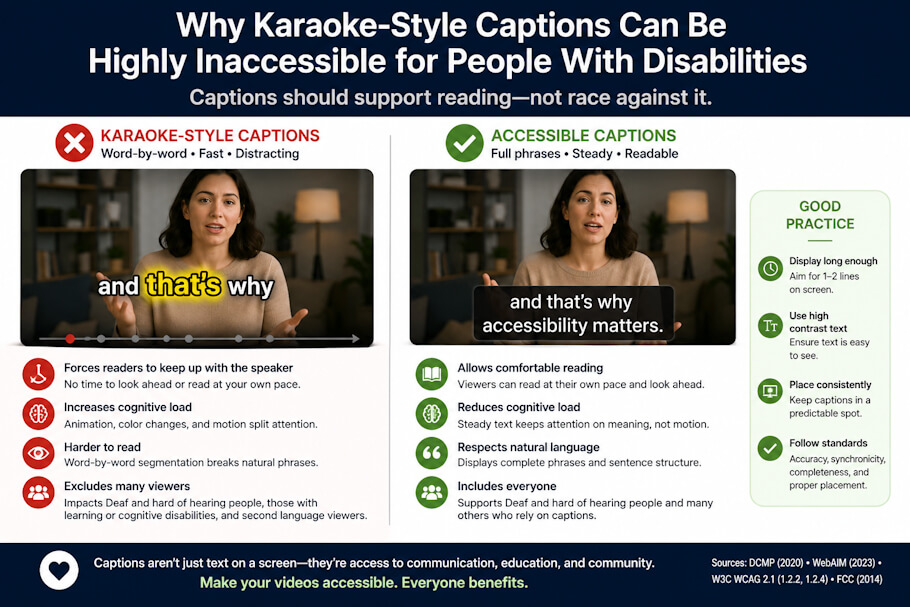
Karaoke-style captions - also known as word-by-word captions, animated subtitles, dynamic text overlays or highlighted captions - are on-screen text in which individual words are revealed and emphasized in time with the speaker's voice, so that each word fades in, scales up, bounces or changes color at the exact moment it is said, much like the bouncing highlight on a karaoke lyric screen. Unlike traditional pop-on captions, which show a full line of text long enough to be read at the viewer's own pace, this style ties the reading speed to the talking speed and usually burns the animation permanently into the video image.
Overview
How Karaoke-Style Video Captions Can Be Highly Inaccessible for People With Disabilities
Karaoke-style captions have become one of the most recognizable visual signatures of modern short-form video. You have almost certainly seen them: single words or small clusters of words popping onto the screen one at a time, each word lighting up, bouncing, or changing color at the exact moment it is spoken. Content creators love them because they hold attention, and video editing apps now generate them automatically with a single tap. Yet the very features that make these captions feel lively - the animation, the word-by-word reveal, and the moving highlight - can quietly lock out many of the people that captions are supposed to help. This paper explains why, drawing on established accessibility guidance and reading research, and it offers practical alternatives for anyone who wants their videos to be genuinely inclusive.
What Karaoke-Style Captions Actually Are
The style goes by many names. People call them karaoke captions, word-by-word captions, animated subtitles, dynamic text overlays, or highlighted captions. Whatever the label, the defining trait is the same: instead of showing a complete phrase that a viewer can read at their own pace, the text is revealed and emphasized in time with the speaker's voice. A word may fade in, scale up, or switch color as it is uttered, mimicking the bouncing-ball effect of a karaoke lyric screen.
This is different from the caption styles that accessibility specialists have refined over several decades. Traditional broadcast and educational captions typically use a pop-on style, in which one or two full lines appear on screen and stay put long enough to be read comfortably before the next block appears (Described and Captioned Media Program, 2020). Karaoke captions borrow more from the paint-on tradition, where words are painted across the screen from left to right, a technique the same guidelines advise using sparingly (Described and Captioned Media Program, 2020). The animated, per-word versions found on social platforms push that idea much further, and in doing so they trade readability for visual flair.
Why Captions Exist in the First Place
It helps to remember what captions are for. Captions provide a synchronized text alternative to the audio in a video so that people who are Deaf or hard of hearing can access speech, sound effects, music cues, and speaker identity (WebAIM, 2023). International standards treat captions as a baseline requirement rather than a nice-to-have. The Web Content Accessibility Guidelines require captions for prerecorded audio content under Success Criterion 1.2.2 and for live audio under 1.2.4 (World Wide Web Consortium, 2023). In the United States, the Federal Communications Commission sets out four pillars of caption quality - accuracy, synchronicity, completeness, and proper placement (Federal Communications Commission, 2014).
Crucially, captions serve a far wider audience than Deaf viewers alone. People with certain cognitive and learning disabilities, people watching in a second language, and people in sound-sensitive environments all rely on them. When a caption style makes text harder to read, the harm therefore ripples across many groups at once. Karaoke captions can undermine several of the quality pillars listed above, particularly readability and completeness, even when the words themselves are technically correct.
Reading Faster Than the Eye Can Comfortably Follow
The single biggest problem with word-by-word captions is timing. Because each word appears only at the instant it is spoken, the reader can never look ahead. Fluent reading depends heavily on the eye jumping forward to preview upcoming words, a process researchers call the perceptual span. Karaoke captions remove that preview entirely, forcing the reader to consume text at the speaker's talking speed rather than at their own reading speed.
That distinction matters enormously. Long-standing captioning guidance recommends a reading rate of roughly 130 to 160 words per minute for many audiences, rising to about 160 to 180 words per minute for general adult content (Described and Captioned Media Program, 2020). Conversational speech, however, often runs faster and in uneven bursts. When words are revealed one at a time at that pace, viewers who read more slowly than average simply cannot keep up. Research into television caption speed found that comprehension varies significantly with caption rate, and that faster rates disadvantage viewers with lower reading fluency (Jensema, 1998). This is not a small group. Reading achievement among Deaf and hard-of-hearing readers spans an extremely wide range, with many readers scoring well below hearing peers of the same age, which means caption pacing that suits a fast reader can exclude the very audience the captions were created for (Traxler, 2000).
Splitting Attention and Raising Cognitive Load
Animated captions do not only move quickly - they move, full stop. Every fade, bounce, and color change is a new visual event that the brain must process alongside the underlying video and the meaning of the words. Cognitive load theory holds that when the eye must track motion and decode text at the same time, working memory can become overloaded, and comprehension suffers (Lewis and Brown, 2012). In a study of multimedia learning, subtitles were found to contribute to cognitive overload for some learners because animation and text split the viewer's attention (Lewis and Brown, 2012).
Segmentation makes this worse. When text is broken into fragments that do not respect natural phrase boundaries - which is exactly what happens when captions are chopped word by word - reading becomes measurably harder. Eye-tracking research on subtitle chunking shows that poorly segmented text increases cognitive load and disrupts the natural rhythm of reading, even when it does not always reduce raw comprehension scores (Rajendran, Duchowski, Orero, Martinez, and Romero-Fresco, 2013). For viewers with dyslexia, attention-deficit disorders, autism, or acquired cognitive conditions, that added load can be the difference between following a video and giving up on it. It is worth noting that well-designed, stable captions can genuinely help these same viewers, which is precisely why the animated versions are such a missed opportunity (3Play Media, 2022).
Motion That Can Trigger Physical Symptoms
For some people the problem is not comprehension but physical discomfort. Constant on-screen motion can trigger symptoms in viewers with vestibular disorders, including dizziness, nausea, disorientation, and migraine (World Wide Web Consortium, 2018). Accessibility guidance takes this seriously. Success Criterion 2.2.2, Pause, Stop, Hide, requires that moving or auto-updating content lasting more than five seconds can be paused, stopped, or hidden, while Success Criterion 2.3.3 addresses animation triggered by interaction and points toward honoring the user's reduced-motion preference (World Wide Web Consortium, 2018). Karaoke captions typically offer no pause control at all - the animation is baked into the video and runs continuously for its full length. A viewer who has enabled a system-wide reduced-motion setting still sees every bounce and flash, because burned-in caption animation ignores those preferences entirely.
There is a related, more serious concern. Text that flashes brightly or changes in rapid, high-contrast bursts can pose a risk to people with photosensitive epilepsy, which is why guidelines limit flashing to no more than three flashes in any one-second period (World Wide Web Consortium, 2023). Most karaoke captions do not reach that threshold, but aggressive, rapidly strobing highlight effects push in a direction that responsible creators should avoid.
The Trouble With Burned-In Text
Almost all karaoke captions are open captions, meaning the words are permanently rendered into the video image rather than delivered as a separate, selectable text track. This burned-in approach removes the customization that makes captions accessible in the first place. A viewer cannot turn open captions off, cannot enlarge them, cannot change their color or font, and cannot reposition them out of the way (Bureau of Internet Accessibility, 2021). People with low vision, who often rely on adjusting text size and contrast, lose all of those controls.
Burned-in text creates a second, less obvious barrier. Because the words live inside the video image rather than in a machine-readable caption file, assistive technologies such as screen readers cannot extract them (Bureau of Internet Accessibility, 2021). A closed-caption file, by contrast, is real text that software can read, search, translate, and feed to a braille display. When captions are animated word by word and burned into the picture, that entire layer of accessibility disappears. Guidelines on images of text exist for exactly this reason, discouraging the presentation of meaningful text as a picture wherever real text could be used instead (World Wide Web Consortium, 2023).
Obscuring Meaning and Losing Non-Speech Information
Good captions convey more than dialogue. They identify who is speaking, describe relevant sound effects, and note music, all of which give Deaf and hard-of-hearing viewers the full picture (WebAIM, 2023). Because karaoke captions are built around emphasizing individual spoken words, they frequently drop this non-speech information altogether. A door slam, a change of speaker, or an ominous musical sting may never appear, leaving the caption technically synchronized yet incomplete.
The word-by-word format also hides sentence structure. Reading is easier when the eye can take in a whole clause and grasp its grammar at a glance. Revealing one word at a time strips out punctuation cues and phrase grouping, so viewers must reassemble meaning from a stream of isolated words. For readers who already find text effortful, that reconstruction work is exhausting and error-prone.
Practical Alternatives That Keep the Energy Without the Barriers
Show complete phrases, held long enough to read
The most effective single change is to display captions as full phrases of one or two lines that stay on screen long enough to be read at a comfortable rate, following the pop-on model rather than the per-word reveal (Described and Captioned Media Program, 2020). Viewers can then read ahead and set their own pace.
Calm the motion
If a brand style calls for some emphasis, keep it gentle. Avoid bouncing, spinning, or strobing effects, limit any highlight to a subtle and steady change, and never let animation run in a way that a viewer cannot escape (World Wide Web Consortium, 2018). Where a platform supports it, honor the user's reduced-motion preference.
Provide a real caption track
Wherever the platform allows, supply genuine closed captions as a separate text track in addition to, or instead of, burned-in text. This restores the ability to resize, restyle, reposition, and machine-read the captions, and it lets assistive technology do its job (Bureau of Internet Accessibility, 2021). Pairing the video with a full transcript adds another accessible route to the same content (WebAIM, 2023).
Preserve completeness and structure
Include speaker labels and important sound descriptions, keep punctuation intact, and break lines at natural phrase boundaries so grammar stays visible (Described and Captioned Media Program, 2020). These small editorial choices carry a large share of a caption's accessibility.
Conclusion
Karaoke-style captions are a case study in how a well-meaning design trend can drift away from the people it should serve. The animation that makes a clip feel energetic is the same animation that outpaces slower readers, overloads working memory, defeats reduced-motion settings, and hides behind burned-in pixels that no screen reader can reach. None of this means video has to become dull. It means the emphasis should be placed on clarity - complete phrases, steady text, a genuine caption track, and the non-speech detail that gives every viewer the full story. Captions were invented to open content up. Designed with a little care, they still can.
Frequently Asked Questions
Are karaoke-style captions ever acceptable to use?
They can be used sparingly for very short, slow-paced clips where the emphasis is decorative rather than essential, but they should always be paired with a genuine closed-caption track or a full transcript so that no viewer is left relying on the animated version alone.
Do karaoke-style captions meet WCAG requirements?
Providing captions can satisfy the requirement for a text alternative, but the animated, burned-in delivery can fail other criteria covering moving content, images of text and text customization, so the format alone does not guarantee compliance.
Are the auto-generated captions in TikTok and Instagram accessible?
Auto-generated captions vary widely; platform caption tracks that a viewer can toggle and restyle are far more accessible than burned-in animated text, and any automatic captions should be checked for accuracy and completeness before publishing.
What is the difference between subtitles and captions?
Subtitles generally assume the viewer can hear and only translate or transcribe dialogue, whereas captions are designed for Deaf and hard-of-hearing audiences and also include speaker identity, sound effects and music cues.
Can I add a closed-caption track to a video that already has burned-in captions?
Yes, most hosting platforms let you upload a separate caption file even when text is already burned in, which restores resizing, repositioning and screen-reader access, though duplicated on-screen text can look cluttered, so a clean version without burned-in captions is preferable.
Do karaoke captions help people learning a new language?
Steady, full-phrase captions support language learners by showing grammar and word grouping, while word-by-word reveals remove that structure and the ability to read ahead, making them less helpful for comprehension than they first appear.
References:
3Play Media. (2022). How captions and transcripts help students with dyslexia. 3Play Media.
Bureau of Internet Accessibility. (2021). How do burned-in captions affect accessibility? Bureau of Internet Accessibility.
Described and Captioned Media Program. (2020). Captioning key: Guidelines and preferred techniques. Described and Captioned Media Program.
Federal Communications Commission. (2014). Closed captioning quality report and order. Federal Communications Commission.
Jensema, C. (1998). Viewer reaction to different television captioning speeds. American Annals of the Deaf, 143(4), 318 - 324.
Lewis, D., and Brown, V. (2012). Multimedia and ADHD learners: Are subtitles beneficial or detrimental? Association for Educational Communications and Technology.
Rajendran, D. J., Duchowski, A. T., Orero, P., Martinez, J., and Romero-Fresco, P. (2013). Effects of text chunking on subtitling: A quantitative and qualitative examination. Perspectives: Studies in Translatology, 21(1), 5 - 21.
Traxler, C. B. (2000). The Stanford Achievement Test, 9th edition: National norming and performance standards for deaf and hard-of-hearing students. Journal of Deaf Studies and Deaf Education, 5(4), 337 - 348.
WebAIM. (2023). Captions, transcripts, and audio descriptions. Web Accessibility in Mind.
World Wide Web Consortium. (2018). Understanding success criterion 2.2.2 and 2.3.3. Web Accessibility Initiative.
World Wide Web Consortium. (2023). Web Content Accessibility Guidelines (WCAG) 2.2. Web Accessibility Initiative.
Making Cellphone Text in Film and TV Accessible for All Audiences: Poor contrast and tiny fonts make on-screen cellphone texts and subtitles hard to read for the 2.2 billion people worldwide with vision impairment.
Insights, Analysis, and Developments
Editorial Note: The lesson of karaoke captions is not that video must be lifeless, but that flair and access are only in conflict when we let motion do the work that clarity should - swap the per-word bounce for a steady phrase, add a real caption track, keep the speaker labels and sound cues, and you keep every ounce of energy while letting far more people actually follow along, which was, after all, the whole point of captions in the first place.
 Author Credentials: Ian C. Langtree is a writer, editor, and the founder and Editor-in-Chief of Disabled World, which he established in 2004 as one of the longest-running independent resources for disability news and information. Over more than two decades, he has written and edited thousands of articles on disability rights, health, accessibility, and assistive technology. Drawing on a global perspective shaped by extensive travel and lived experience, Ian is a committed advocate of the Social Model of Disability, the framework developed by disabled activists in the 1970s that focuses on removing societal barriers rather than on individual impairments. His writing is grounded in that framework and in a lasting commitment to disability rights, accessibility, and social inclusion. To learn more about Ian's background, expertise, and accomplishments, visit his full biography.