World EHS Day: Raising Awareness of Electrosensitivity
Author: Safe Tech International and Europeans for Safe Connections
Published: 15 Jun 2026 - Updated: 13 Aug 2026
Publication Type: Awareness, Appreciation
Table of Contents:
Synopsis - Definition - Overview - FAQs - Insights, Updates - Related Content
Synopsis
This article covers the 9th annual World EHS Day, held on June 16, 2026 - a global awareness event for people living with electromagnetic hypersensitivity (EHS), a condition estimated to affect 5% of the world's population and rising. It spotlights the award-winning animated short film "Remembering Nearfield," narrated by a person with EHS, which has earned 17 international film awards and brings firsthand weight to a condition that remains largely unrecognized. Backed by organizations including Safe Tech International, Europeans for Safe Connections, and the UK charity Electrosensitivity-UK, the article lays out why EHS recognition matters - not just for those directly affected, but for disability advocates, healthcare professionals, environmental researchers, caregivers, and policymakers considering the broader health implications of electromagnetic field (EMF) exposure. For seniors and those with disabilities navigating an increasingly wireless world, the issues raised here are especially relevant.*
At a Glance
- 1 - World EHS Day falls on June 16 each year in honor of the birthday of a boy whose electrosensitive mother lost custody of him because of her EHS - an injustice that inspired the founding of the Coeurs d'EHS movement and this annual day of remembrance.
- 2 - The animated film "Remembering Nearfield" is listed on IMDb, has won 17 international film awards since its 2023 release, and is narrated by a person living with EHS - giving audiences a direct, personal account of the condition's life-altering consequences.
- 3 - Yellow Chairs are placed publicly each World EHS Day as a symbol of the millions of electrosensitives who have quietly withdrawn from society - a tradition that began at the 2018 Dutch documentary premiere of Ubiquity.
Topic Definition
- Electromagnetic Hypersensitivity (EHS)
Electromagnetic hypersensitivity (EHS) is a condition in which individuals experience a range of physiological symptoms they attribute to exposure to electromagnetic fields (EMFs) generated by wireless technology, electrical devices, and other sources of man-made radiation. Reported symptoms vary widely and can include headaches, fatigue, difficulty concentrating, skin sensations, and sleep disturbances, often severe enough to prevent those affected from living or working in environments with significant EMF exposure. EHS is not currently recognized as a medical diagnosis by the World Health Organization, though the WHO acknowledges that the symptoms are real and can be disabling. Advocacy groups and researchers continue to call for further investigation into biological mechanisms, standardized diagnostic criteria, and formal recognition of EHS as a functional impairment to better protect and accommodate those living with the condition.
Overview
International Awareness-Raising Event and Award-Winning Film Highlight Neglected Disability Issue
June is the month of World EHS Day, the global day of electrosensitives, people old and young impaired by today’s environmental electromagnetic pollution, who can no longer fully participate in society. While wireless connectivity and electrification seemingly resolve certain global problems, they bring side effects that restrict the freedoms of many electrosensitives.
World EHS Day remembers people with EHS and has a message for everyone that helps to inform, bring hope and improve awareness of this impairment.
Vital, symbolic and empowering, World EHS Day encourages diverse voices and hearts to rise together with courage, creativity, openness and solidarity. In this spirit the award-winning short film Remembering Nearfield educates audiences with the aim to help gain international recognition for EHS as a health condition.
Inspired by the work of Europeans for Safe Connections and Safe Tech International - non-profit organizations with humanitarian objectives – this animated true story reveals the consequences and challenges facing electrosensitives today. The IMDb listed film, produced in 2023, has won 17 international film awards and continues to strike a chord with electrosensitives and a diverse global audience because it is narrated by a person with EHS and reflects experiential dramas and insights. Compelling social and scientific observations enhance its powerful message.
Electrosensitivity-UK (ES-UK), founded as a charity in 2003 (and which has grown steadily since then, as more and more people have become electrosensitive – and where the trustees are mostly electrosensitive themselves) holds gatherings and awareness-raising events around World EHS Day and over the course of the summer. The charity recommends Remembering Nearfield because it perfectly illustrates the realities that people with EHS are facing.
The 9th World EHS Day approaches. How did it all start? Nine years ago, a boy refused to leave or forsake his electrosensitive mother who was denied custody of her son because of her EHS. She promised him she’d inform the world about EHS. Coeurs d’EHS (Hearts of EHS) was born and in hon our of him the annual World EHS Day is held on his birthday, June 16th.
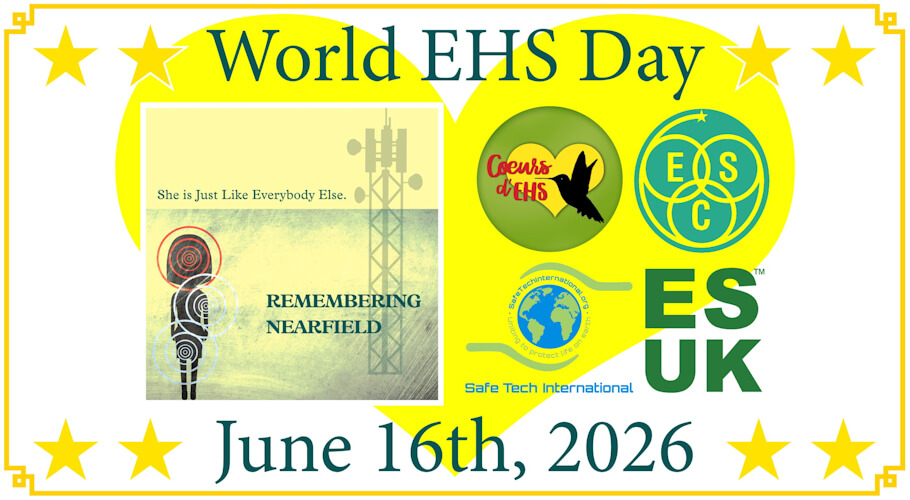
As Remembering Nearfield will show you, electrosensitives may have no choice but to live an isolated life. There are millions of them, 5% and rising of the global population. Many have left society, in silence. Yellow Chairs are often placed around on World EHS Day as a symbol of these missing people. The Yellow Chair was first seen in 2018 at the premiere of Ubiquity, a Dutch documentary about EHS, and since then has been used as a sign to remind the world of their existence.
It is now Yellow June, the month in which World EHS Day inspires creative activities and encounters, helping to make EHS visible, explain the condition and campaign for formal international recognition of this progressive impairment. The activities have another important aspect, focusing awareness on the dangers of anthropogenic electromagnetic fields. Wireless and electrical devices emit radiation that can trigger EHS over time but are linked to a plethora of other critically important health issues that may surprise us. The radiation footprint brings ecological impacts as other species are disturbed and declining from these pervasive environmental influences.
The impacts of industrial forces are reflected in our environment and in us. People have a right to know the nature of the man-made EMF problem and that we are standing at a crossroads with choices to make about our future.
Recognition of EHS is both symbolic and our goal. It points to the clinical diversity of disability and the context in which this debilitating heightened sensitivity to man-made EMFs is happening to people. This context necessitates resilience, hope and solutions, and the recognition that silence can be broken. Many voices are building bridges and crossing borders, to shine a light on EHS, and it is time for more new voices of support to be heard in Yellow June.
This promises to be a magical month because Remembering Nearfield with Coeurs d’EHS and many other supporting organizations are standing proudly together for an immensely inspiring World EHS Day.
Frequently Asked Questions
NOTE: Researched FAQs by Disabled World (DW)
What are the most commonly reported symptoms of electromagnetic hypersensitivity
People who report EHS commonly describe headaches, fatigue, trouble concentrating, tingling or burning skin sensations, dizziness, heart palpitations, and disrupted sleep. Symptoms differ from person to person and can range from mild irritation to effects severe enough to prevent someone from living or working in typical wireless environments.
How can I take part in or support World EHS Day activities
People can get involved by placing a Yellow Chair in a public spot to symbolize those who have withdrawn from society, sharing information about EHS, hosting or attending awareness gatherings, and screening or recommending the awareness film. Donating to or volunteering with EHS charities and simply talking openly about the condition during Yellow June are also meaningful forms of support.
What everyday sources produce the electromagnetic fields associated with EHS
Typical man-made EMF sources include cell phones, cell towers, WiFi routers, Bluetooth devices, cordless phones, smart meters, power lines, and everyday household electronics and wiring. Because these sources are now widespread in homes, workplaces, and public spaces, people who react to them can find it very difficult to locate low-exposure environments.
Are there steps people with EHS take to reduce their exposure at home
Common strategies include using wired internet and wired peripherals instead of wireless, switching devices to airplane mode when not needed, keeping phones away from the body, turning off routers at night, and creating low-exposure sleeping areas. Some also relocate to rural or low-signal areas, though the effectiveness of these measures varies from person to person.
Why is EHS not officially recognized as a medical diagnosis
Health authorities have not established a confirmed biological mechanism or reproducible diagnostic test linking symptoms directly to EMF exposure, which is why bodies like the World Health Organization stop short of formal recognition while still acknowledging the symptoms are real and can be disabling. Advocates argue that more research, standardized criteria, and recognition as a functional impairment are needed.
How can friends and family support someone living with EHS
Supportive steps include believing and respecting the person's experience, reducing wireless device use when visiting them, asking before bringing electronics into their space, and helping them access low-exposure environments. Emotional support matters too, since isolation and disbelief from others are among the hardest parts of living with the condition.
Where can people find more information or connect with EHS support communities
Good starting points include established charities and advocacy organizations focused on electrosensitivity, which often provide guidance, helplines, printed resources, and local or online support groups. Awareness campaigns, documentaries, and the coalitions behind World EHS Day can also point newcomers toward reputable information and communities of others living with the condition.
Insights, Analysis, and Developments
Editorial Note: EHS remains one of the more contested and under-documented conditions in modern environmental medicine, yet the scale of those reporting it and the depth of disruption it causes to daily life are hard to dismiss. The existence of an international day of awareness, a growing coalition of advocacy organizations, and a film that has found genuine resonance across 17 award juries suggests this issue has moved well beyond the margins. Whatever one's position on the science, millions of people are living with real limitations in a world that is growing less accommodating to their condition with each new wireless rollout - and that, at minimum, deserves serious attention.*
* Editorial additions by Ian C. Langtree.