The Story I was Afraid to Tell - Sydney Anne Bennett
Author: Sydney Anne Bennett
Published: 18 Mar 2026 - Updated: 16 Aug 2026
Publication Type: Submitted Article
Table of Contents:
Synopsis - Definition - Overview - FAQs - Insights, Updates - Related Content
Synopsis
This article is a personal essay by disability advocate and writer Sydney Anne Bennett, drawn from the introduction to her debut book Fearfully and Wonderfully Broken (Thomas Nelson, April 28, 2026), in which she recounts how becoming disabled at twenty-two - diagnosed with Functional Neurological Disorder - turned her toward writing as a way of processing chronic pain, daily seizures, and the quiet isolation that so often comes with a body that struggles to keep up. What began as late-night journaling became an Instagram community of over 300,000 people who found real connection in her plain-spoken accounts of invisible grief, strange symptoms, and the loneliness of a life that went off-script. Bennett makes a case not for clever writing or polished inspiration, but for honest storytelling - and her message carries particular weight for anyone living with a neurological condition, a rare or misunderstood diagnosis, or a disability that is hard to put into words for the people around them.*
At a Glance
- 1 - Bennett named her first cane Jeeves.
- 2 - She became disabled two weeks after returning from her honeymoon.
- 3 - Seeing Selma Blair use a cane helped her picture herself with a mobility aid.
- 4 - Her first story, written at six with her mother taking dictation, was about a bear that wanders into the woods and gets lost.
Topic Definition
- Functional Neurological Disorder (FND)
Functional Neurological Disorder (FND) is a medical condition in which the nervous system fails to send or interpret signals correctly, producing a range of physical symptoms - including seizures, tremors, weakness, numbness, and difficulty with movement or speech - that are real and often disabling but cannot be explained by structural damage or disease identifiable through standard imaging or neurological testing. The disorder is understood to arise from a disruption in how the brain functions rather than from visible injury to the brain itself, placing it at the intersection of neurology and the complex relationship between brain activity and body control. FND affects people across all age groups and can develop following physical trauma, illness, or psychological stress, though in many cases no single trigger is identified, and its symptoms can fluctuate significantly over time.
Overview
Sharing Your Disability Story When You're Not Sure Anyone Will Care
I wrote my first story when I was six years old. I was too little to spell most of the words, so I told my mom the story and she wrote it down for me. It was about a little bear who wanders into the woods and gets lost. I illustrated the pages with colored pencils and stuck the whole thing in a three-ring binder - back when people still used those.
I always wanted to be a writer. When I got lost, words would come find me. Late at night, in journals, companions of insomnia, and later of pain, grief, and loss. Nothing made sense until I wrote it down.
So when I became disabled at the age of twenty-two, I did the only thing I knew how to do with that much pain: I wrote.
Pain kept me awake at night, so my fingers tapped the keyboard keys, twinges and needles pricking through my body: tiny insect stings, ant-stilettos tap-dancing across my skin, muscles, and nerves. Maybe you know that kind too.
I never intended for anyone to read those pages. They were just for me. It took weeks before I found the courage to type the word disabled even to myself.
I didn't want a cane but I needed one. I searched online for someone, anyone, who looked like me: a young person with a mobility aid. I found Selma Blair. A cane didn't look like a medical device in Selma's hands. It looked like style. Finesse. Beauty. Bravery. I wanted to be like that.
When I got my first cane (which I promptly named Jeeves) I took a couple of pictures and started sharing my thoughts online.
At the time, I almost didn't think my story was important enough to tell. I knew people who were suffering much more than I was. People who had more dramatic diagnoses, harder treatments, bigger obstacles. Sometimes the question still persists: who am I to talk about it?
But I think that's just another thing many of us share, that we think we're all alone in. We worry about complaining. We worry about being misunderstood. We worry about being too much. I never thought my words would get very far, but people resonate with pain.
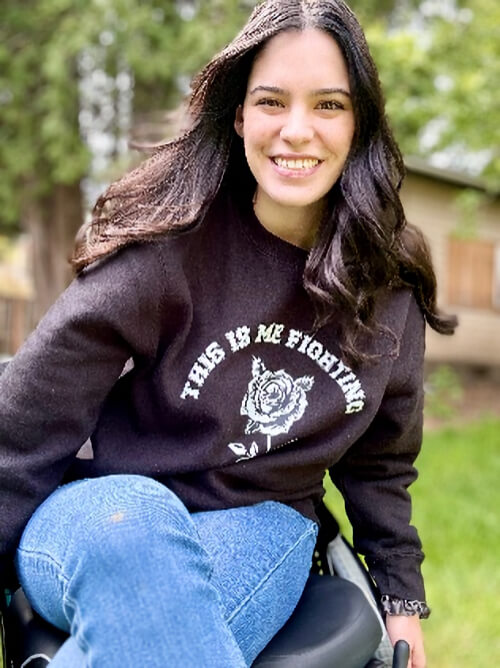
If you live with a specific kind of suffering - disability, chronic illness, a neurological disorder, a genetic condition - it can be isolating in ways that are hard to explain. You start to wonder if anyone else experiences the strange symptoms you do, the awkward moments, the invisible grief that comes with a body that struggles to live.
Finding someone who shares your vulnerability is life-giving. The more I gave small pieces of my story, the more people gave theirs to me. What began as a few slightly ashamed posts quickly became an abundant and genuine community. Within a year, more than 10,000 people had joined the conversation. Five years later, that number is approaching 300,000.
But the numbers are not really the point.
The thing that really mattered were the messages: "I thought I was the only one."
If you have endured - or are enduring - a certain kind of suffering, and you wonder if you should share it, that might be a sign that you really should. That question mark in your mind, lingering over your silent thoughts and feelings and isolation, isn't something you feel unless you have something to say.
Don't worry about being clever. Or inspiring. Or even original.
You simply have to tell the truth.
The moments you think you alone struggle through - the strange symptoms, the embarrassing realities, the complicated emotions - are often the very moments that allow someone else to feel seen.
Share the moments you think you alone experience and you may find dozens - maybe hundreds, maybe thousands, maybe millions - of people who experience them too.
The book came naturally from those early works. Those insomniac scribblings. The posts I thought no one would read.
When HarperCollins Christian Publishing asked me what my first story was, I told them about the little bear that got lost in the woods.
That's where it all began. Maybe where it is right now.
My life wandered off the path I thought it was supposed to take. I've been tramping through the mud for a while now, and it's getting dark. I feel alone. But you're here too.
So if you are wondering whether your story matters, let me offer one encouragement: Don't despise small beginnings.
Tell the truth about your life. Get specific with your honesty. Tell it plainly, boldly (or shyly), and imperfectly. Write it for just one person. Write it for yourself.
That's really all it is - books, writing, storytelling. It's simply telling the truth to one person. And then hitting Post.
Author Bio:
Sydney Anne Bennett is a writer, disability advocate, and speaker who helps people struggling with chronic illness and pain find confidence and hope again - while pointing them to Jesus.
Two weeks after her honeymoon, Sydney became disabled and was later diagnosed with Functional Neurological Disorder (FND), a condition that disrupts the brain's ability to send correct signals to the body. She experiences daily seizures, chronic pain, and mobility loss - and often uses a wheelchair.
In 2022, Sydney began sharing her story on Instagram as a way of processing grief, faith, and the strange in-between of being both young and disabled. Today, she encourages a global audience of over 300,000 people with honesty, humor, and hope that leans hard on Jesus. She lives in Idaho with her husband, Colton, and their two daughters, Hadassah and Felicity. Her new book, Fearfully and Wonderfully Broken, releases April 28th, 2026.
@theanne.girl on IG
Photograph by Sydney Anne Bennett. Used with permission.
Frequently Asked Questions
NOTE: Researched FAQs by Disabled World (DW)
Is Functional Neurological Disorder the same thing as epilepsy
No. Functional seizures are not caused by the abnormal electrical activity seen in epilepsy, and EEG recordings during an episode are typically normal, although a person can have both conditions at the same time.
How do doctors diagnose Functional Neurological Disorder
A neurologist makes the diagnosis using positive clinical signs found on examination, supported by history and, where needed, video EEG or imaging to rule out other causes. It is not simply a label applied when tests come back clear.
Can Functional Neurological Disorder be treated
Yes. Care is usually multidisciplinary and may include specialized physical therapy, occupational therapy, speech therapy for voice and swallowing symptoms, and psychological therapies such as cognitive behavioral therapy, with outcomes varying widely between individuals.
Does an FND diagnosis mean the symptoms are imagined
No. The seizures, weakness, tremors, and pain are genuine and involuntary, and the person cannot stop them at will. The problem lies in how the nervous system is functioning rather than in structural damage.
How common is Functional Neurological Disorder
It is one of the most frequent reasons people are referred to outpatient neurology clinics, appearing across all ages and affecting more women than men in most reported case series.
Can a person with FND still work or drive
Many people continue working, sometimes with flexible hours, remote options, or other accommodations. Driving depends on symptom control and local licensing rules, and anyone having seizures or sudden weakness should get medical and legal guidance before getting behind the wheel.
What should someone consider before sharing a health story online
Decide in advance which details stay private, avoid posting documents that contain personal identifiers, and expect unsolicited advice and questions. Many writers start with a small audience or a private journal and expand only when they feel ready.
How can family and friends support someone whose symptoms change day to day
Believe the person when they describe what is happening, make plans that can be adjusted or canceled without guilt, offer practical help rather than cures, and follow their lead on when a mobility aid or rest break is needed.
Insights, Analysis, and Developments
Editorial Note: Sydney Anne Bennett's essay is a quiet but persuasive argument for the value of specific, unguarded honesty in a media landscape that often rewards performance over truth. She built a following not by crafting a brand but by admitting to the things she assumed no one else experienced - and discovering, post by post, that the opposite was true. Her story is a useful reminder that the most isolating experiences are rarely as singular as they feel, and that the act of putting them into words, however imperfect, is often the first real step out of that isolation. Fearfully and Wonderfully Broken arrives at a moment when conversations about chronic illness, neurological disability, and the emotional weight of living in an unreliable body are long overdue for the kind of frank, human treatment Bennett has made her practice.*
* Editorial additions by Ian C. Langtree.