Cosmetic Psychiatry: Ethics, Aging, and Disability
Author: Ian C. Langtree - Writer/Editor for Disabled World (DW)
Published: 24 Feb 2026 - Updated: 26 Aug 2026
Publication Type: Informative
Table of Contents:
Synopsis - Definition - Overview - FAQs - Insights, Updates - Related Content
Synopsis
The line between healing the sick and enhancing the well has never been blurrier - and nowhere are the consequences more personal than for aging adults and people living with disabilities. Cosmetic psychiatry, the emerging practice of using psychiatric tools to improve the mental states of healthy people, is raising urgent questions about fairness, autonomy, and what it means to age in a society that increasingly turns to pills and technology as solutions. This paper examines a field that most people have never heard of but one that may profoundly shape the future of mental health care for our most vulnerable populations.
At a Glance
- 1 - Bioethicist Arthur Caplan frames enhancement as personal liberty. He argues informed adults should be free to pursue the best brains possible.
- 2 - Psychiatrist Peter D. Kramer coined the term cosmetic psychopharmacology in his 1993 book Listening to Prozac. He noticed some patients seemed transformed rather than merely recovered.
- 3 - Age-related shifts in liver function, kidney clearance, and body composition change how older adults process drugs. Adding enhancement medications to an existing regimen raises the risk of dangerous interactions.
- 4 - Accommodation adapts the environment to meet a person where they are, while enhancement changes the person to fit the environment. Advocates warn that enhancement could become a substitute for accessible spaces and adequate disability support.
Topic Definition
- Cosmetic Psychiatry
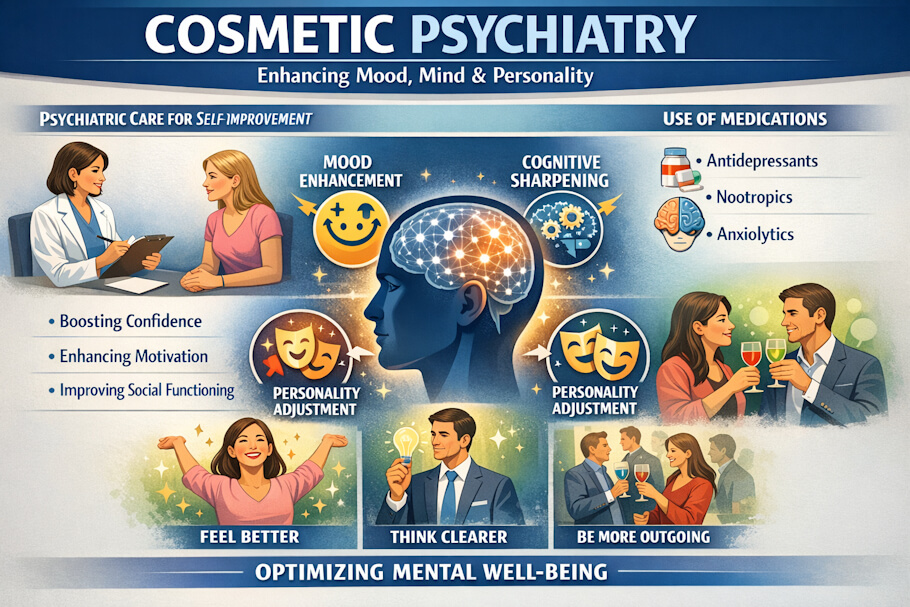
Cosmetic psychiatry is an emerging concept in mental health care that refers to the use of psychiatric interventions - such as medications, nootropics, supplements, and brain stimulation techniques - to subjectively enhance the mental states of people who do not have a diagnosed mental illness. Drawing a parallel to cosmetic surgery, where physicians alter healthy bodies to meet personal preferences rather than treat pathology, cosmetic psychiatry shifts the clinical goal from curing disease to improving cognition, mood, or emotional wellbeing beyond an individual's normal baseline. The term builds on psychiatrist Peter D. Kramer's earlier concept of "cosmetic psychopharmacology," which he introduced in 1993 to describe patients on antidepressants who appeared not merely recovered but fundamentally enhanced. Today, the broader concept of cosmetic psychiatry encompasses a growing range of pharmacological and technological tools and raises critical ethical questions about access, equity, medicalization, and the role of psychiatry in a world where the boundary between treatment and self-improvement is increasingly difficult to define.
Overview
Cosmetic Psychiatry: Enhancement, Ethics, and the Impact on Seniors and Disability
The idea that medicine should only treat illness feels like common sense - until you start pulling at the threads. What happens when someone who is not clinically ill walks into a psychiatrist's office and asks for a medication that could make them sharper, calmer, or more socially confident? This question sits at the heart of a growing and controversial concept known as cosmetic psychiatry. As populations age and disability rates rise, the implications of this emerging field become especially urgent for seniors and people living with disabilities.
What Is Cosmetic Psychiatry?
Cosmetic psychiatry refers to the use of psychiatric interventions - including medications, supplements, and even brain stimulation techniques - to enhance the mental states of people who are not suffering from a diagnosed mental illness. The term draws a deliberate parallel with cosmetic surgery, where physicians reshape healthy bodies to meet a patient's personal desires rather than treat a medical condition (Lugg, 2024). In cosmetic psychiatry, the goal shifts from curing disease to improving subjective wellbeing, sharpening cognition, or elevating mood in otherwise healthy individuals.
The roots of this idea trace back to psychiatrist Peter D. Kramer, who in 1993 coined the phrase "cosmetic psychopharmacology" in his bestselling book Listening to Prozac. Kramer observed that some patients taking the antidepressant fluoxetine seemed not just recovered, but transformed - more assertive, more energetic, and more socially engaged than they had ever been before their illness. He raised a provocative question: if a pill can make someone feel better than they ever have, should doctors offer it to people who were never really sick in the first place? (Kramer, 1993)
From Cosmetic Psychopharmacology to Cosmetic Psychiatry
Kramer's original concept focused on medications, but the modern notion of cosmetic psychiatry has grown much broader. Researcher William Lugg has defined cosmetic psychiatry as the science and practice of interventions that subjectively enhance the mental states of healthy people. This definition encompasses a wide range of tools - from selective serotonin reuptake inhibitors (SSRIs) and stimulants like methylphenidate, to nootropics (so-called "smart drugs"), dietary supplements, transcranial electrical stimulation, and even structured light therapy (Lugg, 2024).
The critical distinction between traditional psychiatry and cosmetic psychiatry lies in purpose. Traditional psychiatry treats diagnosable conditions such as depression, anxiety disorders, or schizophrenia. Cosmetic psychiatry, by contrast, aims to take healthy individuals and push them beyond their normal baseline - improving focus, elevating mood, or reducing ordinary stress. As psychiatrist A. James Giannini once asked, should psychiatry limit itself to the goal of "objective cure," or might it also help individuals pursue "subjective perfection"? (Giannini, 2006)
The Ethics of Enhancement Without Diagnosis
Not surprisingly, cosmetic psychiatry raises serious ethical questions. In traditional medicine, a diagnosis justifies a treatment. Without a diagnosis, how does a psychiatrist justify writing a prescription? And who pays for it? These are not merely academic questions - they have real consequences for patients, insurers, and the medical profession itself.
Bioethicist Arthur Caplan has argued that cognitive and emotional enhancement is a matter of personal liberty. He contends that informed adults should have the right to pursue what he calls "the best brains possible," free from excessive medical gatekeeping (Lugg, 2024). On the other side, critics worry about a slippery slope toward a society in which medications become expected rather than optional - a world where choosing not to enhance feels like falling behind.
There is also a serious concern about distributive justice. If cosmetic psychiatric interventions become available primarily to people who can afford to pay out of pocket, the result could be a deepening of existing social and cognitive inequalities. Weightman and Amos (2024) have cautioned that the commercialization of cosmetic psychiatry risks shifting psychiatrists from a pastoral role of caring for vulnerable patients toward a consumer-driven model that serves the already privileged. They warn that investing psychiatric resources in making relatively happy people happier could come at the expense of those who most desperately need mental health care.
How Cosmetic Psychiatry Relates to Seniors
Aging is accompanied by a range of cognitive and emotional changes that exist on a spectrum. Many older adults experience mild declines in memory, processing speed, and attention that do not meet the diagnostic threshold for conditions like dementia or major depression - yet these changes can profoundly affect their daily quality of life, independence, and sense of self. This is precisely the gray area where cosmetic psychiatry becomes relevant to the aging population.
Consider an older adult who has retired and notices that their thinking feels slower than it once was. They are not clinically depressed, and a neurological evaluation reveals no signs of dementia. Yet they feel diminished - less sharp in conversation, less able to manage household finances, and less confident in social settings. Under a traditional psychiatric model, there may be no treatment to offer because there is no disease to treat. A cosmetic psychiatry framework, however, might consider whether a cognitive-enhancing intervention - a low-dose stimulant, a nootropic supplement, or even transcranial direct current stimulation - could restore some of what aging has taken away.
The appeal is understandable, but the risks for seniors are considerable. Older adults metabolize medications differently than younger people due to age-related changes in liver function, kidney clearance, and body composition. Polypharmacy - the use of multiple medications simultaneously - is already a widespread problem in geriatric medicine, and adding enhancement drugs to an existing medication regimen introduces the possibility of dangerous interactions (Salzman, 2001). Overmedicated seniors have been mistakenly diagnosed with depression, dementia, and even Alzheimer's disease when their symptoms were actually side effects of their prescriptions (Green, 2023).
Cosmetic Psychiatry and Disability
The intersection of cosmetic psychiatry and disability is particularly complex. Disability - whether physical, cognitive, or psychiatric - is defined not only by a person's bodily or mental condition but also by the social environment in which they live. The social model of disability holds that much of what disables people is not their impairment itself, but the barriers erected by a society that fails to accommodate difference. Cosmetic psychiatry, which focuses on enhancing individual mental function, risks reinforcing the idea that it is the person rather than the environment who needs to change.
For people aging into disability - those who acquire impairments through the natural process of aging, for example - cosmetic psychiatry may seem like a way to maintain participation in a world that does not slow down for them. A senior with mild cognitive decline might use cognitive enhancers to keep up with conversations, manage their medications, or continue driving safely. In this sense, cosmetic psychiatry could serve a genuinely supportive function.
However, there is a meaningful difference between accommodation and enhancement. Accommodations meet a person where they are and adapt the environment. Enhancement aims to change the person to fit the environment. Disability rights advocates have long been wary of medical approaches that frame disability primarily as a deficit to be fixed rather than a form of human variation to be supported. If cosmetic psychiatric interventions become a substitute for accessible environments, flexible social services, and adequate disability support, the result could be a world that expects individuals to medicate themselves into compliance rather than building a more inclusive society.
The Blurry Line Between Treatment and Enhancement
One of the most vexing challenges in cosmetic psychiatry is determining where treatment ends and enhancement begins. Philosopher Pamela Bjorklund has argued that health and illness are not binary categories but exist on a complicated continuum where health slides into illness and illness slides back into health in ways that can be difficult to pinpoint (Bjorklund, 2005). This observation is especially true for seniors, whose cognitive and emotional changes often occupy a middle ground between normal aging and clinical pathology.
Take the example of subclinical depression in older adults. A senior may not meet the full diagnostic criteria for major depressive disorder as outlined in the Diagnostic and Statistical Manual of Mental Disorders, yet they may experience persistent sadness, reduced motivation, and social withdrawal that significantly impairs their functioning. Is prescribing an antidepressant in this situation a cosmetic intervention or a clinical one? The answer depends on where we draw the line - and that line, as Bjorklund points out, is neither clear nor fixed.
This ambiguity has real consequences for disability determination. Many public benefits and support services require a formal diagnosis. Individuals whose symptoms fall just below the diagnostic threshold may find themselves ineligible for the assistance they need - yet they may also be unable to access cosmetic psychiatric enhancements because their insurance will not cover non-clinical treatments. The result is a gap in care that disproportionately affects seniors and people with disabilities who lack the financial resources to seek help outside the traditional healthcare system.
Nootropics, Supplements, and the Unregulated Frontier
Beyond prescription medications, a booming market of nootropics and dietary supplements has grown up around the promise of cognitive enhancement. These products - which include compounds like racetams, modafinil, and various herbal and nutritional formulations - are marketed directly to consumers, including seniors, with claims of improved memory, sharper focus, and better mental clarity. The global wellness industry is enormously profitable, and older adults represent a particularly motivated market segment (Cakic, 2009).
The trouble is that many of these products are not well regulated, and their efficacy and safety profiles are often poorly understood. Seniors who self-medicate with over-the-counter nootropics may expose themselves to side effects, drug interactions, or simply waste money on products that do not work as advertised. Without the oversight of a qualified psychiatrist, the risks multiply. This is one area where advocates for cosmetic psychiatry have actually argued in favor of professional involvement - better to have a trained specialist guiding these choices than to leave vulnerable populations navigating the supplement aisle alone (Lugg, 2024).
Looking Ahead: A Conversation That Cannot Wait
Whether we approve of cosmetic psychiatry or not, the reality is that people are already using psychiatric tools for enhancement. Students take stimulants to improve academic performance. Professionals use nootropics to maintain a competitive edge. And seniors, eager to preserve their independence and cognitive vitality, are increasingly drawn to the promises of pharmacological and technological enhancement. The question is not whether cosmetic psychiatry will exist, but how it will be governed, who will have access to it, and whether its benefits will be distributed fairly.
For seniors and people with disabilities, the stakes are especially high. A thoughtfully developed framework for cosmetic psychiatry could provide new tools for maintaining independence, improving quality of life, and bridging the gap between normal aging and clinical impairment. But without careful ethical oversight, it risks deepening inequalities, encouraging overmedication, and diverting psychiatric resources away from those who need them most. As Weightman and Amos (2024) have argued, cosmetic psychiatry must be treated as an experimental concept requiring much clearer clinical governance before it moves into mainstream practice.
The conversation about cosmetic psychiatry is no longer a distant hypothetical. It is happening now, in clinics, pharmacies, and living rooms around the world. Seniors, caregivers, disability advocates, and healthcare professionals all have a stake in shaping where it goes from here.
References:
- Bjorklund, P. (2005). Can there be a "cosmetic" psychopharmacology? Prozac unplugged: The search for an ontologically distinct cosmetic psychopharmacology. Nursing Philosophy, 6(2), 131-143.
- Cakic, V. (2009). Smart drugs for cognitive enhancement: Ethical and pragmatic considerations in the era of cosmetic neurology. Journal of Medical Ethics, 35(10), 611-615.
- Giannini, A. J. (2006). The case for cosmetic psychiatry: Treatment without diagnosis. Psychiatric Times, 23(10).
- Green, A. (2023). Polypharmacy in adults 60 and older. Johns Hopkins Medicine Health Library.
- Kramer, P. D. (1993). Listening to Prozac. Viking.
- Lugg, W. (2024). Cosmetic psychiatry: A concept in urgent need of consideration. Australasian Psychiatry, 32(1), 32-37.
- Salzman, C. (2001). Psychiatric medications for older adults: The concise guide. Guilford Press.
- Weightman, M. J., and Amos, A. J. (2024). Bioethical implications of cosmetic psychiatry: Distributive justice versus utilitarianism. Australasian Psychiatry, 32(5), 477.
Frequently Asked Questions
Is cosmetic psychiatry a recognized medical specialty
No, cosmetic psychiatry is an emerging concept rather than a formal specialty. Researchers describe it as experimental and in need of clearer clinical governance before wider use.
What are nootropics
Nootropics are substances marketed to improve memory, focus, or mental clarity, sometimes called smart drugs. They include prescription compounds as well as herbal and nutritional supplements sold directly to consumers.
How does cosmetic psychiatry differ from traditional psychiatry
Traditional psychiatry treats diagnosable conditions such as depression or anxiety. Cosmetic psychiatry aims to push healthy people beyond their normal baseline by improving mood, focus, or confidence.
Does insurance usually cover cosmetic psychiatric treatments
Enhancements for people without a diagnosis are generally not covered by insurance. This often means patients must pay out of pocket, which can widen access gaps.
What is transcranial direct current stimulation
Transcranial direct current stimulation is a technique that applies a mild electrical current to the scalp to influence brain activity. It is one of the technological tools discussed within cosmetic psychiatry.
Why is polypharmacy a concern for older adults
Polypharmacy is the use of several medications at once, which is common in geriatric care. It raises the chance of harmful interactions and side effects that can mimic other conditions.
What is the social model of disability
The social model holds that people are disabled largely by barriers in society rather than by impairment alone. It emphasizes changing environments instead of only changing individuals.
Are cognitive enhancement supplements regulated for safety
Many nootropic and dietary supplements face limited regulation, so their safety and effectiveness are often poorly understood. Users may risk side effects or spend money on products that do not work.
Insights, Analysis, and Developments
Editorial Note: As cosmetic psychiatry moves from academic journals into real-world clinics and supplement shelves, the people with the most at stake - seniors managing cognitive decline, individuals navigating disability, and families making care decisions - deserve a voice in the conversation. Whether this emerging field becomes a force for empowerment or another source of inequity will depend entirely on the ethical guardrails society chooses to build around it, and the willingness of the psychiatric profession to prioritize those who have the most to lose.
 Author Credentials: Ian is the founder and Editor-in-Chief of Disabled World, a leading resource for news and information on disability issues. With a global perspective shaped by years of travel and lived experience, Ian is a committed proponent of the Social Model of Disability, a transformative framework developed by disabled activists in the 1970s that emphasizes dismantling societal barriers rather than focusing solely on individual impairments. His work reflects a deep commitment to disability rights, accessibility, and social inclusion. To learn more about Ian's background, expertise, and accomplishments, visit his full biography.