Transabled: Body Integrity Dysphoria and BIID Facts
Author: Ian C. Langtree - Writer/Editor for Disabled World (DW)
Published: 6 Sep 2026
Publication Type: Scholarly Paper
Table of Contents:
Synopsis - Definition - Overview - FAQs - Insights, Updates - Related Content
Synopsis
Few subjects in modern psychiatry generate as much heat and as little clarity as transability, a term used by people who feel a persistent need to acquire a physical impairment despite being classified as able-bodied. The clinical counterpart, body integrity dysphoria, was formally recognized by the World Health Organization in ICD-11, yet it remains absent from the American diagnostic manual, and the neuroimaging evidence pointing to right parietal lobe involvement sits awkwardly alongside an identity claim that both disabled and transgender communities have largely declined to endorse. This paper separates what is documented from what is disputed, tracing the condition through four successive clinical names, examining the Falkirk amputations that still anchor the ethical debate, and setting out the strongest version of each argument rather than the most convenient one.
At a Glance
- 1 - The literature divides the population into pretenders, devotees, and wannabes. These categories overlap heavily, and one person may move between them across a lifetime.
- 2 - Amputation requests skew heavily toward the left leg. That lateral bias is one reason researchers began looking at the brain's right hemisphere rather than at sexual motivation.
- 3 - Pretending is the most common lifelong management strategy, not surgery. It carries real physical risk, since prolonged limb binding can restrict circulation and damage tissue.
- 4 - Two Scottish operations in 1997 and 1999 remain the reference case in medical ethics. A planned third amputation was blocked by the hospital ethics committee, and no comparable surgery has since been openly performed in Britain.
Topic Definition
- Transabled
Transabled describes a person who identifies with, and feels a persistent need to acquire, a physical impairment such as limb amputation, paralysis, blindness, or deafness, despite being regarded by others as able-bodied. The term originated within online communities rather than in clinical practice, and it is used by some affected individuals in preference to the medical label body integrity dysphoria, which the World Health Organization added to ICD-11 in 2018 under code 6C21. The distinction matters: transabled frames the experience as an identity, while body integrity dysphoria frames it as a diagnosable condition marked by childhood onset, a stable and specific mismatch between the felt and physical body, and significant distress or functional impairment. Most people who fit the clinical criteria conceal the experience for decades, and the two framings, though often applied to the same person, answer to different standards and carry very different implications for what should follow.
Overview
Transabled: Understanding a Contested Identity and Its Clinical Counterpart
NOTE: BIID is not a formal DSM-5 diagnosis - it was proposed and debated but not adopted, which differs from what some secondary sources state. This paper reflects the accurate position.
* * *
Somewhere in a quiet apartment, a man in his forties sits in a wheelchair he does not medically need. His legs work. He can stand, walk, and run. But for as long as he can remember - certainly since before adolescence - he has felt that the lower half of his body does not belong to him, and that the version of himself he recognizes in his own mind is a paraplegic. He has told almost no one. He has held a job, raised children, and kept the secret for thirty years. In the language of the online communities where he first found others like himself, he is transabled.
That word, and the experience it names, sits at one of the most uncomfortable intersections in contemporary medicine: between psychiatry and identity politics, between neurology and the philosophy of the self, and between two communities - disabled people and transgender people - who have largely refused to claim it. This paper works through what is actually known, what is disputed, and why the dispute matters.
What Transabled Means
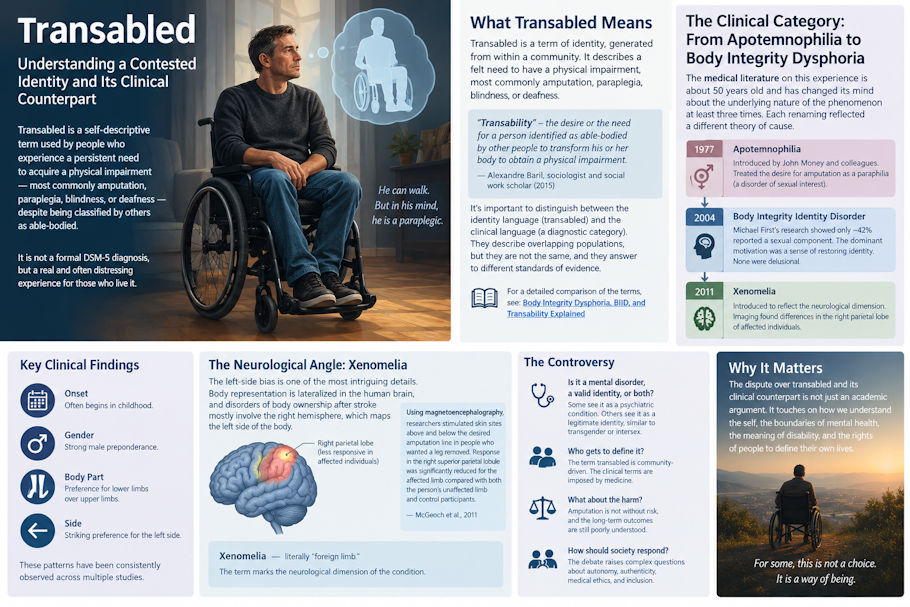
Transabled is a self-descriptive term used by people who experience a persistent need to acquire a physical impairment - most commonly amputation of a limb, paraplegia, blindness, or deafness - despite being classified by others as able-bodied. The term is deliberately constructed on the model of transgender, marking a felt distance between the body a person has and the body a person understands as theirs.
Transability - defined by sociologist and social work scholar Alexandre Baril as "the desire or the need for a person identified as able-bodied by other people to transform his or her body to obtain a physical impairment" [Baril, 2015]. The definition is deliberately framed around social identification rather than diagnosis, which is precisely what makes it contested.
It is worth being precise about a distinction that gets flattened in popular coverage. Transabled is a term of identity, generated from within a community. The clinical counterpart is a diagnostic category. They describe overlapping populations, but they are not the same kind of claim, and they answer to different standards of evidence. A useful discussion of how the identity language and the diagnostic language relate to one another appears in Body Integrity Dysphoria, BIID, and Transability Explained, which traces the terminology across both registers.
The Clinical Category: From Apotemnophilia to Body Integrity Dysphoria
The medical literature on this experience is roughly fifty years old and has changed its mind about the underlying nature of the phenomenon at least three times. Each renaming was not merely cosmetic - each encoded a different theory of cause.
Apotemnophilia (1977)
The first clinical framing, introduced by sexologist John Money and colleagues, treated the desire for amputation as a paraphilia - a disorder of sexual interest. The name literally translates as love of amputation. Under this model, the desire was understood as erotic in origin, closely related to acrotomophilia, which is sexual attraction to amputees. This framing dominated for roughly a quarter century and shaped how the first patients were received by clinicians: as people with an unusual sexual interest rather than people with an unusual body image.
Body Integrity Identity Disorder (2004)
The paraphilic model began to collapse under empirical scrutiny. Psychiatrist Michael First conducted structured telephone interviews with fifty-two people who desired amputation, and the results did not fit the sexual model well [First, 2005]. Only a minority - roughly forty-two percent - reported any sexual component to the desire. The dominant motivation reported was a sense of restoring identity, of becoming complete or correct. Critically, none of the participants were delusional. They knew their limbs were healthy. They knew others would consider the desire irrational. They simply did not experience the limb as theirs.
First proposed the term body integrity identity disorder to capture this, positioning the condition closer to a disorder of identity than of desire. His study also established several clinical regularities that later research has broadly confirmed: onset in childhood, a strong male preponderance, a preference for lower limbs over upper limbs, and a striking preference for the left side.
Xenomelia (2011)
That last detail - the left-side bias - is the kind of anomaly that makes neurologists sit up. Body representation is lateralized in the human brain, and disorders of body ownership following stroke overwhelmingly involve the right hemisphere, which maps the left side of the body. If the desire for amputation were purely psychological, there would be no obvious reason for it to favor one side.
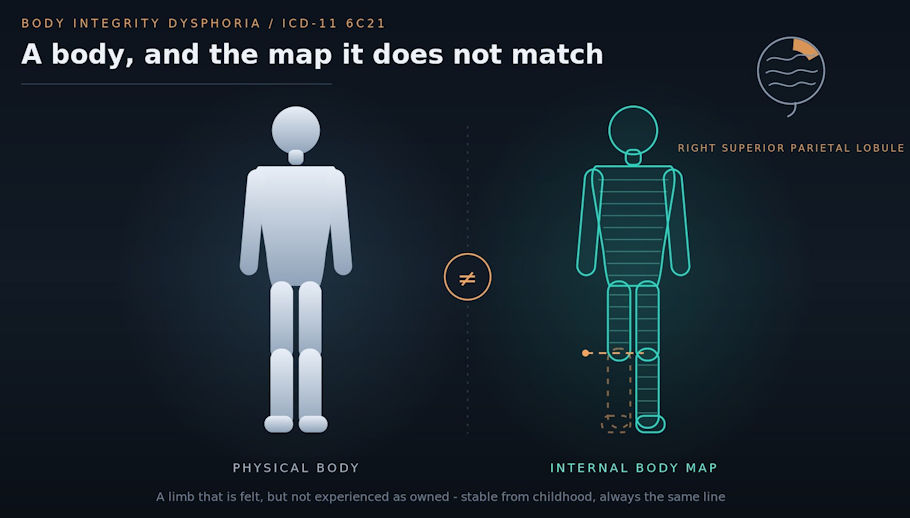
Xenomelia - literally foreign limb. The term was introduced to mark the neurological dimension of the condition, following imaging work that found structural and functional differences in the right parietal lobe of affected individuals [McGeoch et al., 2011].
Using magnetoencephalography, researchers stimulated skin sites above and below the desired amputation line in people who wanted a leg removed. Response in the right superior parietal lobule was significantly reduced for the affected limb compared with both the person's unaffected limb and control participants [McGeoch et al., 2011]. Subsequent structural imaging found differences in cortical thickness and surface area across a right-hemisphere network associated with body representation [Hilti et al., 2013], and later work identified white matter differences as well.
Body Integrity Dysphoria (2018)
The World Health Organization adopted a fourth name when it included the condition in the eleventh revision of the International Classification of Diseases as body integrity dysphoria, code 6C21, filed under disorders of bodily distress or bodily experience. The switch from disorder of identity to dysphoria was meaningful. Dysphoria names the distress arising from a mismatch, not a defect in the person's identity itself - a framing borrowed, consciously, from the reclassification of gender dysphoria.
Diagnostic Criteria and What They Actually Require
The ICD-11 criteria are more demanding than casual descriptions suggest. Four elements must be present [World Health Organization, 2019]:
- An intense and persistent desire to become physically disabled in a significant way, such as becoming a major limb amputee, a paraplegic, or blind.
- Onset by early adolescence.
- Persistent discomfort or intense feelings of inappropriateness concerning the current non-disabled body configuration.
- Harmful consequences, shown either by preoccupation with the desire - including time spent pretending to be disabled - significantly interfering with productivity, leisure, or social functioning, or by attempts to actually become disabled that have placed the person's health or life in serious jeopardy.
The disturbance must also not be better explained by another mental, behavioral, or neurodevelopmental disorder, by a disease of the nervous system, or by another medical condition. That exclusion clause is doing considerable work. It rules out the desire arising within psychosis, within body dysmorphic disorder, within a factitious presentation, or as a consequence of neurological damage.
A Note on the DSM
Body integrity dysphoria does not appear as a formal diagnosis in the fifth edition of the Diagnostic and Statistical Manual of Mental Disorders. It was proposed and debated but not adopted, for reasons that were partly evidentiary - very small identified patient numbers, no established etiology - and partly ethical, since formal recognition raises immediate and unresolved questions about what treatment a recognized diagnosis would license [First and Fisher, 2012]. The result is a genuine divergence between the two dominant diagnostic systems, and it is one reason clinicians in the United States often have less familiarity with the condition than colleagues in Europe.
Prevalence, Presentation, and the Problem of Secrecy
Nobody knows how common this is. Estimates hover around one in ten thousand, but every researcher who publishes a figure attaches heavy caveats, because the methodological problem is severe: the condition is defined in part by concealment. Most affected individuals never disclose to anyone, including clinicians. Almost all published samples are recruited through online forums, which selects for people who have already found a community and a vocabulary. The true population may look quite different from the studied one.
What the available samples do consistently show is a coherent clinical picture. A questionnaire study of fifty-four individuals reported an onset in early childhood, with participants describing the feeling as having always been present rather than as something that developed [Blom, Hennekam, and Denys, 2012]. Participants typically identify a precise line on the body where the desired amputation should occur, and that line remains stable across decades. Many report an early formative encounter with a person with a visible disability, recalled with unusual vividness.
Pretending, and Why It Is Not Trivial
Between the desire and any irreversible act sits a wide behavioral middle ground. Pretending describes the practice of simulating the desired impairment - using a wheelchair, walking with crutches, binding a limb out of sight, wearing occlusive lenses. For many people this is the primary way the condition is managed across a lifetime, and it can be substantially relieving.
It is also not risk free. Prolonged limb binding can compromise circulation and cause tissue damage. And pretending is where the identity question becomes socially explosive, because a person pretending in public is occupying disability-designated space, from parking to seating to social accommodation, without the underlying impairment. This is the practice that generates the sharpest objections from disabled communities, and the objection is not merely symbolic.
Self-Harm and Coerced Surgery
At the extreme, some individuals attempt to force the outcome. First's original sample found that seventeen percent had achieved an amputation, and of those, two thirds used methods that placed them at risk of death - dry ice, tourniquets, firearms, railway tracks - while one third located a surgeon willing to operate [First, 2005]. The strategy of damaging a limb badly enough that amputation becomes medically necessary is documented in the literature and is one of the strongest arguments advanced by clinicians who favor recognizing the condition: people are already being maimed, and the question is only whether it happens under supervision.
The Falkirk Case and the Ethics of Elective Amputation
In 1997, Robert Smith, a surgeon at the Falkirk and District Royal Infirmary in Scotland, amputated the lower left leg of a patient whose limb was entirely healthy. He performed a comparable operation on a German patient two years later. Both men had described the affected leg as superfluous and had reported enduring distress at its presence. Both were reported afterward to be satisfied and improved.
When a third procedure was planned, the hospital's ethics committee reviewed the matter and the trust's chief executive prohibited further such operations. The case became international news, and no comparable procedure has since been openly performed in a British hospital. Falkirk remains the reference point for the entire ethical debate, and it is instructive precisely because the outcomes were good and the practice was still stopped.
The Case For
The argument in favor rests on three pillars. First, autonomy: competent adults are generally permitted to make irreversible decisions about their own bodies, including decisions others find unwise. Second, harm reduction: refusal does not reliably produce continued able-bodiedness, it produces unsupervised self-injury. Third, outcome evidence: the published case literature, though small, is remarkably consistent in reporting durable relief following amputation, including follow-up at one year [Nadeau et al., 2024], where no other intervention has shown comparable effect [Ryan, 2009].
The Case Against
The argument against is equally structured. Surgical destruction of healthy tissue is difficult to reconcile with the obligation to avoid harm, and the resulting impairment is permanent and generates lifelong costs borne partly by others [Müller, 2009]. The evidence base consists almost entirely of uncontrolled case reports with no comparison groups and no systematic tracking of poor outcomes, which are less likely to be published. Consent is complicated by the fact that the desire itself may be a symptom of the disorder for which consent is being given. And there is a legal dimension: in several jurisdictions, a surgeon performing such a procedure may not be shielded by consent from liability for grievous bodily harm [Gibson, 2020].
The unresolved core: if the distress is real and no conservative treatment relieves it, refusing surgery is not a neutral act. It is a choice with its own consequences. The ethics literature has been circling this for two decades without consensus.
What Treatment Currently Exists
The honest answer is that there is no established, evidence-based conservative treatment. Cognitive behavioral therapy and antidepressant medication are used and can reduce comorbid depression and anxiety, improve coping, and reduce the risk of self-injury, but the published record does not show them extinguishing the core desire. Vestibular caloric stimulation, which transiently alters body representation, has been trialed with limited and temporary effect.
More recent work has explored technological approaches that target the underlying body representation rather than the distress around it. Augmented and virtual reality protocols allowing individuals to see and inhabit a virtually amputated body have produced measurable symptom reduction in small studies, and brain-computer interface approaches have been proposed on the reasoning that the problem is one of sensorimotor integration rather than belief. These are early-stage and should not be described as available treatments.
The Identity Argument and Its Critics
Running alongside the clinical literature is a scholarly and activist argument that the diagnostic frame is itself the problem. Baril has argued that transability should be analyzed with the same conceptual tools that disability studies applies elsewhere, and that both trans movements and disability movements have handled transabled people badly [Baril, 2015]. He documents a specific pattern of rejection: transabled people are characterized as dishonest, as appropriating resources belonging to disabled people, and as fetishizing or romanticizing an experience of disability they have not lived.
Sociologist Jenny Davis analyzed self-presentations by contributors to a now-defunct transability website and identified three overlapping categories in the surrounding literature: pretenders, who enact a wished-for impairment; devotees, whose interest in disability is erotic; and wannabes, who seek to actually acquire the impairment [Davis, 2012]. These categories are porous, and a single person may occupy more than one over time. Davis also documented a consistent rhetorical strategy in how transabled people narrate themselves - emphasizing childhood onset, describing an inability to explain the feeling, detailing a precise image of the correct body, and framing the experience as surrender rather than choice. She read this essentialist narrative as a form of stigma resistance: if the need is natural rather than chosen, it is harder to condemn morally.
Why the Comparison to Gender Transition Is Both Made and Rejected
The analogy to gender dysphoria is what gives transability its rhetorical force and also what draws the fiercest objection. Structurally, the parallels are real: early onset, persistent mismatch between felt and physical embodiment, distress that responds poorly to talk therapy, and an established medical framework moving from disorder language to dysphoria language.
The objections are also substantive rather than merely reactive. Trans advocacy has worked for decades to separate gender identity from the category of impairment, and an analogy that treats acquired impairment as an equivalent transition runs directly against that project - which is part of Baril's point about ableism within trans movements. From the disability side, the objection is that disability is constituted substantially by social barriers and discrimination, not by the impairment itself, and the transabled framing risks treating impairment as an aesthetic or identity acquisition detached from the political reality of living disabled. Both objections deserve to be stated at their strongest rather than dismissed, and neither is settled by evidence about brain scans.
Patterns Across Scales
It is worth stepping back to notice that this single phenomenon looks fundamentally different depending on the level of analysis, and that the disagreement between camps is often a disagreement about which level counts.
At the neurological scale, the phenomenon is a failure of multisensory integration in a right-hemisphere network - a limb is felt but not incorporated, producing a persistent mismatch. At the phenomenological scale, it is the lived experience of a body that does not match its own map, described by those affected in the language of impostorhood. At the clinical scale, it is a rare diagnosis with defined criteria, no established treatment, and a small and difficult evidence base. At the social and political scale, it is a contested identity claim with implications for how disability, authenticity, and medical resources are allocated.
Here is a useful analogy. Consider how a coastline appears at different resolutions: from orbit it is a smooth line, from an aircraft a series of bays, from the beach an intricate fractal of stones. None of these views is false, and none can be derived from the others by simple zooming. The mistake is to insist that only one scale is the real one. Much of the public argument about transability consists of a neurological claim being answered with a political objection, or a political claim being answered with a brain scan. Those arguments cannot resolve because they are not actually about the same object.
Temporal Layering
The condition also unfolds across markedly different timescales, and confusing them produces bad reasoning. Across a lifetime, it is remarkably stable - onset in childhood, the same limb, the same line, sustained across decades, which is precisely the pattern that argues against it being a passing preoccupation. Across decades of medical history, the framing has been volatile, cycling through four names and three causal theories in fifty years. Across a generation of social change, the terminology has migrated from clinic to community and back again, and the migration itself is now part of what is being argued about. A person's experience can be stable while the category describing it is not, and the instability of the category is not evidence about the stability of the experience.
Practical Implications for Clinicians and Families
For anyone encountering this in practice rather than in theory, several points follow directly from the evidence rather than from the ideological dispute. Disclosure is rare and costly, and a dismissive first response typically ends the conversation permanently. The desire is not a delusion, and treating it as one is both clinically inaccurate and relationally destructive. Comorbid depression and anxiety are common and are treatable even when the core desire is not. Self-injury risk is concrete and should be assessed directly rather than assumed absent. And the absence of a curative conservative treatment does not mean nothing can be done - reducing isolation, addressing comorbidity, and managing risk are meaningful outcomes in their own right.
Where the Question Stands
Body integrity dysphoria is now a recognized diagnosis in the WHO classification system, supported by a converging if still small body of neuroimaging evidence, with a clinical picture that has held up across independent samples. Transability is a contested identity claim advanced by some of the same people, rejected by significant portions of both the communities it references, and defended in the academic literature on the grounds that the rejection reproduces the very exclusions those communities oppose elsewhere.
These two descriptions are not in competition for a single truth. A phenomenon can be simultaneously a neurologically grounded clinical condition and a site of legitimate identity contestation, in the same way that deafness is simultaneously an audiological finding and a cultural affiliation. What remains genuinely unresolved is narrower and harder: whether medicine should ever act surgically on the desire, and what it owes people when it declines to.
Frequently Asked Questions
Is transability the same as body dysmorphic disorder
No. Body dysmorphic disorder involves distress about a perceived flaw or defect in appearance that others do not see, while body integrity dysphoria involves a limb or function that the person accurately perceives as healthy but does not experience as belonging to them. The ICD-11 criteria specifically exclude cases better accounted for by another mental disorder, which includes body dysmorphic disorder.
Can children be diagnosed with body integrity dysphoria
The ICD-11 criteria require onset by early adolescence, so childhood recognition of the feeling is expected, but formal diagnosis in children is not established practice and there is no pediatric evidence base. Clinicians generally treat childhood reports as information to be documented and monitored rather than as grounds for early intervention.
Do people who obtain amputations later regret them
The published case reports overwhelmingly describe satisfaction and durable relief, including at one year of follow up, but this literature consists of a small number of uncontrolled cases with no comparison group. Poor outcomes are systematically less likely to be published, so the apparent consistency of good results should be treated with caution rather than as settled evidence.
Is transability recognized under disability discrimination law
Generally no. Disability discrimination statutes in most jurisdictions require a physical or mental impairment that substantially limits major life activities, and a desire for impairment does not by itself meet that threshold, though associated psychiatric distress might qualify separately depending on severity and jurisdiction.
Does health insurance cover treatment for body integrity dysphoria
Coverage varies widely and is complicated by the divergence between diagnostic systems, since the condition is coded in ICD-11 but absent from the American diagnostic manual. Psychiatric care for associated depression and anxiety is usually covered under those separate diagnoses, while elective amputation is not covered anywhere as a treatment for this condition.
Are women affected by body integrity dysphoria
Yes, but published samples show a strong male preponderance, with women typically representing under ten percent of participants in the larger studies. Whether this reflects a genuine sex difference or differences in willingness to disclose and participate in research has not been determined.
Can body integrity dysphoria develop after a brain injury
Acquired disorders of limb ownership do occur after right hemisphere stroke or injury, but these are classified separately as neurological conditions rather than as body integrity dysphoria. The ICD-11 criteria explicitly exclude presentations better explained by a disease of the nervous system, and the required childhood onset also rules out most acquired cases.
What should someone do if a family member discloses being transabled
Disclosure is rare and usually follows years of silence, so a dismissive or alarmed reaction typically ends the conversation for good. The most useful response is to listen without treating the person as delusional, and to encourage assessment by a clinician who can address depression, anxiety, and self injury risk even though no treatment currently removes the underlying desire.
References:
Baril, A. (2015). How dare you pretend to be disabled? The discounting of transabled people and their claims in disability movements and studies. Disability and Society, 30(5), 689-703.
Baril, A. (2015). Transness as debility: Rethinking intersections between trans and disabled embodiments. Feminist Review, 111(1), 59-74.
Blom, R. M., Hennekam, R. C., and Denys, D. (2012). Body integrity identity disorder. PLOS ONE, 7(4), e34702.
Davis, J. L. (2012). Narrative construction of a ruptured self: Stories of transability on transabled.org. Sociological Perspectives, 55(2), 319-340.
First, M. B. (2005). Desire for amputation of a limb: Paraphilia, psychosis, or a new type of identity disorder. Psychological Medicine, 35(6), 919-928.
First, M. B., and Fisher, C. E. (2012). Body integrity identity disorder: The persistent desire to acquire a physical disability. Psychopathology, 45(1), 3-14.
Gibson, R. B. (2020). No harm, no foul? Body integrity identity disorder and the metaphysics of grievous bodily harm. Medical Law International, 20(3), 227-247.
Hilti, L. M., Hanggi, J., Vitacco, D. A., Kraemer, B., Palla, A., Luechinger, R., Jancke, L., and Brugger, P. (2013). The desire for healthy limb amputation: Structural brain correlates and clinical features of xenomelia. Brain, 136(1), 318-329.
Langtree, I. C. (2026). Body integrity dysphoria, BIID, and transability explained. Disabled World.
Lenggenhager, B., Hilti, L., Palla, A., Macauda, G., and Brugger, P. (2014). Vestibular stimulation does not diminish the desire for amputation. Cortex, 54, 210-212.
McGeoch, P. D., Brang, D., Song, T., Lee, R. R., Huang, M., and Ramachandran, V. S. (2011). Xenomelia: A new right parietal lobe syndrome. Journal of Neurology, Neurosurgery and Psychiatry, 82(12), 1314-1319.
Monk-Cunliffe, J., and colleagues. (2025). ICD-11 diagnosis of body integrity dysphoria: A case report. Case Reports in Psychiatry, 2025, 6022329.
Müller, S. (2009). Body integrity identity disorder (BIID) - Is the amputation of healthy limbs ethically justified? American Journal of Bioethics, 9(1), 36-43.
Nadeau, M. J., and colleagues. (2024). Successful treatment of body integrity dysphoria with amputation: A case report. Clinical Case Reports, 12(4), e8720.
Ryan, C. J. (2009). Out on a limb: The ethical management of body integrity identity disorder. Neuroethics, 2(1), 21-33.
Stirn, A., Thiel, A., and Oddo, S. (2010). Body integrity identity disorder: Psychological, neurobiological, ethical and legal aspects. Pabst Science Publishers.
World Health Organization. (2019). International classification of diseases for mortality and morbidity statistics (11th revision), code 6C21 body integrity dysphoria.
Insights, Analysis, and Developments
Editorial Note: What makes body integrity dysphoria genuinely difficult is not that the evidence is thin, though it is, but that the strongest arguments on each side are answering different questions - the neurologist asks what is happening in the parietal cortex, the ethicist asks what a surgeon may permissibly do, the disability scholar asks who gets to claim the category, and none of these answers constrains the others as tightly as each camp assumes. Recognition in ICD-11 has not resolved the practical question of treatment, and the identity framing has not resolved the clinical one; what has changed since Falkirk is chiefly that the people affected are now visible enough to be argued about, which is progress of a limited but real kind. Anyone writing about this subject should resist the pull toward either sensationalism or premature certainty, because the honest position is that a small number of people experience something durable, distressing, and poorly understood, and medicine has not yet worked out what it owes them.
 Author Credentials: Ian is the founder and Editor-in-Chief of Disabled World, a leading resource for news and information on disability issues. With a global perspective shaped by years of travel and lived experience, Ian is a committed proponent of the Social Model of Disability, a transformative framework developed by disabled activists in the 1970s that emphasizes dismantling societal barriers rather than focusing solely on individual impairments. His work reflects a deep commitment to disability rights, accessibility, and social inclusion. To learn more about Ian's background, expertise, and accomplishments, visit his full biography.