HealthPedal GOxCy 30: Pedal Powered Wheelchair and Cycle
Author: Ian C. Langtree - View Credentials
Published: 19 Jul 2019 - Updated: 11 Oct 2026
Publication Type: Product Release, Update
Table of Contents:
Synopsis - Definition - Overview - FAQs - Insights, Updates - Related Content
Synopsis
This article introduces the HealthPedal GOxCy 30, a pedal-powered mobility and fitness device designed for individuals with a range of mobility disabilities. Unlike traditional wheelchairs or electric scooters, the HealthPedal functions as a compact "ability cycle" suitable for both indoor and outdoor use, making it easier for users to incorporate physical activity into their daily routines. Its foldable design (just 12 inches wide when collapsed) and affordable price point enhance portability and accessibility, allowing users to store it conveniently or transport it in a car trunk or even on an airplane. The device is engineered for smooth, flat surfaces and can accommodate users up to 250 lbs., with intuitive steering options that can be operated by the user or a companion.
The HealthPedal is already in use by a diverse group of individuals-including stroke survivors, people with MS, Parkinson’s, cerebral palsy, muscular dystrophy, those in post-surgery rehab, and individuals with balance or general weakness-across settings such as assisted living centers, youth facilities, and private homes. This information is authoritative and useful as it has been selected by editors for its relevance to the disability community, providing a practical solution for maintaining mobility, fitness, and independence for seniors and people with disabilities.
At a Glance
- 1 - It supports users weighing up to 250 lbs.
- 2 - The 2019 price was $1,195 (USD), and it included free shipping anywhere in the USA.
- 3 - The HealthPedal company is based in Akron, Ohio, and adopted the GOxCy 30 model in 2018.
- 4 - It is used in assisted living centers, nursing homes, and a developmental disability youth center, as well as by individuals at home.
Topic Definition
- Pedal Powered Wheelchair
A pedal powered wheelchair is a seated mobility device that the rider moves forward with their own legs, using a pedal and chain system much like a bicycle, instead of pushing the wheels by hand or relying on a battery and motor. It gives the stability and back support of a wheelchair while turning everyday travel into light exercise, which makes it useful for people who can still use their legs to some degree but struggle with walking, balance, or endurance. Many people use these chairs as part of rehabilitation after a stroke or surgery, or to manage ongoing conditions such as multiple sclerosis, Parkinson's disease, and cerebral palsy, because regular pedaling can help maintain leg strength, circulation, and range of motion. Most models are designed for smooth indoor floors and paved paths, and many include steering that a companion can take over, so the rider can move around independently while still having support nearby when needed.
Overview
HealthPedal: Pedal Powered Mobility and Fitness Wheelchair Device
HealthPedal, located in Akron, Ohio, is introducing a new resource for people with certain mobility disabilities to benefit from. HealthPedal is a "pedal wheelchair" although it really isn't a "wheelchair." It is an indoor-outdoor "ability cycle" that is compact enough for inside use and durable for outdoor cycling. The functional intention of this new cycle is for users to stay more active throughout the day and get the needed exercise that is not as easy to do with manual wheelchairs or electric scooters.
Originally the distributor of another model, HealthPedal changed course in 2018 with the new model GOxCy 30 due to its much more affordable price, portability (it folds to only 12" wide), and other functional design features that users and healthcare staff utilize.
This new portable model is engineered to be much easier to store when not using and also to travel with in a car trunk going to the park or on an airplane heading to your next vacation location. As well, the current price is a more affordable $1,195 (USD) and even includes free shipping in the USA.
User Groups Vary Widely that Use HealthPedal
Various users include Stroke survivors, persons with MS, Parkinson's, Cerebral Palsy, Muscular Dystrophy, post-surgery rehab, balance issues (safe seated position), and general weakness.
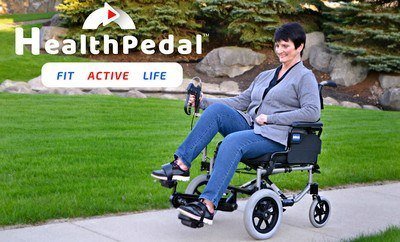
It can and is being used at assisted living and nursing homes, developmental disability youth center, and with individuals at home that simply want to get out to the park, the mall, the zoo and many other locations.
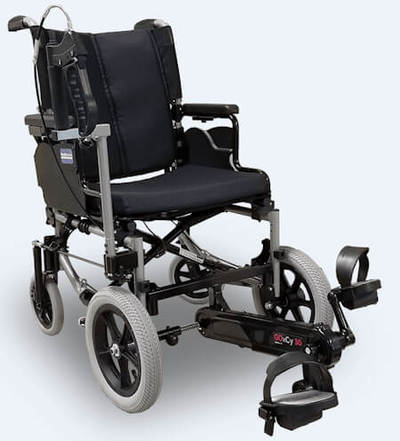
HealthPedal GOxCy 30 is intended to be used on smooth flat surfaces such as wide indoor hallways or paved bicycle and walking paths.
- It accommodates users up to 250 lbs.
- The pedaling system is easy enough for most users to use.
- The smooth steering can be mounted on either the left or right sides with an option for a companion to even do all steering from the rear handles if necessary.
If you or a loved one is looking for a way to stay more active a HealthPedal wheelchair could be a possible solution.
Frequently Asked Questions
Who might benefit most from a pedal powered wheelchair?
People who can move their legs but have trouble walking longer distances, keeping their balance, or building endurance often benefit the most. This includes many seniors and people recovering from stroke, surgery, or living with progressive neurological conditions.
Should I talk to a doctor or therapist before using a pedal wheelchair?
Yes, it is a good idea to speak with a physician or physical therapist first, especially if you have heart problems, recent surgery, or joint pain. They can advise on safe activity levels and whether pedaling fits your rehabilitation goals.
Can someone with one weaker leg still pedal the device?
Many people with one-sided weakness, such as stroke survivors, can still pedal because the stronger leg helps carry the motion of the weaker leg. A therapist can help decide if this type of movement is safe and helpful for your situation.
Can children use a pedal wheelchair or ability cycle?
Some children and teens can use these devices, and they are already used in developmental disability youth settings. Fit and sizing are important, so the rider should be able to reach the pedals comfortably and sit securely before use.
Is a pedal wheelchair allowed on sidewalks and bike paths?
In most areas, mobility devices used by people with disabilities are allowed on sidewalks and paved trails, but local rules can differ. Checking with your city or park authority before heading out is the safest approach.
Does a pedal wheelchair replace a standard wheelchair?
For some people it can serve as a main mobility aid on smooth surfaces, while others use it alongside a standard wheelchair or walker. Many users keep a traditional chair for rough ground, stairs access areas, or days when they feel too tired to pedal.
What health benefits can regular pedaling provide?
Regular pedaling can help maintain leg muscle strength, improve circulation, support joint flexibility, and boost overall cardiovascular fitness. Staying active in this way may also improve mood and help people keep up with social outings and daily activities.
How should a pedal wheelchair be maintained?
Routine care usually includes checking tire pressure, keeping the chain clean and lubricated, and making sure brakes, steering, and folding parts are tight and working properly. Following the maker's care guide and scheduling periodic inspections helps keep the device safe and reliable.
Insights, Analysis, and Developments
Editorial Note: The HealthPedal GOxCy 30 represents a thoughtful advancement in adaptive mobility, bridging the gap between exercise and independence for people with varying physical challenges. Its focus on affordability, portability, and ease of use addresses real-world barriers faced by many in the disability community. By enabling users to remain active and engaged in daily life, whether at home or out in the community, this device offers a practical and dignified approach to fitness and mobility that is likely to inspire further innovation in accessible design. As the demand for inclusive mobility solutions grows, innovations like the GOxCy 30 play a crucial role in enhancing quality of life for diverse populations.
 Author Credentials: Ian C. Langtree is a writer, editor, and the founder and Editor-in-Chief of Disabled World, which he established in 2004 as one of the longest-running independent resources for disability news and information. Over more than two decades, he has written and edited thousands of articles on disability rights, health, accessibility, and assistive technology. Drawing on a global perspective shaped by extensive travel and lived experience, Ian is a committed advocate of the Social Model of Disability, the framework developed by disabled activists in the 1970s that focuses on removing societal barriers rather than on individual impairments. His writing is grounded in that framework and in a lasting commitment to disability rights, accessibility, and social inclusion. To learn more about Ian's background, expertise, and accomplishments, visit his full biography.