Gene-Edited Beagles as Autism Research Models
Author: Genomic Press
Published: 24 Jun 2026 - Updated: 9 Aug 2026
Publication Details: Peer-Reviewed | Research, Study, Analysis
Table of Contents:
Synopsis - Definition - Overview - FAQs - Insights, Updates - Related Content
Synopsis
This peer-reviewed Perspective, published in Genomic Psychiatry, synthesizes a decade of canine research to make a compelling case for gene-edited Beagles as a complementary model in autism spectrum disorder therapeutics research. Unlike mice or non-human primates, dogs have co-evolved with humans over roughly 30,000 years, developing social cognition that closely mirrors our own - a trait that makes them uniquely suited to study conditions where social behavior is disrupted. The article will be of interest to researchers, clinicians, disability advocates, and anyone following the slow, costly failure rate of autism drug development, as it proposes a practical and ethically examined path toward better preclinical models.*
At a Glance
- 1 - Beagles carrying engineered changes in the Shank3 gene - one of the most reliably autism-linked genes in humans - display social withdrawal, altered sensory responses, and reduced eye contact that closely parallel behaviors observed in autistic people.
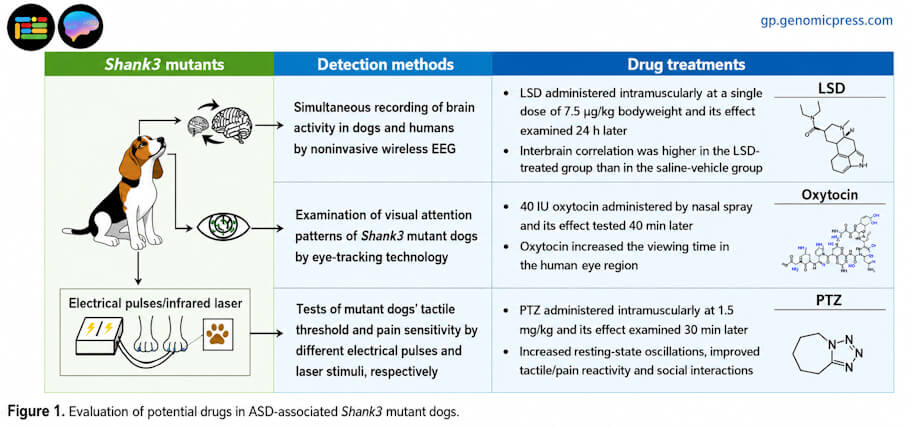
- 2 - Early findings suggest some autism-related traits in gene-edited dogs may be partially eased by oxytocin nasal spray, a low-dose psychedelic compound, and a neural excitation agent, though the authors caution that sample sizes remain small and results are preliminary.
- 3 - Gene editing in dogs currently succeeds only about 25 percent of the time, and training dogs for neuroimaging can take close to two years, underscoring that significant technical barriers remain before canine models can be widely adopted.
Topic Definition
- Autism Spectrum Disorder Animal Models
Autism spectrum disorder animal models are living biological systems - typically mice, non-human primates, or, more recently, gene-edited dogs - used in preclinical research to replicate the genetic, neurological, and behavioral features of autism spectrum disorder in humans. These models are designed to help scientists study the underlying biology of the condition and to test whether experimental drugs or interventions can correct specific deficits before human trials begin. Because autism is defined largely by disruptions to social behavior, the validity of any animal model depends heavily on whether that species naturally engages in the kinds of rich, mutual social interaction that autism affects. A model that lacks genuine social complexity cannot reliably reveal whether a treatment restores it.
Overview
A Review Argues The Family Dog May Become Science’s Unlikely Ally Against Autism
In a new Perspective for Genomic Psychiatry, Dr. Siqi Yuan and colleagues synthesize a decade of canine research, proposing gene-edited Beagles as a complementary, welfare-conscious model for autism therapeutics.
For thirty years the search for autism medicines has hit the same wall, and a new peer-reviewed Perspective in Genomic Psychiatry suggests that the way around it has been sleeping at our feet the entire time. The article is a synthesis rather than a fresh experiment. It gathers a decade of scattered findings and makes a quiet, provocative case. The laboratory Beagle, that gentle and biddable companion, may be the missing bridge between the petri dish and the clinic.
Why The Old Models Keep Failing
More than ninety percent of candidate autism drugs collapse somewhere between the laboratory and the human trial. The review authors trace much of that wreckage to a single cause. The animals we test on cannot do the one thing autism most disturbs, which is to be social in the rich, glancing, eye-meeting way that people are. Mice are convenient and genetically pliable, yet a mouse does not read a face. Monkeys come closer, but they breed slowly, cost a great deal to keep, and, the authors note, a steady human gaze reads to a macaque not as warmth but as threat.
If a drug cannot mend sociability in a creature that was never very social to begin with, how would anyone know whether it works?
The question the synthesis poses is plain. What if the better model has been bred, over thirty thousand years, to look back at us?
"Dogs did not simply move in beside us. They co-evolved to understand us," said Dr. Siqi Yuan, lead author of the Perspective. "That shared social wiring is exactly what other laboratory species lack, and it is exactly what autism research has been missing."
What The Synthesis Pulls Together
The centerpiece is a line of dogs carrying engineered changes in Shank3, a gene whose human counterpart is among the most reliably linked to autism. Across the studies the authors review, these dogs reproduce a striking range of human traits. They withdraw from social contact. They show altered responses to sound, to touch, and to pain. They look away from the eyes of a human face more quickly than other dogs do, the very flinch from the gaze that clinicians observe in autistic people. The review draws these threads into a single table of parallels, from synapse to behavior, that no individual study had assembled before.
What does it mean that a dog, given the human version of an autism gene, begins to behave in human ways?
"When you place the canine findings beside the human literature, the overlaps are difficult to dismiss," said Professor Yong Q. Zhang, the corresponding author, of the School of Life Sciences at Hubei University. "This is not a replacement for mice or monkeys. It is a complement, a third lens that brings the social dimension into focus."
Glimmers Of Treatment, Held At Arm's Length
The synthesis also gathers early and frankly preliminary signs that some of these traits can be eased. [Review Finding] Oxytocin, delivered as a nasal spray, lengthened the time mutant mothers spent licking their pups and coaxed the dogs to dwell longer on the human eye region. A carefully dosed psychedelic restored a kind of brain-to-brain synchrony between dog and handler that the mutation had broken. A compound that nudges neural activity back toward excitation rescued blunted touch sensitivity and social interaction.
Could these scattered rescues point toward medicines that help people?
The authors are careful. The samples are small, the settings controlled, and the human record on oxytocin remains mixed. Promise is not proof.
An Honest Reckoning With The Ethics
None of this arrives without weight, and the authors do not pretend otherwise. Dogs occupy a tender place in human life, and the use of them in research troubles many people deeply. The review meets that discomfort head on. It binds the work to the principles known as the three Rs, replacement, reduction, and refinement, and stresses that every study passes stringent ethical review designed to use as few animals as possible. There is a hard tension here, named plainly in the paper. Too few animals and the data crumble. Too many and the moral cost climbs. Striking that balance, the authors write, is the difficult center of the whole enterprise.
Is it possible that the animal we domesticated for companionship is, all along, the one best suited to study the biology of connection?
The Road Ahead, Soberly Mapped
Other limits are technical. Gene editing in dogs still succeeds only about a quarter of the time. Some mutations prove lethal. Training a dog to lie still for a brain scan can take the better part of two years. And the toolkit for canine neuroscience remains thin beside the lavish one built for mice. Where, then, does the field go? The authors call for new collaborations across disciplines, better editing methods, and gentler ways to train.
Their closing argument is modest and, in its way, moving. The dog earns its place in this work not as a tool but as a translator, an animal that has spent thirty thousand years learning to read us, now asked to help us read ourselves.
About the Study
The peer-reviewed Perspective in Genomic Psychiatry titled "Emerging gene-edited dog models for autism spectrum disorder," is freely available via Open Access, starting on 24 June 2026 in Genomic Psychiatry.
Yuan S, Shi Q, Zhao H, Guo K, Jiang Y-H, Zhang YQ. Emerging gene-edited dog models for autism spectrum disorder. Genomic Psychiatry 2026. Epub 2026 Jun 24.
About Genomic Psychiatry: Genomic Psychiatry: Advancing Science from Genes to Society (ISSN: 2997-2388, online and 2997-254X, print) represents a paradigm shift in genetics journals by interweaving advances in genomics and genetics with progress in all other areas of contemporary psychiatry. Genomic Psychiatry publishes peer-reviewed medical research articles of the highest quality from any area within the continuum that goes from genes and molecules to neuroscience, clinical psychiatry, and public health.
Frequently Asked Questions
NOTE: Researched FAQs by Disabled World (DW)
What is the Shank3 gene and why is it linked to autism
Shank3 is a gene that provides instructions for a protein found at synapses, the junctions where nerve cells communicate. It helps organize the machinery that lets neurons pass signals efficiently, and disruptions or deletions in Shank3 are among the most consistently identified genetic changes associated with autism spectrum disorder in humans, which is why researchers use it to model the condition in animals.
Why are Beagles specifically chosen for this kind of research
Beagles are commonly used because they tend to be gentle, cooperative, uniform in size, and easy to handle, which makes them practical for controlled laboratory work and repeated behavioral testing. Their manageable temperament also helps during lengthy training for procedures like brain scans, and they share the broad social wiring that dogs developed through long domestication alongside people.
What are the three Rs in animal research
The three Rs are replacement, reduction, and refinement, a widely accepted ethical framework guiding the responsible use of animals in science. Replacement means using non-animal methods where possible, reduction means using the fewest animals needed for valid results, and refinement means improving procedures and housing to minimize pain, distress, and to enhance welfare throughout a study.
How do researchers measure social behavior in dogs
Researchers use tools such as eye-tracking technology to record where a dog looks and how long it dwells on a human face or eye region, along with structured tasks that observe how the animal approaches or withdraws from people. They may also pair these behavioral observations with brain activity recordings to connect what a dog does with what is happening neurologically.
What is oxytocin and how might it affect social behavior
Oxytocin is a hormone and signaling molecule produced in the brain that is involved in bonding, trust, and social connection between individuals. In research settings it is sometimes delivered as a nasal spray to study whether it can increase social engagement, though scientists emphasize that human results have been mixed and that its effects on autism traits remain uncertain and under investigation.
How long does it take to train a dog for a brain scan
Training a dog to remain calm and completely still for neuroimaging can take close to two years, because the animal must learn to tolerate the equipment, sounds, and confinement without sedation that could distort the readings. This lengthy preparation is one of the practical barriers that limits how quickly canine models can be scaled up for wider research use.
Why do so many autism drug candidates fail before reaching patients
More than ninety percent of candidate autism drugs fail during development, and researchers attribute much of this to the limitations of the animal models used in early testing. If a species does not naturally engage in complex social behavior, it becomes difficult to tell whether an experimental drug actually improves sociability, so promising laboratory results often do not translate into benefits in human clinical trials.
Insights, Analysis, and Developments
Editorial Note: The argument at the heart of this Perspective is both scientifically grounded and quietly striking - that the animal humans have spent millennia shaping into a social companion may hold answers about a condition defined by the challenges of social connection. With over 90 percent of candidate autism drugs failing before they reach patients, the case for rethinking preclinical models is not academic; it is urgent. This synthesis does not overreach. It assembles existing evidence carefully, acknowledges ethical complexity honestly, and frames the Beagle not as a replacement for existing models but as a third lens - one that may finally bring the social dimension of autism into clearer focus for drug developers and researchers alike.*
Attribution/Source(s): This peer reviewed publication was selected for publishing by the editors of Disabled World (DW) due to its relevance to the disability community. Originally authored by Genomic Press and published on 24 Jun 2026, this content may have been edited for style, clarity, or brevity.
* Editorial additions by Ian C. Langtree.