Brain Injury Repair May Ride on the Cell's Own Vesicles
Author: Genomic Press
Published: 30 Jun 2026 - Updated: 9 Aug 2026
Publication Details: Peer-Reviewed | Literature / Review
Table of Contents:
Synopsis - Definition - Overview - FAQs - Insights, Updates - Related Content
Synopsis
This research, a peer-reviewed Thought Leaders Invited Review led by Dr. Ye Xiong of Henry Ford Health and Michigan State University and published in Brain Medicine, carries weight because it does not rest on a single experiment but instead pulls together preclinical and early clinical evidence into a clear pattern. It argues that traumatic brain injury behaves like a body-wide event rather than a local wound, and that microscopic membrane parcels called extracellular vesicles, drawn from mesenchymal stromal cells, could offer a cell-free therapy. The synthesis is useful precisely because it is honest about the thin human record while showing consistent benefits across rats, swine, and monkeys, giving patients, families, and clinicians - including those caring for seniors and people living with disabilities after brain trauma - a grounded sense of where the science genuinely stands.*
At a Glance
- 1 - Treated rhesus monkeys with hand injuries recovered motor function faster, sometimes regaining full pre-injury grasp.
- 2 - The injured brain can ship its own vesicles into the bloodstream, where one microRNA-rich type traveled to the lung and provoked acute lung injury.
- 3 - Vesicles can be engineered with CRISPR-based tools and surface peptides, including a rabies-derived peptide, to steer them toward neurons and across the blood-brain barrier.
Topic Definition
- Extracellular Vesicles
Extracellular vesicles are tiny membrane-bound parcels that cells release, especially when stressed or injured, and they act as a kind of postal service between cells - ferrying proteins, lipids, and genetic messages such as microRNA from one place to another. When harvested from mesenchymal stromal cells, a versatile type of repair cell, these vesicles carry cargo that can calm inflammation, protect the energy-producing machinery inside cells, and encourage new blood vessels to grow, which is why researchers see them as a possible cell-free therapy that delivers the helpful signals a cell would send without transplanting the cell itself.
Overview
The Brain Talks to the Whole Body After Injury, and a Review Argues Its Cast-Off Vesicles Could Carry the Repair
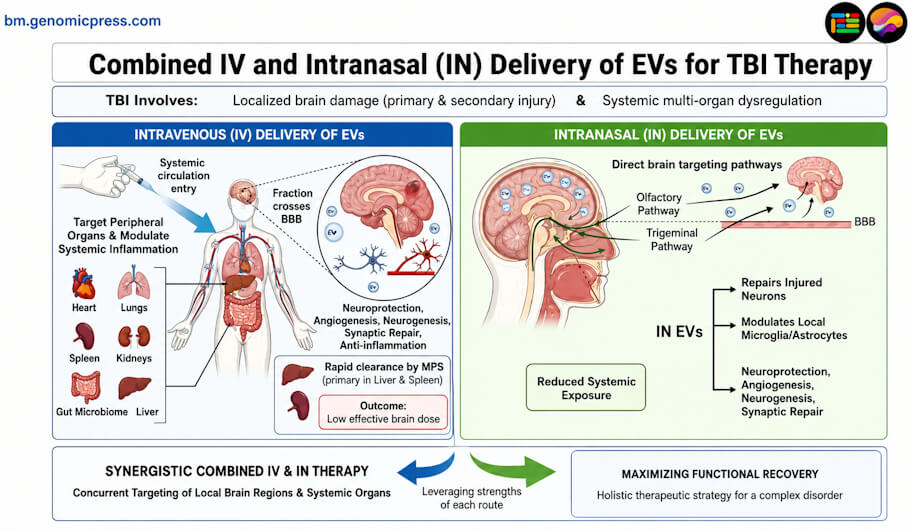
For a long time the textbook picture of a head injury was a local one. Something strikes the skull. The brain underneath bruises, swells, and the damage stays, more or less, where it began. A new peer-reviewed Thought Leaders Invited Review in Brain Medicine, a Genomic Press journal, takes that picture apart. The synthesis, led by Dr. Ye Xiong of Henry Ford Health and Michigan State University, argues that traumatic brain injury behaves less like a single wound and more like a stone dropped in still water. The first splash is the impact. The rings that spread outward extend beyond the brain, reaching peripheral organs such as the lungs, the heart, and the gut, where many secondary systemic responses unfold and can significantly influence long-term outcomes and the overall burden of injury.
What the review proposes as a possible answer is almost poetic in its economy. Cells, when distressed, release vast numbers of microscopic membrane parcels called extracellular vesicles. The authors gather the evidence that vesicles harvested from mesenchymal stromal cells, a type of versatile repair cell, might be turned into a treatment. No transplanted cells. No living graft. Just the messages the cells would have sent, bottled and delivered.
What a Synthesis Can See That a Single Study Cannot
This is a review, not a fresh experiment, and that distinction matters. The authors did not run rats through a maze or dose a patient. They read the field and looked for the shape of it. Reviews reveal patterns invisible in individual studies, and the pattern here is consistency across very different animals. Analysis of existing studies shows that these vesicles improved sensorimotor function and cognition in rats, reduced lesion size, and increased the birth of new neurons in the hippocampus in a dose- and time-dependent way. The benefit held even when treatment began one to seven days after injury, which the authors note points to a clinically relevant therapeutic window.
"Traumatic brain injury has resisted single-target therapies for decades, and our synthesis suggests why," said Dr. Ye Xiong, corresponding author and a member of the Department of Neurosurgery at Henry Ford Health. "The brain injury engages many pathways at once. Extracellular vesicles are appealing precisely because they carry many signals at once, matching the complexity of the disorder rather than fighting it on one front."
How Understanding of the Injury Has Changed
The review walks through the biology with care. The primary injury, the mechanical one, is largely irreversible. It is the secondary cascade that opens a door for treatment. Excitotoxicity. Oxidative stress. Neuroinflammation. The breakdown of the blood-brain barrier. These unfold over hours and days and, the authors write, sometimes years. Because they are potentially modifiable, they become targets. And here the review introduces a striking idea drawn from the primary literature: the injured brain ships its own vesicles into the bloodstream, where they can trigger clotting and inflammation in distant organs. One study cited shows vesicles enriched with a particular microRNA traveling from brain to lung and provoking acute lung injury. The brain, in other words, can wound the body that is trying to keep it alive.
So how might the same kind of vehicle that spreads harm be enlisted to carry repair? That is the question the review circles. The answer rests on source. Vesicles from mesenchymal stromal cells carry a different freight, one rich in molecules that suppress inflammation, protect mitochondria, and stimulate the growth of blood vessels.
Where the Evidence Climbs the Evolutionary Ladder
The strength of this review is its refusal to stop at the rodent. Most evidence in the field comes from mice and rats, and the authors say so plainly. But they also follow the trail upward. In swine models that combine brain injury with severe blood loss, vesicle treatment dampened inflammatory signaling and improved outcomes while showing no organ toxicity. In rhesus monkeys with cortical hand injuries, animals given vesicles recovered motor function faster, sometimes regaining full pre-injury grasp, while untreated animals lagged. The treated monkeys showed calmer microglia and a restored balance of brain activity around the lesion.
"Large-animal work is the bridge," said Dr. Michael Chopp, a co-author affiliated with Henry Ford Health, Michigan State University, and Oakland University. "The primate findings, where treated animals recovered fine motor control that controls failed to regain, give the field a reason to take human trials seriously. A review cannot manufacture that evidence, but it can show how the pieces line up."
The Thin Human Record, and the Honesty to Admit It
Here the review earns trust by undercutting its own enthusiasm. Human evidence is scarce. The authors describe a single case report of a severe TBI patient who received vesicle infusions over six months and showed motor and cognitive gains by eight weeks. They describe a small series of five combat-related TBI patients treated through spinal and muscular routes who reported functional gains, though reductions in spasticity were not statistically significant. That is the human record. Two reports. A handful of people. The synthesis is candid that large, controlled trials simply do not yet exist, and that much clinical work so far has examined vesicles as biomarkers rather than as medicine.
Is a treatment that works across three species but has been tried in only a few humans ready for the clinic? The review does not pretend to know. It lays the question on the table and lets it sit there, which is the honest thing to do.
Engineering the Messenger
Where the review turns most forward-looking is on engineering. The authors describe how the vesicle cargo can be enriched with chosen microRNAs, how parent cells can be edited with CRISPR-based tools, and how the vesicle surface can be studded with peptides that home to the brain. One approach fuses a rabies-derived peptide to a vesicle membrane protein, steering the particles toward neurons and across the blood-brain barrier. Another loads the vesicles onto biomaterial scaffolds that hold them at the injury site and release them slowly, rather than letting the liver and spleen sweep them away within hours.
Delivery itself becomes a strategy. The review makes the case for combining intravenous infusion and intranasal administration: intravenous infusion reaches the embattled peripheral organs, with only a smaller fraction reaching the brain, whereas intranasal delivery can bypass the blood-brain barrier and transport vesicles along olfactory and trigeminal pathways directly into the central nervous system. Each route compensates for the limitations of the other.
Where the Algorithms Enter
The authors devote real attention to artificial intelligence, and not as decoration. Machine learning and large language models can sift enormous datasets to pick out which molecular cargoes track with healing, can monitor manufacturing in real time to hold batches consistent, and can help stratify which patients are likely to respond. The review frames this as a shift away from one-size-fits-all treatment toward something adaptive and mechanism-driven. It also names the limits without flinching: small, fragmented datasets and a lack of standardized methods that, left unaddressed, would produce models that do not generalize.
"Computation lets us interpret the vesicle's signaling and design around it," Dr. Xiong noted. "But the field still lacks the standardized datasets that reliable models require. We are honest in the review that the tools are only as trustworthy as the data feeding them."
The Gap Between Promise and Pharmacy
The review closes on the unglamorous work that decides whether any of this reaches patients. Producing uniform vesicles at scale remains a bottleneck. The field has no agreed potency assays, no shared dosing metrics, no settled way to characterize a batch. Regulators at the U.S. Food and Drug Administration and the European Medicines Agency are still defining what quality means for an engineered vesicle. None of this is solved by a clever molecule. It is solved by the patient, methodical labor of standardization, and the authors say as much.
What the synthesis ultimately offers is a reframing. Treat the brain as part of a body, treat the injury as a conversation gone wrong between organs, and the cell's own messengers start to look less like debris and more like a language worth learning to speak. The science is not finished. The review is clear about that. But it has organized a sprawling, contradictory field into something a reader, and a future trial, can actually navigate.
Frequently Asked Questions
NOTE: Researched FAQs by Disabled World (DW)
How is a vesicle-based therapy different from receiving a stem cell transplant?
A stem cell transplant introduces living cells into the body, which then must survive, integrate, and function. A vesicle-based approach instead delivers only the microscopic messenger parcels those cells naturally release, without any living graft. This cell-free strategy aims to provide the beneficial signals a repair cell would send, such as calming inflammation and encouraging blood vessel growth, while avoiding some of the complications that can come with transplanting cells themselves.
Are there known side effects or safety concerns with extracellular vesicle treatment?
Because the human record so far involves only a small number of people, the full safety profile is not yet established. Animal studies in swine reported improved outcomes without observed organ toxicity, which is encouraging, but large controlled trials are still needed to understand risks in people. Anyone considering experimental vesicle therapy should discuss potential unknowns carefully with a qualified medical team.
When might a vesicle-based brain injury treatment become widely available?
No firm timeline exists. The research is still moving from animal studies and a handful of human reports toward the large, controlled clinical trials that regulators require. Significant hurdles remain in manufacturing consistency, dosing standards, and regulatory definitions of quality, all of which must be resolved before such a therapy could reach general clinical use.
Could this therapy help someone whose brain injury happened years ago?
Current evidence focuses largely on treatment begun within days of injury, where a therapeutic window appears to exist during the secondary injury cascade. Whether the approach could benefit long-standing or chronic injuries is not established by the reviewed research. People living with older injuries should view this as an open scientific question rather than a proven option at this stage.
How much would an engineered vesicle therapy be likely to cost, and would insurance cover it?
Cost and coverage cannot yet be determined because the therapy remains experimental and is not approved for general use. Advanced biologic treatments that require specialized manufacturing often carry high costs, and insurance coverage typically follows regulatory approval and established clinical guidelines. These questions will become clearer only as trials progress and any approved product enters the market.
How can patients or families learn about or take part in research on this treatment?
Because the field is still early, opportunities to participate are limited and tied to formal clinical trials. Interested patients and families can ask a neurologist or neurosurgeon about ongoing studies, consult reputable clinical trial registries, and be cautious of clinics marketing unproven vesicle or stem cell treatments outside of regulated research. A trusted medical provider can help evaluate whether any specific option is legitimate and appropriate.
Insights, Analysis, and Developments
Editorial Note: What lingers after reading this review is the quiet reframing at its center - the idea that a brain injury is less a sealed-off bruise than a conversation gone wrong between organs, and that the cell's own discarded messengers might be taught to carry repair rather than harm. The authors resist overselling, naming the two-report human record and the manufacturing bottlenecks as plainly as they name the primate breakthroughs, and it is that restraint that makes the work trustworthy. For a condition that has shrugged off single-target drugs for decades, a map this candid is worth more than another bold claim.*
Attribution/Source(s): This peer reviewed publication was selected for publishing by the editors of Disabled World (DW) due to its relevance to the disability community. Originally authored by Genomic Press and published on 30 Jun 2026, this content may have been edited for style, clarity, or brevity.
* Editorial additions by Ian C. Langtree.