What Is a Doula? Birth Support, Disability, and Access
Author: Ian C. Langtree - Writer/Editor for Disabled World (DW)
Published: 10 Oct 2026
Publication Type: Informative
Table of Contents:
Synopsis - Definition - Overview - FAQs - Insights, Updates - Related Content
Synopsis
Doulas have moved from the edges of maternity care into hospital delivery rooms, insurance policies, and clinical guidelines, yet many people still are not sure what a doula actually does. This paper explains the role clearly: where the word came from, what kinds of support doulas provide, where their work stops, and what decades of research reveal about their impact. It also looks at an often-missed part of the story, which is how doula care can help close the gaps disabled parents face in pregnancy and birth, and why that matters for everyone who believes good care should fit the person receiving it.
At a Glance
- 1 - Doulas do not deliver babies or perform clinical tasks. Their work is nonmedical, centered on comfort, information, and advocacy.
- 2 - A small British study followed women with intellectual disabilities who had doula support. They described their doulas as reliable sources of pregnancy information.
- 3 - About one in four U.S. adults reports a disability, according to CDC data. Overall, disabled women of reproductive age report pregnancy at rates close to those of nondisabled women.
- 4 - During the COVID-19 pandemic, federal civil rights officials resolved a complaint requiring Connecticut hospitals to allow a designated support person for patients with disabilities. The case showed that access to support during care can be a disability rights issue, not simply a comfort.
Topic Definition
- Doula
A doula is a trained companion who supports a person through pregnancy, labor, and the early weeks after birth, without providing medical care. Doulas offer hands-on comfort such as massage and position changes, steady emotional reassurance, and plain-language explanations that help families understand their options and talk with their care team. Unlike doctors, midwives, or nurses, a doula's only focus is the well-being and experience of the person giving birth, which is why their presence is often described as continuous support. Many doulas also specialize in postpartum care, high-risk pregnancies, pregnancy loss, or supporting parents with disabilities.
Overview
What Is a Doula? Starting With the Word Itself
Picture a hospital room at 3:00 a.m. A first-time parent is eleven hours into labor. The nurse is managing three patients, the obstetrician is in surgery down the hall, and the partner is exhausted and frightened. One person in the room has a single job: stay with the laboring person, minute by minute, until the baby arrives. That person is the doula.
The word comes from ancient Greek, where it referred to a female servant. Its modern meaning dates to medical anthropologist Dana Raphael. In her 1973 book The Tender Gift, she used "doula" for the experienced women who help new mothers, especially with breastfeeding, during the vulnerable weeks after birth (Raphael, 1973). The term stuck and grew. Today it describes a trained, nonmedical companion who gives physical, emotional, and informational support around pregnancy, birth, and the postpartum period.
Doula (noun): A trained, nonclinical support professional who stays with a person before, during, and after childbirth, offering comfort measures, emotional reassurance, and clear information. A doula does not replace a doctor, midwife, or nurse.
This paper explains what doulas do, what the research actually shows, and why doula care matters for one group that maternity care has often overlooked: people with disabilities.
A Brief History: From Guatemala City to Global Practice
The modern evidence for doula care starts with an unusual experiment. In the late 1970s, pediatricians John Kennell and Marshall Klaus were studying mother-infant bonding at a busy hospital in Guatemala City. Their team found that first-time mothers who had a supportive lay companion during labor had shorter labors and fewer complications than mothers who labored alone (Sosa et al., 1980). The companions had no medical training. They simply stayed, talked, touched, and reassured.
That finding was surprising enough to spark decades of follow-up trials. In 1992, Klaus, Kennell, childbirth educator Penny Simkin, and others founded the organization now known as DONA International, which helped turn the doula role into a recognized profession with training standards and certification.
Reading the Pattern Across Timescales
It helps to look at doula care across several timescales at once, since each one shows a different side of the same idea:
- Minutes: the doula's counter-pressure on a laboring person's lower back during a single contraction.
- Months: prenatal visits, birth planning, and postpartum check-ins that build trust over a pregnancy.
- Decades: research and policy shifts that have moved doulas from the margins of maternity care toward insurance coverage and clinical guidelines.
The same principle holds at each scale. Steady, attentive human presence changes how a system behaves. One contraction, one pregnancy, and one health policy are all shaped by whether someone is paying close attention.
What Doulas Actually Do
Doula work is broad but clearly bounded. The easiest way to understand it is to split it into four kinds of support.
Physical Comfort
Doulas use non-drug comfort techniques: massage, counter-pressure, help changing positions, breathing guidance, warm compresses, and suggestions for birth balls or showers. They also help with the small physical tasks that matter when someone is in pain, such as offering sips of water, adjusting pillows, or dimming lights.
Emotional Support
Fear can amplify pain, and anxiety can make labor feel endless. A doula offers steady encouragement and reassurance. They also keep the partner or family involved instead of replacing them.
Informational Support
Doulas explain what is happening in plain language, help prepare questions for clinicians, and walk through options before decisions arise. They do not give medical advice. They help their client understand the advice they receive.
Advocacy and Communication
A good doula helps the client's voice be heard. That might mean reminding the care team of a stated preference, or pausing a rushed conversation so the client can ask a question. Doulas facilitate communication, but they do not make decisions on a client's behalf or speak over clinicians.
Scope of practice: The set of tasks a professional is trained and permitted to perform. A doula's scope is nonclinical. Doulas do not perform vaginal exams, monitor fetal heart rates, give medications, or deliver babies.
Types of Doulas
- Birth doulas, who focus on late pregnancy and labor.
- Postpartum doulas, who support recovery, infant feeding, newborn care, and household adjustment in the weeks after birth.
- Antepartum doulas, who support people on bed rest or with high-risk pregnancies.
- Full-spectrum doulas, who may also support people through miscarriage, pregnancy loss, abortion, adoption, or surrogacy.
The model has also spread beyond birth. "End-of-life doulas" now offer nonmedical companionship to dying people and their families. That shows how far the basic idea of continuous, nonclinical presence can travel.
What the Evidence Says
The strongest summary of the evidence is a Cochrane systematic review of continuous one-to-one labor support. It pooled more than two dozen randomized trials involving nearly 16,000 women (Bohren et al., 2017). People who received continuous support were more likely to have a spontaneous vaginal birth, had slightly shorter labors, and were less likely to need pain medication, instrumental birth, or a cesarean. They were also less likely to report negative feelings about their birth experience. The reduction in cesarean births was about 25 percent.
One detail in that review is especially telling. The benefits were most apparent when support came from someone who was neither hospital staff nor part of the woman's own social circle. In other words, the doula's position as a trained outsider with no competing duties seems to matter.
Continuous labor support: Uninterrupted, one-to-one presence of a support person throughout labor and birth. This is different from intermittent check-ins by busy staff.
Major health bodies have taken note. The American College of Obstetricians and Gynecologists identifies continuous support from personnel such as a doula as one of the most effective tools for improving labor outcomes (American College of Obstetricians and Gynecologists, 2019). The World Health Organization recommends that every woman be allowed a companion of her choice during labor and childbirth (World Health Organization, 2018).
Community and Public Health Findings
Observational research points in the same direction. A Minnesota study compared Medicaid-funded births supported by a community doula program with Medicaid births nationally. Doula-supported births had a cesarean rate of 22.3 percent versus 31.5 percent, and the odds of cesarean were about 41 percent lower after adjusting for clinical and demographic factors (Kozhimannil et al., 2013). Another study found that doula-assisted mothers were less likely to have a low-birth-weight baby or a birth complication, and more likely to start breastfeeding (Gruber et al., 2013).
A word of caution about how to read these figures. Observational studies cannot fully rule out the possibility that people who choose doulas differ in other ways. The randomized evidence is the firmer foundation, and the observational studies are best seen as consistent supporting signals.
Why Disability Belongs in the Doula Conversation
Here the analysis shifts scale, from individual births to the structure of maternity care itself.
Disability is common. CDC survey data indicate that about one in four U.S. adults reports some form of disability, including mobility, cognitive, hearing, vision, self-care, and independent living disabilities (Okoro et al., 2018). Disabled people also become parents. A national analysis found that overall pregnancy rates among women with and without disabilities were similar. Lower rates appeared mainly among women with the most complex disabilities (Horner-Johnson et al., 2016).
Yet maternity care has often been designed as if disabled patients were rare exceptions. The consequences show up in outcomes. A large National Institutes of Health study of more than 223,000 deliveries found that women with disabilities had higher risks for almost every pregnancy complication examined, including severe preeclampsia, postpartum hemorrhage, and blood transfusion (Gleason et al., 2021). Maternal deaths were rare overall, but substantially more likely among women with disabilities.
Severe maternal morbidity: Unexpected, serious complications of labor and delivery, such as hemorrhage requiring transfusion, heart failure, or sepsis, that lead to significant short-term or long-term health consequences.
The study's authors pointed to several possible drivers: higher rates of obstetric intervention, under-recognition of disabled patients as a higher-risk group, and limited clinician knowledge or comfort in caring for them (Gleason et al., 2021). Notice what that list implies. Some of the risk is medical, but some of it is about communication, preparation, and attention. Those are exactly the gaps a doula is trained to fill.
A Thought Experiment
Imagine two patients arriving at the same hospital in labor. Both are healthy. One uses a wheelchair, and the delivery room has a fixed-height bed. One is Deaf, and the interpreter has not yet arrived. Neither problem is clinical in the narrow sense. Both can still turn a routine birth into a stressful, unsafe, or traumatic one. The system was not built with these patients in mind, and someone needs to notice the gap before it widens.
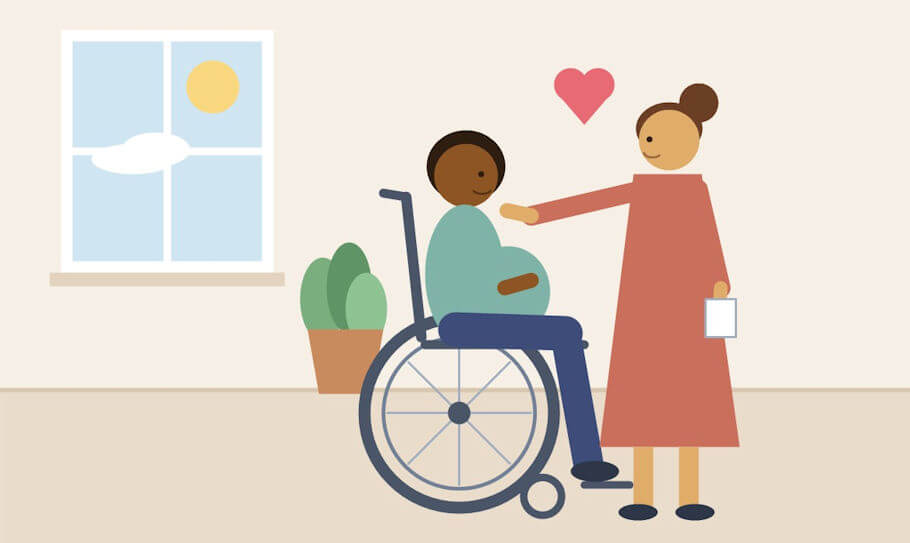
How Doulas Can Support Disabled Parents
The doula role adapts naturally to disability because it is built around the individual, not around a standard protocol. Below are realistic examples of what that looks like, organized by type of need.
Mobility and Physical Disabilities
A doula working with a client who has a spinal cord injury or cerebral palsy might plan comfortable labor positions in advance, check that the birth facility has accessible equipment, and help communicate transfer needs to staff. After the birth, a postpartum doula can help adapt feeding positions and newborn care routines to the parent's body and existing equipment.
Deaf and Hard of Hearing Parents
A doula can help a Deaf client request a qualified sign language interpreter ahead of time, prepare visual birth plans, and make sure staff face the client when they speak. Some doulas are themselves Deaf or fluent in sign language, which allows direct communication during labor.
Intellectual and Developmental Disabilities
One of the few qualitative studies on this topic interviewed women with intellectual disabilities in England who received doula support, along with their doulas. The women valued their doulas as trusted, reliable sources of information during pregnancy (McGarry et al., 2016). Practical strategies include breaking information into small steps, using pictures or easy-read materials, and repeating key points without condescension.
Supported decision-making: An approach in which a person with a disability makes their own choices with help from trusted supporters who explain options and consequences. It is an alternative to having someone else decide for them.
Autism and Sensory Processing Differences
Hospitals are loud, bright, and unpredictable. A doula can help an autistic client plan for sensory needs, such as dimmed lights, fewer people in the room, advance warning before touch, or noise-reducing headphones, and can act as a consistent, familiar presence when staff shifts change.
Chronic Illness and Mental Health Conditions
For clients managing chronic pain, psychiatric disabilities, or past trauma, doulas can offer trauma-informed support. That means asking before touching, explaining procedures, and watching for signs of distress, while coordinating with the client's clinical team instead of acting independently.
Researchers have begun to argue for this specialization directly. A review focused on African American women with disabilities, a group facing both racial and disability-related disparities, recommended doula support and called for doula training specific to disability, trauma-informed care, and maternal mental health (Horton and Hall, 2020).
Support Persons, Civil Rights, and the Hospital Door
Zooming out again, from the room to the legal system around it, there is a civil rights side to support during birth.
Under the Americans with Disabilities Act and Section 504 of the Rehabilitation Act, health care providers must make reasonable modifications to policies so that disabled patients have equal access to care. That principle was tested during the COVID-19 pandemic, when many hospitals adopted strict no-visitor rules. In 2020, the U.S. Department of Health and Human Services Office for Civil Rights resolved a complaint with the state of Connecticut. The state agreed that hospitals must allow a designated support person for patients with disabilities who need one (U.S. Department of Health and Human Services, Office for Civil Rights, 2020).
Reasonable modification: A change to a rule, policy, or practice that allows a person with a disability equal access, unless the change would fundamentally alter the service or create an undue burden.
That resolution was not specifically about doulas. It does establish something important: for many disabled patients, a support person is not a luxury but part of how they get equal access to care. A doula can be one form of that support, alongside or instead of family members.
Paying for a Doula: Access and Policy
Cost has long been the biggest barrier. Private doula fees are often paid out of pocket, which puts doula care out of reach for many low-income families, and disabled adults are disproportionately likely to live on low incomes.
That is changing. Minnesota and Oregon were early states to reimburse doula care through Medicaid, and the Minnesota research cited above helped inform the state's policy debate. Since then, a growing number of state Medicaid programs have added or begun implementing doula coverage. Coverage rules, reimbursement rates, and certification requirements vary widely by state, so families should check their own state's Medicaid program or insurer.
The Lurie Institute's National Center for Disability and Pregnancy Research at Brandeis University has begun examining what Medicaid doula coverage means for disabled pregnant people specifically. This is a sign that disability is starting to enter doula policy conversations, not just clinical ones.
Choosing a Doula: Questions Worth Asking
Any expectant parent can benefit from interviewing several doulas. Disabled parents may want to add a few questions:
- Have you supported clients with disabilities like mine, and what did you learn?
- How will you help me communicate my access needs to the hospital or birth center?
- Are you comfortable working alongside my personal care attendant, interpreter, or service animal?
- How do you handle consent and touch during labor?
- What training have you had in trauma-informed or disability-inclusive care?
- Are you covered by my Medicaid plan or insurance, and if not, do you offer sliding-scale fees?
The goal is not to find someone who knows everything about a particular condition. It is to find someone who listens, asks good questions, and treats the client as the expert on their own body.
Honest Limits and Open Questions
Doula care is not a cure-all. Doulas cannot fix inaccessible buildings, replace qualified interpreters, or overrule medical decisions. Certification is not legally required in most places, so quality and training vary. A doula who oversteps their scope can create friction with clinical teams instead of improving communication.
The research on doulas and disability is also thin. Most of it is small or qualitative, and large trials comparing outcomes for disabled people with and without doula support have not yet been done. The case for doula care in disability is currently built on two strong foundations, robust general evidence for continuous support and well-documented disability-related gaps in maternity care, plus a smaller but growing body of direct evidence.
The Bigger Picture: Presence as Infrastructure
A useful metaphor to end on: think of a doula as a kind of ramp. A ramp does not change who a person is or where they are going. It changes the path so that more people can get there. In the same way, a doula does not change the medicine of birth. They change the human path through it, making information easier to reach, decisions easier to make, and fear easier to bear.
Seen across all three scales, the pattern holds. In the delivery room, presence eases pain and confusion. In health systems, continuous support shows measurable effects on interventions and outcomes. At the level of society, recognizing support as part of access, especially for disabled parents, reflects a broader shift toward care designed for the full range of people who actually give birth.
Frequently Asked Questions
How much does a doula usually cost?
Fees vary widely by region, experience, and type of service. Private birth doula packages typically cost several hundred to a few thousand dollars, while many states now reimburse doula care through Medicaid, and some doulas offer sliding-scale or volunteer services.
Is a doula the same as a midwife?
No. A midwife is a trained health care provider who can manage pregnancy, perform exams, and deliver babies, while a doula provides nonmedical physical, emotional, and informational support and works alongside the clinical team.
When should I hire a doula?
Many families hire a doula during the second trimester, which leaves time for several prenatal meetings to build trust and plan for labor. Postpartum doulas can be hired before or after the birth.
Can I have a doula if I am having a cesarean birth?
Yes. Many hospitals allow a doula in the operating room or recovery area, where they can offer reassurance, explain what is happening, and help with early skin-to-skin contact and feeding, depending on hospital policy.
Do doulas replace my partner during labor?
No. A doula supports the partner as well, suggesting ways to help, giving them breaks, and keeping them involved so that the whole family feels more confident.
Are doulas licensed or certified?
Most states do not require a license to work as a doula. Many doulas complete voluntary training and certification through organizations such as DONA International, and some state Medicaid programs set their own training requirements for reimbursement.
Can a doula help after a pregnancy loss?
Yes. Full-spectrum and bereavement doulas offer emotional and practical support during miscarriage, stillbirth, and other pregnancy losses, including help with memory-making and recovery.
Can a doula attend a home birth?
Yes. Doulas often support planned home births alongside a licensed midwife, providing comfort and continuous presence while the midwife handles the clinical care.
References:
- American College of Obstetricians and Gynecologists. (2019). Approaches to limit intervention during labor and birth (Committee Opinion No. 766). Obstetrics and Gynecology, 133(2), e164-e173.
- Bohren, M. A., Hofmeyr, G. J., Sakala, C., Fukuzawa, R. K., and Cuthbert, A. (2017). Continuous support for women during childbirth. Cochrane Database of Systematic Reviews, (7), CD003766.
- Gleason, J. L., Grewal, J., Chen, Z., Cernich, A. N., and Grantz, K. L. (2021). Risk of adverse maternal outcomes in pregnant women with disabilities. JAMA Network Open, 4(12), e2138414.
- Gruber, K. J., Cupito, S. H., and Dobson, C. F. (2013). Impact of doulas on healthy birth outcomes. The Journal of Perinatal Education, 22(1), 49-58.
- Horner-Johnson, W., Darney, B. G., Kulkarni-Rajasekhara, S., Quigley, B., and Caughey, A. B. (2016). Pregnancy among US women: Differences by presence, type, and complexity of disability. American Journal of Obstetrics and Gynecology, 214(4), 529.e1-529.e9.
- Horton, C., and Hall, S. (2020). Enhanced doula support to improve pregnancy outcomes among African American women with disabilities. The Journal of Perinatal Education, 29(4), 188-196.
- Kozhimannil, K. B., Hardeman, R. R., Attanasio, L. B., Blauer-Peterson, C., and O'Brien, M. (2013). Doula care, birth outcomes, and costs among Medicaid beneficiaries. American Journal of Public Health, 103(4), e113-e121.
- McGarry, A., Stenfert Kroese, B., and Cox, R. (2016). How do women with an intellectual disability experience the support of a doula during their pregnancy, childbirth and after the birth of their child? Journal of Applied Research in Intellectual Disabilities, 29(1), 21-33.
- Okoro, C. A., Hollis, N. D., Cyrus, A. C., and Griffin-Blake, S. (2018). Prevalence of disabilities and health care access by disability status and type among adults - United States, 2016. Morbidity and Mortality Weekly Report, 67(32), 882-887.
- Raphael, D. (1973). The tender gift: Breastfeeding. Prentice-Hall.
- Sosa, R., Kennell, J., Klaus, M., Robertson, S., and Urrutia, J. (1980). The effect of a supportive companion on perinatal problems, length of labor, and mother-infant interaction. New England Journal of Medicine, 303(11), 597-600.
- U.S. Department of Health and Human Services, Office for Civil Rights. (2020). OCR resolves complaint with Connecticut after it revises policy to ensure people with disabilities are not denied reasonable access to support persons in hospital settings during COVID-19. HHS.
- World Health Organization. (2018). WHO recommendations: Intrapartum care for a positive childbirth experience. World Health Organization.
Insights, Analysis, and Developments
Editorial Note: The story of the doula is ultimately a story about attention: who receives it, who gets overlooked, and what changes when someone is fully present for the hardest hours of another person's life. For disabled parents, who have too often met maternity systems unprepared for their bodies, minds, and ways of communicating, a well-trained doula can turn a confusing or frightening experience into one where their voice is heard and their needs are planned for. The research base is still growing, but the direction is clear, and the next step belongs to health systems, insurers, and training programs willing to treat continuous, disability-aware support as a standard part of good care rather than an optional extra.
 Author Credentials: Ian is the founder and Editor-in-Chief of Disabled World, a leading resource for news and information on disability issues. With a global perspective shaped by years of travel and lived experience, Ian is a committed proponent of the Social Model of Disability, a transformative framework developed by disabled activists in the 1970s that emphasizes dismantling societal barriers rather than focusing solely on individual impairments. His work reflects a deep commitment to disability rights, accessibility, and social inclusion. To learn more about Ian's background, expertise, and accomplishments, visit his full biography.