Models of Abnormality and Their Impact on Disability
Author: Ian C. Langtree - Writer/Editor for Disabled World (DW)
Published: 25 Feb 2026 - Updated: 26 Aug 2026
Publication Type: Informative
Table of Contents:
Synopsis - Definition - Overview - FAQs - Insights, Updates - Related Content
Synopsis
The way we define "abnormal" behavior has never been a settled question - and for the millions of people living with disabilities worldwide, the answer carries life-changing consequences. Models of abnormality are the theoretical lenses that psychologists use to explain mental disorders, and each one tells a different story about where problems come from and how they should be addressed. From biological explanations rooted in brain chemistry to sociocultural frameworks that challenge society itself, these models shape diagnoses, treatments, public policy, and the daily experiences of people with disabilities. This paper offers an authoritative, accessible exploration of these competing frameworks and examines what each one means for individuals navigating the complex intersection of mental health and disability.
At a Glance
- 1 - The diathesis-stress model links disorders to biological vulnerability meeting life stressors. A genetic risk may stay dormant without triggering pressures.
- 2 - The humanistic-existential model resists diagnostic labels and centers growth and meaning. Person-centered planning in disability services grows directly from these ideas.
- 3 - Applied behavior analysis has taught adaptive skills to autistic people, yet some self-advocates question it. They warn it can push conformity to neurotypical standards over genuine well-being.
- 4 - The World Health Organization ICF frames disability through the interaction of health, personal traits, and environment. It treats disability as something that emerges from a person and their world, not simply a condition someone has.
Topic Definition
- Models of Abnormality
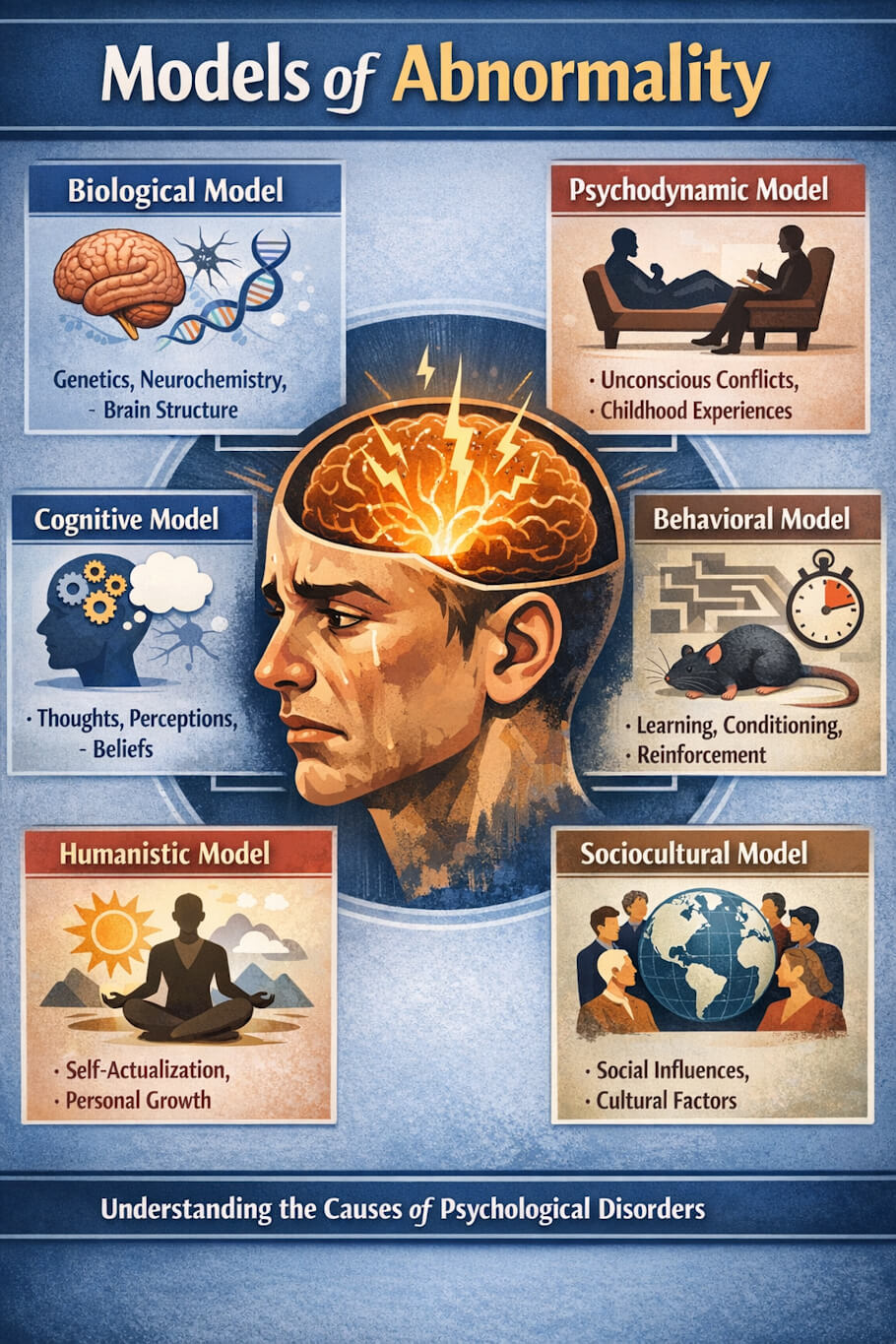
Models of abnormality are the theoretical frameworks used in psychology and related fields to explain why psychological disorders develop, how they manifest, and what kinds of interventions are most likely to help. Each model - whether biological, psychodynamic, behavioral, cognitive, humanistic-existential, or sociocultural - reflects a distinct set of assumptions about the roots of mental distress and atypical behavior, ranging from genetic and neurochemical factors to learned responses, distorted thinking patterns, unresolved inner conflicts, and the influence of social systems and cultural norms. In modern practice, these models are rarely applied in isolation; instead, clinicians typically draw from multiple frameworks in an integrative manner, recognizing that human behavior and disability emerge from the interaction of biological, psychological, and social forces rather than any single cause.
Overview
Models of Abnormality: Understanding the Frameworks Behind Mental Health and Disability
When we talk about what makes behavior "abnormal," we are really asking a question that has puzzled psychologists, physicians, philosophers, and everyday people for centuries. There is no single answer, and there never has been. Instead, the field of psychology has developed several competing frameworks - known as models of abnormality - that each offer a different lens through which to understand psychological disorders, atypical behavior, and disability. These models shape everything from how a diagnosis is made to what kind of treatment is offered, and they carry profound implications for how society treats individuals living with disabilities.
Understanding these models is not just an academic exercise. The model a clinician uses directly influences how they interact with a patient, the kind of help they provide, and even how the patient comes to see themselves. For people with disabilities - whether cognitive, emotional, or physical - the dominant model in their culture or healthcare system can determine whether they are treated with compassion or stigma, whether they receive meaningful support or face institutional barriers. This paper walks through the major models of abnormality, examines how each one relates to disability, and considers the strengths and limitations of each approach.
Also see Models of Disability: Types and Definitions
What Are Models of Abnormality?
Models of abnormality are theoretical frameworks that psychologists and other mental health professionals use to explain the origins, nature, and treatment of psychological disorders. Each model reflects certain assumptions about human behavior and the causes of mental distress. Some emphasize biological factors like brain chemistry. Others focus on learned behaviors, unconscious conflicts, or social and cultural forces. No single model captures the entire picture, which is why most modern practitioners draw from several models simultaneously (Comer, 2015).
These models serve a practical function. They give clinicians a structured way to assess what is going wrong, why it is happening, and what can be done about it. They also influence public policy, legal standards, and the design of support systems for individuals with disabilities. When a society primarily embraces a biological model, for example, it tends to invest heavily in pharmaceutical research and medical infrastructure. When it favors a sociocultural model, it may focus more on reforming institutions and reducing inequality.
The Biological Model
The biological model, sometimes called the medical model, treats psychological abnormality much like any other medical illness. It looks for physical causes - genetic predispositions, neurochemical imbalances, hormonal irregularities, and structural differences in the brain. From this perspective, a person experiencing depression might have low serotonin levels, and the appropriate treatment would involve medication to correct that chemical imbalance (Nolen-Hoeksema, 2014).
This model has produced some of the most significant breakthroughs in mental health treatment. The development of antipsychotic medications in the 1950s, for instance, transformed the care of people with schizophrenia and led to the deinstitutionalization movement that eventually allowed many individuals to live in community settings rather than being confined to asylums. Advances in brain imaging have allowed researchers to identify structural and functional differences associated with conditions like autism spectrum disorder, bipolar disorder, and attention-deficit/hyperactivity disorder.
Relationship to Disability
The biological model has a complicated relationship with disability. On one hand, it has helped legitimize many conditions that were once dismissed as personal weakness or moral failure. Framing a condition as a brain-based illness can reduce blame and open the door to medical support and legal protections. On the other hand, critics argue that the medical model tends to locate the "problem" entirely within the individual, ignoring the environmental and social factors that often contribute to disability. Disability rights advocates have long challenged this perspective, arguing that many of the barriers people face are not inherent to their condition but are instead created by a society that fails to accommodate human variation (Oliver, 1996).
For example, a person who uses a wheelchair is not disabled by their body alone - they are disabled by buildings without ramps, public transit systems without accessible vehicles, and workplaces that refuse to make accommodations. The biological model, taken to its extreme, can miss this crucial distinction.
The Psychodynamic Model
The psychodynamic model traces its roots to the work of Sigmund Freud in the late 19th and early 20th centuries. According to this framework, abnormal behavior arises from unconscious psychological conflicts, often rooted in early childhood experiences. The mind is seen as a battleground where competing forces - the id, ego, and superego - struggle for dominance. When these internal conflicts are not resolved, they can manifest as anxiety, depression, phobias, or other psychological symptoms (Freud, 1917/1963).
Psychodynamic therapists work by helping patients bring these unconscious conflicts into conscious awareness, typically through techniques like free association, dream analysis, and the exploration of the therapeutic relationship itself. The goal is insight - once a person understands the hidden roots of their distress, they can begin to work through it and develop healthier patterns.
Modern psychodynamic approaches have evolved considerably from Freud's original theories. Object relations theory, for instance, emphasizes the role of early attachment relationships in shaping personality and emotional well-being. Attachment-based therapies have shown particular promise in treating conditions like borderline personality disorder and complex trauma (Shedler, 2010).
Relationship to Disability
The psychodynamic model has sometimes been criticized for its application to disability, particularly when it has been used to suggest that physical or cognitive disabilities are rooted in unconscious psychological processes. Historically, some psychodynamic thinkers suggested that certain physical symptoms - including some forms of paralysis and sensory loss - were conversions of psychological distress into bodily form. While conversion disorder is a recognized diagnosis, the broader application of this thinking to people with established physical disabilities was problematic and sometimes harmful.
That said, the psychodynamic model has also contributed positively to our understanding of the emotional experience of living with disability. It has highlighted how grief, identity struggles, and internalized stigma can compound the challenges a person faces, and it has supported the development of therapeutic approaches that help individuals process the emotional dimensions of their condition.
The Behavioral Model
The behavioral model takes a fundamentally different approach. Rather than looking inside the mind for hidden conflicts or chemical imbalances, it focuses on observable behavior and the environmental conditions that shape it. Rooted in the work of researchers like Ivan Pavlov, B.F. Skinner, and John Watson, this model holds that abnormal behavior is learned through the same processes as normal behavior - classical conditioning, operant conditioning, and observational learning (Bandura, 1977).
A phobia, for example, might develop because a person once had a frightening experience with a particular object or situation and subsequently learned to associate fear with that stimulus. Treatment, then, involves unlearning the problematic response and replacing it with a healthier one. Behavioral therapies like systematic desensitization and exposure therapy have strong empirical support for treating anxiety disorders, obsessive-compulsive disorder, and specific phobias.
Relationship to Disability
The behavioral model has had an enormous impact on disability services, particularly in the field of developmental and intellectual disabilities. Applied behavior analysis, or ABA, has been widely used to teach adaptive skills to individuals with autism spectrum disorder and intellectual disabilities. It has helped many people develop communication abilities, self-care routines, and social skills that increase their independence and quality of life.
However, the behavioral model has also faced significant criticism from within the disability community. Some autistic self-advocates, for instance, have raised concerns that certain ABA practices prioritize making individuals conform to neurotypical standards rather than supporting their genuine well-being. The debate around behavioral interventions highlights a broader tension in the models of abnormality - the question of whose definition of "normal" we are using and who benefits from the treatment being offered (Kapp et al., 2013).
The Cognitive Model
The cognitive model, developed most prominently by Aaron Beck and Albert Ellis in the mid-20th century, holds that abnormal behavior is driven by distorted or dysfunctional thinking patterns. According to this framework, it is not events themselves that cause emotional distress but rather the way a person interprets and processes those events. Someone with depression, for example, might habitually engage in negative automatic thoughts - "I am worthless," "Nothing will ever improve," "Everything is my fault" - that perpetuate their low mood (Beck, 1976).
Cognitive therapy involves identifying these maladaptive thought patterns, challenging their accuracy, and replacing them with more balanced and realistic ways of thinking. Cognitive-behavioral therapy, or CBT, which combines cognitive techniques with behavioral strategies, has become one of the most widely practiced and researched forms of psychotherapy in the world. It has demonstrated effectiveness across a wide range of conditions, including depression, anxiety disorders, post-traumatic stress disorder, and eating disorders.
Relationship to Disability
The cognitive model has proven especially useful in addressing the psychological dimensions of disability. People living with chronic physical conditions, acquired disabilities, or neurodevelopmental differences often experience cognitive distortions related to their identity, capabilities, and future. CBT has been adapted successfully for individuals with chronic pain, traumatic brain injury, spinal cord injury, and other conditions (Ehde et al., 2014).
One area where the cognitive model has been particularly influential is in challenging internalized ableism - the tendency for people with disabilities to absorb negative societal messages about their worth and potential. By helping individuals recognize and reframe these automatic thoughts, cognitive approaches can promote greater self-acceptance and resilience. At the same time, critics point out that focusing too heavily on individual cognition can inadvertently place the burden of adjustment on the person with a disability rather than addressing the external systems that create barriers.
The Humanistic-Existential Model
The humanistic-existential model represents a departure from models that focus on pathology and dysfunction. Influenced by thinkers like Carl Rogers, Abraham Maslow, and Viktor Frankl, this framework emphasizes the inherent drive toward growth, self-actualization, and the search for meaning. Abnormality, from this perspective, arises when a person is blocked from fulfilling their potential - often because of restrictive environments, conditional acceptance from others, or a loss of meaning and purpose (Rogers, 1961).
Humanistic therapies emphasize empathy, unconditional positive regard, and the therapeutic relationship itself as tools for healing. The existential branch of this model focuses more directly on the challenges of human existence - the awareness of death, the burden of freedom and responsibility, and the struggle to find meaning in a sometimes indifferent world. Rather than eliminating symptoms, these approaches seek to help people live more authentically and fully.
Relationship to Disability
The humanistic-existential model aligns well with many principles of the disability rights movement. It tends to resist diagnostic labels and instead views each person as a whole human being with unique experiences, strengths, and challenges. This perspective naturally pushes back against the tendency to reduce a person to their diagnosis or to treat disability as a deficit to be fixed.
Person-centered planning, which is now widely used in disability services, draws heavily on humanistic principles. It starts from the question "What does this person want for their life?" rather than "What is wrong with this person?" This approach has been particularly transformative in the field of intellectual and developmental disabilities, where it has supported a shift from institutional care to community inclusion and self-determination (Wehmeyer and Abery, 2013).
The Sociocultural Model
The sociocultural model broadens the lens even further, arguing that abnormal behavior cannot be fully understood without considering the social, cultural, and economic context in which it occurs. Poverty, discrimination, social isolation, cultural dislocation, and systemic inequality all play a role in shaping psychological well-being. From this perspective, treating an individual's symptoms without addressing the social conditions that contribute to their distress is like treating a cough while ignoring the smoke-filled room (Sue et al., 2016).
This model encompasses a range of specific approaches. Family systems therapy examines how dysfunction within family relationships contributes to individual problems. Multicultural perspectives highlight how cultural norms shape definitions of normality and abnormality. Social causation theories link mental health outcomes to structural factors like poverty, racism, and lack of access to education and healthcare.
Relationship to Disability
The sociocultural model has perhaps the strongest natural connection to disability studies and disability rights. The social model of disability, which emerged from disability activism in the 1970s and 1980s, argues that disability is not primarily a medical condition but a social construction. People are disabled not by their bodies or minds but by the barriers that society creates - inaccessible buildings, discriminatory hiring practices, inadequate support services, and cultural attitudes that devalue difference (Barnes, 2012).
This perspective has had a profound impact on policy. Legislation like the Americans with Disabilities Act in the United States and the Equality Act in the United Kingdom reflects sociocultural thinking by requiring that society make accommodations rather than expecting individuals to simply adapt. In the mental health field, the sociocultural model has supported the development of community-based services, peer support programs, and recovery-oriented approaches that emphasize social participation and empowerment rather than purely clinical outcomes.
The Diathesis-Stress Model and Integrative Approaches
In practice, most contemporary mental health professionals do not rely on a single model. Instead, they use integrative or eclectic approaches that draw from multiple frameworks depending on the needs of the individual. The diathesis-stress model, for example, proposes that psychological disorders result from the interaction between a biological vulnerability (the diathesis) and environmental stressors. A person might carry a genetic predisposition for depression, but whether that predisposition develops into a full-blown disorder depends on the stresses and supports they encounter in life (Zubin and Spring, 1977).
The biopsychosocial model, introduced by George Engel in 1977, goes even further by integrating biological, psychological, and social factors into a single comprehensive framework. This model has become the standard in many healthcare settings and is particularly well-suited to understanding disability, which almost always involves the interplay of physical, psychological, and social dimensions.
Relationship to Disability
The World Health Organization's International Classification of Functioning, Disability and Health, commonly known as the ICF, reflects an integrative biopsychosocial approach. Rather than defining disability solely in medical or social terms, the ICF considers the interaction between a person's health condition, their individual characteristics, and the environmental factors they encounter. This framework acknowledges that disability is not simply something a person "has" but rather something that emerges from the relationship between a person and their world (World Health Organization, 2001).
Integrative approaches offer the most complete picture, but they also demand the most from practitioners. Working across multiple models requires flexibility, humility, and a willingness to consider perspectives that might challenge one's training or assumptions. For individuals with disabilities, integrative care that addresses biological needs, psychological well-being, and social barriers simultaneously tends to produce the best outcomes.
Why Models of Abnormality Matter for People with Disabilities
The choice of model is never neutral. Each model carries implicit assumptions about who is responsible for a problem, what counts as a solution, and what the goals of treatment should be. For people with disabilities, these assumptions have real consequences.
A purely biological approach might lead to overreliance on medication and underinvestment in social supports. A purely behavioral approach might prioritize compliance over autonomy. A purely sociocultural approach might overlook genuine biological needs. The best outcomes tend to emerge when practitioners, policymakers, and individuals themselves are able to draw from multiple models, recognizing that human experience is too complex to be captured by any single theory.
There is also a growing recognition that people with disabilities should be active participants in shaping the models and services that affect their lives. The disability rights slogan "Nothing About Us Without Us" reflects a demand that has gained increasing traction in clinical psychology, rehabilitation science, and public policy. Models of abnormality are most useful when they are applied with sensitivity, cultural awareness, and respect for the perspectives of those they are meant to serve (Charlton, 1998).
Conclusion
Models of abnormality provide essential frameworks for understanding psychological disorders and disability, but none of them tells the whole story. The biological model reminds us that the brain and body matter. The psychodynamic model asks us to look beneath the surface. The behavioral model shows us how the environment shapes what we do. The cognitive model highlights the power of our interpretations. The humanistic-existential model insists on the dignity and potential of every person. The sociocultural model refuses to let us ignore the world we live in.
For people with disabilities, these models are not just abstract theories - they are the frameworks that determine what kind of help is available, how they are perceived by others, and how they come to understand themselves. A thoughtful, integrative approach that draws on the best of each model while remaining sensitive to individual needs and social realities offers the most promising path forward. The ongoing evolution of these models, informed increasingly by the voices of people with lived experience, suggests that the field is moving in a more inclusive and compassionate direction.
References:
- Bandura, A. (1977). Social learning theory. Prentice-Hall.
- Barnes, C. (2012). Understanding the social model of disability. In N. Watson, A. Roulstone, and C. Thomas (Eds.), Routledge handbook of disability studies (pp. 12-29). Routledge.
- Beck, A. T. (1976). Cognitive therapy and the emotional disorders. International Universities Press.
- Charlton, J. I. (1998). Nothing about us without us: Disability oppression and empowerment. University of California Press.
- Comer, R. J. (2015). Abnormal psychology (9th ed.). Worth Publishers.
- Ehde, D. M., Dillworth, T. M., and Turner, J. A. (2014). Cognitive-behavioral therapy for individuals with chronic pain. American Psychologist, 69(2), 153-166.
- Engel, G. L. (1977). The need for a new medical model: A challenge for biomedicine. Science, 196(4286), 129-136.
- Freud, S. (1963). Introductory lectures on psycho-analysis. (J. Strachey, Trans.). W. W. Norton. (Original work published 1917).
- Kapp, S. K., Gillespie-Lynch, K., Sherman, L. E., and Hutman, T. (2013). Deficit, difference, or both? Autism and neurodiversity. Developmental Psychology, 49(1), 59-71.
- Nolen-Hoeksema, S. (2014). Abnormal psychology (6th ed.). McGraw-Hill Education.
- Oliver, M. (1996). Understanding disability: From theory to practice. Macmillan.
- Rogers, C. R. (1961). On becoming a person: A therapist's view of psychotherapy. Houghton Mifflin.
- Shedler, J. (2010). The efficacy of psychodynamic psychotherapy. American Psychologist, 65(2), 98-109.
- Sue, D. W., Sue, D., Neville, H. A., and Smith, L. (2016). Counseling the culturally diverse: Theory and practice (7th ed.). Wiley.
- Wehmeyer, M. L., and Abery, B. H. (2013). Self-determination and choice. Intellectual and Developmental Disabilities, 51(5), 399-411.
- World Health Organization. (2001). International Classification of Functioning, Disability and Health (ICF). World Health Organization.
- Zubin, J., and Spring, B. (1977). Vulnerability: A new view of schizophrenia. Journal of Abnormal Psychology, 86(2), 103-126.
Frequently Asked Questions
Who first proposed the biopsychosocial model
The biopsychosocial model was introduced by physician George Engel in 1977. It combines biological, psychological, and social factors into one framework and is now common in many healthcare settings.
What is the difference between abnormality models and models of disability
Models of abnormality explain the causes and treatment of psychological disorders. Models of disability focus more broadly on how society and environment define and respond to disability.
Is there one correct model of abnormality
No single model captures the whole picture of mental distress. Most modern clinicians combine several frameworks to fit the needs of each person.
What does the term diathesis mean
Diathesis refers to an underlying vulnerability or predisposition to a disorder. It is often biological or genetic and may only lead to a disorder when combined with stress.
How do models of abnormality influence public policy
The dominant model in a society shapes where resources go. A biological focus favors medical and pharmaceutical investment, while a sociocultural focus encourages reform of institutions and social conditions.
What is cognitive behavioral therapy
Cognitive behavioral therapy combines cognitive techniques that address thinking patterns with behavioral strategies that change actions. It is one of the most widely researched forms of psychotherapy.
What does the phrase Nothing About Us Without Us mean
It is a disability rights slogan calling for people with disabilities to help shape the decisions and services that affect them. It stresses direct participation rather than choices made only by others.
Which model is most associated with the disability rights movement
The sociocultural model has the closest link to disability rights. It gave rise to the social model of disability, which locates disability in societal barriers rather than the individual.
Insights, Analysis, and Developments
Editorial Note: As psychology continues to evolve, the models of abnormality are increasingly moving away from rigid, single-cause explanations and toward integrative frameworks that honor the full complexity of human experience. For people with disabilities, this shift matters enormously - it means a future where treatment plans consider not just brain chemistry or behavior patterns, but also the social barriers, cultural contexts, and personal aspirations that shape every individual's life. The growing influence of disability rights perspectives within clinical psychology signals a welcome recognition that the most effective models are those built not just by researchers and clinicians, but in genuine partnership with the people they are designed to serve.
 Author Credentials: Ian is the founder and Editor-in-Chief of Disabled World, a leading resource for news and information on disability issues. With a global perspective shaped by years of travel and lived experience, Ian is a committed proponent of the Social Model of Disability, a transformative framework developed by disabled activists in the 1970s that emphasizes dismantling societal barriers rather than focusing solely on individual impairments. His work reflects a deep commitment to disability rights, accessibility, and social inclusion. To learn more about Ian's background, expertise, and accomplishments, visit his full biography.