The Word Dunce: Historical Origins, Modern Usage, and Social Impact
Author: Ian C. Langtree - Writer/Editor for Disabled World (DW)
Published: 2 Feb 2026 - Updated: 8 Aug 2026
Publication Type: Glossaries, Definitions
Table of Contents:
Synopsis - Definition - Overview - FAQs - Insights, Updates - Related Content
Synopsis
From Scholar to Slur: The Evolution and Impact of Dunce
The word "dunce" carries centuries of baggage, transforming from a term honoring a brilliant medieval scholar into one of education's most cutting insults. This linguistic journey reveals much about how society treats intelligence, learning differences, and human dignity. When a teacher places a child in the "dunce corner" or someone casually throws the word around, they're wielding a weapon with deeper historical roots and more damaging contemporary effects than most realize. For seniors who grew up when dunce caps were still classroom fixtures, for individuals with learning disabilities who've been mislabeled, and for anyone who's ever felt intellectually diminished, this word resonates with particular pain. Understanding its origins, tracking its evolution, and recognizing its ongoing harm allows us to make more thoughtful choices about the language we use to discuss intelligence, learning, and human worth.
At a Glance
- 1 - The insult traces back to Scottish philosopher John Duns Scotus, who lived from roughly 1266 to 1308.
- 2 - Duns Scotus earned the honorific Doctor Subtilis, meaning the Subtle Doctor, for his sophisticated reasoning.
- 3 - Dunce caps served as standard classroom discipline across the 19th and much of the 20th century before fading out.
- 4 - Research on stereotype threat shows that intelligence-based insults can measurably lower a person's actual test performance.
Topic Definition
- Dunce
A dunce is someone regarded as slow to learn or lacking in intelligence, particularly in academic contexts. The word evolved from the name of John Duns Scotus, a brilliant medieval philosopher whose followers were later mocked by Renaissance humanists for clinging to outdated scholastic methods. By the 17th century, "dunce" had completed its transformation from honoring intellectual sophistication to insulting intellectual capacity. The term gained particular cultural prominence through the dunce cap - a tall, conical hat used in schools as punishment and humiliation for students who answered incorrectly or learned more slowly than peers. While dunce caps have largely disappeared from classrooms, the word persists in modern English as a pejorative term for someone perceived as foolish or academically incompetent, carrying forward centuries of educational shame and continuing to harm individuals with learning disabilities, seniors remembering childhood humiliation, and anyone who has struggled with formal education.
Overview
The Surprising Origins: From Duns Scotus to Classroom Shame
The word "dunce" originates from an unlikely source: John Duns Scotus, a highly respected Scottish theologian and philosopher who lived from approximately 1266 to 1308. Duns Scotus was anything but stupid - he earned the title "Doctor Subtilis" (the Subtle Doctor) for his sophisticated philosophical arguments and became one of the most influential thinkers of the medieval period (Wolter, 1990). His followers, known as "Dunsmen" or "Dunses," dominated European universities for nearly two centuries.
The dramatic reversal began during the Renaissance, when humanist scholars rejected medieval scholasticism and particularly targeted the complex, hair-splitting arguments associated with Duns Scotus's followers. By the 16th century, "Duns" or "Dunsman" had become a term of mockery for someone who couldn't grasp new learning or who stubbornly clung to outdated ideas (Ayers, 1986). The irony is profound: a term derived from one of history's sharpest minds became synonymous with intellectual inadequacy.
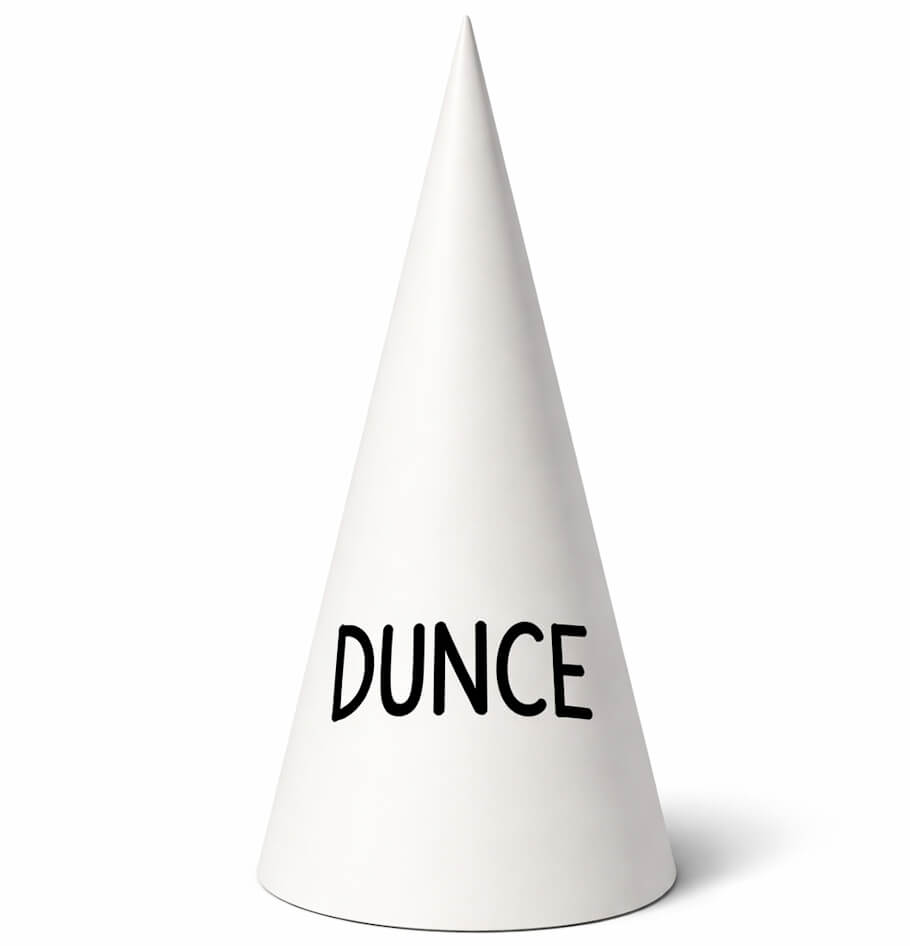
By the 17th century, "dunce" had fully transformed into its modern meaning - a person slow to learn or lacking intelligence. The famous dunce cap, a tall conical hat worn as punishment and humiliation in classrooms, emerged as a physical manifestation of this verbal label. Students forced to wear these caps and sit in corners faced not just educational stigma but social exile from their peers (Hendrick, 2003).
The Dunce Cap Era: Educational Practice and Psychological Harm
Throughout the 19th and much of the 20th century, the dunce cap served as a standard disciplinary tool in American and European schools. Teachers would identify students who answered incorrectly, failed to complete assignments, or simply learned more slowly than their peers, then subject them to ritualized humiliation. The child would don the tall pointed hat, often labeled with the word "DUNCE," and sit facing a corner or standing before the class (Foucault, 1977).
This practice reflected educational philosophies that viewed shame as a legitimate motivational tool. The logic suggested that public humiliation would inspire students to work harder and avoid future designation as a dunce. However, psychological research has thoroughly debunked this assumption. Studies consistently show that shame-based discipline damages self-esteem, increases anxiety, decreases actual learning, and can create lasting psychological trauma (Tangney & Dearing, 2002).
Children subjected to dunce cap punishment often internalized the label. Rather than motivating improvement, the experience convinced many students that they were fundamentally intellectually inferior. This self-fulfilling prophecy meant that students labeled as dunces frequently stopped trying altogether, their academic trajectories permanently altered by an educational practice that mistook cruelty for pedagogy (Covington, 1992).
The practice gradually disappeared from most Western schools by the mid-20th century as educational psychology evolved and teachers recognized the harm these punishments inflicted. However, the word itself persisted in common usage, carrying forward the legacy of classroom humiliation into contemporary language.
Modern Usage: Casual Insults with Serious Consequences
Today, "dunce" appears less frequently than blunter insults like "idiot" or "moron," but it maintains a presence in English vocabulary. People use it to criticize someone's mental capacity: "Don't be such a dunce," or "Only a dunce would make that mistake." The word appears in political commentary, workplace criticism, and casual conversation, often deployed by speakers who may not fully grasp its historical weight.
What distinguishes "dunce" from other intelligence-based insults is its specific educational context. While "fool" or "idiot" cast aspersions on general judgment, "dunce" targets learning ability and academic competence. This specificity makes it particularly cutting for individuals who struggle with formal education, literacy, or cognitive processing (Siperstein et al., 2007).
The entertainment industry occasionally resurrects the term for comedic effect. Television shows and films sometimes feature dunce caps as visual shorthand for stupidity, treating historical educational abuse as a source of humor. While some viewers recognize this as period-appropriate satire, others see their own painful experiences reflected and trivialized on screen.
Social media has given "dunce" new life in some corners of the internet. Users label public figures as dunces, create "dunce of the day" features, and employ dunce cap imagery in memes. This digital resurrection normalizes the term for younger generations who never experienced dunce caps firsthand but absorb the underlying message: some people deserve public intellectual humiliation.
Impact on Individuals with Learning Disabilities
For people with learning disabilities, the word "dunce" carries particularly harmful resonance. Conditions like dyslexia, dyscalculia, ADHD, and various processing disorders create genuine challenges with specific types of learning, but these conditions have nothing to do with overall intelligence (Shaywitz, 1998). Yet children and adults with learning disabilities frequently face exactly the kind of intellectual dismissal that "dunce" embodies.
Historical context matters here. Before educators widely recognized learning disabilities as legitimate neurological conditions, schools routinely mislabeled students with these challenges as lazy, unmotivated, or stupid - in other words, as dunces. Children who struggled to read due to dyslexia, couldn't memorize multiplication tables because of dyscalculia, or had difficulty focusing because of ADHD often found themselves in remedial tracks, separated from peers, and subjected to educational practices rooted in shame rather than accommodation (Hallahan & Mercer, 2002).
Even today, when legal protections and educational understanding have dramatically improved, individuals with learning disabilities report lasting psychological effects from being treated as intellectually inferior during their school years. The word "dunce" triggers these memories and reinforces negative self-perceptions that many have worked years to overcome (McNulty, 2003).
Research on stereotype threat demonstrates that even casual use of intelligence-based insults can impair cognitive performance. When individuals from stigmatized groups encounter reminders of negative stereotypes about their intelligence, their actual test performance declines (Steele & Aronson, 1995). For someone with a learning disability hearing themselves or others described as dunces, this effect compounds already existing challenges.
Advocacy organizations working on behalf of individuals with learning disabilities have pushed for more respectful language that acknowledges different learning styles without implying intellectual deficiency. The shift toward terms like "learning differences" rather than "learning disabilities" reflects this effort, as does increased awareness about the harm of casual insults targeting intelligence (Corker & Shakespeare, 2002).
The Senior Population: Generational Memory and Cognitive Aging
For many seniors, the word "dunce" evokes direct memories of classroom humiliation - either their own or witnessed experiences of peers. Adults who are now in their seventies and eighties attended school when dunce caps remained common in some educational settings. These individuals carry decades-old memories of wearing the cap themselves or watching classmates endure this punishment (Tyack & Cuban, 1995).
The psychological literature on trauma and memory shows that humiliating experiences from childhood can maintain emotional potency across the lifespan. Seniors who were labeled dunces may have spent their entire lives compensating for this early stigma, perhaps avoiding educational opportunities or harboring persistent doubts about their intellectual capabilities despite evidence to the contrary (Erikson, 1963).
Additionally, the word "dunce" takes on new painful dimensions as seniors face age-related cognitive changes. Normal aging brings some decline in processing speed and certain types of memory function, though overall intelligence and wisdom often increase (Salthouse, 2012). However, seniors experiencing these changes may feel vulnerable to being perceived as less mentally sharp than they once were.
When younger people casually call someone a dunce in the presence of seniors experiencing memory lapses or processing delays, the insult can feel personally directed even when it's not. The fear of cognitive decline, dementia, or being dismissed as intellectually diminished makes intelligence-based insults particularly painful for this population (Levy, 2009).
Seniors diagnosed with conditions like Alzheimer's disease or other dementias face especially cruel implications from a word like "dunce." These diseases affect cognitive function through no fault of the individual, yet the stigma surrounding dementia often includes assumptions about lost intelligence or personhood. Language that mocks cognitive struggles reinforces this dehumanizing perspective (Sabat, 2001).
Intergenerational communication requires sensitivity to these dynamics. Younger speakers might toss around "dunce" without realizing they're reopening old wounds or touching on current fears for older listeners. Building awareness of this generational context can foster more compassionate language choices across age groups.
Broader Disability Implications: Beyond Learning Challenges
While learning disabilities represent one significant area of impact, the word "dunce" affects people across the full spectrum of disabilities in various ways. Intellectual disabilities, developmental disorders, brain injuries, mental health conditions, and even physical disabilities that affect communication can all make individuals targets for this kind of intellectual dismissal (Rapley, 2004).
People with intellectual disabilities face perhaps the most direct harm from "dunce" and similar terms. These individuals have genuine cognitive limitations that affect learning and adaptive functioning, yet describing them as dunces shows fundamental misunderstanding of disability. Intellectual disability results from various causes - genetic conditions, prenatal exposure to toxins, birth complications, early childhood trauma - and affected individuals deserve support and accommodation, not mockery (Schalock et al., 2010).
The disability rights movement has worked for decades to eliminate language that reduces people to their limitations or suggests they lack fundamental worth because of cognitive differences. Terms like "retarded," "feeble-minded," and "dunce" all share this dehumanizing quality. Activists and advocates promote person-first language ("person with an intellectual disability" rather than "the intellectually disabled person") and dignity-affirming terminology (Blaska, 1993).
Brain injury survivors often experience cognitive changes that make processing information more difficult, affect memory, or slow response times. These individuals frequently report frustration when others assume cognitive changes mean diminished intelligence. Being called a dunce - or treated as one - compounds the challenges of rehabilitation and reintegration (Lezak et al., 2004).
Mental health conditions can also affect cognitive function temporarily or episodically. Depression impairs concentration and memory, anxiety disrupts focus, and various psychiatric medications have cognitive side effects. Individuals managing these conditions while trying to work, study, or function in daily life face enough challenges without the added burden of intelligence-based insults (Austin & Boyd, 2010).
Even some physical disabilities invite unfair assumptions about intelligence. People with speech impairments due to cerebral palsy or other conditions report that strangers often assume cognitive disability based solely on communication differences. The word "dunce" reflects and reinforces this tendency to conflate physical manifestation with intellectual capacity (Biklen & Burke, 2006).
Linguistic Alternatives: Moving Toward Respectful Communication
Recognizing the harm that "dunce" and similar terms cause raises the practical question: what should people say instead when they want to critique someone's decision, call out a mistake, or express frustration with poor judgment? The answer depends on context and intent, but several principles guide respectful communication.
First, focus on specific behaviors or decisions rather than making global statements about someone's intelligence. Instead of "Don't be such a dunce," try "That approach might not work because..." This shift addresses the actual issue without attacking the person's fundamental worth or capabilities (Rosenberg, 2003).
Second, consider whether criticism is necessary at all. Much casual use of "dunce" and similar insults serves no constructive purpose - it's verbal aggression masquerading as communication. Pausing to ask "Will calling this person a name improve anything?" often reveals that silence or redirection would serve better than insult.
Third, when discussing others' cognitive abilities in legitimate contexts (educational planning, workplace accommodations, medical care), use precise, respectful terminology. "Learning disability," "cognitive difference," "processing challenge," or specific diagnosis names communicate clearly without stigma (Snow, 2013).
Fourth, examine the underlying attitudes that make intelligence-based insults tempting. Why does someone's intellectual capacity seem like an appropriate target for mockery? What assumptions about worth and ability drive these linguistic choices? Addressing these deeper issues creates more sustainable change than simply swapping one insult for another (Sen, 2009).
Educational settings particularly benefit from eliminating "dunce" and similar terms. Teachers and administrators who model respectful language about cognitive differences create classroom cultures where all students feel valued. This doesn't mean avoiding honest assessment of academic performance, but it does mean separating evaluation of work from judgment of personhood (Dweck, 2006).
Cultural Variations and Global Perspectives
While this paper focuses primarily on English-language usage of "dunce," attitudes toward intelligence-based insults and educational shame vary across cultures. Some societies maintain practices similar to historical dunce caps, while others have developed alternative approaches to academic struggle and learning differences.
In some Asian educational systems, public identification of low-performing students remains more common and culturally accepted than in contemporary Western contexts. However, research increasingly shows that these practices produce similar psychological harms regardless of cultural context, suggesting universal human responses to shame and humiliation (Fung & Chen, 2001).
Other languages have their own equivalents to "dunce" - words that specifically target learning ability and academic performance. The harm these terms cause transcends linguistic boundaries, though specific cultural contexts shape how, when, and against whom they're deployed (Bruner, 1996).
International disability rights movements have made cross-cultural efforts to promote respectful language and eliminate terms that stigmatize cognitive differences. The United Nations Convention on the Rights of Persons with Disabilities, ratified by most countries worldwide, establishes dignity and respect as fundamental principles, implicitly challenging the use of terms like "dunce" (United Nations, 2006).
Examining cultural variations reveals both the universality of intelligence-based hierarchies and the possibility of alternatives. Some Indigenous cultures, for instance, have traditionally recognized diverse forms of intelligence and contribution without creating the kind of academic shame that produced the dunce cap (Cajete, 1994).
Moving Forward: Education, Advocacy, and Language Change
Eliminating "dunce" from common usage requires multifaceted efforts across education, media, advocacy, and interpersonal communication. No single intervention will accomplish this goal, but combined approaches can shift linguistic norms over time.
Educational institutions should explicitly address the history and harm of intelligence-based insults in curriculum addressing bullying, disability awareness, and social-emotional learning. Students who understand why "dunce" hurts can make more informed language choices and stand up against casual ableism when they encounter it (Meyer et al., 2014).
Media representation matters significantly. When television shows, films, and other entertainment normalize "dunce" as harmless fun or acceptable critique, they reinforce harmful attitudes. Conversely, media that accurately portrays the impact of intelligence-based insults or showcases diverse forms of intelligence can shift public perception (Norden, 1994).
Disability advocacy organizations continue pushing for language change through public education campaigns, policy recommendations, and direct engagement with institutions and individuals using harmful terminology. These efforts have successfully reduced usage of many stigmatizing terms over past decades, though constant vigilance remains necessary (Linton, 1998).
Individuals can contribute by examining their own language, gently correcting others when appropriate, and modeling respectful alternatives. These micro-level interventions may seem small but collectively create cultural change. When someone hears "dunce" and thinks "that's not okay anymore," linguistic norms have shifted (Burr, 2015).
Legal and policy frameworks also play roles. While free speech protections appropriately prevent government regulation of most language choices, institutional policies in schools, workplaces, and other settings can establish expectations for respectful communication. Many organizations now include intelligence-based insults in their harassment and bullying policies (Hehir, 2002).
The goal isn't linguistic purism or excessive policing of casual conversation. Rather, it's cultivating awareness of how words affect real people navigating real challenges, then choosing language that reflects our better values around dignity, respect, and inclusion.
References
Austin, J. K., & Boyd, J. R. (2010). Psychiatric nursing in long-term rehabilitation of persons with serious mental illness. In P. W. Corrigan (Ed.), Psychiatric rehabilitation (2nd ed., pp. 231-256). Elsevier.
Ayers, M. R. (1986). Mechanism, superaddition, and the proof of God's existence in Locke's Essay. The Philosophical Review, 95(4), 549-572.
Biklen, D., & Burke, J. (2006). Presuming competence. Equity & Excellence in Education, 39(2), 166-175.
Blaska, J. (1993). The power of language: Speak and write using "person first." In M. Nagler (Ed.), Perspectives on disability (2nd ed., pp. 25-32). Health Markets Research.
Bruner, J. (1996). The culture of education. Harvard University Press.
Burr, V. (2015). Social constructionism (3rd ed.). Routledge.
Cajete, G. (1994). Look to the mountain: An ecology of Indigenous education. Kivaki Press.
Corker, M., & Shakespeare, T. (Eds.). (2002). Disability/postmodernity: Embodying disability theory. Continuum.
Covington, M. V. (1992). Making the grade: A self-worth perspective on motivation and school reform. Cambridge University Press.
Dweck, C. S. (2006). Mindset: The new psychology of success. Random House.
Erikson, E. H. (1963). Childhood and society (2nd ed.). Norton.
Foucault, M. (1977). Discipline and punish: The birth of the prison. Pantheon Books.
Fung, H., & Chen, E. C. (2001). Across time and beyond skin: Self and transgression in the everyday socialization of shame among Taiwanese preschool children. Social Development, 10(3), 419-437.
Hallahan, D. P., & Mercer, C. D. (2002). Learning disabilities: Historical perspectives. In R. Bradley, L. Danielson, & D. P. Hallahan (Eds.), Identification of learning disabilities (pp. 1-67). Erlbaum.
Hehir, T. (2002). Eliminating ableism in education. Harvard Educational Review, 72(1), 1-32.
Hendrick, H. (2003). Child welfare: Historical dimensions, contemporary debate. Policy Press.
Levy, B. (2009). Stereotype embodiment: A psychosocial approach to aging. Current Directions in Psychological Science, 18(6), 332-336.
Lezak, M. D., Howieson, D. B., Bigler, E. D., & Tranel, D. (2004). Neuropsychological assessment (4th ed.). Oxford University Press.
Linton, S. (1998). Claiming disability: Knowledge and identity. NYU Press.
McNulty, M. A. (2003). Dyslexia and the life course. Journal of Learning Disabilities, 36(4), 363-381.
Meyer, E. J., Tilland-Stafford, A., & Airton, L. (2014). Transgender and gender-creative students in PK-12 schools: What we can learn from their teachers. Teachers College Record, 118(8), 1-50.
Norden, M. F. (1994). The cinema of isolation: A history of physical disability in the movies. Rutgers University Press.
Rapley, M. (2004). The social construction of intellectual disability. Cambridge University Press.
Rosenberg, M. B. (2003). Nonviolent communication: A language of life. PuddleDancer Press.
Sabat, S. R. (2001). The experience of Alzheimer's disease: Life through a tangled veil. Blackwell.
Salthouse, T. A. (2012). Consequences of age-related cognitive declines. Annual Review of Psychology, 63, 201-226.
Schalock, R. L., Borthwick-Duffy, S. A., Bradley, V. J., Buntinx, W. H., Coulter, D. L., Craig, E. M., ... & Yeager, M. H. (2010). Intellectual disability: Definition, classification, and systems of supports (11th ed.). American Association on Intellectual and Developmental Disabilities.
Sen, A. (2009). The idea of justice. Harvard University Press.
Shaywitz, S. E. (1998). Dyslexia. New England Journal of Medicine, 338(5), 307-312.
Siperstein, G. N., Parker, R. C., Bardon, J. N., & Widaman, K. F. (2007). A national study of youth attitudes toward the inclusion of students with intellectual disabilities. Exceptional Children, 73(4), 435-455.
Snow, K. (2013). Disability is natural: Revolutionary common sense for raising successful children with disabilities (2nd ed.). BraveHeart Press.
Steele, C. M., & Aronson, J. (1995). Stereotype threat and the intellectual test performance of African Americans. Journal of Personality and Social Psychology, 69(5), 797-811.
Tangney, J. P., & Dearing, R. L. (2002). Shame and guilt. Guilford Press.
Tyack, D., & Cuban, L. (1995). Tinkering toward utopia: A century of public school reform. Harvard University Press.
United Nations. (2006). Convention on the Rights of Persons with Disabilities. United Nations.
Wolter, A. B. (1990). The philosophical theology of John Duns Scotus. Cornell University Press.
Frequently Asked Questions
Is the word dunce considered offensive today
Yes, many people view dunce as offensive because it mocks a person's learning ability and can reinforce shame for those with learning disabilities or cognitive differences.
What did a dunce cap look like
A dunce cap was a tall cone-shaped hat that tapered to a point, often marked with the word DUNCE, placed on a student's head during classroom punishment.
When did schools stop using dunce caps
Dunce caps largely disappeared from Western classrooms by the middle of the 20th century as educators recognized that shame-based discipline harmed rather than helped students.
Why is the word dunce linked to a philosopher
The term comes from John Duns Scotus, whose devoted followers were later mocked by Renaissance humanists, turning his name into a byword for someone unable to accept new ideas.
What are respectful alternatives to calling someone a dunce
Instead of insults, focus on the specific behavior or decision, or use precise terms such as learning disability, cognitive difference, or processing challenge when relevant.
Does calling someone a dunce affect learning
Yes, studies show that shame-based labels can lower self-esteem, raise anxiety, and reduce actual learning, sometimes altering a student's academic path for years.
How does the word dunce affect older adults
For many seniors the word revives memories of classroom humiliation and can heighten fears about age-related cognitive changes, making the insult especially painful.
Insights, Analysis, and Developments
Editorial Note: The word "dunce" carries weight far beyond its four letters. From its origins honoring a brilliant philosopher, through its transformation into an educational weapon, to its contemporary usage as casual insult, this term has marked and harmed generations of learners. For seniors who remember classroom humiliation, individuals with learning disabilities who still fight against stigma, and people across the disability spectrum who face assumptions about their intelligence, "dunce" isn't just a word - it's a reminder of society's historic and ongoing tendency to confuse different with deficient, struggle with stupidity, and accommodation needs with inadequacy. Moving forward requires more than simply striking one word from our vocabulary. It demands examining the attitudes that make intelligence-based insults tempting, recognizing the diverse ways humans think and learn, and committing to language that affirms human dignity regardless of cognitive differences. Every time someone pauses before calling another person a dunce and chooses a more respectful alternative, they participate in this essential cultural shift. The transformation may happen slowly, but it mirrors the original transformation that created "dunce" in the first place - except this time, the change moves toward inclusion rather than exclusion, understanding rather than mockery, and respect rather than shame.
 Author Credentials: Ian is the founder and Editor-in-Chief of Disabled World, a leading resource for news and information on disability issues. With a global perspective shaped by years of travel and lived experience, Ian is a committed proponent of the Social Model of Disability, a transformative framework developed by disabled activists in the 1970s that emphasizes dismantling societal barriers rather than focusing solely on individual impairments. His work reflects a deep commitment to disability rights, accessibility, and social inclusion. To learn more about Ian's background, expertise, and accomplishments, visit his full biography.