How Disability Stories In Archaeology Ignore The Disabled
Author: Caitlin Leyden
Published: 7 Jun 2026 - Updated: 17 Aug 2026
Publication Type: Submitted Article
Table of Contents:
Synopsis - Definition - Overview - FAQs - Insights, Updates - Related Content
Synopsis
This article by Caitlin Leyden examines how disability is portrayed in archaeology and modern storytelling, arguing that ancient remains of physically disabled people are too often used as evidence of human compassion rather than as records of real individuals who lived full lives. Leyden points out that these accounts tend to center the caretakers and the community burden while ignoring the disabled person at the heart of the story, and she connects this pattern to the way disability is discussed today, particularly in social media narratives that prioritize parents and onlookers over disabled children and adults. For readers with disabilities, seniors, family members, and anyone interested in archaeology, disability studies, or how cultural ideas about productivity shape our judgments of human worth, the piece offers a thoughtful and accessible reframing that asks us to recognize the humanity and value of disabled people regardless of what they can produce.*
At a Glance
- 1 - Compassion is often named as a defining trait separating early hominins from modern humans.
- 2 - Ancient remains of disabled people are frequently read as proof a group cared for someone who could not add resources.
- 3 - Stories that do center disabled people tend to focus only on those who overcome their disabilities, ignoring those who cannot meet cultural ideas of success.
- 4 - The piece links bioarchaeology, the scientific study of human remains from archaeological sites, with disability studies to question whose perspective a discovery is meant to serve.
Topic Definition
- Disability Representation in Archaeology
Disability representation in archaeology is the way researchers interpret and present the remains and life stories of physically disabled people found at ancient sites. Too often these individuals are treated as evidence of a community's capacity for care rather than as people who lived full lives in their own right, and the framing tends to center caretakers and the burden of dependence while leaving the disabled person at the margins. The subject sits where bioarchaeology, the scientific study of human remains from archaeological sites, meets disability studies, and it asks a pointed question - whether our readings of the past reveal the experience of disabled people themselves or simply project modern beliefs about productivity, value, and worth onto them. At its core it challenges scholars and storytellers alike to consider whose perspective a discovery is meant to illuminate.
Overview
What makes us human? Is it our tool use, large brain size, or language? There is one trait that has been used to show the shift from ancient hominin species to human and that is compassion.
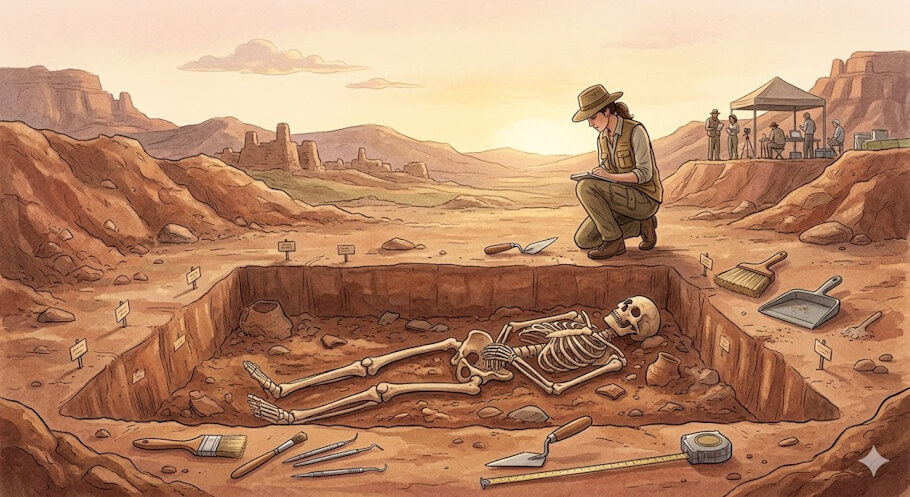
The story goes: archaeologists discover the ancient bones of a disabled person who would have needed the people around them to take care of them. Modern humans see this as proof of that group's capacity for human empathy and compassion. They focus on what it means for these humans or pre-humans to have to care for someone who cannot add to the resources of their community and would not survive without help. But why do we always focus on the stories of the caretakers rather than the experience of the disabled person?
When physically disabled people's remains are found in archaeological digs, this is often presented as a way to show that humans have always cared for others. However, these stories are colored by our modern beliefs about the worth of people. People are only worthy if they can produce something every hour of the day. People are seen as less worthy when they are unable to work at all, as much, or in the ways that society expects them to work. We put our current system of value onto people of the past.
When physically disabled people's remains are found, we assume that they could not produce value; therefore, only other people's compassion would lead to their survival. This is a problematic way to view disabled people. First, it focuses on the realities of people living with disabled people, not on the disabled person themselves. Second, it ties a person's worth exclusively to what they can produce, rather than recognizing that everyone has worth. The third problem is that it acts as if only these physically disabled people in the past required compassion, and not that every community is full of people with different limitations and skills, who work together to raise up the entire community, regardless of what each individual can do. We see disabled people as a problem, and focus on what resources they take away from a community, rather than recognizing them as part of the community.
This is not a problem that is only seen in our discussions of early humans. This is also seen in how we discuss disability today. Many parents use social media to tell stories about their disabled children. They focus on how difficult it is to be a parent of a disabled child and ignore the stories of the children. There is more focus on how these disabilities disrupt other people's lives than on the life of the disabled person at the center of the story.
Even though anyone can be disabled, people often view the disabled as uncomfortable to see or interact with, taking advantage of the system or other people, lazy, or annoying. Stories about disabled people are often about the people burdened with their care, rather than the experiences of that person. When there are stories that focus on disabled people, they are often about people who overcome their disabilities. People don't want to hear stories about disabled people who are unable to achieve their goals because they are disabled. People don't want to hear about how disabled people can be an important part of their community, even when they are unable to produce what our system considers valuable.
These disability narratives focus on non-disabled people, othering those with disabilities. They say that disabled people have no worth because of their disability, that they can add nothing to their community, and that they only exist to help other people be more human through compassion. However, disabled people are never seen through that lens of humanity. Many times, we focus on these stories as proof of the long history of human compassion, while only thinking about the experiences of the people who take care of someone who is disabled. When you look at disabled people as proof of ancient compassion, you ignore their lives.
Rather than dehumanizing disabled people and seeing them as something requiring empathy and compassion, we should be able to present them as people who also lived and had worth despite what they could and could not do. While their disabilities may have been a major part of their lives, we need to stop looking at them simply as living obstacles that affect the people around them. Recognizing the humanity of disabled people means thinking about their experiences, not just those who lived beside them. It is recognizing that everyone has worth, regardless of whether or not they match our cultural ideas of success.
Frequently Asked Questions
NOTE: Researched FAQs by Disabled World (DW)
What is bioarchaeology
Bioarchaeology is the scientific study of human skeletal remains recovered from archaeological sites, used to learn about health, diet, injury, disease, and daily life in past populations.
How do archaeologists identify disability in ancient skeletal remains
Researchers examine bones for signs of healed fractures, joint changes, congenital differences, and conditions that would have affected mobility or function, then combine those observations with burial context to reconstruct a picture of the person's life.
What is the social model of disability
The social model holds that people are disabled largely by physical and social barriers and attitudes rather than solely by their impairments, shifting the focus from fixing the individual toward removing obstacles in society.
Why does language matter when writing about disabled people in history
Word choices such as burden, sufferer, or victim can frame disabled people as problems rather than individuals, so careful language helps present them as full members of their communities with their own experiences and worth.
What does it mean to other someone
Othering is treating a person or group as fundamentally different or apart from a perceived norm, which can lead to their experiences being overlooked and their humanity being reduced to a single trait.
Are there examples of disabled people holding valued roles in ancient societies
Yes, evidence from various cultures suggests people with impairments took part in community life through crafts, knowledge keeping, spiritual roles, and other contributions, showing that worth was not always tied to physical labor.
How can researchers avoid projecting modern values onto the past
They can draw on multiple lines of evidence, involve disabled scholars and communities, question their own assumptions about productivity, and consider the range of ways a society may have understood ability and belonging.
How can families share stories about disabled children more respectfully online
They can center the child's own voice and experiences, ask for consent where possible, avoid framing the child mainly as a hardship, and present them as a whole person rather than a lesson in someone else's resilience.
Insights, Analysis, and Developments
Editorial Note: By tracing a single assumption from ancient burial sites to present day social media feeds, Leyden makes a compelling case that the way we tell stories about disability reveals more about our own values than about the people we claim to honor, and her call to see disabled people as individuals with worth - rather than as symbols of someone else's compassion - is a reminder worth carrying into how we write, research, and speak about disability across every era.*
* Editorial additions by Ian C. Langtree.