Müllerian Mimicry: How Species Unite Through Warning
Author: Ian C. Langtree - Writer/Editor for Disabled World (DW)
Published: 16 Jun 2026 - Updated: 13 Aug 2026
Publication Type: Scholarly Paper
Table of Contents:
Synopsis - Definition - Overview - FAQs - Insights, Updates - Related Content
Synopsis
When a bird learns to avoid a toxic butterfly by its vivid orange-and-black wings, it rarely suspects that the very next butterfly it encounters - wearing nearly identical colors but belonging to an entirely different species - is equally lethal and equally honest in its advertising. Müllerian mimicry, first described by the German-Brazilian naturalist Fritz Muller in 1878, is one of evolutionary biology's most counterintuitive revelations: that genuinely dangerous species can evolve to look like each other not out of deception but out of mutual benefit, sharing the cost of educating predators and strengthening each other's defenses simply by converging on the same signal. This paper traces the science from Muller's original mathematical insight through modern genomics, explores the astonishing diversity of Müllerian mimicry rings across the natural world, and asks what - if anything - this elegant biological logic has to say about the signals, communities, and strategies of human disability advocacy.
At a Glance
- 1 - Fritz Muller's 1878 mathematical proof that predator-sampling costs decrease as more defended species share the same warning signal was decades ahead of its time and laid the groundwork for modern quantitative evolutionary ecology.
- 2 - The genes controlling red wing patterning in Heliconius butterflies have, in some cases, literally crossed species boundaries through rare hybridization events, giving evolution a molecular shortcut to shared warning coloration across distinct species.
- 3 - The logic of Müllerian mimicry - that a shared, honest, widely recognized collective signal is more effective than isolated individual signals - finds a conceptual echo in disability pride movements, where diverse communities with different conditions gain strength by uniting under common frameworks and symbols.
Topic Definition
- Müllerian Mimicry
Müllerian (also written as Mullerian) is pronounced as myoo-LEER-ee-uhn (U.S. English) or muul-EER-ee-uhn (U.K. English). Müllerian mimicry is an evolutionary phenomenon in which two or more species that are all genuinely unpalatable, toxic, or otherwise defended against predation independently converge on the same warning signal - typically a shared pattern of conspicuous coloration, but also potentially encompassing smell, sound, or other sensory cues - because doing so reduces the per-species mortality cost of educating predators: a predator that has already learned to avoid one species bearing the shared signal will avoid all others bearing it too, distributing the training burden across every species in the mimicry ring and making each individual safer than it would be if it alone carried the signal. Named after the German-Brazilian naturalist Fritz Muller, who described the underlying mathematical logic in 1878, Müllerian mimicry differs fundamentally from Batesian mimicry in that every participating species is genuinely defended - there is no deception involved, and the shared signal is honest, mutually reinforcing, and increasingly reliable the more widely it is shared across a community of co-mimics.
Overview
A Warning Signal Everyone Can Trust
Imagine a young bird, inexperienced and hungry, scanning the undergrowth of a South American rainforest. It spots a brightly patterned butterfly - vivid orange and black - and snaps it up. Within moments it tastes something deeply unpleasant, and the memory locks in. From that point on, anything wearing those colors gets avoided. So far, so predictable. But here is where the story becomes genuinely interesting: the next butterfly the bird might encounter, wearing almost exactly the same warning pattern, belongs to an entirely different species with a completely separate evolutionary lineage. It is not faking. It is just as toxic. And both species benefit from looking alike because the bird only had to learn the lesson once.
This is Müllerian mimicry - a mutual convergence on shared warning signals among species that are all genuinely defended against predation. It is one of the most studied, most elegant, and in some ways most counterintuitive phenomena in evolutionary biology. Named after the German-Brazilian naturalist Johann Friedrich Theodor Muller (better known as Fritz Muller), who described it mathematically in 1878, Müllerian mimicry has since become a cornerstone of our understanding of how natural selection can drive radically different organisms toward the same solution to the same problem [Sherratt, 2008]. This paper explores how Müllerian mimicry works, why it matters, what makes it different from related phenomena, and - perhaps surprisingly - what it might have to say about how we understand disability and human social signaling.
Fritz Muller and the Origins of the Theory
Fritz Muller was born in Windischholzhausen, Germany, in 1821. He trained as a naturalist and, after being barred from academic positions in Prussia due to his political views, emigrated to Brazil in 1852, where he spent most of the rest of his life studying the extraordinary biodiversity of the Atlantic Forest. He became a close correspondent of Charles Darwin, and it was Darwin who helped bring Muller's key theoretical contributions to the attention of the English-speaking scientific world [Mallet and Joron, 1999].
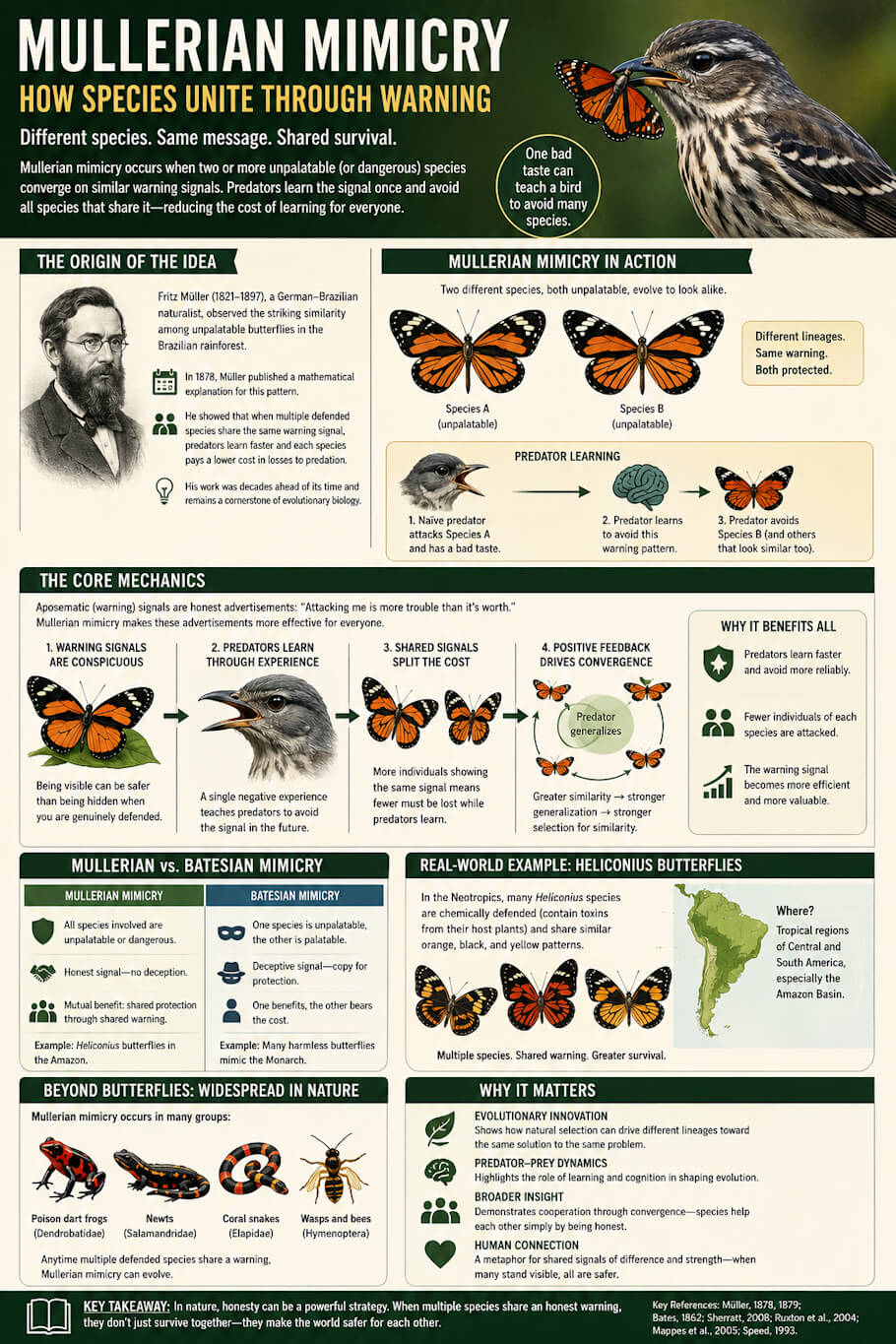
In 1878, Muller published a short but remarkable paper in the German journal Kosmos, offering a mathematical explanation for something that had puzzled naturalists for years: why were multiple species of unpalatable butterfly in South America so similar in appearance? The English naturalist Henry Walter Bates had already, in 1862, described what is now called Batesian mimicry - where a palatable, harmless species copies the warning colors of a defended species to deter predators. But Bates's model could not explain why two species that were both unpalatable would converge on the same appearance. If each was already defended, why bother looking like the other? [Bates, 1862].
Muller's insight was statistical and elegant. Predators need to learn, through trial and error, which warning signals to avoid. That learning process has a cost: individual prey animals must be sampled by naive predators before the lesson sinks in. If two unpalatable species share the same warning pattern, those sampling costs are divided between them. The predator learns faster, and the mortality tax paid by each species during the learning process is lower. Both species benefit. The more individuals there are displaying the same signal, the cheaper the signal becomes to maintain - and the safer each individual bearing it becomes [Muller, 1879].
This mathematical framing was decades ahead of its time. Muller essentially constructed one of the first population-level quantitative arguments in evolutionary biology, anticipating later work in evolutionary ecology by a good half-century.
How Müllerian Mimicry Works: The Core Mechanics
At the heart of Müllerian mimicry is the interaction between prey signals and predator learning. Most vertebrate predators - birds, lizards, mammals - are capable of associative learning. They can link a visual, olfactory, or auditory cue to a negative experience, and they can generalize that association to similar cues in the future. This is the biological foundation on which all mimicry systems are built [Ruxton, Sherratt, and Speed, 2004].
Aposematism - the use of conspicuous warning signals by prey - evolved because, paradoxically, being visible can be safer than being hidden when you are genuinely unpalatable or dangerous. A cryptic prey animal that is captured and eaten is simply dead. An aposematic prey animal that is captured, sampled, and rejected survives long enough to pass its genes on, provided the encounter is not immediately lethal. The warning signal essentially says: "Attacking me is more trouble than it is worth" [Mappes, Marples, and Endler, 2005].
Müllerian mimicry extends this logic across species boundaries. When two genuinely aposematic species converge on the same warning signal, each effectively "piggybacks" on the predator education program run by the other. A predator that has already learned to avoid Species A will also avoid Species B if B looks enough like A. Neither species is deceiving anyone - both are as unpalatable as advertised. The shared signal is an honest one, and the mimicry is sometimes described as "mutualistic" rather than parasitic [Speed, 1993].
The Role of Predator Psychology
The efficiency of the system depends critically on how predators generalize. If a bird learns to avoid one specific butterfly pattern and then encounters a slightly different pattern, it faces a decision: is this new pattern sufficiently similar to the dangerous one to warrant caution? The greater the overlap between the appearances of two species, the more likely predators are to generalize between them. This creates a powerful selection pressure driving mimics toward one another, because the closer the resemblance, the greater the safety benefit [Speed, 1993].
Importantly, Müllerian mimicry is a self-reinforcing system. As two species become more similar in appearance, the combined signal becomes more common in the environment, predators encounter it more often, and the learned aversion becomes stronger. The more common the signal, the more valuable it is to display it. This dynamic has been compared to a positive feedback loop in evolutionary terms - once Müllerian co-mimicry starts, it tends to accelerate [Joron and Mallet, 1998].
Müllerian vs. Batesian Mimicry: An Important Distinction
Because Müllerian mimicry and Batesian mimicry are both forms of warning-signal mimicry, they are frequently confused. The difference is fundamental, however, and understanding it is essential to grasping what makes Müllerian mimicry so distinctive [Bates, 1862; Sherratt, 2008].
In Batesian mimicry, one species - the mimic - is harmless or palatable, while the other - the model - is defended. The mimic benefits by appearing to share the model's defenses, but it is essentially a fraud. It contributes nothing to predator education and may actually undermine the signal over time: if a predator frequently encounters the harmless mimic and does not receive negative reinforcement, the value of the warning signal erodes. This means Batesian mimicry is typically frequency-dependent in a negative way. The more common the mimic becomes relative to the model, the weaker the protection for both. There is an inherent tension between mimic and model [Ruxton, Sherratt, and Speed, 2004].
Müllerian mimicry, by contrast, is positively frequency-dependent. All participants are genuinely defended. There is no deception. As the shared signal becomes more common - because more defended individuals of multiple species are displaying it - the signal becomes more recognizable and more reliably avoided by predators. The "value" of the signal increases with its frequency rather than decreasing. This makes Müllerian mimicry a genuinely cooperative system in evolutionary terms, even though cooperation is not consciously intended by any of the species involved [Mallet and Joron, 1999].
A useful way to summarize the distinction: in Batesian mimicry, the mimic is a freeloader exploiting a signal it did not help create. In Müllerian mimicry, every participant both contributes to and benefits from the shared signal equally.
Classic Examples in Nature
Heliconius Butterflies
No discussion of Müllerian mimicry is complete without the Heliconius butterflies of Central and South America. This genus of long-winged tropical butterflies has become the most intensively studied example of Müllerian mimicry in the world, and for good reason: it displays the phenomenon in astonishing diversity, complexity, and geographic variation [Merrill et al., 2015].
Heliconius butterflies accumulate cyanogenic compounds from their larval host plants in the genus Passiflora. These compounds make the butterflies genuinely toxic to most vertebrate predators. The butterflies advertise this toxicity with bold red, orange, yellow, and black patterns on their wings. Crucially, multiple species of Heliconius within any given geographic area share nearly identical wing patterns, despite being distinct species with different evolutionary histories. Heliconius melpomene and Heliconius erato, for example, are not closely related within the Heliconius genus, yet they are nearly indistinguishable in wing pattern within any single locality [Heliconius Genome Consortium, 2012].
Even more striking is the geographic variation. In one region of Peru, both H. melpomene and H. erato wear a red-and-black pattern. Hundreds of miles away, in a different region, both species wear a completely different pattern - perhaps yellow-and-black or orange-rayed. Each geographic region has its own locally dominant mimicry ring pattern, and the two species track each other's pattern shifts across the landscape. This phenomenon of local co-adaptation is one of the strongest available lines of evidence that the similarity is indeed driven by mutual mimicry selection rather than common ancestry [Joron and Mallet, 1998].
Poison Dart Frogs
The poison dart frogs (family Dendrobatidae) of Central and South America offer another spectacular example. Many species within this family are brilliantly colored in reds, blues, oranges, and yellows - colors that warn predators of the potent alkaloid toxins sequestered in their skin. Like Heliconius, different species in the same geographic area often share similar aposematic patterns, and the patterns vary dramatically across geographic regions even within a single species [Ruxton, Sherratt, and Speed, 2004].
Ranitomeya imitator, one of the most remarkable species in this family, offers an especially clear case. Across its geographic range in Peru, it mimics the pattern of whichever other Ranitomeya species is locally most common and most toxic - taking on distinctly different appearances in different regions to match its local Müllerian partner. In some areas it displays red-and-black stripes; in others, bright yellow spots; in yet others, a banded orange-and-black pattern. Each local form closely resembles the local dominant toxic species, providing a natural experiment in Müllerian co-mimicry across a single species' range [Sherratt, 2008].
Bees, Wasps, and Hoverflies
The familiar yellow-and-black striped pattern of bees and wasps is itself a Müllerian mimicry ring in action. Multiple species of stinging Hymenoptera - honeybees, bumblebees, yellowjacket wasps, hornets, and various solitary bee and wasp species - all share variations on the same basic yellow-and-black warning pattern. Birds and other vertebrates that have experienced the sting of any one of these species will tend to avoid all others displaying the same coloration, benefiting all the genuinely stinging species simultaneously [Ruxton, Sherratt, and Speed, 2004].
Layered on top of this genuine Müllerian ring is a Batesian component: numerous species of hoverflies (family Syrphidae) also wear yellow-and-black patterns, mimicking the warning coloration of the stinging Hymenoptera without possessing any sting or venom themselves. This creates a mixed system, with a Müllerian core (the actual stinging species) and a Batesian fringe (the harmless mimics) - a pattern that is common in nature and that illustrates how the two types of mimicry can coexist in the same ecological community.
Mimicry Rings: Community-Level Phenomena
One of the most fascinating features of Müllerian mimicry is its community-level organization. In any given tropical habitat, defended species do not all converge on a single warning pattern. Instead, they cluster into what biologists call "mimicry rings" - groups of co-mimics sharing the same signal. A forest may have several distinct mimicry rings operating simultaneously: one of red-and-black butterflies, another of yellow-banded species, another of orange-spotted forms. Each ring is a separate "channel" of predator education [Joron and Mallet, 1998].
Why multiple rings rather than universal convergence on a single super-signal? The answer probably involves several factors. Different predator communities may learn different signals. Species with slightly different ecologies (different flight heights, different microhabitats, different activity times) may encounter different predators, each of which maintains its own learned associations. Additionally, the genetics of warning coloration patterns may constrain how far a given species can shift its appearance without losing other important functions of its wing pattern, such as thermoregulation or mate recognition [Merrill et al., 2015].
The maintenance of multiple mimicry rings within a single community is itself a research area of ongoing interest, because it represents a kind of stable polymorphism in which the evolutionary landscape has multiple peaks rather than a single optimum. How populations navigate between these peaks - and whether they can shift from one ring to another - is a question that connects Müllerian mimicry to broader debates in evolutionary genetics about the nature of adaptive landscapes [Mallet and Joron, 1999].
Genetic Underpinnings: How Evolution Engineers the Signal
One of the most productive areas of recent research into Müllerian mimicry has been the genetics underlying wing pattern variation in Heliconius. How does natural selection actually change the appearance of a butterfly's wings? And how do two different species manage to evolve toward the same pattern, given that they are starting from different genetic architectures?
Research over the past two decades has revealed that much of the variation in Heliconius wing patterns is controlled by a small number of genomic regions with large effects - sometimes called "supergenes" or "mimicry loci." These are genomic regions in which multiple functionally related genes are packed closely together and inherited as a unit, because the chromosomal region has been stabilized against recombination by structural rearrangements [Joron et al., 2011]. The advantage of this arrangement is that it allows co-adapted sets of genes to evolve and be transmitted together, rather than being shuffled apart by recombination in each generation. Wing pattern genes that need to act in concert to produce a specific mimicry pattern thus stay together.
Even more intriguingly, genomic research has shown that H. melpomene and H. erato - those two distantly related species that track each other's pattern so closely - have not only evolved similar wing patterns independently but have, in some cases, actually exchanged genetic material. The Heliconius Genome Consortium demonstrated in 2012 that the genes underlying mimicry patterns have in some cases moved between species via a process called introgressive hybridization - rare hybridization events that allow genetic material to cross species barriers and accelerate the co-mimicry process [Heliconius Genome Consortium, 2012]. This means evolution has found a shortcut: rather than each species independently reinventing the same color pattern from scratch, they can occasionally borrow the genetic solution from each other.
Convergent Molecular Evolution
Perhaps even more remarkable is the evidence that, in cases where introgression has not occurred, the same gene - the gene optix, encoding a transcription factor that controls red wing patterning - has been independently recruited to produce red warning coloration in multiple distantly related Heliconius lineages. Different mutations in the same gene, in different species, produce similar visual outcomes through convergent molecular evolution [Merrill et al., 2015]. This is convergent evolution happening at the molecular level, not just the phenotypic level - a striking illustration of how constrained evolutionary pathways can be when selection pressure is strong enough.
Beyond Color: Other Sensory Modalities in Müllerian Mimicry
While the visual examples of Müllerian mimicry - vivid wing patterns, bright skin colors - are the most familiar and most studied, the phenomenon is not limited to the visual domain. Defended species can share warning signals in multiple sensory channels simultaneously, and in some cases non-visual signals may be equally important or even primary.
Chemical and Olfactory Signals
Many defended insects produce distinctive chemical compounds alongside their visual signals. Some Heliconius species, for example, produce volatile compounds that may function as olfactory warning cues in addition to their visual patterns. In some snake species, chemical signals in the form of skin secretions may complement visual banding patterns in communicating distastefulness to predators [Ruxton, Sherratt, and Speed, 2004].
Acoustic Mimicry
Sound-producing defended species may also form Müllerian complexes. Bumblebees and other stinging Hymenoptera produce characteristic buzzing sounds at particular frequencies, and there is evidence that these acoustic signals carry warning information that predators can learn to associate with the unpleasant experience of being stung. Acoustic Müllerian mimicry - in which multiple stinging species share similar buzzing profiles - is a relatively under-studied but potentially widespread phenomenon [Ruxton, Sherratt, and Speed, 2004].
Multimodal Warning Signals
The most effective warning systems are probably multimodal - combining visual, chemical, and acoustic cues that reinforce each other and provide redundancy against the limitations of any single sensory channel. A predator that hunts primarily by smell may be educated by chemical warning signals even in low light, while a visual predator learns from color patterns in bright daylight. A species that advertises its defenses through multiple channels simultaneously is broadcasting its warning to the widest possible audience of predators, and Müllerian co-mimics that share signals across multiple sensory modalities would be expected to gain the strongest mutual benefits [Mappes, Marples, and Endler, 2005].
Geographic Variation and Mimicry Races
One of the conceptually challenging aspects of Müllerian mimicry is geographic variation. As noted in the Heliconius example, the same species can wear dramatically different wing patterns in different geographic regions, each local form tracking a different local assemblage of co-mimics. These locally adapted forms are sometimes called "mimicry races" or "geographic races," and they raise an interesting question: how does the transition between races occur?
At the boundaries between geographic races - the transition zones where one warning pattern gives way to another - individuals bearing intermediate or hybrid patterns face a double disadvantage. They are not sufficiently similar to either local mimicry ring to be well-protected, and their novel appearance may actually attract rather than deter curious predators [Mallet and Joron, 1999]. This creates a strong selection against intermediate forms, which in turn creates very abrupt transitions between mimicry races - sometimes within just a few kilometers. These sharp boundaries are sometimes called "warning-color contact zones," and they have become important study systems for understanding how selection can maintain strong geographic structure in natural populations.
The existence of mimicry races also raises the possibility that Müllerian mimicry may sometimes contribute to speciation. If populations within a species become sufficiently differentiated in warning color patterns that they no longer recognize each other as potential mates - or if hybrid offspring are at a selective disadvantage because they bear intermediate, poorly-protected patterns - the divergence in mimicry pattern could drive reproductive isolation and the formation of new species [Merrill et al., 2015].
Evolutionary Dynamics: Is Müllerian Mimicry Truly Mutualistic?
Calling Müllerian mimicry "mutualistic" is appealing and largely accurate, but the evolutionary dynamics are more nuanced than the term implies. For the system to function as a true mutualism, each species should benefit roughly equally from the shared signal. In practice, however, the benefits are asymmetric in ways that matter.
Consider two co-mimics that differ greatly in abundance. The rarer species benefits more from resembling the commoner one than vice versa, because predators are more likely to have already encountered the common species and learned the signal. In evolutionary terms, the rarer species is effectively "riding" the predator education paid for by the more abundant species. This is sometimes described as a form of quasi-parasitism within the Müllerian system - the relationship is still mutualistic (both species do better together than apart), but the benefits are not equally shared [Joron and Mallet, 1998].
Similarly, if the two species differ in palatability - one being only mildly unpleasant and the other being severely toxic - the mildly-defended species benefits more from the association, because predators trained on the highly toxic species will avoid both. This shades the Müllerian relationship toward the Batesian end of the spectrum without fully crossing into it: the mildly defended species is still genuinely unpalatable, but it is exploiting the more strongly defended co-mimic's reputation to a degree [Speed, 1993].
These nuances remind us that evolutionary relationships rarely fit cleanly into discrete categories. Müllerian mimicry sits on a continuum with Batesian mimicry, and the exact position of any given pair of co-mimics on that continuum depends on their relative abundances, the strength of their individual defenses, and the learning characteristics of the predators they face.
Müllerian Mimicry and Disability: Exploring a Conceptual Bridge
The connection between Müllerian mimicry - a biological phenomenon involving warning signals and predator avoidance - and human disability may not be immediately obvious. It requires stepping outside strict biology and thinking about principles that operate, in different forms, at multiple levels of organization in the natural and social world. This section explores those connections carefully, distinguishing between biological parallels, evolutionary perspectives on disability, and the more speculative but intellectually productive territory of social signaling and identity.
An Important Caveat
Any attempt to draw analogies between biological mimicry systems and human social phenomena requires care and intellectual honesty. Human social behavior is vastly more complex than predator-prey signaling, shaped by culture, language, conscious intention, and political history in ways that have no direct parallel in butterfly wing patterns. The connections explored here are conceptual rather than causal - they illuminate common principles without implying that human disability is "just like" a biological defense system. With that caveat clearly in place, the parallels are genuinely instructive.
Evolutionary Medicine and Disability-Associated Traits
The most biologically direct connection between evolutionary mimicry theory and disability lies in the broader field of evolutionary medicine, which asks why natural selection has not eliminated traits that cause disease or disability. The answer, often, involves trade-offs - cases where a genetic variant that causes harm in one context confers significant advantage in another [Nesse and Williams, 1994].
The canonical example is sickle cell disease. The genetic variant responsible for sickle cell disease, when inherited in a double dose (homozygous), causes a serious and life-shortening blood disorder characterized by misshapen red blood cells, severe pain crises, and organ damage. Yet in populations where malaria is endemic, inheriting a single copy of the sickle cell variant (heterozygous, or "sickle cell trait") confers significant protection against the most severe forms of malaria infection. Natural selection maintains the variant in the population despite the cost it imposes on homozygous individuals, because the benefit to heterozygous carriers - the majority of individuals carrying the variant - outweighs that cost in environments where malaria pressure is strong [Nesse and Williams, 1994].
This is not Müllerian mimicry, but it illustrates the same general principle that underlies it: a trait that appears purely costly when examined in isolation may be part of a larger adaptive system in which its true function is defense. Just as the butterfly's toxicity imposes a metabolic cost that is justified by the predator deterrence it affords, the sickle cell variant imposes a cost on homozygotes that is justified (in evolutionary terms) by the protection it provides to heterozygotes in malaria-endemic regions.
Other Trade-Off Conditions
Similar evolutionary trade-off arguments have been proposed for a range of other conditions associated with disability. Phenylketonuria (PKU), a metabolic disorder that causes intellectual disability if untreated, may have been maintained in European populations in part because heterozygous carriers show some resistance to certain mycotoxins. Cystic fibrosis, which causes severe respiratory and digestive problems, may have been maintained in European populations because heterozygous carriers may have had some historical advantage against cholera or typhoid [Williams, Nesse, 1991]. These hypotheses are not universally accepted and some remain debated, but they illustrate a recurring pattern: conditions that manifest as disability in one environment or genetic dosage may have represented fitness advantages in ancestral environments or in heterozygous form.
The conceptual bridge to Müllerian mimicry is the shared logic of collective defense at a cost: in both biological mimicry and genetic trade-off conditions, what looks like a simple disadvantage turns out, under closer examination, to be embedded in a system of mutual dependencies and environmental contingencies.
Social Signaling, Shared Identity, and the Disability Community
Moving from the biological to the social domain, perhaps the most thought-provoking parallel between Müllerian mimicry and disability lies in the concept of shared signal systems within communities of people with disabilities. This is a conceptual analogy rather than a biological one, and it should be read as such - but as an analogy, it has real explanatory power.
Müllerian mimicry works because multiple defended species converge on a shared warning signal, and the more individuals display that signal, the more reliably predators learn to respect it. In human social contexts, the disability rights and disability pride movements have developed shared symbols, languages, and visual identifiers that function as community-level signals in the social environment. The disability pride flag, the rainbow-colored wheelchair icon, the infinity loop symbol of the neurodiversity movement, the use of blue and yellow in autism advocacy - these are all shared signals that communicate, at the community level, "we are here, we are many, and our experience matters" [Davis, 1995; Shakespeare, 2006].
The parallel to a Müllerian mimicry ring is not perfect, but it is suggestive. In a mimicry ring, different species - each with their own distinct identity and biology - converge on a common signal that strengthens the group's collective visibility and protection. In disability advocacy, people with widely varying conditions - physical disabilities, sensory disabilities, cognitive and developmental disabilities, psychiatric disabilities, chronic illness - sometimes converge on shared symbols and narratives that strengthen the collective voice of the disability community even across the real differences between their individual experiences.
Visibility as a Form of Social Defense
The concept of aposematism - making oneself more visible precisely because one is defended, rather than hiding - also resonates with certain strands of disability culture and advocacy. The instinct in many social contexts is for people with disabilities to minimize their visibility, to "pass" as non-disabled where possible, or to conceal assistive devices and adaptations that mark them as different. This could be loosely analogized to crypsis in biology - hiding rather than advertising.
But disability pride culture, beginning in earnest with the Independent Living Movement of the 1970s and accelerating with the Americans with Disabilities Act of 1990 and subsequent advocacy movements, has increasingly emphasized the value of visibility - of displaying rather than concealing disability identity, of insisting on accommodation rather than assimilation. The logic here, though expressed in entirely different terms, echoes the aposematic logic underlying Müllerian mimicry: visibility, when it is part of a well-recognized collective signal, can be more protective than hiding [Davis, 1995; Shakespeare, 2006].
The more people visibly identify with a community and collectively signal their presence, the more difficult that presence becomes to ignore at the policy and social level. This is not a biological defense mechanism - it is a political and cultural one - but the structural parallel to Müllerian mimicry's mutual reinforcement logic is real.
Shared Signals Across Different Disabilities
One of the most striking features of Müllerian mimicry is that the species in a mimicry ring are genuinely different from one another - different biology, different evolutionary histories, different ecologies - but they converge on a shared signal because the shared signal is more effective than any individual signal could be. This mirrors something important about the structure of the disability community.
People with physical disabilities, learning disabilities, sensory disabilities, and psychiatric conditions have very different lived experiences and needs. Yet the disability rights movement has often found power in coalition - in insisting on a shared framework of rights, accommodation, and anti-discrimination that applies across the diversity of disability experiences. The "social model of disability," which locates disability not in the individual body but in the mismatch between individual bodies and an environment designed for a narrow range of physical and cognitive profiles, is itself a kind of shared signal: a common framework that allows diverse people with diverse conditions to speak with one voice about structural barriers [Shakespeare, 2006].
The efficiency of that shared framework echoes Müllerian logic: a single strong, widely recognized signal is more effective at changing the behavior of the social environment than many scattered, species-specific signals would be.
Honest Signaling, the Handicap Principle, and Disability
There is one further bridge between evolutionary mimicry theory and disability that deserves attention: the concept of honest signaling. Müllerian mimicry is, at its core, a system of honest signals. Every species in a Müllerian ring genuinely is what its signal claims to be: defended, unpalatable, and worth avoiding. The signal is credible precisely because it is backed up by real chemical or physical defense [Sherratt, 2008].
The evolutionary biologist Amotz Zahavi proposed in 1975 what he called the "handicap principle" - the idea that honest signals in nature are often costly to produce precisely because that cost is what makes them reliable [Zahavi, 1975]. A peacock's tail, for instance, is genuinely cumbersome and metabolically expensive to grow and maintain. It would be impossible to fake a full peacock tail without the underlying physiological resources to support it. The cost is the guarantee.
There is an argument - not universally accepted and best understood as a theoretical provocation rather than an established finding - that visible disability markers function, in some social contexts, as particularly credible honest signals precisely because they cannot be easily faked. A person using a wheelchair or a white cane is displaying information about their physical situation that is, in general, reliable. The signal is hard to fake and expensive (in terms of lived experience, not metabolic cost) in a way that parallels, at least loosely, the honest signals of Müllerian mimics [Zahavi, 1975].
This parallel should not be pushed too far - human social signaling is embedded in contexts of stigma, power, and justice that have no biological analog - but it points toward a general principle that appears across very different levels of biological and social organization: signals that are honest, backed by real substance, and shared across large communities tend to be more durable and more effective than signals that are isolated or deceptive.
Functional Neurological Disorder and a Note on Batesian Analogy
It is worth briefly noting one clinical phenomenon that has sometimes been discussed in terms of biological mimicry, even though it sits closer to Batesian than Müllerian mimicry: functional neurological disorder (FND). FND is a condition in which genuine neurological symptoms - tremor, seizures, weakness, paralysis - arise from functional rather than structural causes. The symptoms "mimic" those of organic neurological diseases such as epilepsy or multiple sclerosis, but without the same underlying pathological mechanism.
FND is not mimicry in the biological sense - it is not a behavioral or evolutionary strategy of any kind, and drawing a direct analogy to Batesian mimicry risks the severe misreading that the symptoms are somehow fraudulent or deliberate. They are not. FND is a genuine neurological condition that causes real suffering and real disability. The analogy to mimicry is purely phenomenological and descriptive: the symptoms look like those of other conditions, just as a Batesian mimic looks like its defended model [Shakespeare, 2006]. Mentioning it here is not to endorse that framing but to clarify where such comparisons have appeared in clinical literature and why they are limited.
Conclusion
Müllerian mimicry is far more than an interesting curiosity about butterfly wing patterns. It is a window into some of the deepest principles of evolutionary biology: the power of collective defense, the dynamics of predator learning, the role of honest signals, the genetics of convergent adaptation, and the way that natural selection can drive radically different organisms toward the same solution to the same problem. From the rainforests of South America, where Heliconius butterflies track each other's patterns across mountain ranges, to the mossy banks where poison dart frogs wear their brightly advertised toxins, Müllerian mimicry reminds us that in nature, cooperation and self-interest are not always opposites. Sometimes the most effective individual strategy is to join a collective.
The connections to human disability explored in this paper are conceptual rather than biological in the strict sense. No one is claiming that disability advocacy "evolved" in the same way that butterfly wing patterns did. But the structural parallels - between shared warning signals and shared community symbols, between the collective strength of a mimicry ring and the collective voice of a disability rights coalition, between honest biological signaling and the credibility that comes from visible, substantiated lived experience - are genuinely illuminating. They suggest that the logic of mutual reinforcement through shared signals, which natural selection has discovered independently in dozens of unrelated biological lineages, may reflect something more fundamental about how collective identity and collective defense work across very different kinds of systems.
Understanding Müllerian mimicry, in other words, does not just help us understand butterflies. It helps us think more clearly about what it means to signal membership in a community, why honest signals are more durable than deceptive ones, and what happens when individuals with genuinely different identities and experiences find common ground in a shared framework. These are lessons that extend, carefully and with appropriate humility about the limits of analogy, from the forest floor to the legislative hall.
References:
- Bates, H. W. (1862). Contributions to an insect fauna of the Amazon Valley (Lepidoptera: Heliconidae). Transactions of the Linnean Society of London, 23(3), 495-566.
- Davis, L. J. (1995). Enforcing normalcy: Disability, deafness, and the body. Verso.
- Heliconius Genome Consortium. (2012). Butterfly genome reveals promiscuous exchange of mimicry adaptations among species. Nature, 487(7405), 94-98.
- Joron, M., and Mallet, J. L. B. (1998). Diversity in mimicry: Paradox or paradigm? Trends in Ecology and Evolution, 13(11), 461-466.
- Joron, M., Frezal, L., Jones, R. T., Chamberlain, N. L., Lee, S. F., Haag, C. R., Whibley, A., Becuwe-Bonnet, V., Pardo-Diaz, C., Munoz, A., Geltman, E., Mavarez, J., Baxter, S., Abanto, M., Bermingham, E., Wolstencroft, J., and Dasmahapatra, K. K. (2011). Chromosomal rearrangements maintain a polymorphic supergene controlling butterfly mimicry. Nature, 477(7363), 203-206.
- Mallet, J., and Joron, M. (1999). Evolution of diversity in warning color and mimicry: Polymorphisms, shifting balance, and speciation. Annual Review of Ecology and Systematics, 30, 201-233.
- Mappes, J., Marples, N., and Endler, J. A. (2005). The complex business of survival by aposematism. Trends in Ecology and Evolution, 20(11), 598-603.
- Merrill, R. M., Dasmahapatra, K. K., Davey, J. W., Dell'Aglio, D. D., Hanly, J. J., Huber, B., Jiggins, C. D., Joron, M., Kozak, K. M., Llaurens, V., Martin, S. H., Montgomery, S. H., Morris, J., Nadeau, N. J., Pinharanda, A. L., Rosser, N., Thompson, M. J., Vanjari, S., Wallbank, R. W. R., and Yu, Q. (2015). The diversification of Heliconius butterflies: What have we learned in 150 years? Journal of Evolutionary Biology, 28(8), 1417-1438.
- Muller, F. (1879). Ituna and Thyridia: A remarkable case of mimicry in butterflies (R. Meldola, Trans.). Proceedings of the Entomological Society of London, 1879, xx-xxix.
- Nesse, R. M., and Williams, G. C. (1994). Why we get sick: The new science of Darwinian medicine. Times Books.
- Ruxton, G. D., Sherratt, T. N., and Speed, M. P. (2004). Avoiding attack: The evolutionary ecology of crypsis, warning signals and mimicry. Oxford University Press.
- Shakespeare, T. (2006). Disability rights and wrongs. Routledge.
- Sherratt, T. N. (2008). The evolution of Müllerian mimicry. Naturwissenschaften, 95(8), 681-695.
- Speed, M. P. (1993). Müllerian mimicry and the psychology of predation. Animal Behaviour, 45(3), 571-580.
- Williams, G. C., and Nesse, R. M. (1991). The dawn of Darwinian medicine. Quarterly Review of Biology, 66(1), 1-22.
- Zahavi, A. (1975). Mate selection - a selection for a handicap. Journal of Theoretical Biology, 53(1), 205-214.
Migratory Predators Link Evolution Across Vast Distances: New research shows migratory predators can link the evolution of species thousands of miles apart, even when those species never share the same territory.
Frequently Asked Questions
Is Mullerian mimicry found outside the tropics or only in South America
While the most famous examples like Heliconius butterflies and poison dart frogs come from Central and South American rainforests, Mullerian mimicry occurs worldwide wherever defended species share habitats. Temperate regions host it too, most obviously in the yellow-and-black stinging bees, wasps, and hornets found across North America, Europe, and Asia.
Can a single species belong to more than one Mullerian mimicry ring at the same time
Generally a given population settles into one locally dominant ring because bearing an intermediate or mixed signal reduces protection. However, across a species wide geographic range different populations can belong to different rings, and in rare transitional zones individuals may carry blended patterns that leave them poorly protected until selection resolves them toward one ring.
How long does it take for a predator to learn and remember a warning signal
Learning speed varies by predator and signal strength, but many birds and lizards form a lasting aversion after only one or a few unpleasant encounters. The memory can persist for weeks or longer, which is why a shared signal displayed by many individuals is so efficient at spreading protection across an entire mimicry ring.
Do Mullerian mimics ever evolve back toward looking different from each other
Because the system is positively frequency dependent, selection strongly favors staying similar once convergence begins, so reversal is uncommon while conditions hold steady. Divergence can happen if predator communities change, if populations become geographically isolated, or if a different local ring becomes more common and pulls a population toward a new shared pattern.
Are humans able to see the warning colors the same way predators do
Not exactly, because many bird and insect predators perceive ultraviolet wavelengths that humans cannot see, so some warning patterns include UV components invisible to us. This means two co-mimics that look slightly different to a human eye may appear far more identical to the actual predators whose learning drives the mimicry.
Does climate change threaten Mullerian mimicry systems
Shifting temperatures and habitats can move species ranges, break up established mimicry rings, and bring together co-mimics that never previously overlapped, which may disrupt the shared signals predators have learned. Because these systems depend on stable local predator populations and consistent signal frequencies, rapid environmental change is a plausible source of stress for them.
How do scientists prove two species are true Mullerian mimics rather than just similar by chance
Researchers combine several lines of evidence, including confirming that both species are genuinely defended, showing that their patterns track each other across geographic regions, and testing predator behavior to confirm shared avoidance. Genetic studies that reveal convergent evolution or gene exchange behind the matching patterns provide especially strong confirmation that the resemblance is driven by mutual mimicry.
Insights, Analysis, and Developments
Editorial Note: Müllerian mimicry is a reminder that nature's most durable solutions are often collective ones - that the strength of a signal grows not just from the individual bearing it, but from every other individual bearing it too. From the Heliconius butterflies tracking each other's wing patterns across the Andes to the poison dart frogs of the Peruvian jungle advertising their toxins in strikingly convergent colors, the biological world has rediscovered this principle independently, repeatedly, and in spectacular variety. That the same structural logic - shared honest signals, collective reinforcement, the power of visibility over concealment - resonates in the human experience of disability advocacy is not a coincidence so much as an invitation: to look for the deeper principles that animate both the natural world and the social one, and to take seriously what biology can teach us about solidarity, visibility, and the surprisingly complex business of making yourself understood.
 Author Credentials: Ian is the founder and Editor-in-Chief of Disabled World, a leading resource for news and information on disability issues. With a global perspective shaped by years of travel and lived experience, Ian is a committed proponent of the Social Model of Disability, a transformative framework developed by disabled activists in the 1970s that emphasizes dismantling societal barriers rather than focusing solely on individual impairments. His work reflects a deep commitment to disability rights, accessibility, and social inclusion. To learn more about Ian's background, expertise, and accomplishments, visit his full biography.