Far-UVC at 222 nm: Safety, Evidence and Why It Waits
Author: Ian C. Langtree - Writer/Editor for Disabled World (DW)
Published: 17 Aug 2026 - Updated: 18 Aug 2026
Publication Type: Scholarly Paper
Table of Contents:
Synopsis - Definition - Overview - FAQs - Insights, Updates - Related Content
Synopsis
This article examines a technology that has spent a decade sitting between laboratory promise and empty ceilings. Far-UVC light at 222 nanometers inactivates airborne viruses and bacteria within seconds, yet appears not to penetrate past the dead outer layer of human skin - an asymmetry that rests not on the light being gentle, but on microbes being smaller than the depth at which the light is absorbed. The paper traces the biophysics, weighs the chamber and occupied-room evidence against the human infection outcomes still missing, examines the ozone chemistry that manufacturers rarely advertise, and unpacks the five interlocking reasons - a regulatory vacuum rather than a regulatory wall among them - that the fixtures remain almost invisible. It then turns to the population with the most at stake, showing why environmental infection control functions as barrier removal in the disability sense, and why the same technology carries specific unstudied risks for photosensitive, immunocompromised, and institutionally housed people.
At a Glance
- 1 - Filtered lamps matter: an unfiltered krypton-chloride lamp emits a hazardous longer-wavelength tail. Every safety study used filtered units.
- 2 - Ozone is the real caveat. NIST measured 34 volatile organic compounds rising during operation, making ventilation a safety requirement rather than an optional pairing.
- 3 - A hospital isolation room targets twelve air changes per hour. A five-lamp chamber study reached the equivalent of 184, a figure no ventilation system can physically deliver.
- 4 - Solid-state 222 nm LEDs are not close. Aluminum gallium nitride degrades below roughly 250 nm, and current prototypes are less efficient than the excimer lamps they would replace.
Topic Definition
- Germicidal Lamp
A germicidal lamp is a light source built to emit ultraviolet radiation at wavelengths that damage the genetic material of microorganisms, rendering bacteria, viruses, mold spores, and fungi unable to replicate and therefore unable to cause infection. The classic design is a low-pressure mercury vapor tube emitting at 254 nanometers, a wavelength chosen because it sits close to the absorption peak of DNA, and these lamps have disinfected drinking water, laboratory air, hospital corridors, and food processing equipment since the 1930s. Because 254 nm light also injures human skin and eyes, conventional germicidal lamps are installed where people are not - inside ducts and water treatment chambers, in upper-room fixtures aimed above head height, or in rooms cleared of occupants. Newer far-UVC lamps at 222 nanometers, produced by krypton-chloride excimer discharge rather than mercury, represent a deliberate departure from that constraint, since the shorter wavelength is absorbed by the dead outer layer of skin before it reaches living tissue. The category is defined by function rather than by any single wavelength or lamp chemistry, and the distinction between designs that require an empty room and designs intended for occupied ones is the most consequential thing to know about any given unit.
Overview
The Wavelength That Sits in a Strange Gap
There is a narrow band of ultraviolet light, roughly 200 to 235 nanometers wide in the electromagnetic spectrum, that behaves in a way that seems to violate common sense. It is energetic enough to destroy viruses and bacteria in mid-air within seconds, yet it appears not to reach the living cells of human skin or the regenerative layers of the eye. Most of the practical work in this band happens at 222 nanometers, and the technology that produces it has been commercially available for roughly a decade. If you walk into a hospital, a school, a subway car, or an airport terminal today, you are almost certainly not walking under one.
That gap - between what the physics permits and what the built environment actually contains - is the real subject of this paper. The science is interesting. The reason the science has not translated into infrastructure is arguably more interesting, and it turns out to matter enormously to disabled people, who are simultaneously the population with the most to gain from clean indoor air and the population most likely to be harmed if the engineering is done carelessly.
What Far-UVC Actually Is
Locating 222 Nanometers on the Spectrum
Ultraviolet light is conventionally divided into three regions. UVA, from 315 to 400 nm, is the band that penetrates deepest into skin and drives photoaging. UVB, from 280 to 315 nm, causes sunburn and is the principal driver of skin cancer. UVC, from 100 to 280 nm, is almost entirely absorbed by atmospheric oxygen and ozone before it reaches the ground, which means that in evolutionary terms, terrestrial life has essentially never encountered it.
Far-UVC is the shortest, most energetic slice of the UVC band, generally defined as 200 to 235 nm. Conventional germicidal UVC, the technology used in upper-room fixtures and water treatment since the 1930s, sits at 254 nm - just outside that slice, and biologically a very different animal.
Twenty-two nanometers may not sound like much of a difference. In photobiology it is the difference between a lamp that must be aimed away from people and a lamp that can, in principle, be pointed at them.
How the Lamp Works
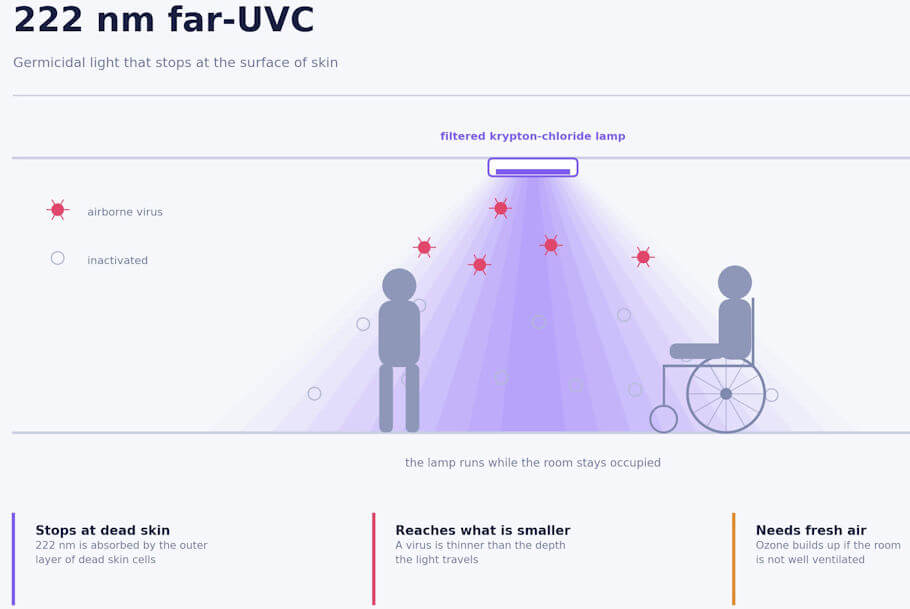
Practically all 222 nm fixtures on the market use a krypton-chloride excimer lamp, often abbreviated KrCl. An excimer, short for excited dimer, is a molecule that only exists in an electronically excited state and falls apart the instant it emits a photon. Run an electrical discharge through a sealed quartz tube containing krypton and a chlorine donor, and you get a population of short-lived KrCl molecules that emit a sharp peak at 222 nm as they dissociate.
The peak is sharp but not pure. A raw KrCl lamp also emits a low-level tail at longer wavelengths, extending well past 240 nm into territory that is genuinely hazardous to skin and eyes. Removing that tail requires an optical bandpass filter bonded to the lamp window. This is not a refinement or an upgrade. An unfiltered KrCl lamp is a different and more dangerous product than a filtered one, and essentially every safety study in the literature was performed with filtered lamps. Buyers who do not verify filtration are not buying the device the research describes.
The Biophysics: Why One Wavelength Behaves Differently
Absorption Depth Is Everything
Photons do not decide what to damage. They are absorbed by whatever molecule happens to be in their path with a matching absorption cross-section, and then they stop. At 222 nm, proteins and peptide bonds absorb ferociously - considerably more strongly than they do at 254 nm. The practical consequence is that far-UVC is extinguished within a few micrometers of any protein-dense surface.
Human skin has a built-in answer to this. The stratum corneum, the outermost layer, is a stack of roughly ten to twenty micrometers of flattened, keratin-packed dead cells with no nuclei and no DNA worth damaging. It is, functionally, a disposable optical filter that the body regenerates continuously. Far-UVC deposits its energy there and goes no further.
A virus or bacterium has no such luxury. An influenza virion is on the order of 0.1 micrometers across. A bacterial cell is one to two micrometers. There is no dead outer layer to sacrifice, because the entire organism is smaller than the depth at which far-UVC is absorbed. Every photon that strikes it reaches something that matters. This is the core asymmetry, and it is worth naming clearly, because it is not a claim about far-UVC being gentle. It is a claim about geometry.
Far-UVC is not safer because it is weaker. Photon for photon, it is more energetic than the 254 nm light it replaces. It is safer because human tissue is thick and microbes are thin.
Where the Analogy Strains
The skin argument is robust. The eye argument is more delicate, and honest accounts should say so. The corneal epithelium is only around fifty micrometers thick in total, perhaps five or six cell layers, and it has no thick keratinized dead layer equivalent to the stratum corneum. A 2025 laboratory assessment using reconstructed human corneal epithelium, ex vivo human donor corneas, and porcine corneas found that at 222 nm, damage-relevant intensity reached the middle of the epithelium, while the deeper stromal and endothelial layers - the ones that do not regenerate well - were spared. Conventional 254 nm light penetrated considerably further. The authors noted that superficial epithelial repair occurred within twenty-four hours but flagged the open question of whether repeated daily exposures accumulate DNA damage faster than repair clears it (Zamudio Díaz et al., 2025).
This is why the occupational exposure limits treat the eye more conservatively than the skin, and why anyone reading marketing copy that says far-UVC simply cannot reach living cells should treat it as a simplification rather than a finding.
Evidence That It Inactivates Airborne Pathogens
Dose Response at the Bench
The foundational metric in germicidal UV is the D90, the dose in millijoules per square centimeter required to inactivate ninety percent of a given organism. Lower is better. Work at Columbia University's Center for Radiological Research established D90 values for aerosolized human coronaviruses of 0.56 mJ/cm squared for the alpha coronavirus HCoV-229E and 0.39 mJ/cm squared for the beta coronavirus HCoV-OC43 (Buonanno et al., 2020). To put those numbers in context, exposure at the then-current regulatory ceiling of roughly 3 mJ/cm squared per hour would reach ninety percent inactivation in about eight minutes and 99.9 percent in about twenty-five.
A 2025 comparative study extended this across viral architecture, testing single-stranded RNA, double-stranded RNA, single-stranded DNA, and double-stranded DNA viruses, and found 222 nm effective across all four classes. That breadth matters for pandemic preparedness in a way that a single-pathogen result does not, because it suggests the mechanism is not dependent on any particular genome chemistry.
Room-Scale Chambers
Petri dishes are not rooms. The decisive early demonstration came from a bioaerosol chamber at the University of Leeds measuring 4.26 by 3.35 by 2.26 meters - about 32 cubic meters - ventilated at three air changes per hour and seeded continuously with aerosolized Staphylococcus aureus, chosen as a conservative surrogate because it is harder to kill than most respiratory viruses. Five filtered KrCl lamps mounted at 2.12 meters produced a 98.4 percent reduction in steady-state airborne pathogen load, which the authors translated into 184 equivalent air changes per hour (Eadie et al., 2022).
Equivalent air changes per hour, usually written eACH, is the workhorse concept in modern ventilation practice. It converts any air-cleaning intervention - filtration, ventilation, germicidal UV - into a single common currency: how many times per hour would you have to completely replace the room's air to achieve the same reduction in airborne pathogen concentration. A well-ventilated office runs at four to six eACH. A hospital isolation room targets twelve.
A figure of 184 eACH is not achievable by any conventional means. You cannot move that much air through an occupied room without turning it into a wind tunnel. That single comparison explains most of the enthusiasm the technology attracts.
Occupied Rooms
Chambers are still not the world. The most important field study to date ran for four months in an occupied mouse-cage cleaning room at Columbia University, approximately 38 square meters with a 2.5 meter ceiling, with animal husbandry staff working normally throughout. Rather than seeding a pathogen, the investigators measured naturally occurring airborne murine norovirus, which is present at high levels in such rooms and is notably hardy. Comparing alternating weeks with lamps on and off, infectious airborne virus fell by 99.8 percent, a 412-fold reduction, at an average irradiance of 0.464 microwatts per square centimeter - comfortably inside every applicable exposure limit (Buonanno et al., 2024).
What Is Still Missing
Here is the honest ledger. Every result above measures pathogen concentration in air. None of them measures whether fewer people got sick. That distinction is not pedantic. Transmission depends on dose, timing, host susceptibility, and behavior in ways that airborne concentration alone does not capture, and the history of infection control is littered with interventions that reduced a surrogate marker and failed to reduce disease.
That gap is finally beginning to close. Preliminary findings presented at the 2026 International Conference on Far-UVC Science and Technology in Aarhus included a controlled study of tuberculosis transmission in South Africa using real patient-generated aerosols, reporting roughly a 91 percent reduction in transmission, and a six-month controlled trial across twelve Danish long-term care facilities reporting lower hospitalization-requiring infection rates and reduced antibiotic prescribing in equipped facilities (ICFUST, 2026). A multi-site double-blinded randomized controlled trial of far-UVC against ESKAPEE pathogens on hospital surfaces in La Paz, Bolivia, has published its protocol. These are the first results of the kind that infection control committees actually act on, and they are very new.
The Safety Record and Its Boundaries
Two Standards Bodies, One Disagreement
A threshold limit value, or TLV, is the exposure a worker can receive over an eight-hour day without expected adverse effect. For far-UVC, the two authoritative bodies do not currently agree, and understanding why is essential to reading the field.
The International Commission on Non-Ionizing Radiation Protection set a limit of 23 mJ/cm squared at 222 nm in its 2004 guidelines (ICNIRP, 2004). That figure was derived by extrapolating an action spectrum built largely from data at longer wavelengths, at a time when nobody was seriously proposing to irradiate occupied rooms. In late 2021, after reviewing the newer tissue-penetration evidence, the American Conference of Governmental Industrial Hygienists revised its 2022 values sharply upward to 161 mJ/cm squared for the eye and 479 mJ/cm squared for the skin - roughly seven-fold and twenty-fold increases respectively (ACGIH, 2022). Prominent photobiologists had argued explicitly that the older limits were not defensible at this wavelength (Sliney and Stuck, 2021).
The practical effect is that a fixture installation legal and conservative under ACGIH may exceed the standing international guideline by a wide margin. Buyers, regulators, and building operators in different jurisdictions are working from different arithmetic, and that alone slows procurement.
What Human and Animal Studies Show
The safety literature is unusually deep for a technology this young. Four strands are worth knowing.
- A deliberate extreme-exposure case study delivered escalating skin doses of 1,500, 6,000, and 18,000 mJ/cm squared. No visible change occurred at 1,500. Transient skin yellowing appeared at 6,000 and resolved within twenty-four hours. No erythema - no sunburn reaction - occurred at any point up to 18,000 mJ/cm squared, a dose hundreds of times the ICNIRP limit (Eadie et al., 2021).
- A simulated office study exposed participants under ceiling-mounted filtered lamps to head doses up to 50 mJ/cm squared, using validated dry-eye instruments including SPEED and OSDI, and found no clinically significant eye discomfort, alongside a 52 percent reduction in bacteria and fungi (Kousha et al., 2024).
- A 36-month clinical observation of four physicians working in an ophthalmic examination room fitted with 222 nm lamps tracked visual acuity, refractive error, and corneal endothelial cell density, and found no significant change and no delayed effects such as pterygium, keratopathy, or cataract (Sugihara et al., 2025).
- Most striking for the disability question, a long-term study at Kobe University exposed xeroderma pigmentosum group A model mice - animals with a DNA repair defect conferring an over ten-thousand-fold increased skin cancer risk - to repeated 222 nm irradiation. None developed skin cancer. UVB-exposed controls developed tumors universally (Yamano et al., 2020).
The Byproduct Problem Nobody Advertises
The most serious near-term caveat has nothing to do with skin or eyes. Photons at 222 nm carry enough energy to split molecular oxygen, and the resulting oxygen atoms recombine with O2 to form ozone. Ozone then reacts with volatile organic compounds already present indoors - from cleaning products, furniture, cosmetics, and human skin oils - producing formaldehyde, other oxidized organics, and secondary organic aerosol, meaning ultrafine particles formed in the air rather than emitted directly.
The National Institute of Standards and Technology measured this systematically. In chamber experiments, ozone reached maximum concentrations around 52 parts per billion, with 34 distinct volatile organic compounds increasing during operation and detectable ultrafine particle and formaldehyde formation. Field testing in a restroom showed ozone rising about 5 ppb above background every time the lamps were switched on. Critically, byproduct formation depended heavily on precursor concentrations, lamp count, air change rate, and air mixing (Link et al., 2024).
A Columbia University study in a small conference room found the picture more reassuring at realistic settings: a single lamp at manufacturer-recommended intensity produced no significant ozone increase and negligible particle change, while a deliberately over-lamped four-fixture configuration raised ozone 5 to 10 ppb above background and increased particle counts by around 16 percent. The authors recommended using the smallest irradiance sufficient for disinfection and maintaining ventilation above three air changes per hour (Narouei et al., 2025).
The system-level lesson is that far-UVC is not a substitute for ventilation. It is a multiplier that requires ventilation to be safe. Installing it in a sealed, poorly ventilated room - precisely the room that most needs help - is the configuration where the chemistry turns against you.
Why These Fixtures Are Not Everywhere
Given the above, the obvious question is why a technology with a decade of commercial availability and a substantial safety literature remains effectively invisible. The answer is not one barrier but five interlocking ones.
A Regulatory Vacuum, Not a Regulatory Wall
In the United States, no agency approves the installation of a far-UVC lamp in an office, a school, or a nightclub. The Food and Drug Administration regulates UVC lamps as radiation-emitting electronic products under the Radiation Control for Health and Safety Act, requiring compliance with reporting rules, but it does not approve consumer disinfection lamps and states plainly that while there is some evidence 222 nm causes less damage than 254 nm, long-term safety data is lacking (FDA, 2021). Medical claims trigger device review; a ceiling fixture making no medical claim does not.
Counterintuitively, this permissiveness is the problem. The flip side of having no regulator is having no institution empowered to confer public trust. A risk-averse hospital epidemiologist, school district, or facilities director looking for the authority that has certified this technology as safe for continuous human exposure finds nobody home, and defaults to no.
The Free Rider Problem in Evidence
The evidence that would unlock institutional adoption - large cluster-randomized trials measuring human infection outcomes - costs tens of millions of dollars. No individual manufacturer can fund that, because the moment the result is published, every competitor benefits equally. This is a textbook public goods failure. Vaccines have the same structure, and it is resolved by patent protection plus public funding. Far-UVC has neither: excimer lamp technology is decades old and largely unpatentable, and public research funding has been episodic and pandemic-cycle dependent. Research consequently proceeded in academic silos rather than toward a coordinated evidentiary goal (Williamson, 2025).
Photons Are Expensive Here
KrCl excimer lamps convert only a few percent of input electrical energy into 222 nm light, and the mandatory optical filter discards more. That inefficiency propagates into cost, heat, and lamp life. Comparative analysis puts current far-UVC at roughly 71 to 729 dollars per equivalent air change over five years, against 16 to 99 dollars for HEPA filtration, with a Corsi-Rosenthal box - a cheap DIY fan and filter cube - at about 20 dollars. Far-UVC fixtures do draw less power, typically 10 to 40 watts against 43 to 60 for portable HEPA units, and lamps last 10,000 to 30,000 hours against one to three years for filters.
The hoped-for escape is a solid-state 222 nm LED, which would follow the cost curve that made white LEDs ubiquitous. That escape is not imminent. The bandgap required is roughly 5.5 to 6 electron volts, and aluminum gallium nitride, the workhorse material for deep-UV LEDs, degrades badly below about 250 nm. Current 222 nm LED prototypes are less efficient than excimer lamps, not more, and realistic estimates put commercial viability a decade or more away.
Standards Arrived After the Market
UL 8802, the Standard for Ultraviolet Germicidal Equipment and Systems, was published only recently. ANSI/ASHRAE Standard 241-2023, Control of Infectious Aerosols, established the equivalent clean airflow framework that finally lets germicidal UV be credited on equal terms with ventilation and filtration, and it is deliberately technology-agnostic - air cleaners qualify if they meet performance targets and pass emissions testing for formaldehyde, ozone, and particulate matter (ASHRAE, 2023). That emissions requirement is exactly the right gate, and it is very new. Building codes and procurement specifications update on a cycle measured in years, not months.
The Attention Cycle
Interest in indoor air peaked in 2021 and 2022 and has receded. Meanwhile the CDC's own guidance on germicidal ultraviolet still centers on upper-room 254 nm systems, which have seventy years of field use, and emphasizes qualified HVAC installation, lockable switching, minimum ceiling heights, and maintenance training (CDC, 2024). That is a mature, cautious evidence base recommending a mature, cautious technology. Far-UVC is asking institutions to adopt something newer on thinner evidence during a period of diminished urgency.
Far-UVC and Disability
This is where the analysis stops being purely technical, and where two arguments run in opposite directions. Both are true, and holding both at once is the whole task.
Who Actually Bears the Burden of Airborne Infection
More than one in four American adults - over 70 million people - reported a disability in 2022, rising to 43.9 percent among adults aged 65 and over (CDC BRFSS data). The distribution of harm from airborne pathogens across that population is not proportional. A retrospective population-based cohort study of 29 million adults in England found that during the first two waves of the pandemic, mortality involving COVID-19 was substantially elevated among disabled people, with hazard ratios of 3.1 for those reporting more limiting disability and 1.9 for those reporting less limiting disability. Among adults aged 30 to 69, the more-disabled group faced roughly 8.5 times the risk for women and 5.4 times for men. Fifty-eight percent of COVID-related deaths in England during that period occurred among people with disabilities (Bosworth et al., 2021).
Layer onto that a structural fact: many disabled people are compelled to occupy exactly the environments where airborne transmission concentrates. Nursing facilities, group homes, day programs, sheltered workshops, dialysis centers, inpatient rehabilitation units, special education classrooms, and hospital waiting rooms are congregate settings with dense occupancy, long dwell times, high staff turnover, and frequently aged mechanical ventilation. People in these settings often cannot choose to leave, cannot work remotely, and cannot decline the shared air.
Environmental Control as Barrier Removal
Disability studies distinguishes between the medical model, which locates disability in the individual body and asks the individual to adapt, and the social model, which locates disability in the mismatch between a body and an environment built without it in mind, and asks the environment to change. That distinction maps with unusual precision onto infection control.
Masking, avoidance, and staying home are individual adaptations. They place the entire burden of protection on the person at risk, require constant vigilance, and are stigmatized. Ventilation, filtration, and germicidal UV are environmental modifications. They protect everyone in the room automatically, require nothing of the protected person, and are invisible.
This is the same logic as a curb cut, and the same logic as captioning. Occupational safety has a formal name for it: the hierarchy of controls, which ranks elimination and engineering controls above administrative rules, which in turn rank above personal protective equipment. Far-UVC, correctly deployed, is an engineering control. It is structurally in the same category as a wheelchair ramp, and it inherits the same virtue - the accommodation that stops being an accommodation because it is simply how the building works.
The point sharpens for immunocompromised people specifically. Solid organ transplant recipients, people on B-cell depleting therapies such as rituximab, people receiving active chemotherapy, and people with primary immunodeficiency mount weak or absent responses to vaccination. For them, the pharmaceutical layer of protection is partly or wholly unavailable, which means the environmental layer is not one option among several. It is the layer that remains.
Infection Prevention as Disability Prevention
There is a second temporal dimension. Long COVID, post-viral myalgic encephalomyelitis, post-polio syndrome, congenital rubella syndrome, and post-infectious dysautonomia are all reminders that infectious disease is a major generator of long-term disability, not merely a hazard to already-disabled people. Reducing airborne transmission is therefore an upstream intervention against disability incidence, operating on a timescale of years and decades that ordinary infection control metrics never capture. A technology evaluated only on absenteeism this quarter will systematically undervalue itself.
Where Far-UVC Could Harm Disabled People
Now the other direction. A technology that is safe for a median adult standing upright and blinking normally is not automatically safe for everyone, and disabled people are disproportionately represented in every one of the following categories.
- Photosensitivity conditions. Xeroderma pigmentosum, cutaneous lupus erythematosus, erythropoietic protoporphyria, solar urticaria, actinic prurigo, and oculocutaneous albinism all involve abnormal responses to ultraviolet light. The Kobe University mouse work is genuinely encouraging for xeroderma pigmentosum specifically, since those animals carry the same repair defect. But an animal model is not a person, and the other conditions have their own action spectra, some driven by mechanisms far-UVC may or may not trigger. Human data in these populations is essentially absent.
- Photosensitizing medications. Doxycycline, amiodarone, hydrochlorothiazide, voriconazole, methotrexate, and several antipsychotics all lower the threshold for phototoxic reaction. People with chronic conditions are, by definition, the people taking chronic medication. Whether these interactions extend into the far-UVC band is largely unstudied.
- Ocular surface disease. Severe dry eye, Sjögren's syndrome, incomplete lid closure from facial palsy or after stroke, and reduced blink rate in Parkinson's disease all thin or destabilize the tear film and prolong ocular surface exposure. Given that the corneal epithelium is already the more sensitive tissue at 222 nm, this is the population where the margin is narrowest and the research thinnest.
- Respiratory and chemical sensitivity. Ozone is a well-established asthma trigger, and secondary organic aerosol is ultrafine particulate. People with asthma, COPD, bronchiectasis, tracheostomies, or multiple chemical sensitivity are precisely those for whom a 5 to 10 ppb ozone increase is not negligible. The population that benefits most from fewer airborne pathogens overlaps heavily with the population most harmed by byproducts.
- Geometry and position. Irradiance falls with the square of distance from the fixture. Exposure limits assume a person of typical height moving normally. A person lying in a hospital bed with a ceiling fixture two meters above their upturned face, a wheelchair user whose eye height and gaze angle differ from the design assumption, or a person who cannot reposition themselves away from a malfunctioning lamp all sit outside the modeled case. Dosimetry studies of ceiling-mounted fixtures have shown that ocular and facial dose varies substantially with head orientation.
- Reporting and consent. The safety literature relies heavily on subjective symptom questionnaires. A nonspeaking autistic adult, a person with advanced dementia, a person with significant intellectual disability, or an infant cannot complete a SPEED or OSDI instrument. Institutional residents also frequently cannot decline an installation decided by a facility administrator. The population least able to report a problem is disproportionately the population housed in congregate settings where these fixtures are most likely to be installed first.
Designing for the Edge, Not the Average
None of the above is an argument against far-UVC. It is an argument for a specific design discipline that the field has not yet institutionalized: validate at the edge of the distribution rather than at its center. Concretely, that means dosimetry modeled for supine and seated occupants rather than standing ones, mandatory verification of optical filtration, ozone and particulate monitoring as a commissioning requirement rather than an afterthought, clearly labeled and accessible switching, and safety studies that deliberately recruit photosensitive and ocular-surface-disease participants instead of screening them out.
The wheelchair ramp is instructive again. Ramps became standard not because they were proven safe for the average person, but because the design question was reframed around the person who could not use the stairs. Far-UVC will earn a place in disability infrastructure when its evidence base is built the same way.
Reading the Technology Across Timescales
One reason far-UVC is confusing to evaluate is that its relevant processes unfold across five orders of magnitude of time, and arguments about it routinely conflate them.
- Microseconds to seconds: photon absorption, nucleic acid and protein damage, individual pathogen inactivation. This layer is settled physics.
- Minutes: room-scale air cleaning, measured as eACH, competing against ventilation and mixing. Well characterized in chambers, less so in real rooms with real airflow.
- Hours to days: ozone accumulation and secondary organic aerosol chemistry, which depend entirely on ventilation rate and what else is in the air. Actively contested and installation-specific.
- Months to years: epidemiological effect on actual infections, and cumulative tissue exposure. The frontier, with the first real trials only now reporting.
- Decades: technology cost curves, standards development, code adoption, and the incidence of infection-acquired disability. Almost never measured, and where the largest value probably sits.
Confidence should decline as you move down that list, and most public argument about far-UVC consists of borrowing confidence from the first tier to make claims about the fourth.
Practical Guidance
For anyone actually evaluating a purchase, five questions separate credible products from the rest. Does the fixture use an optical bandpass filter, with a spectral output measurement to prove it? What irradiance does it produce at occupant head height, and what eight-hour dose does that imply against both the ACGIH and ICNIRP limits? What is the ventilation rate in the target room, and is it above three air changes per hour? Has ozone been measured in a comparable installation? And is the fixture being sold as a supplement to ventilation and filtration, or as a replacement for them - because the second answer is disqualifying.
Frequently Asked Questions
Does far-UVC disinfect surfaces or only the air
Both, though air is where it performs best. Far-UVC inactivates microorganisms on any surface the light directly reaches, and hospital studies have shown useful reductions on equipment near sinks. Shadowed areas receive no dose, so surface disinfection is uneven and should not replace cleaning.
Can you see 222 nanometer light
Not the germicidal output itself, which is far below the visible range. Many krypton-chloride lamps do produce a faint violet or bluish glow from secondary emission, so a visible tint is normal and its absence does not mean the lamp is off. Reputable fixtures include a separate indicator light.
Is far-UVC safe around cats and dogs
Animal skin evidence is reassuring, since the mouse studies underpinning human safety used live animals with no tumors or lesions. Fur provides additional shielding. Animals with thin coats, exposed skin, or prominent eyes have not been specifically studied, and reptiles and amphibians should be treated as unknown.
Does far-UVC damage plants artwork or fabrics
Prolonged ultraviolet exposure fades dyes, embrittles some plastics, and degrades paper and textiles over years, though 222 nanometer light penetrates materials poorly compared with longer ultraviolet wavelengths. Museums, archives, and galleries should test before installing. Houseplants tolerate typical room-level irradiance without visible harm.
Do far-UVC lamps contain mercury
No. Krypton-chloride excimer lamps use krypton gas and a chlorine donor, which avoids the mercury disposal and breakage hazards of conventional 254 nanometer germicidal tubes. This is a genuine environmental advantage and simplifies end-of-life handling in schools and care settings.
Does far-UVC exposure produce vitamin D
No. Vitamin D synthesis requires ultraviolet B light around 295 to 300 nanometers reaching living cells in the deeper epidermis. Far-UVC stops in the dead outer layer and never contacts the precursor molecule, so it offers no vitamin D benefit and equally no risk of interfering with it.
How is a far-UVC ceiling fixture different from a UV sanitizing wand or box
Consumer wands and boxes almost always use 254 nanometer light and are designed for brief surface treatment of objects with people not present. Far-UVC fixtures run continuously in occupied rooms and target air. The two are not interchangeable, and pointing a 254 nanometer wand at skin causes real injury.
Does far-UVC work against mold spores and fungi
Yes, but less efficiently than against viruses and bacteria. Fungal spores carry pigmented protective coats and thicker walls, requiring substantially higher doses. Far-UVC also does nothing about the moisture source feeding mold growth or about allergenic fragments already settled in dust, so it is a poor substitute for remediation and filtration.
References:
American Conference of Governmental Industrial Hygienists. (2022). TLVs and BEIs: Threshold limit values for chemical substances and physical agents and biological exposure indices. ACGIH.
ASHRAE. (2023). ANSI/ASHRAE Standard 241-2023: Control of infectious aerosols. American Society of Heating, Refrigerating and Air-Conditioning Engineers.
Bosworth, M. L., Ayoubkhani, D., Nafilyan, V., Foubert, J., Glickman, M., Davey, C., and Kuper, H. (2021). Deaths involving COVID-19 by self-reported disability status during the first two waves of the COVID-19 pandemic in England: A retrospective, population-based cohort study. The Lancet Public Health, 6(11).
Buonanno, M., Welch, D., Shuryak, I., and Brenner, D. J. (2020). Far-UVC light (222 nm) efficiently and safely inactivates airborne human coronaviruses. Scientific Reports, 10.
Buonanno, M., Kleiman, N. J., Welch, D., and Brenner, D. J. (2024). 222 nm far-UVC light markedly reduces the level of infectious airborne virus in an occupied room. Scientific Reports, 14.
Centers for Disease Control and Prevention, National Institute for Occupational Safety and Health. (2024). About germicidal ultraviolet (GUV). U.S. Department of Health and Human Services.
Eadie, E., Barnard, I. M. R., Ibbotson, S. H., and Wood, K. (2021). Extreme exposure to filtered far-UVC: A case study. Photochemistry and Photobiology, 97(3).
Eadie, E., Hiwar, W., Fletcher, L., Tidswell, E., O'Mahoney, P., Buonanno, M., Welch, D., Adamson, C. S., Brenner, D. J., Noakes, C., and Wood, K. (2022). Far-UVC (222 nm) efficiently inactivates an airborne pathogen in a room-sized chamber. Scientific Reports, 12, 4373.
International Commission on Non-Ionizing Radiation Protection. (2004). Guidelines on limits of exposure to ultraviolet radiation of wavelengths between 180 nm and 400 nm. Health Physics, 87(2).
International Conference on Far-UVC Science and Technology. (2026). Conference proceedings and presented findings. Aarhus University.
Kousha, O., O'Mahoney, P., Hammond, R., Wood, K., and Eadie, E. (2024). 222 nm far-UVC from filtered krypton-chloride excimer lamps does not cause eye irritation when deployed in a simulated office environment. Photochemistry and Photobiology, 100(1).
Link, M. F., Shore, A., Robertson, R., Hamadani, B. H., and Poppendieck, D. (2024). Spectral characteristics and indoor air quality impacts of 222 nm germicidal ultraviolet devices (NIST IR 8550). National Institute of Standards and Technology.
Narouei, F. H., Tang, X., Wang, C., Hashmi, R., Welch, D., Sethuraman, S., Brenner, D. J., and McNeill, V. F. (2025). Effects of germicidal far-UVC on ozone and particulate matter in a conference room. PLOS ONE, 20.
Sliney, D. H., and Stuck, B. E. (2021). A need to revise human exposure limits for ultraviolet UV-C radiation. Photochemistry and Photobiology, 97(3).
Sugihara, K., Kaidzu, S., Sasaki, M., Ichioka, S., Sano, I., Hara, K., and Tanito, M. (2025). Ocular safety of 222 nm far-ultraviolet-C full-room germicidal irradiation: A 36-month clinical observation. Photochemistry and Photobiology, 101(5).
U.S. Food and Drug Administration. (2021). UV lights and lamps: Ultraviolet-C radiation, disinfection, and coronavirus. Center for Devices and Radiological Health.
Williamson, R. D. (2025). Blueprint for far-UVC (Version 1.0). Blueprint Biosecurity.
Yamano, N., Kunisada, M., Kaidzu, S., Sugihara, K., Nishiaki-Sawada, A., Ohashi, H., Yoshioka, A., Igarashi, T., Ohira, A., Tanito, M., and Nishigori, C. (2020). Long-term effects of 222 nm ultraviolet radiation C sterilizing lamps on mice susceptible to ultraviolet radiation. Photochemistry and Photobiology, 96(4).
Zamudio Díaz, D. F., Busch, L., Kröger, M., Klein, A. L., Lohan, S. B., Mewes, K. R., Vierkotten, L., Witzel, C., Rohn, S., and Meinke, M. C. (2025). Corneal safety assessment of germicidal far UV-C radiation. Scientific Reports, 15.
Note: One note on sourcing: the tuberculosis and Danish care-facility results are preliminary conference findings from June 2026 and are flagged as such in the text rather than presented as peer-reviewed outcomes.
Insights, Analysis, and Developments
Editorial Note: Far-UVC occupies an unusual position in public health: a technology whose failure to spread is a story about institutions rather than about physics. The photons behave as advertised, the exposure limits have been revised upward by the body that studies them most closely, and the first controlled trials measuring actual transmission are finally reporting. What has been missing is any entity with the standing to say yes, and any commercial actor with the incentive to fund the evidence that would let one. That vacuum has a cost, and it is not distributed evenly - it lands hardest on people who cannot leave the shared air they are given, in nursing facilities, group homes, dialysis units, and classrooms. The correct posture is neither the enthusiasm of vendors nor the shrug of institutions that decided in 2022 that indoor air was somebody else's problem. It is the patient, unglamorous work of measuring ozone at commissioning, modeling dose for a person lying in a bed rather than standing in a hallway, and recruiting the photosensitive volunteers that safety studies have so far screened out.
 Author Credentials: Ian is the founder and Editor-in-Chief of Disabled World, a leading resource for news and information on disability issues. With a global perspective shaped by years of travel and lived experience, Ian is a committed proponent of the Social Model of Disability, a transformative framework developed by disabled activists in the 1970s that emphasizes dismantling societal barriers rather than focusing solely on individual impairments. His work reflects a deep commitment to disability rights, accessibility, and social inclusion. To learn more about Ian's background, expertise, and accomplishments, visit his full biography.