Chemogenetics: Rewriting the Rules of Disability Care
Author: Ian C. Langtree - Writer/Editor for Disabled World (DW)
Published: 3 Sep 2026
Publication Type: Scholarly Paper
Table of Contents:
Synopsis - Definition - Overview - FAQs - Insights, Updates - Related Content
Synopsis
For almost two decades chemogenetics has been the quiet workhorse of neuroscience laboratories, a way of installing a chemical switch into a chosen population of brain cells and then flipping it with a pill. In August 2026 that quiet ended, when researchers learned that human trials were already underway abroad for epilepsy, Parkinson's disease and neuropathic pain. This paper sets out what the technology actually does at the molecular level, traces the near-collapse and recovery that reshaped it in 2017, and examines the newest work - over-the-counter switches, ultrasound-guided delivery, and imaging that lets clinicians see a receptor working inside a living brain. It then turns to the harder question that the excitement tends to skip: what a reversible, drug-gated, user-controlled intervention would mean for disabled people, and what it would put at risk.
At a Glance
- 1 - Deschloroclozapine activates designer receptors within ten minutes of injection. It works at doses roughly twenty times smaller than the original actuator drug.
- 2 - Focused ultrasound can open the blood-brain barrier at a single chosen spot. An injected virus then installs receptors only there, with no skull opening and no implanted hardware.
- 3 - A radioactive tracer version of the actuator drug lets researchers photograph receptor levels inside a living brain. Macaque studies using it found expression stayed useful for about two years.
- 4 - A 2026 redesign of the inhibitory receptor responds to diphenhydramine, the antihistamine sold in ordinary drugstores. Using a non-prescription drug as the trigger removes one of the largest regulatory obstacles to human use.
Topic Definition
- Chemogenetics
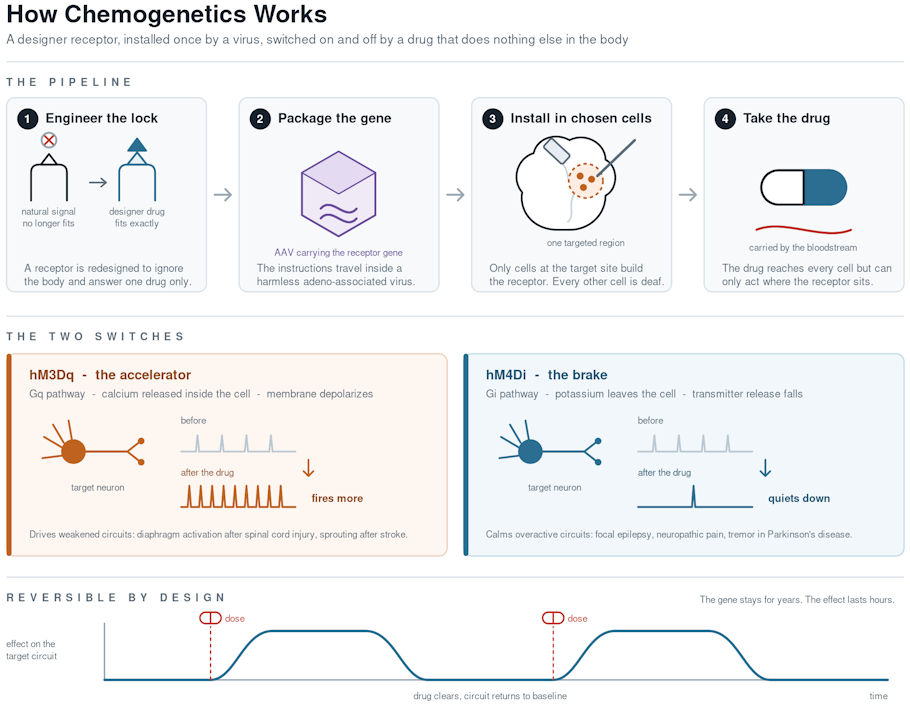
Chemogenetics is a method for controlling specific cells by giving them an engineered receptor that ignores the body's own signals and responds only to a chosen drug, which would otherwise pass through the system without effect. The receptor is delivered as a gene, usually inside a harmless virus, into a precisely targeted group of cells, and from then on those cells alone can hear the drug when it arrives in the bloodstream. Take the drug and the targeted cells become more active or less active, depending on which receptor was installed; stop the drug and they return to normal within hours. Because the effect scales with dose and disappears when dosing stops, chemogenetics functions less like a surgical correction and more like a dial that can be turned up, turned down, or left alone entirely.
Overview
Imagine a light switch that does nothing until you swallow a particular pill. The wiring is installed, the fixture is mounted, the circuit is complete - but the switch simply will not respond to any hand that touches it. Only one specific chemical, circulating in the bloodstream, can flip it. Take the pill and the light comes on. Let the drug clear and the light goes off again. Nothing is cut, nothing is burned out, nothing is permanently rearranged.
That is chemogenetics in a sentence, and it is one of the more consequential ideas in modern neuroscience that most people outside the field have never heard of. In August 2026 it stopped being a purely laboratory technology. At a National Institutes of Health BRAIN Initiative meeting in Bethesda, Maryland, Bryan Roth of the University of North Carolina - the pharmacologist whose lab built the first of these switches nearly twenty years ago - reported that at least seven registered clinical trials in China were already testing chemogenetic therapies in human beings, for intractable epilepsy, Parkinson's disease, and trigeminal neuropathic pain (Chemical and Engineering News, 2026). The room, by all accounts, was stunned.
This paper explains what chemogenetics actually is, how it works at the level of proteins and circuits, what has changed in the past two years, and - the question that gets asked least often and matters most - what it might mean for disabled people, both as a set of clinical possibilities and as a fresh set of ethical problems.
What Chemogenetics Means
Chemogenetics is the deliberate engineering of a biological molecule so that it stops responding to its natural signals and instead responds only to a drug that has no other business in the body. The engineered molecule is the actuator. The drug that switches it is the ligand, sometimes called the effector or actuator drug.
The word is a compound with a compound meaning. The chemo half refers to the small molecule that does the triggering. The genetic half refers to the fact that the receiving apparatus is put into cells as a gene, not as a device. Nothing is drilled, threaded, or implanted in the conventional sense. A virus carrying a piece of engineered DNA is injected, cells read that DNA, and they build the new receptor themselves.
The elegance of the arrangement lies in its double specificity. A conventional drug goes everywhere the bloodstream goes and acts on every cell that carries its target receptor. A chemogenetic drug also goes everywhere the bloodstream goes - but it only has something to bind to in the small population of cells that were given the engineered gene. Specificity is not achieved by aiming the drug. It is achieved by having previously decided which cells are listening.
The lock-and-key inversion
Pharmacologists have long described drug action with a lock-and-key metaphor: the receptor is the lock, the drug is the key. Chemogenetics inverts the design problem. Rather than searching for a key that fits an existing lock, researchers change the lock so that only one otherwise useless key will turn it. The founding paper's title says it plainly - evolving the lock to fit the key (Armbruster et al., 2007).
A Short History: RASSLs, DREADDs, and the Naming of Things
The lineage begins in the late 1990s with what Bruce Conklin's group called RASSLs, or receptors activated solely by synthetic ligands (Conklin et al., 2008). These were modified G protein-coupled receptors that had lost sensitivity to their natural messengers but retained sensitivity to a synthetic compound. The idea worked. The problem was that the synthetic compounds were not truly inert - they still hit endogenous receptors elsewhere in the body, which muddied every experiment and killed any hope of clinical use.
The breakthrough came in 2007. Armbruster and colleagues in Roth's laboratory ran a directed evolution campaign in genetically engineered yeast, generating and screening thousands of mutant human M3 muscarinic acetylcholine receptors. They isolated variants that had gone deaf to acetylcholine, the body's own neurotransmitter, while becoming exquisitely sensitive to clozapine-N-oxide, a metabolite then believed to be pharmacologically inert in humans. They named the new class DREADDs - Designer Receptors Exclusively Activated by Designer Drugs (Armbruster et al., 2007).
The naming stuck, and the tools spread through neuroscience with unusual speed. Within a decade, DREADDs had become standard equipment in thousands of laboratories, used to answer a question that had been nearly unanswerable before: what does this particular group of cells actually do in a behaving animal (Roth, 2016)?
How It Works: Three Scales of the Same Mechanism
Scale one - the receptor and the signal
Most chemogenetic actuators are engineered G protein-coupled receptors, or GPCRs, the seven-pass membrane proteins that mediate a very large share of all cellular signaling. The two workhorses are named for what they do:
- hM3Dq couples to the Gq signaling pathway. Activation triggers phospholipase C, releases internal calcium stores, depolarizes the cell, and makes neurons fire more. It is the accelerator.
- hM4Di couples to Gi. Activation opens inward-rectifying potassium channels, suppresses calcium influx at the axon terminal, and reduces both firing and neurotransmitter release. It is the brake.
Two details matter for anyone thinking about therapy. First, hM4Di does much of its work at the presynaptic terminal - the point where one neuron hands its message to the next. That means it can quiet a specific pathway rather than an entire cell, which is a finer instrument than it first appears. Second, other family members exist: rM3Ds engages the Gs pathway, and KORD, built from the kappa opioid receptor and switched by salvinorin B, allows two independent chemogenetic systems to run in the same animal at once (Vardy et al., 2015). That capacity, called multiplexing, is what turns a single switch into a control panel.
Scale two - the ion channel alternative
Not every actuator is a GPCR. Scott Sternson's group built a parallel toolkit from ligand-gated ion channels, pairing PSAMs (pharmacologically selective actuator modules) with PSEMs (pharmacologically selective effector molecules) (Magnus et al., 2011). The most clinically interesting member is PSAM4-GlyR, a chimera that welds a triple-mutant ligand-binding domain from the alpha-7 nicotinic receptor onto the chloride-conducting pore of a glycine receptor. When the matched drug binds, chloride flows and the neuron is silenced directly, with no signaling cascade in between.
The 2019 refinement was what made this interesting to clinicians. Sternson's team showed that PSAM4-GlyR responds to varenicline - an approved smoking-cessation medicine - and to a family of ultrapotent synthetic ligands with sub-nanomolar potency and roughly five thousand to ten thousand-fold selectivity over other targets (Magnus et al., 2019). A tool that runs on an existing approved drug has a very different regulatory path from one that requires a novel chemical entity.
A caution belongs here, because it is the kind of detail that separates a working understanding from a superficial one. Chloride-based silencing is not unconditionally silencing. The direction chloride moves depends on a cell's internal chloride concentration, described by its reversal potential. In neurons where that gradient runs the other way - and researchers reported exactly this for striatal medium spiny neurons in eLife in 2021 - opening a chloride channel can excite rather than inhibit. Inhibition is a property of the cell, not only of the tool.
Scale three - getting the gene into the right cells
The actuator gene almost always travels by adeno-associated virus, or AAV, a small, non-integrating, generally well-tolerated viral vector that has become the standard vehicle for gene therapy in the nervous system. Targeting is achieved through a stack of overlapping constraints: where the needle goes, which AAV serotype is used, which genetic promoter drives expression, and whether the construct is switched on only in cells expressing a particular marker.
The result is a therapy with an unusual temporal structure. The gene delivery is a single event with effects that last years. The functional intervention is a pill taken on a Tuesday afternoon and gone by Wednesday. Very few medical technologies separate installation from operation so cleanly, and as the ethics section argues, that separation is where much of the interesting moral territory sits.
The Ligand Problem, and How the Field Nearly Came Undone
For a decade the field ran on clozapine-N-oxide, on the assumption that it was inert. In 2017 that assumption collapsed. Gomez and colleagues showed, using positron emission tomography and careful pharmacokinetics, that clozapine-N-oxide does not readily cross the blood-brain barrier and is instead back-converted in the body to clozapine, an antipsychotic with a long list of off-target actions and a serious side effect profile (Gomez et al., 2017). It was clozapine, not clozapine-N-oxide, that had been reaching the brain and turning the switches - along with a great many receptors nobody intended to touch.
This was a genuine crisis and, to the field's credit, it produced a genuine correction. Chemists went looking for better keys, and found several:
- Deschloroclozapine (DCZ) activates hM3Dq and hM4Di in mice and monkeys within about ten minutes, at doses roughly twenty times lower than clozapine-N-oxide and sixty times lower than compound 21, with no detectable off-target action at effective doses (Nagai et al., 2020).
- JHU37160 (J60) and related high-potency ligands were developed alongside radiolabeled versions that allow receptor expression to be imaged directly in a living brain (Bonaventura et al., 2019).
- Olanzapine, an antipsychotic already on pharmacy shelves worldwide, turned out to be a full and potent agonist at hM4Di, offering a shortcut to human use (Weston et al., 2019).
The pattern worth noticing is a general one in translational science. A tool designed for discovery has to be re-engineered almost from scratch before it can be a treatment, and the hardest part is rarely the clever part. It is the boring part - the drug that has to be safe, oral, brain-penetrant, cheap, and already familiar to regulators.
What Changed in 2025 and 2026
Human trials, without warning
The seven Chinese trials reported in August 2026 are the field's inflection point. The receptor under test responds to clozapine; three of the trials use AAV as the delivery vector; and the sequencing of registrations - six studies beginning some months after an initial epilepsy trial - suggests investigators saw acceptable early safety before expanding into further indications. No results had been published at the time of reporting, and investigators listed in the registries had not responded to press inquiries (Chemical and Engineering News, 2026). That silence is itself part of the story, and a legitimate cause for scientific caution rather than celebration.
An over-the-counter switch
In July 2026, a team reported in Signal Transduction and Targeted Therapy that mutating hM4Di at two positions - S85 and Y416 - makes it fully and potently responsive to diphenhydramine, the antihistamine sold in every drugstore. They named the class GRANPAs, for G protein-coupled receptors activated by non-prescription agents, and showed that diphenhydramine given to mice expressing the receptor in the ventral hippocampus reversibly changed anxiety-related behavior and blunted chemically induced seizures, including on-demand seizure suppression in a chronic epilepsy model (Next-generation chemogenetic inhibition, 2026). Swapping clozapine for an antihistamine removes one of the largest practical barriers standing between this technology and ordinary clinical use.
Seeing the switch from outside the skull
A longitudinal study in twenty macaques used carbon-11 labeled DCZ as a PET tracer to track receptor expression over time. Expression of both hM4Di and hM3Dq peaked around sixty days after injection, held steady for roughly a year and a half, and declined gradually after two years, with meaningful behavioral control persisting for about two years (Longitudinal assessment of DREADD expression, 2025). This is the sort of unglamorous data that clinical medicine cannot proceed without. It tells a future clinician when to expect the therapy to work, when to re-image, and when a booster might be needed.
Better vehicles
Progress in AAV capsid engineering has been rapid and is arguably as important as progress in the actuators themselves. Engineered capsids that bind the human transferrin receptor, and others that engage human carbonic anhydrase IV, cross the blood-brain barrier at rates one hundred-fold or more above the previous standard vector in primate studies, with reduced uptake by the liver. Meanwhile, the approval of the first brain-delivered AAV gene therapy in the United States, for AADC deficiency, established that regulators will license direct-to-brain viral therapy when the case is strong.
Non-invasive installation
One further approach deserves attention because it dissolves the assumption that gene delivery means neurosurgery. Acoustically targeted chemogenetics uses focused ultrasound to transiently open the blood-brain barrier at a single, precisely chosen location. A virus given by simple intravenous injection then enters the brain only at that spot, and only those neurons build the receptor (Szablowski et al., 2018). No craniotomy, no electrode, no implanted hardware - a millimeter-scale intervention delivered through an intact skull.
Chemogenetics and Disability: Where the Two Meet
Every indication currently under investigation maps onto a recognized cause of long-term disability. This is not incidental. Chemogenetics is at its most useful precisely where a circuit misbehaves persistently, where drugs that act body-wide cause unacceptable collateral effects, and where the surgical alternative is destructive.
Drug-resistant focal epilepsy
Roughly a third of people with epilepsy continue to have seizures despite optimal medication. For focal epilepsy, the established fallback is resective surgery: identify the seizure focus and remove it. That works, and it is irreversible, and it removes functioning brain tissue along with the malfunctioning kind.
The chemogenetic alternative was demonstrated in a rat model of focal neocortical seizures, where inhibitory DREADD expression in the focus, combined with the actuator drug, suppressed seizures without impairing normal behavior (Kätzel et al., 2014). It was then reproduced in a nonhuman primate model, where hM4Di expressed throughout a seizure focus plus a selective agonist rapidly suppressed widespread cortical seizures (Miyakawa et al., 2023). The tissue stays. The suppression is dose-dependent and reversible. For a person weighing surgery against a lifetime of breakthrough seizures, a third option that removes nothing is not a minor addition to the menu.
Chronic pain
Chronic pain is among the largest single contributors to years lived with disability worldwide, and the pharmacological options are notoriously poor - opioids bring tolerance, dependence, and sedation, and non-opioid alternatives are frequently inadequate.
Working in mice, Haroun and colleagues expressed PSAM4-GlyR selectively in NaV1.8-positive sensory neurons - the population that carries most nociceptive traffic - and showed that varenicline reversed mechanical, thermal, and cold hypersensitivity after nerve constriction injury, and also reversed cancer-induced bone pain (Haroun et al., 2023). The critical features are that the silencing is confined to pain-carrying peripheral neurons rather than the whole nervous system, and that repeated dosing did not produce the tolerance that undermines opioid therapy. Trigeminal neuropathic pain is one of the three indications in the current human trials.
Cervical spinal cord injury and breathing
High cervical spinal cord injury frequently damages the phrenic motor circuitry that drives the diaphragm, and ventilator dependence follows. Benevides and colleagues delivered an excitatory DREADD by bilateral intraspinal injection at the fourth cervical segment and showed that the high-affinity ligand J60 produced more than a doubling of phrenic inspiratory output, with increased tidal volume in awake, freely behaving animals (Benevides et al., 2025).
Consider what that architecture would mean in practice. Rather than a permanently implanted diaphragm pacing system with its leads, its battery, and its infection risk, a person might take a dose that increases their own diaphragm drive for a defined period - overnight, or during exertion, or during a respiratory infection when reserve matters most. The intervention becomes something scheduled around a life rather than something the life is scheduled around.
Stroke, plasticity, and the timing of everything
Stroke recovery illustrates a capability no other neuromodulation technology has in quite the same form: phase-specific intervention. In rodent work, inhibitory DREADDs applied acutely reduce excitotoxic damage in the tissue surrounding the infarct, while excitatory DREADDs applied during the later recovery window promote axonal sprouting and functional rewiring, particularly when paired with rehabilitation training. The same installed hardware serves opposite purposes at different times, because what changes is not the receptor but the schedule of the drug. Recovery after brain injury is fundamentally a problem of timing, and chemogenetics is unusually well suited to timing.
Parkinson's disease
Deep brain stimulation is genuinely transformative for many people with Parkinson's disease, and it also requires electrodes in the brain, a pulse generator in the chest, wires under the skin, periodic surgery for battery replacement, and lifelong programming visits. A chemogenetic approach offers what amounts to a reversible, chemically titrated adjustment of the same circuits, without hardware. Parkinson's is one of the indications in the current human trials, which suggests investigators consider the preclinical case sufficient to justify first-in-human exposure.
Outside the nervous system
It is worth noting that chemogenetic logic is not confined to neurons. The inducible caspase-9 safety switch used in cell therapy - a suicide gene that lies dormant until the dimerizing drug rimiducid is given, at which point the engineered cells rapidly die - is the same design principle applied to immunology, and it has been in human use since 2011 (Di Stasi et al., 2011). Any cell type, any process, can in principle be given a drug-gated switch. The nervous system simply happens to be where the payoff is most dramatic.
Why the Design Matters to Disabled People Specifically
Strip away the molecular detail and three properties stand out, each of which speaks to a longstanding complaint about how disability is medically managed.
It is a dial, not a switch
Effects scale with dose. A person could, in principle, choose more suppression on a difficult day and less on an easy one. Contrast that with resective surgery, which delivers one setting forever, or with a systemic drug whose dose is constrained by what the rest of the body will tolerate.
It is reversible at the level that matters day to day
Stop the drug and the effect stops. There is a meaningful difference between an intervention you can put down and one you cannot, and it is not only a clinical difference - it is a difference in who is holding the controls.
It puts the trigger in the person's own hand
This is the property with the deepest implications. An implanted stimulator is adjusted by a clinician in a programming session. A chemogenetic therapy is activated by the person deciding to take a tablet. The therapeutic act belongs to the patient in a way that is rare in neurological medicine, and disability advocates have spent decades arguing that the location of control is not a side issue.
The Honest Objections
A paper that only listed advantages would be advocacy, not analysis. The difficulties are substantial.
The installation is not reversible
The pill is optional. The receptor is not. AAV-delivered genes persist for years, and while expression eventually declines, there is at present no reliable way to remove an actuator that a person no longer wants. Consent given at one point in life binds a body indefinitely. This asymmetry - reversible use, irreversible installation - is the single most important ethical feature of the technology and it is routinely glossed over in enthusiastic coverage.
Immune responses and access
DREADDs are built from human receptors and are therefore comparatively unlikely to provoke immunity, but chimeric actuators and the viral capsids that carry them are another matter. A large fraction of the adult population carries pre-existing neutralizing antibodies against common AAV serotypes, which excludes them from treatment outright. High vector doses raise the risk of inflammatory response, and the macaque data suggest a narrow band between enough expression and too much immune activation.
Cost, and who ends up on the wrong side of it
Approved AAV gene therapies have carried prices in the high six and seven figures. Disability and poverty are strongly correlated in every country that measures it. A technology that arrives at that price point does not reduce disability; it stratifies it. The most consequential decisions about chemogenetics may turn out to be decisions about reimbursement rather than about receptors.
Behavioral control and the people least able to refuse it
The GRANPA study modulated anxiety-related behavior in mice. That result is scientifically valuable and it should also give anyone pause. A drug-gated switch on circuits governing mood, arousal, impulse, or aggression is a tool for managing behavior, and disabled people - particularly people with intellectual disabilities, people under guardianship, and people in institutional settings - have a long documented history of having their behavior managed on someone else's authority. The technology does not create that risk. It sharpens it considerably.
The cure question
Disability scholarship has, for forty years, distinguished the medical model, which locates disability in the individual body and seeks to fix it, from the social model, which locates disability in the mismatch between bodies and environments. Debates over gene therapy for deafness have shown how sharp this can become, with parts of the signing Deaf community describing elimination-oriented research as cultural erasure rather than medical progress.
Chemogenetics occupies an unusual position in that argument. Because it is optional and reversible at the point of use, it is closer in structure to an assistive technology - a wheelchair, a hearing aid, a communication device - than to a genetic correction that removes a trait from a person and, eventually, from a population. That is a real distinction and it deserves to be made carefully rather than used as a rhetorical shield. The distinction holds only so long as the person genuinely chooses when to take the drug, and only so long as no one else can make that decision for them.
Timescales: What to Expect, and When
The next one to three years
Safety and feasibility data from the Chinese trials, assuming they are published. Regulatory filings elsewhere will depend heavily on what those data show. Expect intense interest in actuator drugs based on already-approved compounds, since that is the fastest available route.
Three to ten years
Routine PET verification of receptor expression before dosing. Closed-loop systems in which a sensor detects a seizure onset or a pain flare and releases actuator drug automatically. Non-invasive ultrasound-guided delivery moving from primate work into human trials. Second-generation actuators tuned to over-the-counter drugs.
Beyond ten years
Multiplexed sets of mutually orthogonal receptors, so that several circuits can be tuned independently in the same person with different pills. Expression systems that can themselves be switched off, resolving the irreversibility problem. And, if the technology succeeds, a genuinely new clinical category - not a cure, not a prosthesis, but a set of drug-addressable adjustments to circuits a person already has.
A Closing Thought
The most striking thing about chemogenetics is not any single application. It is the shape of the thing. Medicine has largely been organized around interventions that are either systemic and blunt or local and permanent. Chemogenetics is neither. It is local, specific, and provisional - installed once, invoked at will, silent the rest of the time.
Whether that shape turns out to serve disabled people well depends far less on the receptors than on decisions that have nothing to do with molecular biology: who is offered the therapy, who is charged for it, who holds the bottle, and who is permitted to say no. The engineering, remarkably, appears to be nearly solved. The governance has barely been started.
Frequently Asked Questions
Is chemogenetics a form of gene editing
No. Gene editing rewrites DNA a person already has, while chemogenetics adds a new gene coding for an engineered receptor without altering the existing genome. The added gene is usually carried by an adeno-associated virus and stays outside the chromosomes in most cells.
Does receiving a chemogenetic therapy require brain surgery
Most current approaches inject the viral vector directly into the target tissue, which does require a neurosurgical procedure. Researchers are testing ultrasound-guided and bloodstream-delivered alternatives that could avoid opening the skull, but those methods remain at the animal stage.
What happens if someone stops taking the designer drug
The engineered receptor sits inactive and the treated cells behave exactly as they did before. Any symptoms the therapy was controlling would be expected to return, much as they return when any daily medication is stopped.
Are chemogenetic therapies available to patients outside clinical trials
No. As of 2026 chemogenetics remains investigational everywhere in the world, and all human exposure has occurred through registered clinical trials. No regulator has yet approved a chemogenetic treatment for routine care.
How much might a chemogenetic therapy cost
No price exists yet because nothing has been approved. Comparable gene therapies delivered by adeno-associated virus have launched at several hundred thousand to several million dollars per patient, which is why access and reimbursement are treated as central problems rather than afterthoughts.
Can a person feel the designer drug taking effect
That depends entirely on which circuit was targeted. Someone with a pain-silencing receptor might notice relief within an hour, while someone with a seizure-suppressing receptor might feel nothing at all unless a seizure was beginning.
Could a chemogenetic therapy interact with other medications
Yes, and this is an active safety concern. Actuator drugs repurposed from existing medicines carry their own established interactions and side effects, so prescribers would need to account for the drug itself as well as its action on the engineered receptor.
Is chemogenetics being studied in children
Current registered trials enroll adults, and pediatric use raises extra questions because a child cannot consent to a receptor that may persist for years. Childhood-onset epilepsy syndromes are nonetheless among the conditions where potential benefit is greatest, so the question will be revisited.
References:
- Armbruster, B. N., Li, X., Pausch, M. H., Herlitze, S., and Roth, B. L. (2007). Evolving the lock to fit the key to create a family of G protein-coupled receptors potently activated by an inert ligand. Proceedings of the National Academy of Sciences, 104(12), 5163 - 5168.
- Benevides, E. S., Thakre, P. P., Rana, S., Sunshine, M. D., Jensen, V. N., Oweiss, K., and Fuller, D. D. (2025). Chemogenetic stimulation of phrenic motor output and diaphragm activity. eLife, 13, e97846.
- Bonaventura, J., Eldridge, M. A. G., Hu, F., Gomez, J. L., Sanchez-Soto, M., and Michaelides, M. (2019). High-potency ligands for DREADD imaging and activation in rodents and monkeys. Nature Communications, 10, 4627.
- Chemical and Engineering News. (2026, August). First human trials of designer protein therapies stun US neuroscientists. Chemical and Engineering News, 104.
- Conklin, B. R., Hsiao, E. C., Claeysen, S., Dumuis, A., Srinivasan, S., Forsayeth, J. R., and Roth, B. L. (2008). Engineering GPCR signaling pathways with RASSLs. Nature Methods, 5(8), 673 - 678.
- Di Stasi, A., Tey, S. K., Dotti, G., Fujita, Y., Kennedy-Nasser, A., Martinez, C., and Brenner, M. K. (2011). Inducible apoptosis as a safety switch for adoptive cell therapy. New England Journal of Medicine, 365(18), 1673 - 1683.
- Gomez, J. L., Bonaventura, J., Lesniak, W., Mathews, W. B., Sysa-Shah, P., Rodriguez, L. A., and Michaelides, M. (2017). Chemogenetics revealed: DREADD occupancy and activation via converted clozapine. Science, 357(6350), 503 - 507.
- Haroun, R., Gossage, S. J., Zhao, J., Cox, J. J., and Wood, J. N. (2023). Chemogenetic silencing of NaV1.8-positive sensory neurons reverses chronic neuropathic and bone cancer pain in FLEx PSAM4-GlyR mice. eNeuro, 10(9).
- Kätzel, D., Nicholson, E., Schorge, S., Walker, M. C., and Kullmann, D. M. (2014). Chemical-genetic attenuation of focal neocortical seizures. Nature Communications, 5, 3847.
- Longitudinal assessment of DREADD expression and efficacy in the monkey brain. (2025). eLife, 14, RP105815.
- Magnus, C. J., Lee, P. H., Atasoy, D., Su, H. H., Looger, L. L., and Sternson, S. M. (2011). Chemical and genetic engineering of selective ion channel-ligand interactions. Science, 333(6047), 1292 - 1296.
- Magnus, C. J., Lee, P. H., Bonaventura, J., Zemla, R., Gomez, J. L., Ramirez, M. H., and Sternson, S. M. (2019). Ultrapotent chemogenetics for research and potential clinical applications. Science, 364(6436), eaav5282.
- Miyakawa, N., Nagai, Y., Hori, Y., Mimura, K., Orihara, A., Oyama, K., and Minamimoto, T. (2023). Chemogenetic attenuation of cortical seizures in nonhuman primates. Nature Communications, 14, 971.
- Nagai, Y., Miyakawa, N., Takuwa, H., Hori, Y., Oyama, K., Ji, B., and Minamimoto, T. (2020). Deschloroclozapine, a potent and selective chemogenetic actuator enables rapid neuronal and behavioral modulations in mice and monkeys. Nature Neuroscience, 23(9), 1157 - 1167.
- Next-generation chemogenetic inhibition using a brain-permeant non-prescription agent. (2026). Signal Transduction and Targeted Therapy, 11.
- Roth, B. L. (2016). DREADDs for neuroscientists. Neuron, 89(4), 683 - 694.
- Szablowski, J. O., Lee-Gosselin, A., Lue, B., Malounda, D., and Shapiro, M. G. (2018). Acoustically targeted chemogenetics for the non-invasive control of neural circuits. Nature Biomedical Engineering, 2, 475 - 484.
- Vardy, E., Robinson, J. E., Li, C., Olsen, R. H. J., DiBerto, J. F., Giguere, P. M., and Roth, B. L. (2015). A new DREADD facilitates the multiplexed chemogenetic interrogation of behavior. Neuron, 86(4), 936 - 946.
- Weston, M., Kaserer, T., Wu, A., Mouravlev, A., Carpenter, J. C., Snowball, A., and Lignani, G. (2019). Olanzapine: A potent agonist at the hM4D(Gi) DREADD amenable to clinical translation of chemogenetics. Science Advances, 5(4), eaaw1567.
Insights, Analysis, and Developments
Editorial Note: It is tempting to read chemogenetics as another entry in the long list of technologies promising to fix disabled bodies, and that reading misses what is genuinely novel about it. The receptor does nothing on its own; it waits. Whoever decides when to take the drug is the person deciding when the intervention happens, and that is an unusual distribution of authority in neurological medicine. The engineering problems that remain are real but tractable, and the field has already survived one serious reckoning with its own assumptions. What has not been worked out is everything that happens after the science - the pricing, the consent frameworks, the safeguards for people whose choices are routinely made by others, and the question of whether a switch installed in a brain can ever truly be uninstalled. Those are not footnotes to the research. They are the part that will determine whether any of it helps.
 Author Credentials: Ian is the founder and Editor-in-Chief of Disabled World, a leading resource for news and information on disability issues. With a global perspective shaped by years of travel and lived experience, Ian is a committed proponent of the Social Model of Disability, a transformative framework developed by disabled activists in the 1970s that emphasizes dismantling societal barriers rather than focusing solely on individual impairments. His work reflects a deep commitment to disability rights, accessibility, and social inclusion. To learn more about Ian's background, expertise, and accomplishments, visit his full biography.