Neuralese Recurrence: Wordless AI Thought and Disability
Author: Ian C. Langtree - Writer/Editor for Disabled World (DW)
Published: 25 Sep 2026
Publication Type: Scholarly Paper
Table of Contents:
Synopsis - Definition - Overview - FAQs - Insights, Updates - Related Content
Synopsis
Most AI chatbots today do their reasoning one word at a time, forcing rich internal calculations through a channel narrower than a keyhole. Neuralese recurrence is the proposal to open that channel wide, letting models loop their full internal state back into themselves and think in numbers no human can read. The payoff could be smarter machines, but the price may be losing one of the few windows researchers have into how those machines reach their conclusions. This paper explains the concept in plain terms, traces the research behind it, and draws on decades of work with people who have aphasia, use AAC, or rely on brain-computer interfaces - people whose experiences show, more clearly than any benchmark, what it means for a capable mind to be limited by its output channel.
At a Glance
- 1 - Many people with aphantasia do not regard it as a disability at all. It is better understood as one natural variation in how minds represent the world.
- 2 - Transformers trained to output meaningless rows of dots have still solved multi-step problems on constructed tasks. The computation happened in hidden layers the text never revealed.
- 3 - The word neuralese first appeared in AI research describing numeric messages that cooperating agents invented to talk to each other. No human could read them, so researchers had to build a translator.
- 4 - People with severe, even global, aphasia can still do arithmetic, reason logically, and play chess despite impaired language. Brain imaging shows the language network stays largely quiet during math and logic in healthy people too.
Topic Definition
- Neuralese Recurrence
Neuralese recurrence is an approach to artificial intelligence in which a language model feeds its own internal numeric state, a long vector of numbers representing what it has worked out so far, directly back into itself to continue reasoning, instead of first converting each step into a written word. The term combines "neuralese," meaning information encoded in the internal representations of a neural network rather than in human language, with "recurrence," the looping of a system's output back into its input. Because a single internal vector can hold far more information than one word, the technique may let models reason more efficiently and explore several possibilities at once, but it also makes their thinking much harder for people to observe, audit, or correct.
Overview
Thinking Without Saying
Picture a brilliant colleague who solves problems in her head, but after every single thought she must stop, write one word on a sticky note, tear up her mental scratchpad, and start again from nothing but the pile of sticky notes. She would still get things done, but she would be working with one hand tied behind her back. That, in rough outline, is how most of today's large language models reason. Neuralese recurrence is the name AI researchers have given to the idea of cutting that restraint loose - letting a model carry its rich internal state forward directly, instead of squeezing every step of thought through a single written word.
The idea matters for two reasons. It may make AI systems far more capable, and it may make them far harder for humans to understand. Along the way, it raises old questions that disability research has been answering for decades: Does thinking require words? What happens when a mind has more to say than its output channel can carry? And how do we trust a process we cannot see?
Unpacking the Term
Where "Neuralese" Came From
The word is a playful echo of "mentalese," the philosopher Jerry Fodor's name for a hypothetical language of thought. In AI, it was first used seriously by Andreas, Dragan, and Klein (2017), who studied artificial agents that learned to cooperate by sending each other streams of numbers. Those numeric messages worked, but no human could read them. The researchers called this private code neuralese and built methods to translate it into English.
Neuralese: information encoded as long lists of numbers (vectors) inside or between neural networks, rather than as human-readable words or symbols.
The Recurrence Half
In computing, recurrence means feeding a system's output back into itself as input, so its state loops forward through time. Recurrent neural networks, formalized in work such as Elman (1990) and refined into the long short-term memory architecture by Hochreiter and Schmidhuber (1997), dominated language processing before 2017. They carried a hidden memory vector from word to word. Put the two halves together and neuralese recurrence describes a model that loops its internal numeric state back into itself during reasoning, rather than passing that reasoning through text.
The phrase reached wide audiences through AI 2027, a scenario forecast by Kokotajlo and colleagues (2025), which imagined future models adopting "neuralese recurrence and memory" and becoming dramatically more capable - and much more opaque - as a result.
The Token Bottleneck: Why Current Models Think Out Loud
To see why anyone would want neuralese recurrence, it helps to understand the architecture it would replace. The transformer (Vaswani et al., 2017), which powers nearly every major chatbot, processes text as tokens - chunks of words drawn from a fixed vocabulary.
Residual stream: the running internal representation a transformer builds as information passes up through its layers. At each position it is a vector of thousands of numbers, and it holds far more nuance than any single word.
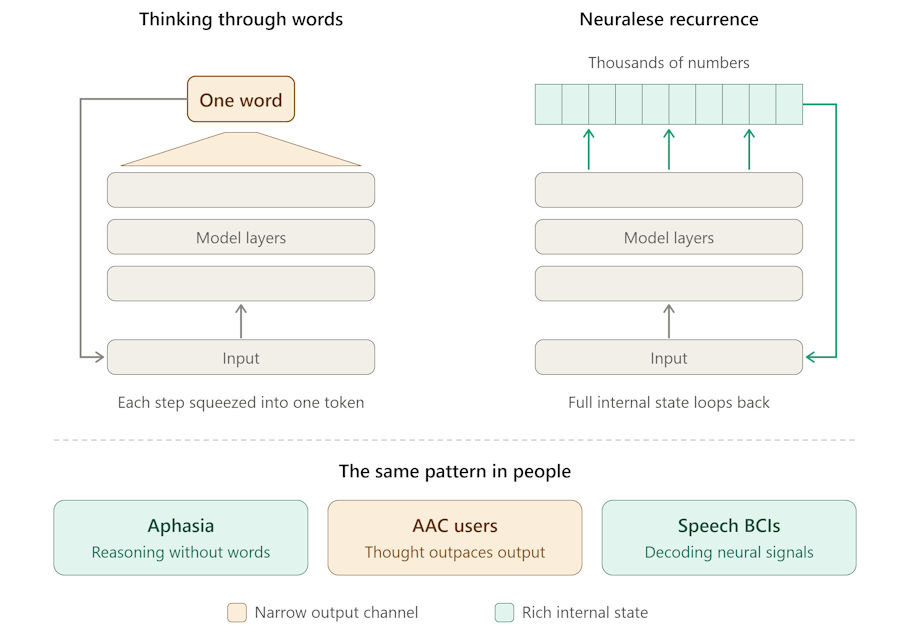
Here is the catch. Information flows upward through the layers within one step, and later positions can look back at earlier ones through the attention mechanism, but only layer by layer. The deep, late-layer understanding reached while producing one token cannot feed back into the early layers for the next token except by way of the token itself. Every time the model commits to a word, its richest conclusions have to be compressed into that word.
The numbers make the squeeze vivid. A vocabulary of about 100,000 tokens means each token can carry at most roughly 17 bits of information (the base-2 logarithm of 100,000 is about 16.6). A single residual stream vector with thousands of dimensions, each stored as a 16-bit number, has a nominal capacity tens of thousands of times larger. Not all of that capacity carries useful meaning, but the gap is enormous.
Chain of Thought as a Workaround
Researchers discovered that asking models to write out intermediate steps improves their reasoning (Wei et al., 2022). This chain-of-thought approach lets a model use its own text as a scratchpad. It works, but it forces all extended thinking through the narrow token channel. Neuralese recurrence proposes a wider pipe: feed the vector back, skip the word.
How Researchers Are Building It
Coconut: Continuous Thought
The best-known experiment is Coconut, short for "Chain of Continuous Thought," from researchers at Meta (Hao et al., 2024). Instead of decoding its final hidden state into a token, the model feeds that hidden state straight back in as the next input. The team trained it gradually, replacing written reasoning steps with these "continuous thoughts" one stage at a time.
The results were striking in a specific way. On logic puzzles that require exploring several possible paths, Coconut matched or beat ordinary chain-of-thought while generating far fewer tokens. Analysis suggested a single continuous thought could hold several candidate next steps at once, behaving somewhat like a breadth-first search - something a single committed word cannot do.
Recurrent Depth: Thinking Longer Inside
A related approach loops computation vertically rather than across tokens. Geiping and colleagues (2025) built a 3.5-billion-parameter model with a recurrent block that can be run again and again at test time. Given a hard problem, the model iterates internally before answering. With enough iterations, it performed like a much larger model on some reasoning benchmarks, without writing a single intermediate word.
Hints That Hidden Thinking Already Happens
Even standard transformers can do some computation that never appears in their text. Pfau, Merrill, and Bowman (2024) showed that on certain constructed tasks, models trained to emit meaningless filler tokens (literally rows of dots) could still solve problems that required intermediate steps. The dots carried no meaning to a reader, but the computation happened anyway in the hidden layers.
Why Safety Researchers Are Paying Attention
Written chain of thought has an accidental benefit: humans can read it. If a model plans something harmful or misreads a task, its reasoning trace often reveals the problem. A cross-institution group of researchers argued that this monitorability is "a new and fragile opportunity" for AI safety, and warned that moving toward latent reasoning could close that window (Korbak et al., 2025).
The word "fragile" is well chosen. Written reasoning is not a perfect mirror of what a model computes - Turpin and colleagues (2023) showed that stated explanations can omit factors that actually drove an answer. Still, an imperfect window beats a wall. Neuralese recurrence would shift reasoning into vectors that, like the agent messages Andreas and colleagues studied, require specialized interpretability tools to decode at all.
Interpretability: the research field that tries to explain what is happening inside a neural network in terms humans can understand, rather than judging the system only by its outputs.
Timescales: How the Pattern Unfolds
Neuralese recurrence looks different depending on the clock you use, and keeping the scales straight prevents a lot of confusion.
- Milliseconds: within a single forward pass, information climbs through the layers. Recurrent depth approaches loop here.
- Seconds to minutes: across a reasoning episode, a model produces a sequence of steps. Coconut-style methods pass vectors along this axis instead of words.
- Months: across training, models learn what their hidden states mean. A latent code shaped only by reward pressure can drift away from anything human-like, which is exactly what made early neuralese hard to translate.
- Years: across the field, the tradeoff between capability and transparency becomes a policy question. Whether labs adopt latent reasoning at scale is still an open decision.
The same underlying pattern - rich state compressed through a narrow channel, or allowed to flow freely - repeats at each scale. That recurring shape is also where disability research enters the picture.
The Disability Connection
To be clear about scope: neuralese recurrence is an AI architecture concept, not a medical one. But the questions it raises have been studied directly in people with disabilities, and that research offers some of the clearest evidence we have about the relationship between thought, language, and the channels that carry them.
Thought Does Not Require Words: Evidence From Aphasia
The whole premise of neuralese recurrence is that reasoning can happen without language. Human neuroscience strongly supports that premise, and much of the evidence comes from people with aphasia - language impairment, usually after stroke.
Aphasia: a disorder affecting the ability to produce or understand language, typically caused by damage to language areas of the brain. It affects language, not intelligence.
Fedorenko and Varley (2016) reviewed studies of people with severe, even global, aphasia who could still perform arithmetic, reason logically, understand other people's beliefs, play chess, and appreciate music. Brain imaging told the same story in healthy people: the brain's language network stays largely quiet during math and logic tasks. Fedorenko, Piantadosi, and Gibson (2024) went further, arguing in Nature that language is primarily a tool for communication rather than for thought itself.
This reframes the AI debate usefully. A model reasoning in words is, in a sense, doing something humans mostly do not do. People with aphasia demonstrate every day that a mind can think well while its word channel is compromised - a living refutation of the idea that thought and speech are the same thing.
Human Minds Differ in Their Inner Format
Human thinking also varies enormously in the format it takes. Nedergaard and Lupyan (2024) proposed the term anendophasia for people who report little or no inner speech. In their experiments, these individuals performed worse on verbal memory and rhyme judgments but just as well on many other tasks - evidence that people reach similar conclusions through different internal formats.
Similarly, aphantasia, the absence of voluntary visual imagery, was named by Zeman, Dewar, and Della Sala (2015). Many people with aphantasia do not consider it a disability at all; it is better described as a variation in cognition. At the other end, Temple Grandin (1995) described her autistic thinking as primarily visual, "thinking in pictures," while stressing in later writing that autistic people think in varied ways and not all are visual thinkers.
The lesson for AI is humbling. There is no single natural "format of thought" that machines should be forced into. Neurodiversity is, among other things, proof that minds can run on different internal codes and still arrive at sound reasoning.
Decoding Real Neural Activity: Speech Neuroprostheses
The most literal meeting point between "neuralese" and disability lies in brain-computer interfaces that translate neural signals into language. In 2023, two landmark studies in Nature restored communication to people who had lost speech. Willett and colleagues (2023) decoded attempted speech from Pat Bennett, who has amyotrophic lateral sclerosis (ALS), at 62 words per minute. Metzger and colleagues (2023) enabled Ann Johnson, paralyzed by a brainstem stroke, to communicate at 78 words per minute through text and a digital avatar. A year later, Card and colleagues (2024) reported about 97.5 percent accuracy for Casey Harrell, a man with ALS, in the New England Journal of Medicine.
These systems used recurrent neural networks to translate patterns of brain activity into sounds and words. The parallel with Andreas and colleagues' original work is close: in both cases, researchers face a rich numeric signal that carries meaning and must build a translator to turn it into human language. The key difference is purpose. Speech neuroprostheses decode a human's intent to give that person back a voice, while AI neuralese translation tries to recover what a machine is doing so humans can oversee it.
The Bandwidth Gap
People who use augmentative and alternative communication (AAC) - devices, symbol boards, or eye-gaze keyboards - know the token bottleneck from the inside. Their thoughts are as fast and complex as anyone's, but the output channel is slow, often a small fraction of the roughly 150 words per minute of ordinary conversation. Many AAC users describe the frustration of compressing a full idea into a few selected words, knowing listeners will judge the idea by its compressed form.
That is the same structural problem transformers face, seen from a human angle. It carries a practical warning: people routinely underestimate minds whose output is narrow. Speech neuroprostheses are, in effect, an effort to widen the pipe for humans, just as neuralese recurrence is an effort to widen it for machines.
Transparency and Trust in Assistive AI
Disabled people are increasingly heavy users of AI - for AAC word prediction, image descriptions for blind users, captioning, and cognitive support. When a system's reasoning is visible, a user or caregiver can catch errors. If future assistive tools reason in neuralese, that check disappears. For someone who relies on an AI to describe a medication label or draft a message to a doctor, the ability to ask "why did you say that?" and get an honest, readable answer is not an abstract safety concern. It is a matter of daily autonomy.
What Neuralese Recurrence Is Not
A few clarifications prevent common misreadings. It is not a secret language that models invent to hide things from people; it is a numeric representation that happens to be unreadable. It is not the same as the older recurrent neural networks, which passed state between words but still read and produced one token at a time. And it is not yet standard practice in widely deployed chatbots, which still largely reason through visible or summarized text. The concept describes a direction of research and a set of tradeoffs, not a finished technology.
Seeing the Whole Pattern
Step back and one shape repeats across every scale discussed here: a rich internal state, a narrow output channel, and a question of who gets to see inside. In a transformer, it is the residual stream squeezed into a token. In a person with aphasia, it is intact reasoning behind impaired language. In an AAC user, it is fluent thought behind a slow keyboard. In a speech neuroprosthesis, it is neural activity finally translated into words.
Neuralese recurrence asks whether machines should keep thinking through the narrow channel for the sake of human oversight, or be freed from it for the sake of capability. Disability research does not answer that question, but it sharpens it. It shows that thought without words is real and powerful, that narrow output does not mean narrow minds, and that the tools we build to translate hidden signals - whether from a brain or from a machine - decide who is understood and who is left unheard.
Frequently Asked Questions
Do any public AI chatbots use neuralese recurrence right now?
Widely used chatbots still mainly reason through text, either shown to the user or summarized. Latent reasoning methods remain largely experimental, though AI companies do not always disclose every architectural detail of their newest models.
Is neuralese the same thing as machine code or binary?
No. Machine code is a fixed set of instructions designed by engineers, while neuralese is a learned pattern of numbers whose meaning emerges during training and is not defined in advance by anyone.
Could researchers translate neuralese back into plain language?
Partially. Interpretability tools can sometimes identify concepts or features inside a model, but translations are incomplete and there is no guarantee that every internal step has a clean equivalent in human language.
Does the human brain work like neuralese recurrence?
There are loose similarities, since the brain is full of feedback loops and much human thinking happens without words. However, biological neurons, chemistry, and brain organization differ greatly from artificial networks, so the comparison is an analogy rather than an equivalence.
Would neuralese recurrence make AI assistive technology better for disabled users?
It might make tools faster or more capable, but it could also make them harder to question when they make mistakes. The overall benefit would depend on whether developers pair it with strong ways to explain and verify the output.
Can a person with ALS or locked-in syndrome get a speech brain-computer interface today?
These systems are still mostly available through clinical trials at research centers. People interested in participating can ask a neurologist or search clinical trial registries for implanted brain-computer interface studies.
Why do some researchers want AI to keep reasoning in words even if it is slower?
Readable reasoning lets people spot errors, bias, or unsafe plans before a system acts on them. Many safety researchers consider that visibility worth some loss in efficiency, at least until better inspection tools exist.
Is inner speech necessary for good reasoning in people?
Research suggests it is not required for most reasoning. People with little or no inner voice perform normally on many tasks, although inner speech appears to help with certain verbal memory and sound based judgments.
References:
Andreas, J., Dragan, A., and Klein, D. (2017). Translating neuralese. Proceedings of the 55th Annual Meeting of the Association for Computational Linguistics.
Card, N. S., Wairagkar, M., Iacobacci, C., Hou, X., Singer-Clark, T., Willett, F. R., Kunz, E. M., Fan, C., Vahdati Nia, M., Deo, D. R., Srinivasan, A., Choi, E. Y., Glasser, M. F., Hochberg, L. R., Henderson, J. M., Shahlaie, K., Stavisky, S. D., and Brandman, D. M. (2024). An accurate and rapidly calibrating speech neuroprosthesis. New England Journal of Medicine, 391(7), 609-618.
Elman, J. L. (1990). Finding structure in time. Cognitive Science, 14(2), 179-211.
Fedorenko, E., Piantadosi, S. T., and Gibson, E. A. F. (2024). Language is primarily a tool for communication rather than thought. Nature, 630, 575-586.
Fedorenko, E., and Varley, R. (2016). Language and thought are not the same thing: Evidence from neuroimaging and neurological patients. Annals of the New York Academy of Sciences, 1369(1), 132-153.
Geiping, J., McLeish, S., Jain, N., Kirchenbauer, J., Singh, S., Bartoldson, B. R., Kailkhura, B., Bhatele, A., and Goldstein, T. (2025). Scaling up test-time compute with latent reasoning: A recurrent depth approach. arXiv preprint arXiv:2502.05171.
Grandin, T. (1995). Thinking in pictures: And other reports from my life with autism. Doubleday.
Hao, S., Sukhbaatar, S., Su, D., Li, X., Hu, Z., Weston, J., and Tian, Y. (2024). Training large language models to reason in a continuous latent space. arXiv preprint arXiv:2412.06769.
Hochreiter, S., and Schmidhuber, J. (1997). Long short-term memory. Neural Computation, 9(8), 1735-1780.
Kokotajlo, D., Alexander, S., Larsen, T., Lifland, E., and Dean, R. (2025). AI 2027. AI Futures Project.
Korbak, T., Balesni, M., Barnes, E., Bengio, Y., Benton, J., Bloom, J., Chen, M., Cooney, A., Dafoe, A., Dragan, A., et al. (2025). Chain of thought monitorability: A new and fragile opportunity for AI safety. arXiv preprint arXiv:2507.11473.
Metzger, S. L., Littlejohn, K. T., Silva, A. B., Moses, D. A., Seaton, M. P., Wang, R., Dougherty, M. E., Liu, J. R., Wu, P., Berger, M. A., Zhuravleva, I., Tu-Chan, A., Ganguly, K., Anumanchipalli, G. K., and Chang, E. F. (2023). A high-performance neuroprosthesis for speech decoding and avatar control. Nature, 620, 1037-1046.
Nedergaard, J. S. K., and Lupyan, G. (2024). Not everybody has an inner voice: Behavioral consequences of anendophasia. Psychological Science, 35(7), 780-797.
Pfau, J., Merrill, W., and Bowman, S. R. (2024). Let's think dot by dot: Hidden computation in transformer language models. arXiv preprint arXiv:2404.15758.
Turpin, M., Michael, J., Perez, E., and Bowman, S. R. (2023). Language models don't always say what they think: Unfaithful explanations in chain-of-thought prompting. Advances in Neural Information Processing Systems, 36.
Vaswani, A., Shazeer, N., Parmar, N., Uszkoreit, J., Jones, L., Gomez, A. N., Kaiser, L., and Polosukhin, I. (2017). Attention is all you need. Advances in Neural Information Processing Systems, 30.
Wei, J., Wang, X., Schuurmans, D., Bosma, M., Ichter, B., Xia, F., Chi, E., Le, Q., and Zhou, D. (2022). Chain-of-thought prompting elicits reasoning in large language models. Advances in Neural Information Processing Systems, 35.
Willett, F. R., Kunz, E. M., Fan, C., Avansino, D. T., Wilson, G. H., Choi, E. Y., Kamdar, F., Glasser, M. F., Hochberg, L. R., Druckmann, S., Shenoy, K. V., and Henderson, J. M. (2023). A high-performance speech neuroprosthesis. Nature, 620, 1031-1036.
Zeman, A., Dewar, M., and Della Sala, S. (2015). Lives without imagery: Congenital aphantasia. Cortex, 73, 378-380.
Insights, Analysis, and Developments
Editorial Note: Neuralese recurrence is still mostly a research direction rather than a feature of the tools people use every day, which means the choices being made now about capability versus transparency will shape AI for years to come. For the disability community, the stakes are practical as well as philosophical: assistive AI is only as trustworthy as our ability to question it, and a system that reasons in unreadable vectors cannot easily explain itself to the person depending on it. At the same time, disability research offers the field something valuable - hard evidence that thought runs deeper than words, that slow output does not signal a slow mind, and that translating hidden signals is a responsibility as much as a technical challenge.
 Author Credentials: Ian is the founder and Editor-in-Chief of Disabled World, a leading resource for news and information on disability issues. With a global perspective shaped by years of travel and lived experience, Ian is a committed proponent of the Social Model of Disability, a transformative framework developed by disabled activists in the 1970s that emphasizes dismantling societal barriers rather than focusing solely on individual impairments. His work reflects a deep commitment to disability rights, accessibility, and social inclusion. To learn more about Ian's background, expertise, and accomplishments, visit his full biography.