Stephen Hawking, Disability, and the Limits of Motivation
Author: Lexx Che
Published: 23 Sep 2026 - Updated: 12 Oct 2026
Publication Type: Paper, Essay
Table of Contents:
Synopsis - Definition - Overview - FAQs - Insights, Updates - Related Content
Synopsis
This paper by systems builder and author Lexx Che looks past the familiar inspirational retelling of Stephen Hawking's life and asks a more practical question: what happens when a person keeps an exceptional ability to think while steadily losing the physical means to act on those thoughts. Drawing on his Operating in the Dark framework and Anti-Coaching methodology, Che traces how Hawking's communication moved from natural speech to a spelling card read through eyebrow movements, and later to computer-based word selection and synthesized speech, with the interface having to change each time his remaining motor control declined. The central finding is that motivation and discipline both have boundaries - neither can restore lost physical capacity - and that agency survived because an external architecture of technology, assistants, and colleagues kept rebuilding the path between Hawking's mind and the world. The piece is useful for people living with progressive conditions such as ALS, for caregivers, seniors, and assistive technology professionals, and for anyone in leadership who has been told to simply try harder when the real problem is structural, offering a clear-eyed alternative to the idea that willpower alone overcomes disability.*
At a Glance
- 1 - Discipline can organize available capacity, but it cannot manufacture capacity that no longer exists.
- 2 - Under severe constraint, the best choice is often the one that keeps movement, reversibility, or access to the next decision open.
- 3 - Organizations often mistake structural failure for an attitude problem, demanding more commitment when authority or information is missing.
- 4 - Acceptance of an irreversible condition is framed as informational accuracy rather than surrender, allowing action to be built around the fixed variable.
Topic Definition
- Decision Architecture Under Constraint
Decision architecture under constraint refers to the deliberate structuring of choices, resources, and support systems when a person or organization faces limits that cannot be removed through effort or willpower. Rather than asking how to increase motivation, it examines what actions remain structurally possible by looking at responsibility, authority, information, capacity, and available outside resources, then identifies which connections between them still allow meaningful action. In a disability context, this often means building around a fixed physical limitation using assistive technology, human assistance, and adapted workflows, so that a person's abilities can continue to reach the outside world even as some channels close. The approach favors options that preserve flexibility, reversibility, and access to future decisions, and it treats accurate acceptance of a permanent condition as a starting point for planning rather than a form of giving up.
Overview
Stephen Hawking Was Not a Motivation Story
Stephen Hawking's life is often reduced to a story of extraordinary motivation and perseverance. This article examines it through a different framework: what happens when intellectual capacity remains immense while the physical channels for action progressively disappear. Through the Operating in the Dark framework and the Anti-Coaching methodology, the article explores the limits of motivation and discipline, the role of technology and external support in extending human agency, and the emergence of decision architecture as a critical mechanism for operating under irreversible constraint.
What one radically constrained life reveals about responsibility, discipline, decision architecture, and the limits of motivation.
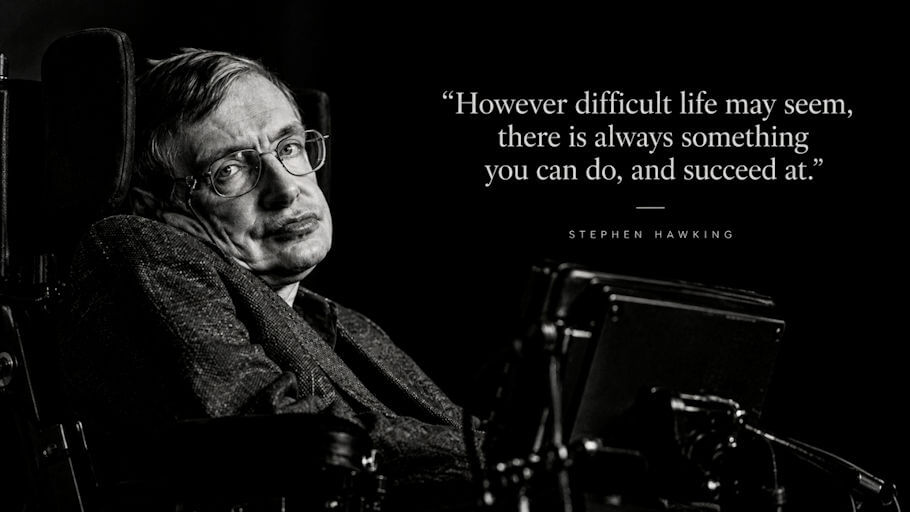
"However difficult life may seem, there is always something you can do, and succeed at."
- Stephen Hawking
Stephen Hawking is almost too easy to turn into a motivational story. A brilliant physicist receives a devastating diagnosis, loses control over much of his body, eventually loses natural speech, and continues working for decades. Compress the biography hard enough and it becomes the familiar formula: adversity, courage, perseverance, achievement. It is inspiring, easily understood, and almost useless as an explanation.
I am interested in a different question. What happens when a human being retains an extraordinary capacity to think while progressively losing the ordinary capacity to act? Hawking's life creates an unusually sharp case for examining a problem that appears in far less extreme forms across leadership, psychology, technology, organizations, and ordinary human life: what remains when circumstances cannot be negotiated with and motivation cannot remove the constraint?
This is where the language of my Operating in the Dark framework begins: responsibility under conditions in which information, resources, options, or control are incomplete. It is also one of the central problems addressed by my Anti-Coaching methodology. The purpose is not to generate a more persuasive reason to act. It is to understand what action remains structurally possible.
The Mind and the Interface
Hawking was diagnosed with motor neuron disease shortly after his twenty-first birthday. His physical capabilities progressively deteriorated while his intellectual work continued. After a severe case of pneumonia and a tracheostomy in the 1980s, he lost his natural speaking voice; for a period, communication could mean selecting letters through eyebrow movements as another person pointed to a spelling card. Computer systems later allowed him to select words and produce synthesized speech, and as his remaining motor control deteriorated, the interface itself had to keep changing.
Consider what that means operationally rather than emotionally. An idea can exist perfectly clearly inside a mind and still be unable to enter the external world. Between thought and consequence sits an interface: hands, speech, movement, tools, other people, machines. For most of us this interface is so abundant that we rarely notice it. We notice it when it breaks.
Hawking makes that interface impossible to ignore. The mind could work on singularities, black holes, space and time while the physical bandwidth connecting that mind with other human beings became extraordinarily narrow. Even conversation could require substantial time; Cambridge physicist Martin Rees recalled that as Hawking's communication became more restricted, sentences could take minutes to construct and he learned to economize with words.
A global mind was operating through an increasingly narrow gate.
That changes the nature of the problem.
Motivation Has a Boundary
Motivation is useful. It can initiate action, increase effort, redirect attention and help someone tolerate temporary difficulty. There is an enormous difference, however, between recognizing motivation as one variable in human behavior and treating it as the universal engine behind sustained performance.
Permanent constraint exposes that difference brutally. Motivation cannot restore a muscle that no longer responds. It cannot transform an inaccessible communication channel into an accessible one, manufacture physical capacity through belief, or make a progressively narrowing interface disappear. At some point, increasing psychological intensity against a structural limitation produces little more than wasted energy.
Hawking himself described how, after his tracheostomy, communicating through a spelling card was difficult enough for conversation, let alone writing a scientific paper. Technology changed the available action space: a computer program allowed him to select words, and later systems connected his remaining movement to a speech synthesizer. This was not abstract resilience. A previously blocked path between cognition and the external world was being reconstructed.
The distinction matters well beyond disability. Organizations frequently treat structural failure as an attitude problem. Leaders demand greater commitment when authority is missing, teams increase effort when information is unavailable, founders push harder when the operating model has stopped scaling, and individuals blame themselves for insufficient motivation while their actual environment makes the expected action unsustainable.
Pressure can increase while agency decreases.
More motivation does not automatically close that gap.
Discipline Is Stronger - and Still Insufficient
Discipline is a more durable concept because it reduces dependence on emotional state. You perform an action because it belongs to an established system rather than because you happen to feel sufficiently inspired. In Operating in the Dark, discipline matters precisely because unstable environments cannot be allowed to dictate every decision.
Yet discipline also has a boundary. It can organize available capacity. It cannot manufacture unavailable capacity.
If an executive lacks critical information, discipline may ensure that a decision is made on schedule, but it cannot make the missing information suddenly exist. If a team carries responsibility without authority, disciplined execution may improve local performance while leaving the structural contradiction untouched. If the physical mechanism required for an action disappears, repeating the instruction more rigorously becomes absurd.
This is where responsibility becomes more demanding than perseverance. Responsibility means confronting the real configuration of the system, including the parts we dislike. It requires distinguishing a difficult action from an impossible one, a temporary bottleneck from a permanent constraint, an emotional resistance from a missing capability.
Discipline asks whether you will continue.
Responsibility eventually asks whether continuing in the same form still makes sense.
When Action Must Be Re-Architected
Hawking's working life became increasingly dependent on an architecture extending beyond his body. Technology replaced functions that had disappeared. Assistants and colleagues became part of the communication environment. Hardware and software mediated the translation of thought into language. When one control mechanism became unusable, another had to be developed around whatever physical capacity remained.
It would be inaccurate to turn this architecture into another story of individual heroism. Hawking did not personally create every technological system, medical intervention or support structure around him. That is precisely the point. Agency does not have to reside entirely inside one body to remain agency; external systems can become part of the mechanism through which an individual continues to produce consequences.
The usual language of independence becomes less useful here. A system can contain profound dependency and still generate extraordinary output. What matters is whether its dependencies are understood, available and connected to the objective.
This is close to what I describe in the Anti-Coaching methodology as intervention at the level of architecture. Instead of asking how to make a person want an outcome more intensely, examine responsibility, authority, information, capacity, constraints and available external resources. Then determine which connections between them still permit action.
Sometimes the correct intervention is psychological.
Sometimes it is technological.
Sometimes it is structural.
Confusing them is expensive.
Decision Architecture Under Constraint
A decision made in abundance can hide weak reasoning. There may be enough money, time, people, mobility, information or alternative routes for several mistakes to remain survivable. Severe constraint removes that protection.
The available decision space contracts. Some paths disappear completely; others become disproportionately valuable because they are among the few that remain. The task changes from selecting the ideal option to identifying which option still preserves movement, information, reversibility or access to the next decision.
This is what I call operating in the dark. Darkness does not necessarily mean ignorance. It means acting when some variable required for comfortable certainty is unavailable and may remain unavailable.
Under those conditions, responsibility cannot be postponed until clarity arrives. Decisions still have consequences. Resources still decay. Windows close. Other actors move. The operator has to separate what is unknown from what is unknowable, what is constrained from what is merely inconvenient, and what must be accepted from what can still be redesigned.
Hawking represents an extreme version of this architecture. The set of physically available actions kept narrowing, while the value of the remaining channels increased. Communication technology was therefore more than convenience; it was infrastructure connecting intellectual capacity to external consequence.
When options approach zero, architecture matters more, not less.
Technology as an Extension of Agency
There is another reason Hawking belongs in a contemporary discussion rather than only in the history of twentieth-century physics. His life makes visible a relationship between human beings and technology that is now becoming central to debates about artificial intelligence, automation, augmentation and the future of work.
Technology is often discussed as a substitute for human capability: the machine performs something the human previously performed. Hawking presents another configuration. Technology can become the interface through which an otherwise inaccessible human capability enters the world.
The distinction has consequences. A speech synthesizer does not explain Hawking's physics; the intellectual work remained his. Yet without an effective communication interface, intellectual capacity could become trapped behind an increasingly severe physical bottleneck. Technology altered the conversion rate between internal capacity and external action.
This same principle appears in less dramatic systems. Software can reduce coordination cost. AI can expand analytical or communicative capacity. Automation can remove low-value operations from a constrained team. A well-designed information system can allow one person to control a process that previously required several layers of translation.
The important question is not whether technology makes humans stronger in some abstract sense.
It is which constraint the technology removes - and what becomes possible after its removal.
The Psychology of an Unchangeable Condition
Behavioral language often assumes that an obstacle can eventually be overcome. Goals are adjusted, habits reinforced, incentives redesigned, beliefs challenged. Much of this is useful when the underlying environment remains sufficiently negotiable.
Some conditions are not negotiable.
That fact changes the psychological problem because endless resistance to an irreversible constraint consumes resources without altering reality. Acceptance in this context is not surrender or passivity. It is informational accuracy: this variable is currently fixed, therefore action must be constructed around it.
The Anti-Coaching methodology begins from that harder ground. Before attempting to increase motivation, it asks what the system actually permits. Before interpreting stalled action as weakness, it examines whether responsibility, authority, information and capacity are aligned. Before demanding perseverance, it asks whether the route being preserved still leads anywhere.
This removes some comforting explanations. It also removes unnecessary shame. A system failing because its architecture is impossible does not become viable because the people inside it are told to believe harder.
Reality does not negotiate with rhetoric.
It does, however, leave constraints to map.
Responsibility Without the Promise of Relief
Much of modern performance culture contains an implicit bargain: endure pressure now and eventually pressure will end. Work harder until the launch. Survive the crisis. Push through the quarter. Recover after the transformation.
Some environments never provide that relief. The crisis mutates instead of ending. One constraint disappears and another replaces it. The temporary operating mode becomes the permanent one.
My Responsibility Series was built around this territory because conventional advice weakens rapidly once instability stops being exceptional. Responsibility under persistent pressure is not the heroic acceptance of unlimited burden. It is the continuous determination of what you control, what you influence, what you must delegate, what requires external capacity, and what reality has already removed from the decision space.
Hawking lived for decades inside a condition that offered no plausible return to an earlier physical baseline. Yet his professional life did not consist of one enormous act of endurance repeated every morning. The surrounding architecture changed as his available capabilities changed. His work continued through successive configurations of human assistance, technology, communication and increasingly scarce physical control.
That is a much more serious model than inspiration.
It requires no mythology.
What Hawking Actually Shows Us
There is a temptation to end here with the familiar lesson that anyone can achieve anything. Hawking's life supports no such claim. Different people possess different capacities, resources, support systems, opportunities and constraints; using an exceptional life to shame ordinary people into greater effort would reproduce exactly the motivational simplification this analysis rejects.
The more useful lesson is narrower and harder. Human agency is not identical to freedom from constraint. Agency can survive inside severe constraint when the remaining possibilities are identified accurately and an architecture is constructed around them.
This applies to a scientist losing physical capabilities, but the underlying principle travels. It applies to an executive operating with incomplete information, a company whose resources have collapsed, a team working under institutional restrictions, a founder whose original model no longer fits reality, and a person facing circumstances that determination alone cannot alter.
The first task is not to become more motivated.
The first task is to stop lying about the system.
Map the constraint. Establish responsibility. Identify remaining capacity. Bring external resources into the architecture where necessary. Protect the channels that still produce consequence. Make the next decision from reality rather than from the version of reality you would prefer to inhabit.
Motivation may return. Discipline may keep the machinery moving. Neither should be asked to perform the work of architecture.
Stephen Hawking spent much of his adult life with fewer physical options than almost anyone reading this article. Yet between an extraordinarily capable mind and the external world, a changing system continued to preserve a path for action. The path became narrower. The output did not become meaningless.
That is the point at which the motivational story ends and the more difficult question begins:
When reality has removed most of your options, can you still recognize the ones it has left?
More frameworks for decision-making under incomplete information, persistent pressure, and responsibility can be found in my Responsibility Series - Operating in the Dark.
Author Bio
System Builder and Narrative Architect with nearly 20 years of experience, author, independent journalist, and researcher with Ukrainian roots. His work spans more than 1,000 projects across strategy, design, technology, digital ecosystems, organizational transformation, identity, and decision architecture. He is the developer of the Anti-Coaching methodology and author of the Responsibility series and other books exploring uncertainty, power, communication, and human agency.
His research also extends into independent journalism, with articles published across international media. He is listed as a journalist and author in Muck Rack’s global media-intelligence database, while his published work is represented in EBSCOhost’s international research and bibliographic infrastructure.

Email: digital.lexx@gmail.com
LinkedIn: https://www.linkedin.com/in/lexx-che/
Projects: https://www.behance.net/deepdgtl
Books / Website: https://www.amazon.com/stores/Lexx-Che/author/B0FV36JBWS
Muck Rack: https://muckrack.com/lexx_che
Frequently Asked Questions
NOTE: Researched FAQs by Disabled World (DW)
What type of motor neuron disease did Stephen Hawking have?
Stephen Hawking had amyotrophic lateral sclerosis, commonly known as ALS or Lou Gehrig's disease in North America. It is the most common form of motor neuron disease and progressively damages the nerve cells that control voluntary muscle movement.
How long did Stephen Hawking live after his ALS diagnosis?
Hawking was diagnosed at age 21 in 1963 and lived until March 2018, surviving more than five decades with the condition. This is far longer than typical, as many people with ALS live between two and five years after diagnosis.
What is augmentative and alternative communication?
Augmentative and alternative communication, often shortened to AAC, covers any method that supplements or replaces spoken language. It ranges from low-tech tools such as letter boards and picture cards to high-tech speech-generating devices controlled by touch, switches, or eye movement.
Can people with ALS today use eye-tracking to communicate?
Yes, eye-gaze systems allow users to select letters, words, and phrases on a screen simply by looking at them, and the device then speaks the text aloud. These systems are widely used by people with ALS once hand and speech control become limited.
What is voice banking and why is it recommended after an ALS diagnosis?
Voice banking is the process of recording a person's own voice while they can still speak so it can later be used to create a personalized synthetic voice. Many ALS clinics recommend doing it early so a future speech device sounds like the user rather than a generic voice.
Are speech-generating devices covered by insurance?
In the United States, Medicare and many private insurers classify speech-generating devices as durable medical equipment and may cover them with a speech-language pathologist evaluation and physician prescription. In Canada, provincial assistive device programs often help cover the cost, though eligibility rules vary by province.
What is the difference between the medical model and the social model of disability?
The medical model treats disability mainly as a condition within the individual that should be treated or fixed. The social model focuses on barriers in the environment, attitudes, and systems, arguing that removing those barriers is key to full participation.
Why do some disability advocates criticize inspirational stories about disabled people?
Many advocates argue that such stories often present disabled people as objects of inspiration for nondisabled audiences rather than as ordinary people with full lives. Critics say this framing can hide real barriers like inaccessible spaces, discrimination, and lack of support.
Anti-Coaching: Beyond the Limit
Read More From the Series:
- Vincent van Gogh: What Reproduction Cannot Preserve: An artist's essay on why Vincent van Gogh's original paintings and drawings reveal brushstroke, texture, and scale that digital reproductions cannot preserve.
- Beethoven's Hearing Loss and the Architecture of Feedback: Beethoven's progressive hearing loss stripped away the feedback his composing and performing relied on, while notation, memory, and sketches kept his work going.
Insights, Analysis, and Developments
Editorial Note: Disability communities have pushed back for years against what is often called inspiration porn - the habit of turning disabled lives into feel-good lessons for nondisabled audiences - and Che's essay lands squarely on the right side of that debate by refusing to use Hawking to shame anyone into working harder. What makes the argument worth reading is its insistence that dependency and agency are not opposites; Hawking's decades of scientific output relied on a shifting network of machines, medical care, and people, and that network was part of how his agency operated rather than a footnote to it. For people managing progressive illness, for families arranging care, and for anyone who has been told a lack of effort is the problem when the real obstacle is access, the takeaway is practical and humane: map what cannot change, protect the channels that still work, and bring in outside help without treating it as a personal failure.*
* Editorial additions by Ian C. Langtree.