Effective Altruism and Disability: A Critical Guide
Author: Ian C. Langtree - Writer/Editor for Disabled World (DW)
Published: 4 Aug 2026 - Updated: 20 Sep 2026
Publication Type: Paper, Essay
Table of Contents:
Synopsis - Definition - Overview - FAQs - Insights, Updates - Related Content
Synopsis
Effective altruism began with a deceptively simple question - if we are going to give, why not give where it does the most good - and grew within two decades into a global network of researchers, pledgers and grantmakers moving hundreds of millions of dollars a year. Its methods are rigorous, its results in global health are substantial, and its central insight about the vast spread between mediocre and excellent charity is difficult to argue with. Yet the same machinery that makes the movement powerful, the reduction of unlike goods to a single comparable number, has drawn sustained fire from disability scholars and advocates who argue that the numbers quietly encode assumptions about whose lives count and how much. This paper sets out what effective altruism actually claims, how its measurement tools work, where they converge with disability interests, and where the collision is real rather than rhetorical.
At a Glance
- 1 - Peter Singer's 1972 essay on famine relief supplies effective altruism with its founding moral argument.
- 2 - GiveWell directed roughly 397 million dollars to high-impact programs in 2024, most of it to malaria prevention.
- 3 - Disability advocate Ari Ne'eman argued in 2017 that effective altruism and disability rights are incompatible, a charge the movement still debates.
- 4 - The Global Burden of Disease project rebuilt its disability weights in 2010 using public surveys across several countries rather than relying on expert panels alone.
Topic Definition
- Effective Altruism
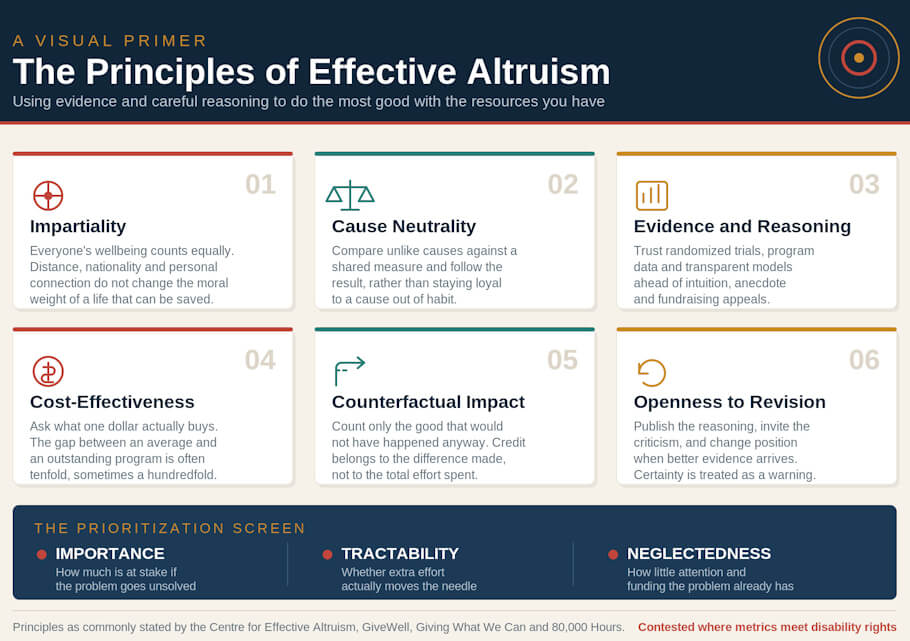
Effective altruism is a philosophy and a practical movement that applies evidence, careful reasoning and explicit cost-effectiveness analysis to the question of how to help others as much as possible with whatever resources a person controls, whether that is money, career time or influence. It is distinguished from ordinary charitable giving by three commitments: impartiality, meaning a life saved far away counts equally to one saved nearby; cause neutrality, meaning donors compare unlike causes against a shared measure rather than defaulting to personal attachment; and a willingness to follow the resulting analysis even when it recommends something counterintuitive. In practice this has produced organizations such as GiveWell, Giving What We Can, 80,000 Hours and Open Philanthropy, and has concentrated funding on measurable global health interventions, animal welfare and long-range catastrophic risk.
Overview
Effective Altruism: The Idea in One Breath
Imagine you are walking past a shallow pond and see a small child drowning. You could wade in and pull the child out, but you would ruin your shoes. Almost nobody hesitates. Now imagine the child is ten thousand miles away, the cost of rescue is roughly the price of those shoes, and the rescue is mediated by a bank transfer rather than by wet trousers. Peter Singer built an entire moral tradition out of the observation that most of us treat these two cases very differently, and that we struggle to explain why distance and mediation should matter morally (Singer, 1972).
Effective altruism is what happened when that argument met spreadsheets. It is a philosophy and a social movement holding that we should use careful evidence and explicit reasoning to work out how to benefit others as much as possible with the resources we have, and then act on that reasoning. The word "effective" is doing heavy lifting. It signals a claim that the difference between an average charitable intervention and an outstanding one is not marginal but often enormous - frequently a factor of ten, sometimes a factor of a hundred - and that ignoring this difference is itself a moral failure.
Cause neutrality - the willingness to compare unlike causes against a common measure, and to move resources toward whichever does the most good, rather than staying loyal to a cause because of personal history or emotional attachment.
That single commitment - cause neutrality - is where effective altruism becomes genuinely radical, and it is also where it collides most violently with disability rights. Hold onto it. Nearly every dispute we will examine grows from it.
How the Movement Assembled Itself
Effective altruism did not arrive fully formed. It accreted from several independent projects that discovered they were asking the same question.
GiveWell, founded in 2007 by two former hedge fund analysts, Holden Karnofsky and Elie Hassenfeld, began as an attempt to answer a mundane-sounding question: which charity actually does the most good per dollar? The answer, they found, was almost never published anywhere. Charity evaluators of the era rated organizations on overhead ratios, which measure administrative thrift rather than results. GiveWell instead demanded randomized evidence, program-level cost data, and room for more funding.
In 2009, the Oxford philosophers Toby Ord and William MacAskill launched Giving What We Can, built around a public pledge to donate at least ten percent of lifetime income to the most effective charities the donor can identify. By early 2026 that community had grown past ten thousand pledgers in more than one hundred countries, with recorded donations exceeding half a billion dollars (Giving What We Can, 2026). Two years later came 80,000 Hours, which reframed the question from money to time, arguing that the roughly eighty thousand working hours in a career are the largest philanthropic asset most people control. The Centre for Effective Altruism was established in 2011, and the phrase "effective altruism" itself was settled on around the same time, chosen partly because it was bland enough not to prejudge which causes mattered.
Open Philanthropy, which grew out of GiveWell and became independent, now functions as the movement's largest grantmaking body. GiveWell alone directed approximately 397 million dollars to high-impact programs in 2024, with roughly three quarters of that flowing to four top charities, the largest single share going to the Against Malaria Foundation for insecticide-treated bed nets (GiveWell, 2025).
The Machinery: How Effective Altruists Decide
The importance, tractability, neglectedness framework
Most cause prioritization in effective altruism runs through a three-part screen popularized by 80,000 Hours. Importance asks how much suffering or lost value is at stake if the problem goes unsolved. Tractability asks whether additional effort actually moves the needle. Neglectedness asks how many resources are already committed, on the economic logic that the tenth million dollars into a crowded field usually buys less than the first million into an empty one.
The framework is elegant, and it is also where the first structural tension with disability appears. Neglectedness rewards problems nobody is working on. But disability services in wealthy countries are neither neglected nor cheap, which pushes them steadily down the priority list even when the people affected are among the worst off.
The measuring stick
To compare a bed net against a cataract operation against a cash transfer, you need a common unit. Health economics supplies two.
QALY (quality-adjusted life year) - one year of life lived in full health equals 1.0; a year lived in a worse health state is discounted toward 0.
DALY (disability-adjusted life year) - the mirror image, counting health lost. It sums years of life lost to early death plus years lived with disability, the latter multiplied by a "disability weight" between 0 and 1.
The DALY was developed by Christopher Murray and Alan Lopez for the World Bank's 1993 World Development Report and became the backbone of the Global Burden of Disease studies (Murray and Lopez, 1996). It is one of the most consequential measurement instruments ever built in public health. It is also, as we will see, the precise point where effective altruism inherited a controversy it did not create.
Where Disability Enters the Picture
The World Health Organization estimates that about 1.3 billion people, roughly sixteen percent of the world's population, live with significant disability, and that systemic health inequities mean many die up to twenty years earlier than people without disabilities, with up to double the risk of conditions including asthma, depression, diabetes, obesity and stroke (World Health Organization, 2022). By any importance test, this is an enormous problem.
So why is disability almost never listed alongside global health, animal welfare, biosecurity and artificial intelligence safety as a headline effective altruism cause? The answer reveals something structural about how the movement thinks, and it is worth unpacking slowly.
The example that started the argument
In Doing Good Better, MacAskill contrasted the cost of training and placing a guide dog for a blind person in a wealthy country - tens of thousands of dollars - with the cost of trachoma surgery in a low-income country, which runs to a few tens of dollars per operation. His conclusion was that if your goal is to reduce blindness and its burdens, the surgery does vastly more per dollar (MacAskill, 2015).
The arithmetic is defensible, though later fact-checking within the movement noted that the surgery figure needs care: only a fraction of trachoma operations avert full blindness, so the honest comparison is closer than the headline suggests. But the deeper objection from disability scholars was never about arithmetic. It was about what the example communicates: that a blind person's assistive technology is a luxury, that independence aids are a sentimental indulgence, and that the appropriate response to disability is prevention and cure rather than access and accommodation.
The Metric Problem: What a Disability Weight Actually Encodes
Here we reach the analytical heart of the matter. To assign blindness a disability weight, someone must decide how much worse a year of life with blindness is than a year without it. Early Global Burden of Disease weights came from expert panels using a technique called the person trade-off. Following sustained criticism, the 2010 revision rebuilt the weights using paired-comparison surveys of ordinary people across multiple countries plus a large open web survey (Salomon et al., 2012). Blindness, on the resulting 0-to-1 scale, sits well below the midpoint, in the region of 0.19.
Three objections recur in the disability studies literature, and they are not equivalent.
Objection one: the respondents are usually not disabled
Weights are typically elicited from general populations imagining a health state rather than from people living in it. Imagination is a poor instrument here. People systematically overestimate how much a permanent impairment will reduce their long-run wellbeing, a pattern psychologists call the impact bias.
Objection two: the disability paradox
Albrecht and Devlieger (1999) found that more than half of people with serious and persistent disabilities rated their own quality of life as good or excellent - a result so at odds with outside expectation that they named it a paradox. The finding has been replicated in various forms across three decades. If self-reported wellbeing among disabled people is high and externally assigned weights are low, at least one of the two is measuring something other than wellbeing.
Objection three: the weights absorb social conditions
When a survey respondent imagines blindness, what they are really pricing is blindness in a world built for sighted people - inaccessible transport, employment discrimination, stigma. That penalty is real, but it is a property of the environment, not the body. Encoding it into a biological weight makes an oppression look like a symptom. This is the insight behind the social model of disability, articulated by the Union of the Physically Impaired Against Segregation in 1976 and given its name by Michael Oliver in the early 1980s.
Social model of disability - the distinction between impairment (a bodily difference) and disability (the exclusion produced when society is organized around non-disabled bodies). The wheelchair user is not disabled by the wheelchair; they are disabled by the staircase.
To be fair to the metric's designers, Murray and colleagues have repeatedly insisted that a disability weight measures health loss, not the worth of a person or the quality of their life. That defense is philosophically coherent. It is also, in practice, routinely forgotten the moment the numbers enter a funding decision.
Mere Difference, Bad Difference, and Why the Distinction Matters
Analytic philosophy has sharpened this dispute into a clean fork. Elizabeth Barnes defends what she calls the mere-difference view: that disability is a way of having a minority body, comparable to being in a sexual or racial minority, and is not intrinsically bad for wellbeing (Barnes, 2016). The opposing bad-difference view holds that disability, holding social conditions fixed, does make a life go worse.
The stakes are not academic. If mere-difference is correct, then a cost-effectiveness model that treats averting a disability as a benefit is not measuring welfare; it is smuggling in a value judgment that disabled people themselves largely reject. If bad-difference is correct, prevention has real welfare value and the metric is roughly doing its job, though it may still be badly calibrated.
Notice that most people, including most disability advocates, hold positions between these poles, and that the answer may differ by condition. Chronic pain and severe untreated depression look like bad-difference cases to almost everyone. Deafness within a signing community looks to many like a mere difference. A framework that applies one answer uniformly across all impairments will be wrong somewhere.
The Singer Problem
No account of this relationship is honest without addressing Peter Singer directly. The philosopher whose 1972 essay supplies effective altruism's founding argument also argued in Practical Ethics that infanticide of severely impaired newborns can be permissible in some circumstances, and he has criticized aspects of disability rights legislation. Disability activists, including the group Not Dead Yet, protested his 1999 appointment at Princeton, and protests have followed him to effective altruism events since.
Two things are true at once, and holding both is necessary for clear thinking. First, Singer's views on infanticide and moral status are not entailed by effective altruism - one can accept the drowning-child argument and reject everything else Singer has written. Most effective altruists do. Second, the fact that the movement's most visible philosophical patron holds those views is not a coincidence of biography; it reflects a shared underlying framework of preference utilitarianism in which moral status tracks psychological capacities. Eva Kittay's work on cognitive disability represents the most sustained philosophical pushback on exactly this point, arguing that theories keyed to rationality and self-awareness systematically fail people with profound intellectual disabilities and the networks of care that sustain them (Kittay and Carlson, 2010).
The Incompatibility Charge and the Replies
In 2017 the disability rights advocate Ari Ne'eman, founder of the Autistic Self Advocacy Network and later a federal disability policy official, published an essay arguing that effective altruism and disability rights are fundamentally incompatible. His argument was structural rather than personal. Services that enable disabled people to live in the community - personal assistance, supported employment, accessible housing - are expensive per person by design, because they are individualized. A framework that always routes money to the cheapest unit of good will always route it away from them.
The most common reply from within the movement runs roughly as follows. Cost-effectiveness reasoning does not assert that expensive people matter less; it asserts that a fixed budget helps more people when spent efficiently, and that this is a claim about budgets rather than about persons. If a rich country's disability services are underfunded, the effective altruist answer is that the country should tax and spend more, not that a private donor comparing global options should fund them ahead of malaria chemoprevention.
Both arguments are stronger than their opponents usually concede. The reply is correct that opportunity cost is real and does not vanish because acknowledging it feels cold. The critique is correct that a framework which never funds a category of need, in a society where philanthropy is a major funding channel for that need, has a distributional consequence regardless of what it says about persons. This is a case where two levels of analysis - the individual decision and the aggregate pattern of a movement's decisions - produce different verdicts, and conflating them generates most of the heat in the debate.
Where the Two Traditions Already Agree
It would be a distortion to present this only as conflict. A large share of what effective altruism funds is, in disability terms, primary prevention of impairment - and much of it is genuinely excellent.
- Vitamin A supplementation, long a GiveWell priority through Helen Keller Intl, prevents childhood blindness and death from measles and diarrheal disease.
- Trachoma and cataract programs restore vision at very low cost, and organizations such as Sightsavers pair surgical delivery with disability-inclusive eye health work.
- The Lead Exposure Elimination Project, incubated through the Charity Entrepreneurship model in 2020, targets lead in paint and consumer goods across low-income countries. Lead exposure causes irreversible cognitive impairment in children, so this is disability prevention on a population scale for a few dollars per child.
- Obstetric fistula repair, supported through the Fistula Foundation and long recognized by GiveWell, addresses a condition whose primary harm is incontinence-driven social exclusion - a textbook case of impairment plus stigma producing disability.
Almost no one in disability rights objects to any of this. Preventing lead poisoning is not an insult to people with intellectual disabilities, any more than preventing spinal cord injury is an insult to wheelchair users. The friction appears not at prevention but at the next question: once impairment exists, does the framework have anything to offer beyond regret?
What the Framework Currently Misses
Access and inclusion as multipliers, not costs
Disability-inclusive development is largely absent from effective altruism's cause landscape, yet the economic case is not weak. Getting a disabled child into school, or a disabled adult into work, converts a lifetime of dependency-related loss into productivity and wellbeing. The intervention is cheap relative to the lifetime effect, and it is chronically underfunded, which is precisely the neglectedness pattern effective altruism claims to hunt for. The absence looks less like a considered judgment and more like a blind spot in what gets measured.
The participation principle
The UN Convention on the Rights of Persons with Disabilities, adopted in 2006 and in force since 2008, obliges states to consult closely with disabled people through their representative organizations in decisions that affect them, and Article 32 extends this to international cooperation (United Nations, 2006). This codifies the disability movement's oldest slogan, "nothing about us without us" (Charlton, 1998). Effective altruism's epistemics are expert-driven and quantitative by construction; the CRPD's are participatory and rights-based. These are not incompatible, but they require deliberate bridging, and the bridging is mostly not yet built.
The policy signal
Health metrics do not stay in academic papers. The United States restricts the use of QALY-based cost-per-life-year thresholds in Medicare coverage decisions, a restriction disability and patient groups fought for precisely because they viewed the metric as systematically undervaluing their lives. The Institute for Clinical and Economic Review responded by developing an equal-value life years gained measure, which counts an added year identically regardless of the health state lived in. That is a concrete example of a metric being repaired in response to the disability critique rather than abandoned.
Temporal Layers: How This Pattern Moves Across Time
It helps to see the tension resolving at three different speeds, because arguments that seem contradictory are often just operating on different clocks.
Immediate, months to a few years. A donor allocates a specific sum. Here cost-effectiveness dominates and the disability critique has the least purchase, because the trade-off really is between this dollar and that dollar.
Institutional, five to twenty years. A movement builds evaluation infrastructure, and the categories baked into that infrastructure determine what future donors can even see. Interventions that produce hard-to-quantify goods - dignity, participation, self-determination - become structurally invisible. This is the timescale on which the disability critique bites hardest, and it is also the timescale on which it can still be fixed.
Civilizational, decades and beyond. Effective altruism's longtermist wing asks what the far future should contain. Whether that imagined future includes disabled people, or quietly assumes their engineered absence, is a question the movement has barely begun to answer in public. It deserves more attention than it gets, because assumptions made now about what a good future looks like tend to harden into design constraints later.
Repairs Already Underway
The movement is not static, and several developments respond directly to the disability critique even when they are not framed that way.
GiveWell revised its moral weights after commissioning beneficiary preference research in low-income settings, moving away from purely analyst-set values toward what affected people say they value. The Happier Lives Institute, founded in 2019, argues for measuring outcomes in wellbeing-adjusted life years derived from self-reported life satisfaction rather than from externally assigned health weights. That shift matters enormously here, because self-report is exactly the channel through which the disability paradox becomes visible. If you ask disabled people how their lives are going instead of asking strangers to imagine it, the numbers change.
The obvious next step, largely untaken, is participatory weighting: constructing health-state values with substantial input from people who occupy those states. It would be more expensive and slower. It would also be a direct application of effective altruism's own stated commitment to following evidence about what actually makes lives go well.
A Closing Thought on Coherence
The deepest disagreement here is not about mathematics. Both traditions accept that resources are finite and that choices have costs. The disagreement is about what a number represents. Effective altruism treats a quantified estimate as a compressed summary of reality, imperfect but improvable, and holds that refusing to quantify does not avoid a trade-off but merely hides it. Disability rights treats certain quantifications as constitutive rather than descriptive - as acts that help create the reality they claim to measure, by telling institutions and disabled people themselves how much a life is worth.
Both are right, which is why the argument does not resolve. A measurement is a map, and a map is not the territory; but in social systems, maps get used to redraw territory. The productive response is neither to discard the map nor to mistake it for the ground, but to keep asking who drew it, from which vantage point, and whose roads got left off.
Frequently Asked Questions
Who founded effective altruism?
No single person founded it. The movement formed when several independent projects converged around 2009 to 2011: GiveWell, started by Holden Karnofsky and Elie Hassenfeld in 2007; Giving What We Can, launched by Toby Ord and William MacAskill at Oxford in 2009; and 80,000 Hours and the Centre for Effective Altruism, both established in 2011. The name itself was chosen by vote among that early community because it was neutral enough not to prejudge which causes deserved priority.
Is effective altruism the same thing as utilitarianism?
No, although the two overlap and the confusion is understandable. Utilitarianism is a complete moral theory holding that the right action is whichever maximizes aggregate wellbeing. Effective altruism is narrower: it is a claim about how to allocate the resources you have already decided to give away, and it is compatible with many moral frameworks, including religious ones. Plenty of effective altruists reject utilitarianism outright while accepting that if you are going to donate, you should find out what works.
What happened to effective altruism after the FTX collapse?
The failure of the cryptocurrency exchange FTX in November 2022 and the subsequent fraud conviction of its founder, Sam Bankman-Fried, who had been the movement's most prominent funder and a vocal advocate of earning to give, triggered serious internal reckoning. Funding tightened, several organizations restructured, and the movement debated whether its emphasis on maximizing expected value had encouraged excessive risk-taking. Core institutions such as GiveWell and Open Philanthropy continued operating and their grantmaking has since grown.
Does effective altruism fund anything in wealthy countries?
Relatively little, and this is deliberate rather than accidental. The reasoning is that a dollar buys far more health improvement in a low-income country, where the same amount can fund a full course of malaria prevention rather than a fraction of an hour of skilled labor in a high-income health system. Some effective altruism funding does go to domestic policy work in wealthy countries, particularly on criminal justice reform, land use policy and biosecurity, mostly through Open Philanthropy rather than through individual donor recommendations.
What is earning to give and is it still recommended?
Earning to give is the strategy of deliberately taking a high-paying job in order to donate a large share of the income, on the reasoning that a well-paid person can fund several direct workers. 80,000 Hours promoted it heavily in the early 2010s and has since substantially downgraded it, arguing that direct work on neglected problems is usually higher impact for most people and that the strategy carries real risks of value drift and burnout. It remains a reasonable option for people with unusually strong earning potential and weak comparative advantage in direct work.
How can a disabled person get involved in effective altruism?
The same routes are open as to anyone, including the Giving What We Can pledge, which scales with income rather than requiring a fixed sum, and volunteer or research participation through local and online groups. More distinctively, disabled people bring exactly the expertise the movement's health metrics currently lack, and there is unmet demand for work on participatory health valuation, disability-inclusive development cost-effectiveness, and accessible community building. Several effective altruism organizations run remote-first and flexible working arrangements that make participation more practical than in many comparable sectors.
Are there charity evaluators that focus specifically on disability?
There is no direct equivalent of GiveWell operating exclusively in the disability sector, which is itself part of the gap this debate identifies. Assessment tends to run through disability-specific development organizations such as CBM, Humanity and Inclusion and Sightsavers, through the International Disability Alliance, and through country-level monitoring under the UN Convention on the Rights of Persons with Disabilities. Donors wanting rigor in this area generally have to combine general effectiveness research with disability-specific program evidence themselves.
References:
- Albrecht, G. L., and Devlieger, P. J. (1999). The disability paradox: High quality of life against all odds. Social Science and Medicine, 48(8), 977-988.
- Barnes, E. (2016). The Minority Body: A Theory of Disability. Oxford University Press.
- Charlton, J. I. (1998). Nothing About Us Without Us: Disability Oppression and Empowerment. University of California Press.
- GiveWell. (2025). GiveWell's 2024 Metrics and Impact. GiveWell.
- Giving What We Can. (2026). Announcing Our 2026 Strategy. Giving What We Can.
- Kittay, E. F., and Carlson, L. (Eds.). (2010). Cognitive Disability and Its Challenge to Moral Philosophy. Wiley-Blackwell.
- MacAskill, W. (2015). Doing Good Better: How Effective Altruism Can Help You Make a Difference. Gotham Books.
- Murray, C. J. L., and Lopez, A. D. (1996). The Global Burden of Disease. Harvard School of Public Health, World Health Organization and World Bank.
- Ne'eman, A. (2017). Effective altruism and disability rights are incompatible. NOS Magazine.
- Oliver, M. (1990). The Politics of Disablement. Macmillan.
- Salomon, J. A., Vos, T., Hogan, D. R., et al. (2012). Common values in assessing health outcomes from disease and injury: Disability weights measurement study for the Global Burden of Disease Study 2010. The Lancet, 380(9859), 2129-2143.
- Singer, P. (1972). Famine, affluence, and morality. Philosophy and Public Affairs, 1(3), 229-243.
- Singer, P. (2011). Practical Ethics (3rd ed.). Cambridge University Press.
- United Nations. (2006). Convention on the Rights of Persons with Disabilities. United Nations.
- World Health Organization. (2022). Global Report on Health Equity for Persons with Disabilities. World Health Organization.
Altruism and Brain Wiring: Treating Empathically Challenged: Peer-reviewed neuroscience research reveals that people with heightened activity in brain regions associated with empathy and emotion are the most generous and altruistic.
Summer Camps Promote Altruism in Children: Peer-reviewed research from the University of Geneva shows summer camps significantly increase altruistic behavior in children, with benefits sustained over weeks.
Insights, Analysis, and Developments
Editorial Note: What makes this dispute worth following is that neither side is arguing in bad faith, and neither can be dismissed on its own terms. Effective altruism is right that finite resources force comparisons, and that refusing to make those comparisons explicitly does not abolish them but merely conceals who loses. Disability advocates are right that the instruments used to make those comparisons were built largely without the participation of the people they measure, and that a number describing a life carries force far beyond the spreadsheet it was calculated in. The most interesting work now is happening at the seam between them, in wellbeing-based metrics drawn from self-report, in beneficiary preference research, and in the still-unrealized possibility of health valuations built with disabled people rather than about them.
 Author Credentials: Ian is the founder and Editor-in-Chief of Disabled World, a leading resource for news and information on disability issues. With a global perspective shaped by years of travel and lived experience, Ian is a committed proponent of the Social Model of Disability, a transformative framework developed by disabled activists in the 1970s that emphasizes dismantling societal barriers rather than focusing solely on individual impairments. His work reflects a deep commitment to disability rights, accessibility, and social inclusion. To learn more about Ian's background, expertise, and accomplishments, visit his full biography.