Möbius Strip and Disability: Metaphor, Meaning, Uses
Author: Ian C. Langtree - Writer/Editor for Disabled World (DW)
Published: 31 Aug 2026
Publication Type: Scholarly Paper
Table of Contents:
Synopsis - Definition - Overview - FAQs - Insights, Updates - Related Content
Synopsis
Mathematics and disability rarely share a page, yet a single twisted loop of paper turns out to say something profound about both - this paper examines how the Möbius strip, a surface with only one side and one edge, has become a working metaphor in disability studies for the idea that impairment and social exclusion are not opposite territories but one continuous surface, drawing on the social model of disability alongside its earlier use by thinkers in psychoanalysis and feminist theory to show that the pairing is far from arbitrary.
At a Glance
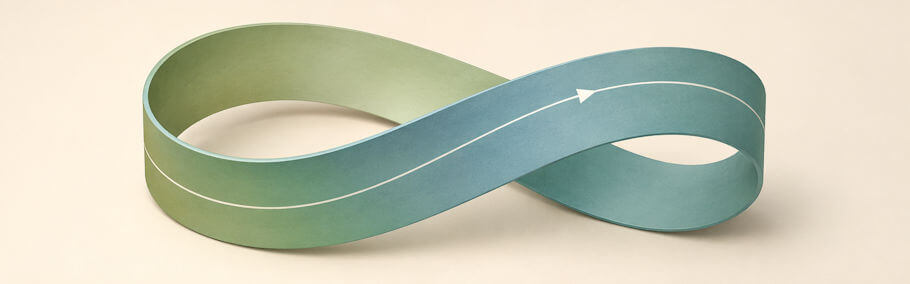
- 1 - The Möbius strip has only one side and one edge. A pencil line traced along it returns to its start having covered what looks like both faces.
- 2 - Two mathematicians described the shape independently in 1858. August Ferdinand Möbius and Johann Benedict Listing both arrived at it within the emerging field of topology.
- 3 - Jacques Lacan borrowed the same shape for psychoanalysis. He used it to argue that a person's psychological inside and social outside form one continuous surface rather than sealed compartments.
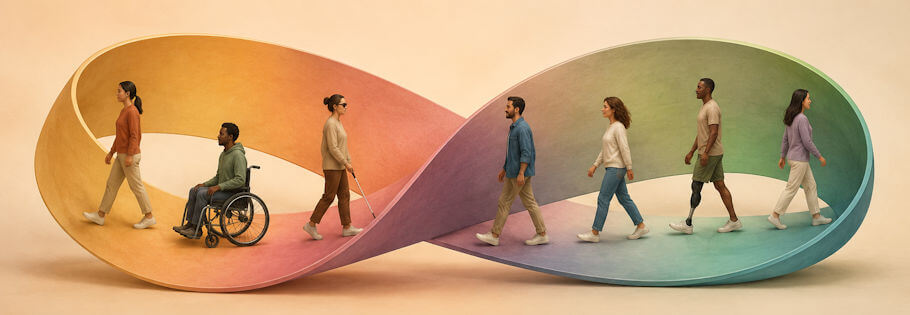
- 4 - The metaphor reframes dependence itself as shared rather than one-directional. Instead of independent givers and dependent receivers on opposite sides, everyone occupies points on a single continuous loop of mutual reliance.
Topic Definition
- Möbius Strip
A Möbius strip, also called a Möbius band or Möbius loop, is a one-sided surface with a single continuous edge, made by taking a long strip of material, giving it a half-twist, and joining the two ends together. The name is pronounced "MOH-bee-us," with the first syllable rhyming with "toe." Because of that twist, what appear to be its two separate faces are actually one and the same, so a line drawn along the surface will travel across the whole thing and come back to where it began without ever lifting off or crossing a border. Mathematicians call it non-orientable, meaning there is no consistent way to say which side is up, and they study it within topology, the branch of mathematics concerned with the properties of shapes that survive bending and stretching.
Overview
The Möbius Strip and Disability: A Metaphor for Continuity, Interdependence, and the Undoing of Binaries
Ask a mathematician and a disability scholar to describe a boundary, and you will hear two very different answers - yet they turn out to be describing the same puzzle. A boundary is supposed to separate an inside from an outside, a here from a there, an us from a them. The Möbius strip quietly refuses that logic. So does a growing body of thought about what disability actually is and where it lives. This paper traces the connection between the two, not as a scientific fact but as a disciplined metaphor, and shows that the pairing is neither arbitrary nor new. Scholars in disability studies, feminist theory, and psychoanalysis have already reached for this strange little loop of paper to say something they could not say in a straight line.
What the Möbius Strip Actually Is
Before a metaphor can do honest work, the thing behind it has to be understood accurately. A Möbius strip is a surface with only one side and one edge, formed by taking a long rectangular strip, giving it a single half-twist, and joining the ends. It was described independently in 1858 by two German mathematicians, August Ferdinand Möbius and Johann Benedict Listing, working within the young field of topology [Britannica, 2024]. If you set a pencil on the surface and trace forward without lifting it, you eventually return to your starting point having covered what looks like both faces - proof that there is really only one.
The strip belongs to a branch of mathematics sometimes nicknamed rubber sheet geometry, because it studies the properties of shapes that survive bending, stretching, and twisting rather than the fixed lengths and angles of ordinary geometry [Britannica, 2024].
Non-orientable is the technical term for the strip's defining trait: within the surface you cannot consistently tell clockwise from counterclockwise, because a journey around the loop flips your sense of direction. There is no stable "this side up."
Two properties matter most for everything that follows. First, the strip is one-sided, so any attempt to sort its points into "inner surface" and "outer surface" collapses. Second, it is continuous, so a traveler passes from what seemed like one region to its apparent opposite without ever crossing a border. Hold on to those two ideas - single-sidedness and seamless continuity - because they are the hinges on which the disability metaphor turns.
The Social Model of Disability in Brief
The metaphor becomes powerful only against the background of a specific idea about disability. For much of modern history, disability was framed through what is now called the medical or individual model, which locates the "problem" inside a person's body and treats it as something to be diagnosed, corrected, or cured. In 1983 the disability rights scholar and activist Michael Oliver, himself a wheelchair user, named an alternative that had been building among disabled people and organizations such as the Union of the Physically Impaired Against Segregation in the 1970s [Oliver, 1983; UPIAS, 1976].
This alternative, the social model of disability, draws a careful distinction between two words that everyday language treats as synonyms.
- Impairment - a condition or difference of body or mind, such as reduced mobility, chronic pain, or a sensory or cognitive variation.
- Disability - the exclusion and disadvantage produced when environments, attitudes, and institutions are built as if that impairment did not exist.
In this reading, a person is not disabled purely by their legs but by the staircase with no ramp, not by their eyes but by the sign printed only in small type. Oliver argued that disability is, in effect, something imposed on top of impairment by a society that unnecessarily isolates and excludes people [Oliver, 1983]. The word "disability," then, does not name a fact stored inside a body. It names a relationship - a meeting point between a body and a world.
Where the Two Ideas Meet
Here is the thought experiment. Draw a line down the middle of an ordinary strip of paper and label one side "the individual" and the other "society." This is the intuitive, common-sense picture: my body is here, the world is over there, and disability sits on one side or the other depending on which model you believe. Now give the strip a half-twist and join the ends. Trace your finger along the "individual" side, keep going, and without ever crossing an edge you arrive on the "society" side. The two labels were never on separate surfaces. They were always points on one continuous plane.
That is precisely the claim the social model makes about impairment and disability. The border we imagine between "a problem in the person" and "a problem in the environment" does not hold up when you actually travel across it. Disability emerges in the twist - at the continuous, one-sided junction where body and world meet.
The Möbius strip gives disability studies a shape for its central intuition: that inside and outside are not opposite territories but one surface seen from different stretches of the same path.
The Metaphor Already in Use: Cypher's Classroom
This is not a connection invented for the sake of a clever comparison. It appears explicitly in the disability studies literature. In a 2008 essay in Disability Studies Quarterly, the field's flagship journal, Joy Cypher used the Möbius strip as the organizing image for a course team-taught from a disability studies perspective, reflecting on how the shape modeled the relationship between teacher and student, theory and lived experience [Cypher, 2008].
What Cypher's account foregrounds is interdependence - a concept she describes as foundational to both feminist and disability thought. On a Möbius surface there is no self-sufficient "top" that instructs a passive "bottom"; knowledge and support circulate around a single continuous loop. That reframing quietly dismantles one of the most stubborn assumptions in how societies talk about disability: the idea that there are independent people on one side who give help and dependent people on the other side who receive it. The strip suggests instead that everyone is always somewhere on the same loop of mutual reliance, a point disability communities have long insisted upon.
Undoing the Binaries
Step back from the classroom and the pattern repeats at a larger scale. Much of disability theory is an argument against binaries - abled versus disabled, normal versus abnormal, independent versus dependent, whole versus broken. The Möbius strip is, in mathematical form, a machine for defeating exactly that kind of two-sided thinking. Its single surface makes the sorting operation impossible.
Consider what disability scholars sometimes call the temporarily able-bodied, the observation that nearly everyone who lives long enough will experience impairment through aging, illness, or injury. The tidy line between "the disabled" and "the non-disabled" turns out to be a line we all cross, usually more than once, and often without noticing the moment of transition - just as a finger tracing the strip crosses from one apparent side to the other without ever meeting an edge. What felt like a wall between two groups is revealed as a path within one.
This is where the metaphor earns its keep across timescales. In the immediate moment, it reframes a single encounter - a person and an inaccessible doorway - as a relationship rather than a deficit. At the life-course scale, it dissolves the fantasy of a permanently able body. And at the cultural scale, spanning generations, it reshapes how a society draws the very categories through which it distributes dignity, resources, and blame. The same shape holds coherent meaning as you zoom from a doorway to a lifetime to a civilization.
A Wider Intellectual Lineage
The Möbius strip has a long history as a thinking tool in the humanities, which is part of why its use in disability studies feels so natural. The most famous case comes from psychoanalysis. The French thinker Jacques Lacan repeatedly used the strip as a topological model to argue that the psychological "inside" and the social "outside" of a person are continuous rather than sealed off from one another, and to describe the relationship between the subject and desire [Kalaidjian, 2012]. Lacan's basic move - using one-sidedness to deny a clean split between interior and exterior - is structurally identical to the disability studies move that denies a clean split between impairment and environment.
Feminist theory offers a parallel. Writers working on the body have used the same figure to reject the old division between mind and flesh, or between the self and its social inscription, treating the two as one twisting surface rather than stacked layers. Seen together, these fields form a recognizable meta-pattern: whenever a discipline needs to argue that a supposed boundary is actually a continuity, the Möbius strip tends to appear. Disability studies is a natural member of that family precisely because its core insight is that the line between body and world is not where we thought it was.
The Limits of the Metaphor
Intellectual honesty requires marking where the analogy stops. A Möbius strip is a formal object with no politics, no pain, and no history of exclusion; disability is lived in bodies and shaped by real institutions that allocate real harm and real care. The strip cannot tell us which ramps to build or which policies to fund, and it should never be used to imply that impairment is "merely" a matter of perspective or that material barriers are illusions. A metaphor is a lens for seeing structure, not a substitute for justice. Used carelessly, any elegant image can aestheticize suffering and let a reader feel that understanding the shape is the same as changing the conditions. It is not.
What the metaphor does offer is a rare kind of clarity. It gives a precise, memorable, non-sentimental form to an idea that plain prose keeps flattening back into a binary: that disability is a continuous relationship between people and their built and social worlds, that dependence and independence are two names for stretches of a single loop, and that the boundary we keep drawing between "them" and "us" is one we are all quietly tracing our way across.
Frequently Asked Questions
Can you make a Möbius strip at home
Yes and it takes about a minute. Cut a long strip of paper, give one end a single half-twist, then tape the two ends together and you have a working Möbius strip you can trace and cut to explore its properties.
What happens if you cut a Möbius strip down the middle
Instead of falling into two separate loops as most people expect, it opens into one longer loop with two full twists in it. Cutting that result again produces two loops that are linked together.
Is the Möbius strip used in real technology
Yes it has practical uses. Continuous-loop recording tapes and some conveyor and printer belts have been built with a half-twist so that wear is spread across the entire surface rather than just one face, extending their working life.
What is the difference between the medical model and the social model of disability
The medical model locates disability inside the individual as a condition to be treated or cured, while the social model locates it in the barriers, attitudes, and structures of society that exclude people with impairments. The two models lead to very different priorities for change.
Who first proposed the social model of disability
The term was named by the British scholar and activist Michael Oliver in 1983, building on principles developed in the 1970s by disabled people and organizations such as the Union of the Physically Impaired Against Segregation. It grew out of the disability rights movement rather than from clinical medicine.
Does using a metaphor risk trivializing real disability
It can if handled carelessly, because a formal shape has no pain, history, or politics of its own. Responsible writers use the Möbius image to clarify structure while stressing that it never replaces material access, fair policy, or lived experience.
Why do so many disciplines borrow the Möbius strip
Because it gives a precise visual form to the idea that a supposed boundary is actually a continuity. Fields from psychoanalysis to feminist theory reach for it whenever they need to argue that an inside and an outside are really one connected surface.
What does the term temporarily able-bodied mean
It is the observation that nearly everyone who lives long enough will experience impairment through aging, illness, or injury. The phrase reframes disability as a shared human trajectory rather than a fixed trait belonging only to a separate group.
References:
- Britannica. (2024). Möbius strip: Definition, history, properties, applications, and facts. Encyclopaedia Britannica.
- Cypher, J. (2008). The Möbius strip: Team teachers reflecting on disability studies and critical thinking. Disability Studies Quarterly, 28(4).
- Kalaidjian, W. (2012). Lacan, topology, and "The jet-propelled couch." American Imago, 69(2).
- Oliver, M. (1983). Social work with disabled people. Macmillan.
- Union of the Physically Impaired Against Segregation. (1976). Fundamental principles of disability. UPIAS.
Insights, Analysis, and Developments
Editorial Note: The value of the Möbius metaphor is not that it settles any practical question about access, policy, or care, but that it hands us a durable mental image for a truth that ordinary language keeps collapsing back into an us-and-them binary - that disability lives in the twist where body meets world, that the boundary between the temporarily able and the disabled is one we are all slowly crossing, and that a shape first sketched in 1858 can still teach a genuinely humane lesson about where the line between self and society really runs.
 Author Credentials: Ian is the founder and Editor-in-Chief of Disabled World, a leading resource for news and information on disability issues. With a global perspective shaped by years of travel and lived experience, Ian is a committed proponent of the Social Model of Disability, a transformative framework developed by disabled activists in the 1970s that emphasizes dismantling societal barriers rather than focusing solely on individual impairments. His work reflects a deep commitment to disability rights, accessibility, and social inclusion. To learn more about Ian's background, expertise, and accomplishments, visit his full biography.